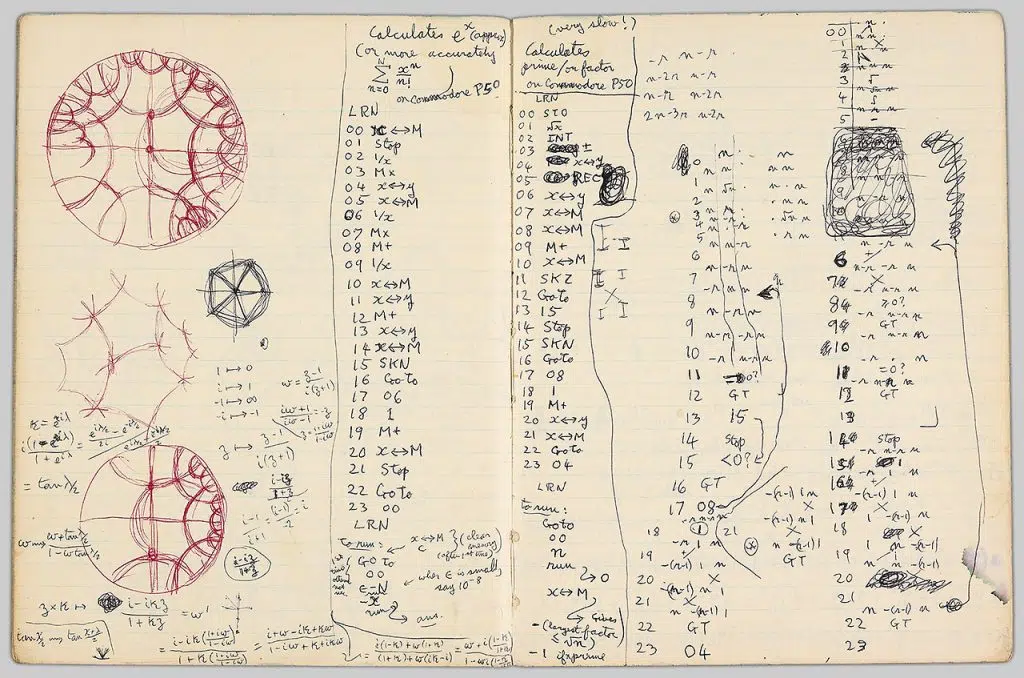
Abakcus
← Back to home

Kronecker Wallis · Barcelona

15 Science Books That Print Like Design Objects: The Kronecker Wallis Catalog

In a corner of the world, a small publisher is taking the most important texts in the history of science and turning them, one by one, into design objects.

Abakcus · A Curated List

15 Science Books That Print Like Design Objects — the Kronecker Wallis catalog

We stopped treating books as objects a long time ago. With scientific classics, the situation is even worse. Anyone who wants to read the Principia today is stuck either with scanned PDFs or with academic reprints bound like phone directories. In 2016, a handful of people in Barcelona who took this gap between content and form personally founded Kronecker Wallis. The name joins the surnames of two mathematicians, Leopold Kronecker and John Wallis, and it summarizes the publisher's entire agenda on its own. These people take mathematics and science seriously. In the most physical sense of the word.

The story began with a Kickstarter campaign. The first project was to reprint Newton's Principia Mathematica with the design it deserved. The campaign succeeded, the book was printed, and the resulting object was something rarely seen in science publishing. Munken Polar paper, an exposed hand-sewn spine, two colors in petrol blue and coral orange, Lucas de Groot's typeface The Serif. Then came Euclid, then Humboldt, then Tesla, Curie, Turing, Gauss. Every time, the same approach: the complete text, in its best translation, in a design worthy of its subject, and often in a binding produced by hand.

The scale of this operation deserves an honest note. Kronecker Wallis is not a conglomerate. It is a team whose website opens with "dispatch may take a little longer these days, thanks for your patience," a team that sews and numbers some of its books one by one as orders come in, with print runs wandering between 90 and 1,000 copies. The Japanese stab binding on the Gauss book takes 30 to 40 minutes per copy. Some titles have been sold out for years, and the reprint dates being mentioned sound like "mid-2027." I have marked the stock status of every book on this list, because in this catalog, "I'll buy it later" carries a price.

Below is the complete catalog, organized under five headings. Prices and technical details are current as of the date this piece was prepared. Everything ships worldwide from Barcelona.

PART I

Mathematics

  1. 01

    Euclid's Elements: Completing Oliver Byrne's Work

    PRICE 200€ · CATEGORY MATHEMATICS · ALL 13 BOOKS

    Sold out · reprint mid-2027
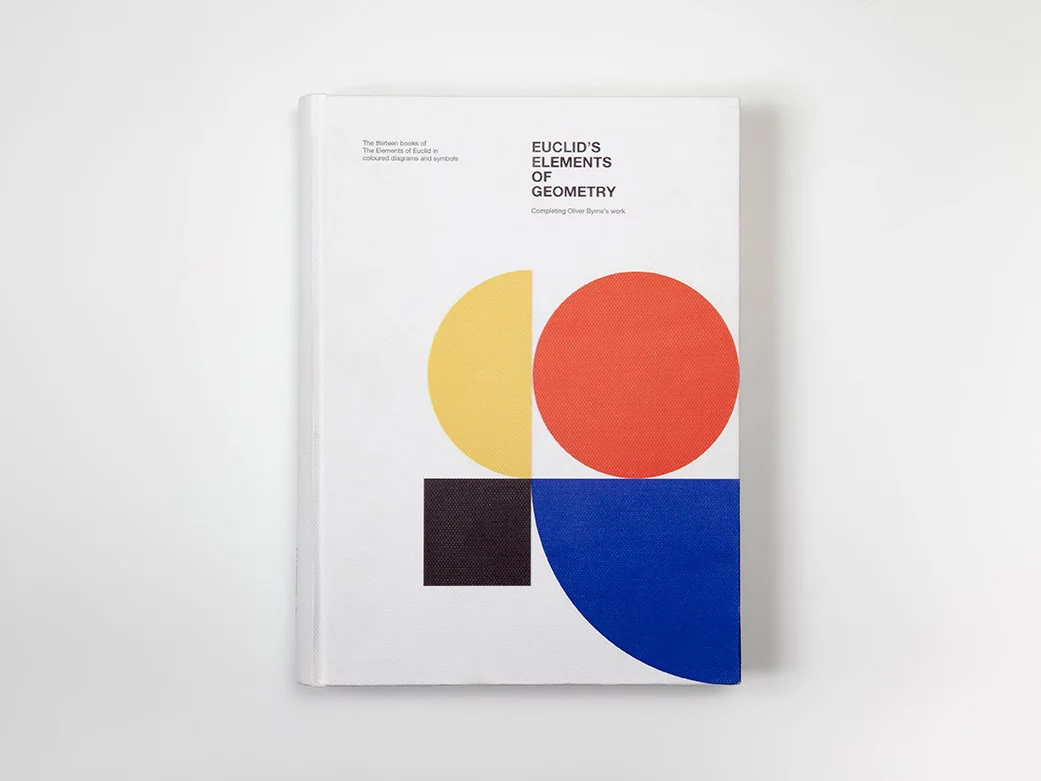
    Euclid's Elements: Completing Oliver Byrne's Work — cover
    View on Kronecker Wallis →

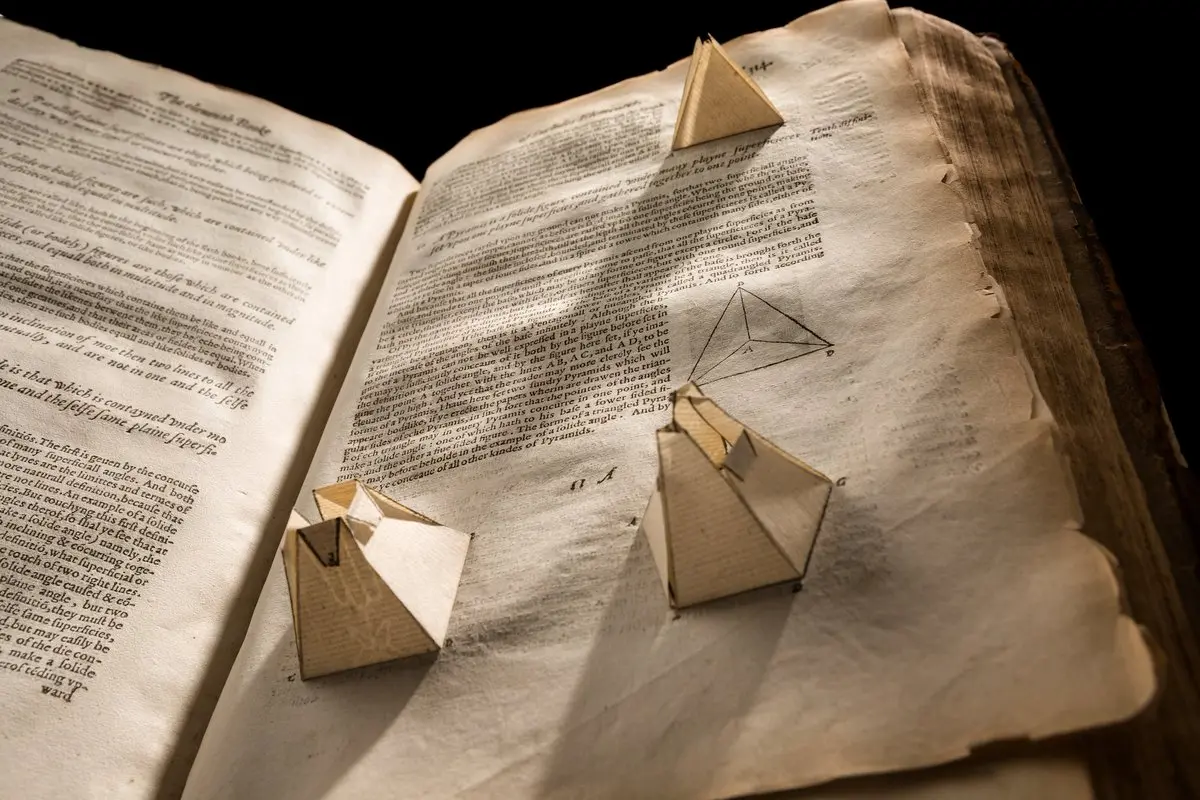
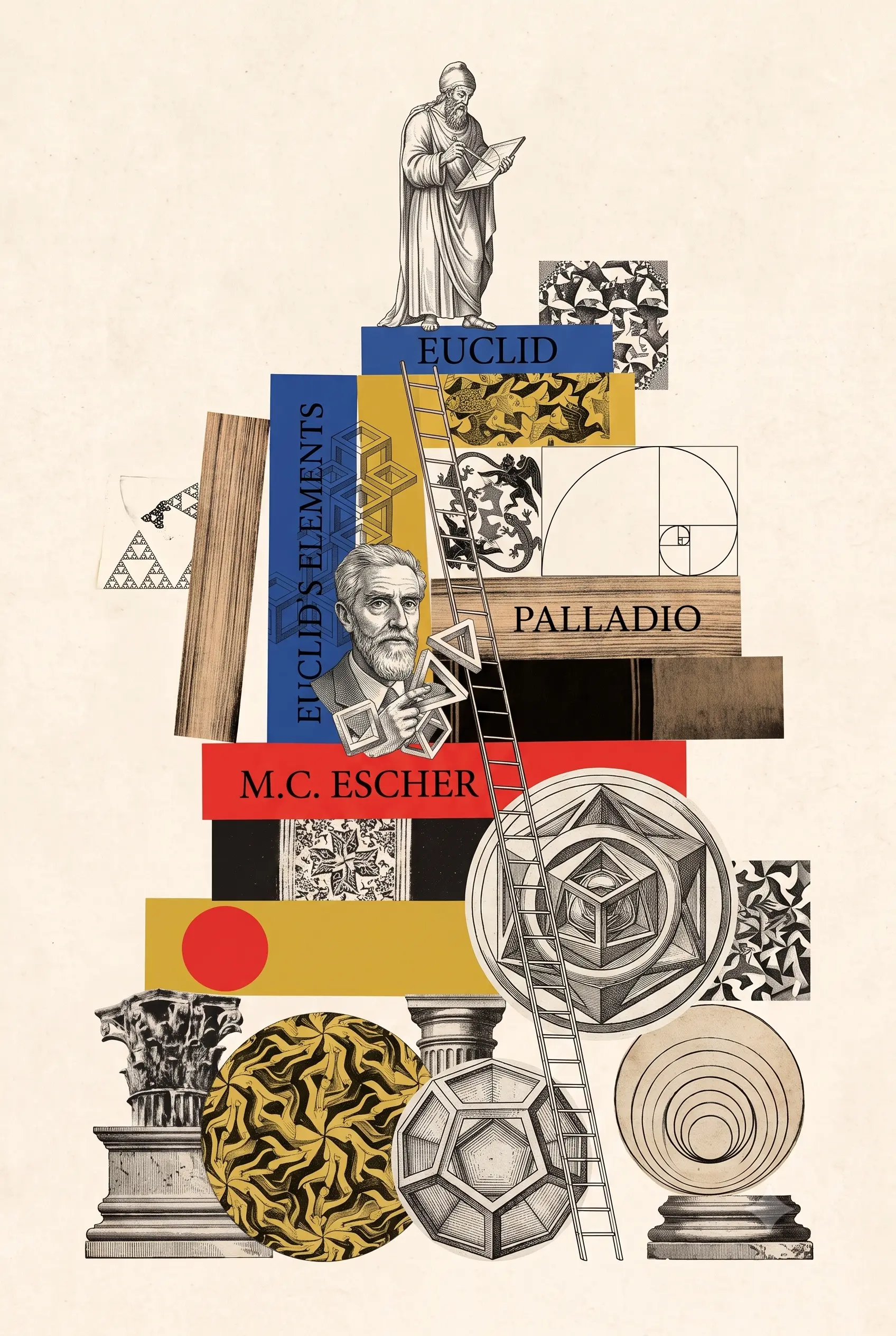
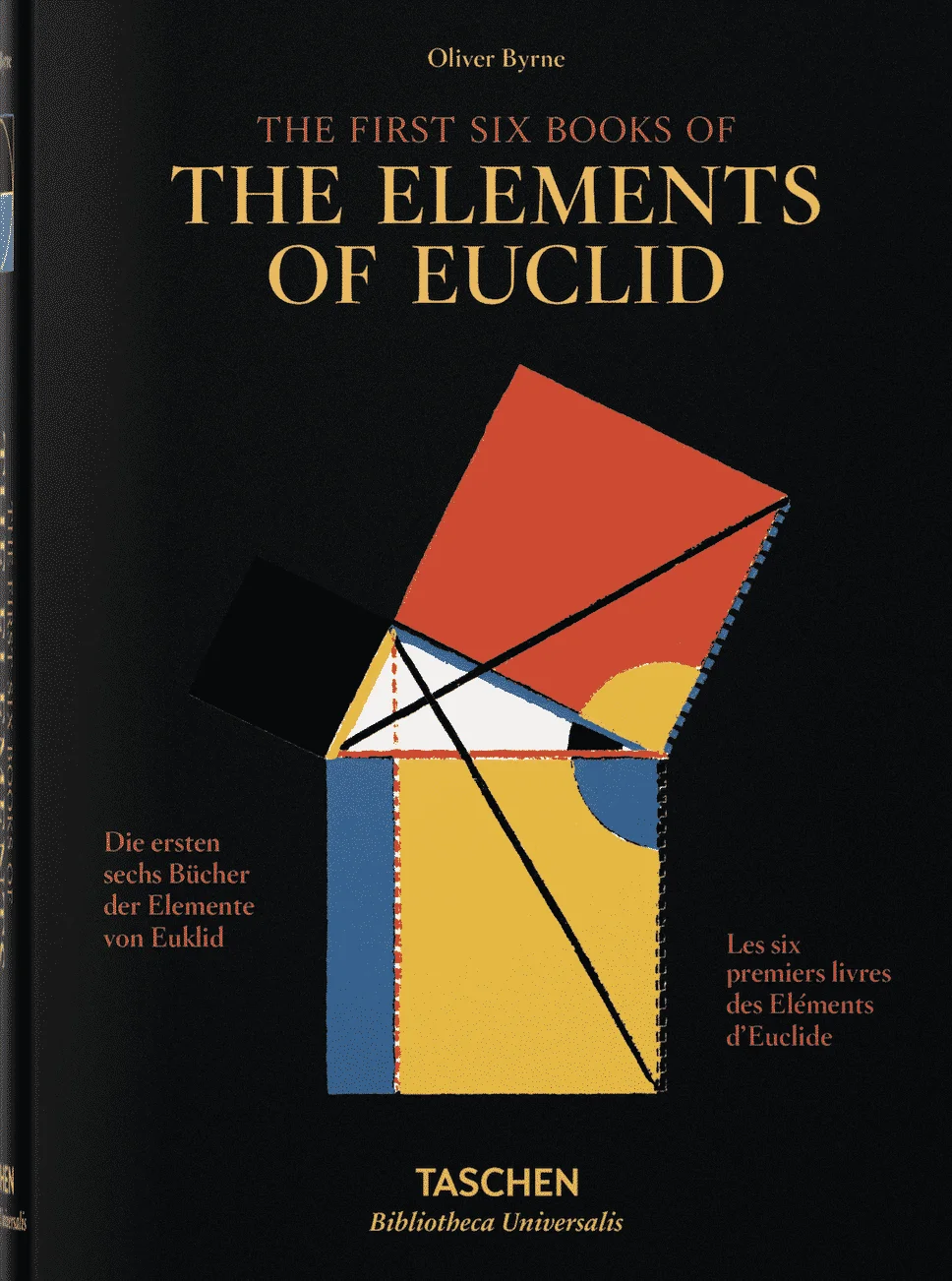
    The flagship of the catalog, and probably the work this publisher will be remembered for. The backstory is well known: in 1847, the Irish engineer Oliver Byrne printed the first six books of Euclid's Elements in a revolutionary visual language. He threw out the letter references in the proofs and replaced them with geometric shapes in red, yellow, blue, and black. The result was a publication far ahead of its time. But the Elements consists of thirteen books, and Byrne stopped at the sixth. The later books move into arithmetic and mixed subjects, which made the visual language increasingly difficult to apply.
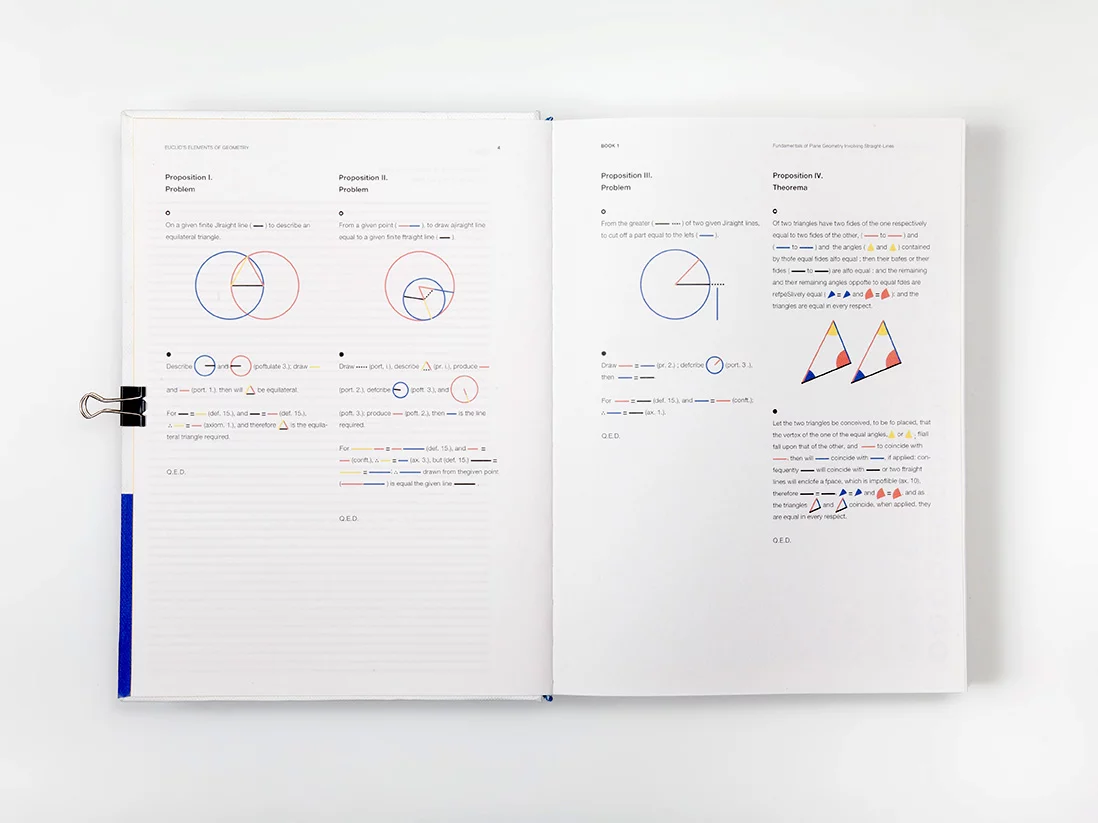
    Euclid's Elements: Completing Oliver Byrne's Work — interior spread

    This is exactly where Kronecker Wallis stepped in. With a team of mathematicians, university teachers, and postdoctoral researchers, they completed the remaining seven books in Byrne's language. What emerged is a publication that did not exist before and, given the sheer labor involved, is unlikely ever to be produced again: all thirteen books, in a single volume, in the Byrne aesthetic. The Elements is estimated to trail only the Bible in the number of editions printed since the invention of the press. This edition is one of the strangest and most handsome links in that long chain — and it is not the first time someone tried to make Euclid stand up off the page. Currently sold out, with a reprint expected in mid-2027. Mark your calendar.
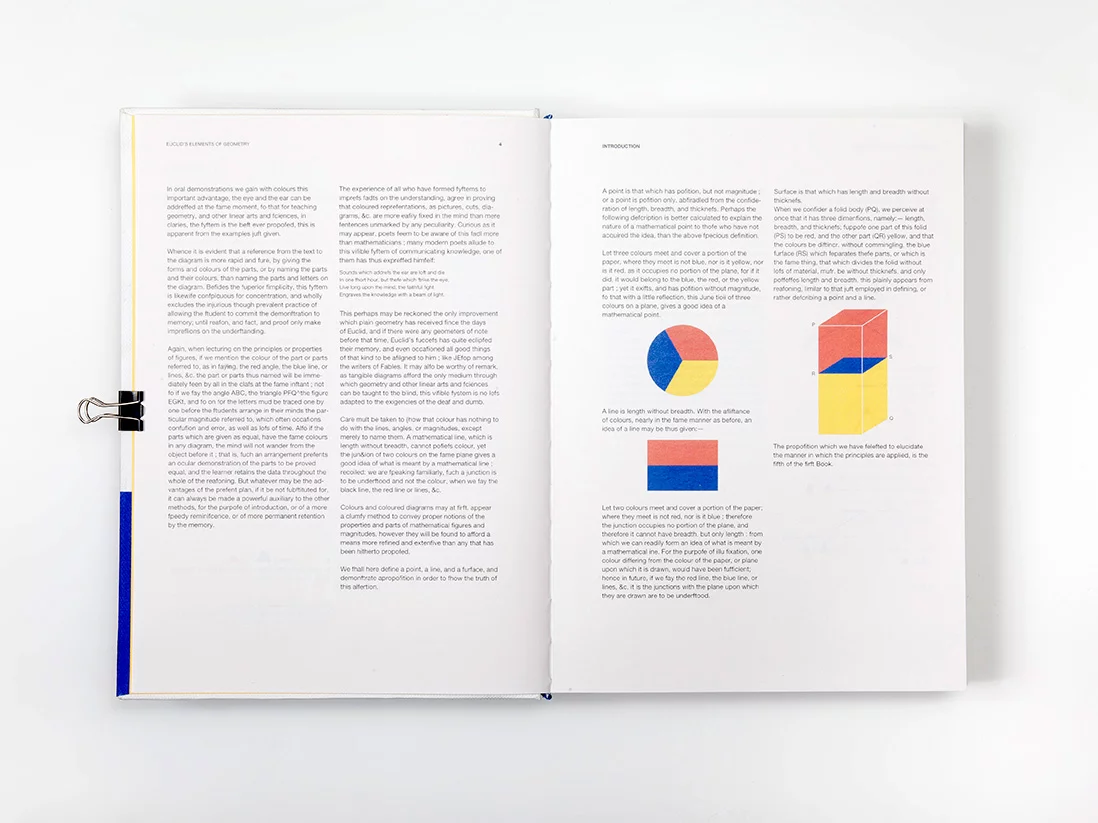
    Euclid's Elements: Completing Oliver Byrne's Work — detail
    View on Kronecker Wallis →
  2. 02

    Isaac Newton's Principia Mathematica: Collector's Edition

    PRICE 60€ · THREE SEPARATE VOLUMES + MAIN COVER · MUNKEN POLAR PAPER · MOTTE TRANSLATION

    Roughly 300 copies left
    Isaac Newton's Principia Mathematica: Collector's Edition — cover
    View on Kronecker Wallis →

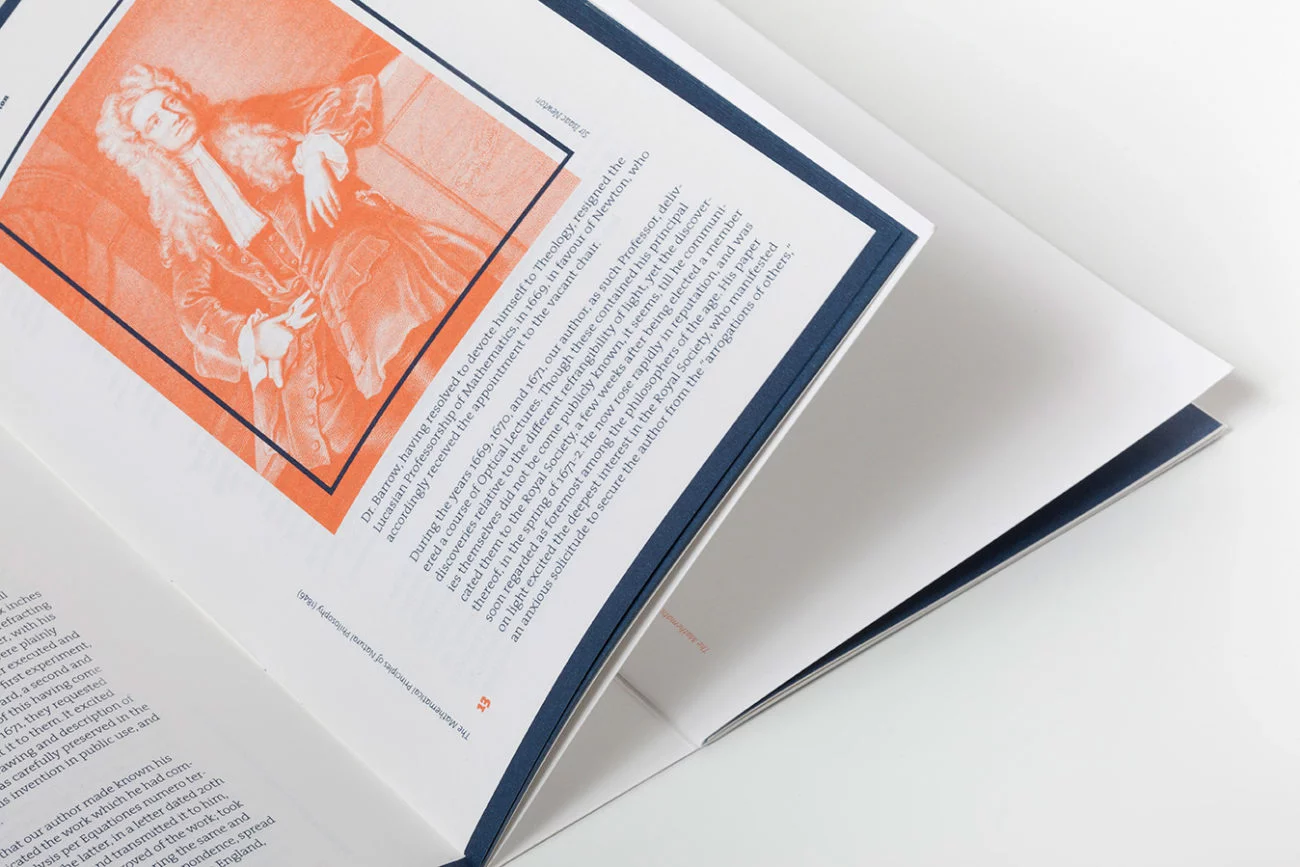
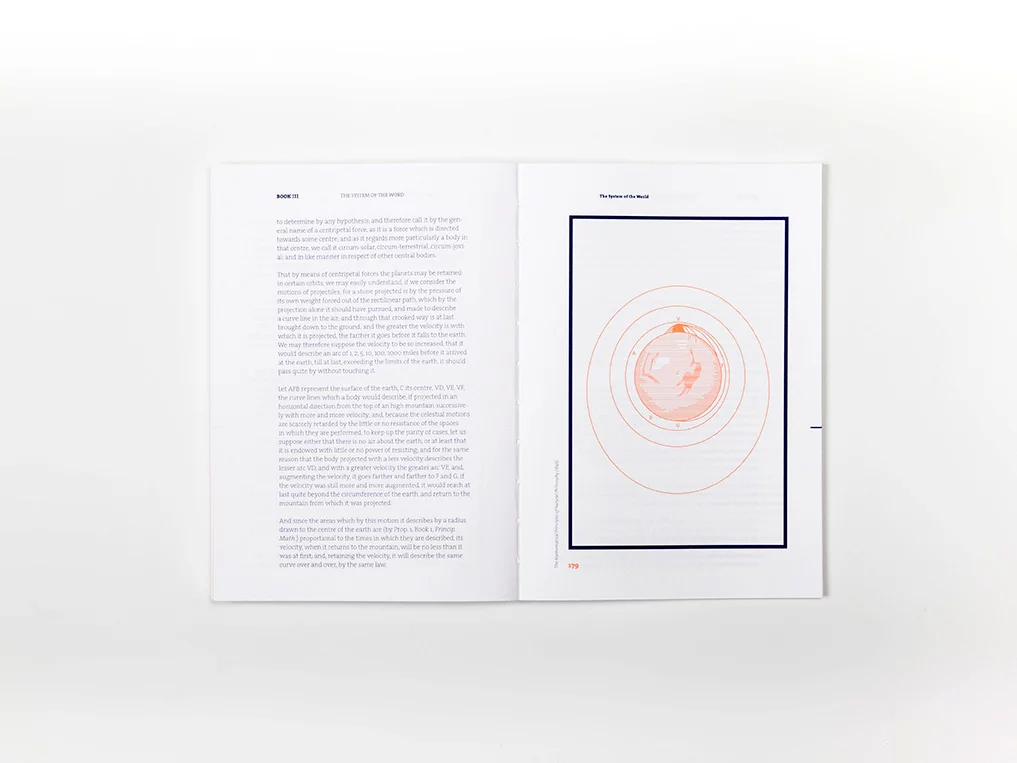
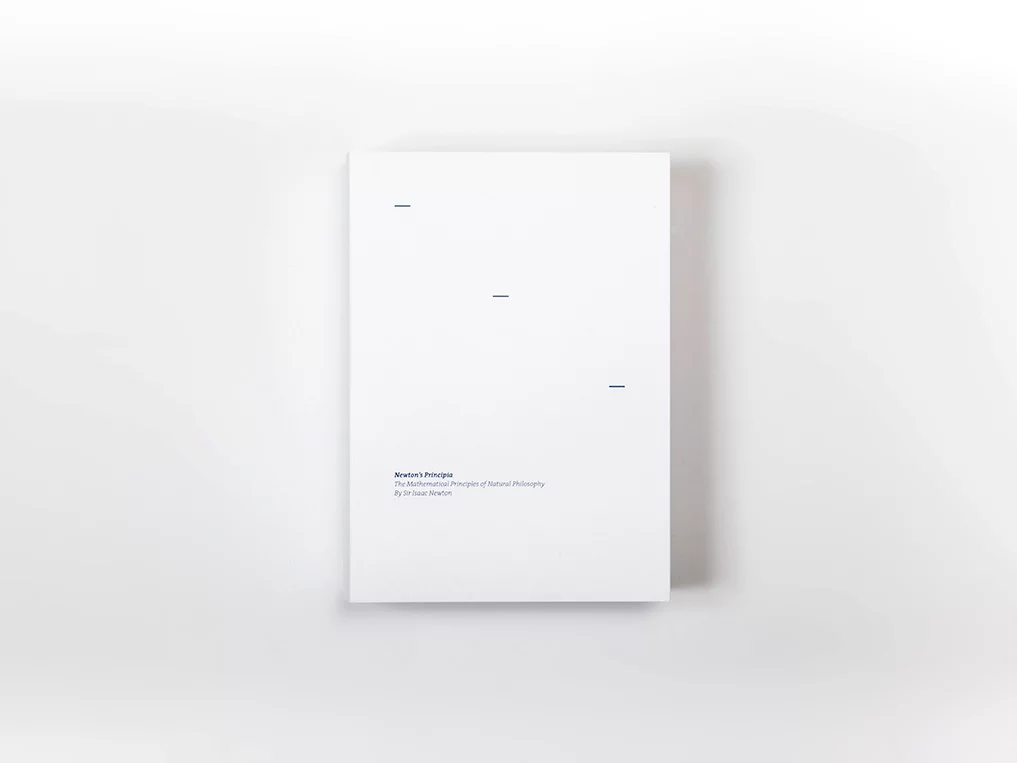
    The project that founded the publisher. Newton's 1687 masterwork consists of three books: The Motion of Bodies, The Movement of Bodies Through Resisting Mediums, and The System of the World. This edition stays faithful to that structure, binding the three books individually and housing them all inside a single main cover. Open them side by side, display them separately, or read straight through as one continuous text.

    Isaac Newton's Principia Mathematica: Collector's Edition — the three volumes

    Every design decision is deliberate. The spine is left exposed, so the book opens wider and the stitching that usually stays hidden comes into view. The Greek letters alpha, beta, and gamma are dry-embossed on the covers. The text is Andrew Motte's first American translation, revised by N.W. Chittenden. Two colors, petrol blue and coral orange, run through the pages, colored backgrounds mark the opening of each section, and the index pages are printed on heavier paper so the book falls open right there. Of a limited run of roughly 1,000 copies, about 300 remain.

    Isaac Newton's Principia Mathematica: Collector's Edition — exposed spine detail
    View on Kronecker Wallis →
  3. 03

    Newton's College Notebook

    PRICE 50€ · FACSIMILE · 1664–1665

    Sold out
    Newton's College Notebook — facsimile cover
    View on Kronecker Wallis →

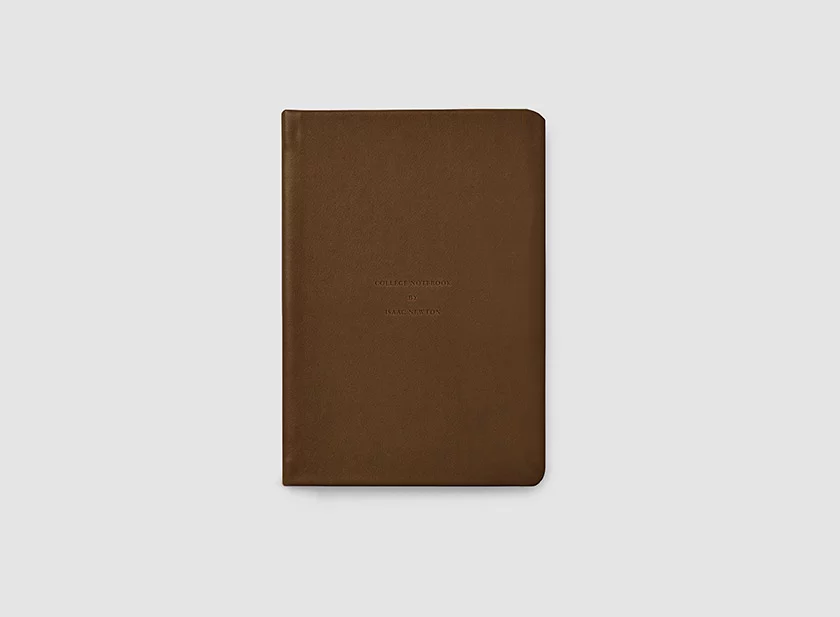
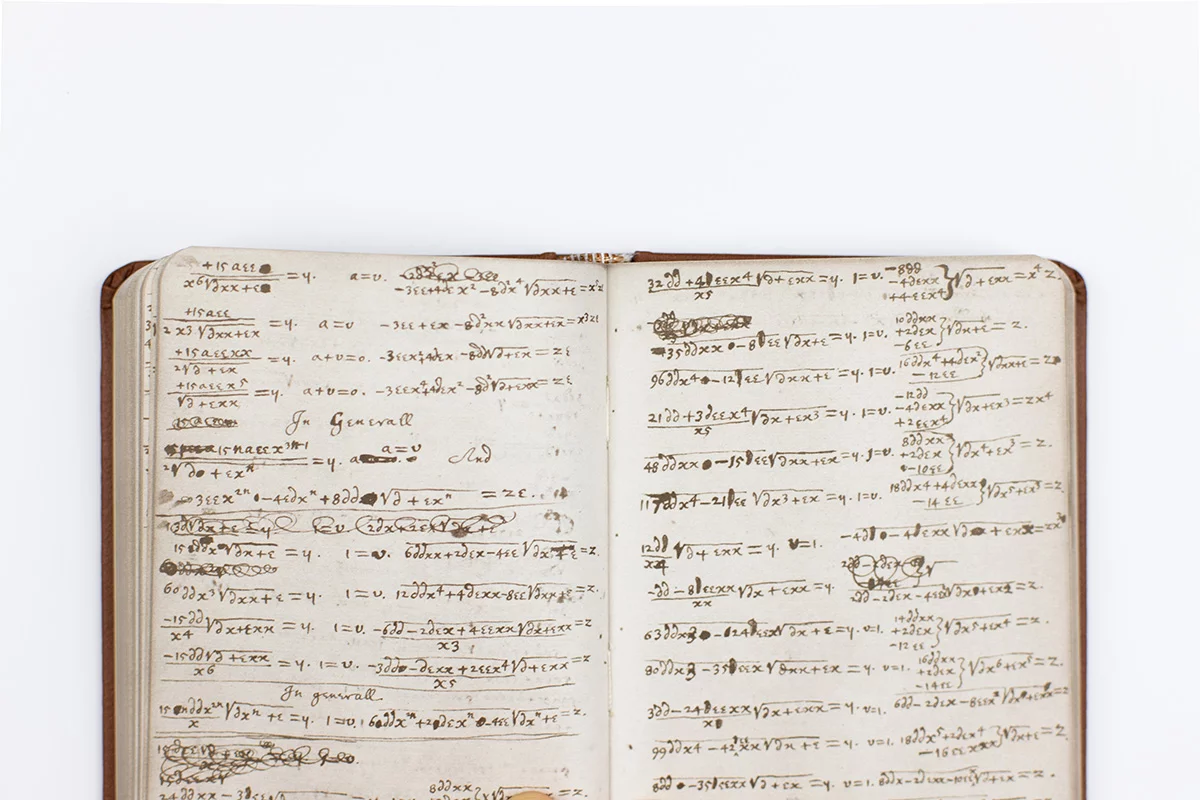
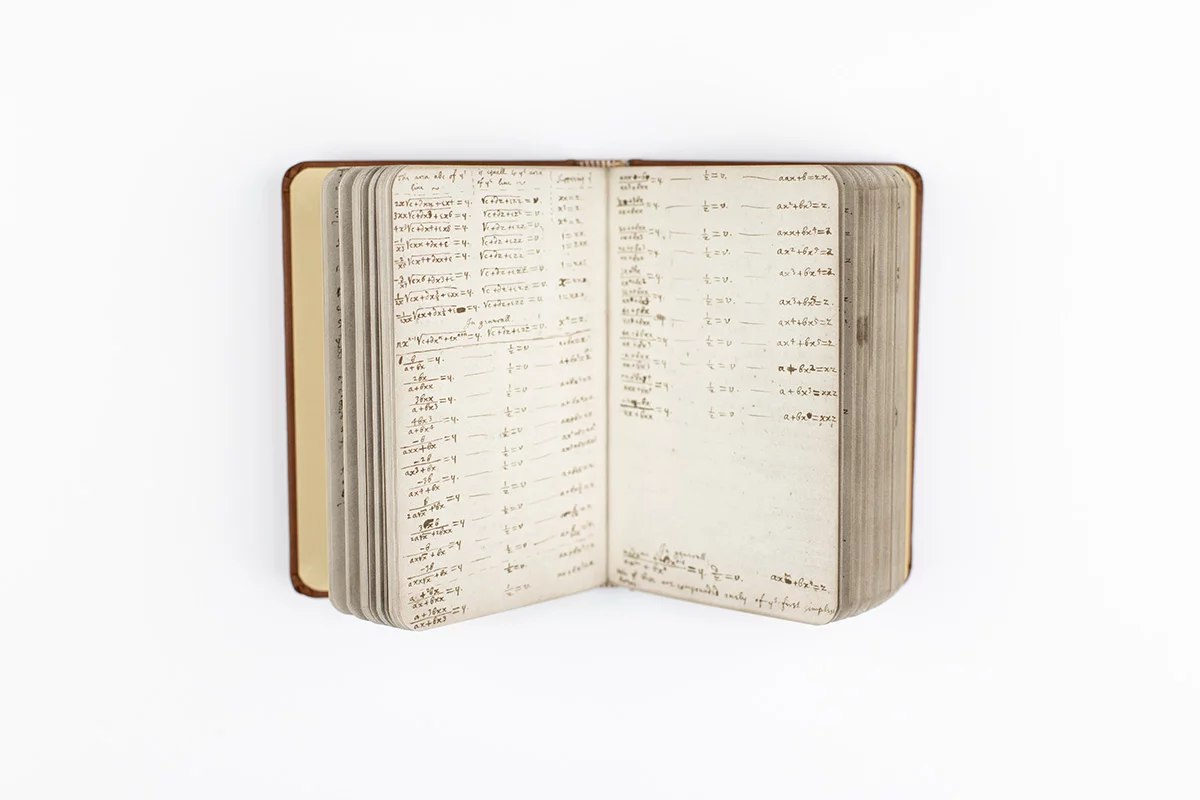
    A facsimile of the small notebook young Newton used around 1664–1665. Every interior page of the original, preserved at the Cambridge University Library, is reproduced exactly as it is. The notebook holds Newton's reading notes on mathematics and geometry, and the most visible influences on its pages are John Wallis and René Descartes. That Wallis, the man who lent the publisher half its name, shows up in Newton's student notebook is a pleasant coincidence.

    Newton's College Notebook — interior page

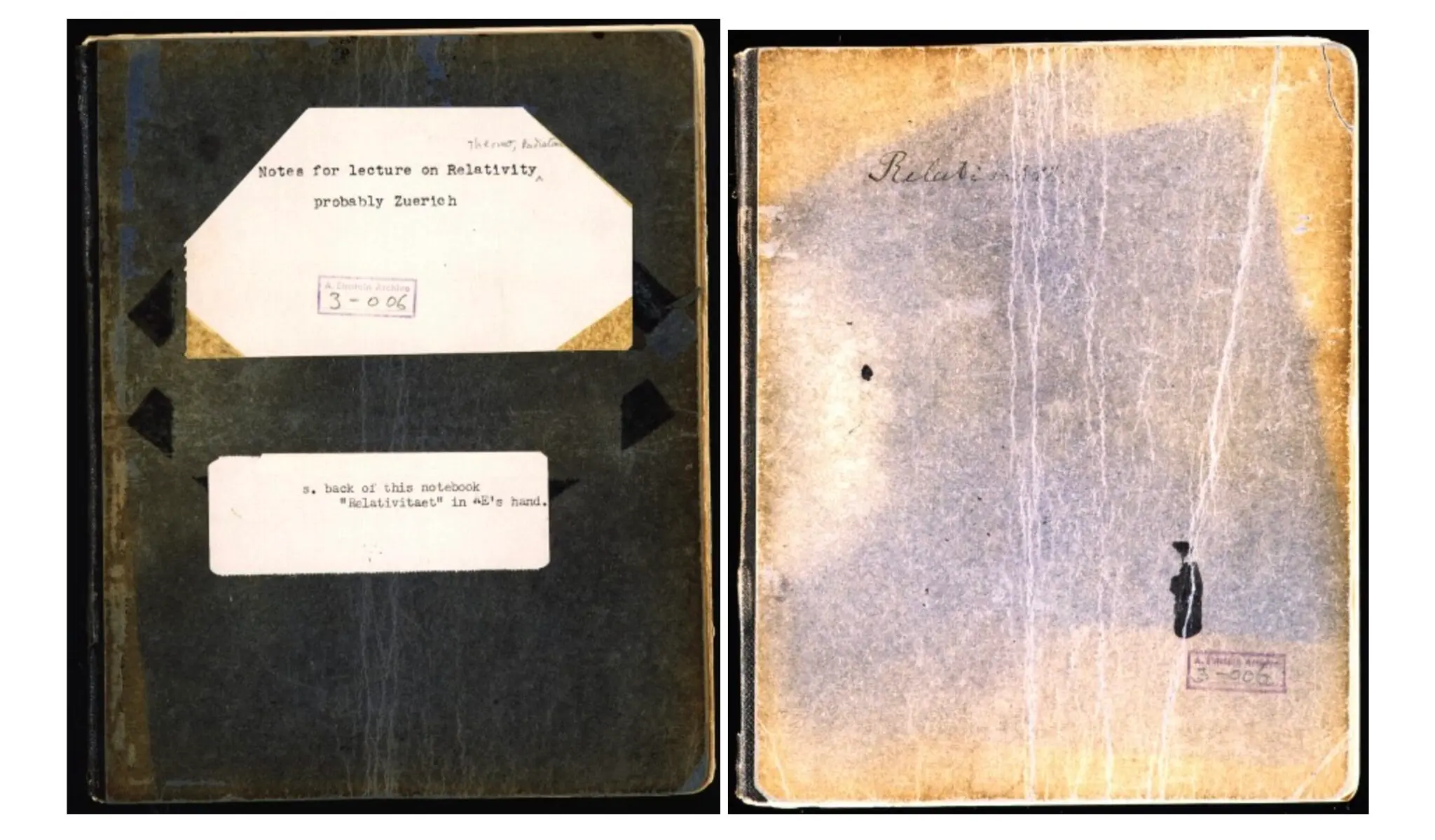
    What makes it valuable is that the notebook does not stay a reading log. In its pages you watch Newton's own mathematical thinking take root: his study of infinite series, the development of the binomial theorem, the evolution of the differential calculus and its application to problems of quadratures and integration. In the notebook of a student in his early twenties sit the first sketches of ideas that would reorder the world within a few years — the same private, working kind of page you find three centuries later in Einstein's Zurich notebook, wrestling with a different set of equations. Currently sold out.

    Newton's College Notebook — detail
    View on Kronecker Wallis →
  4. 04

    Gauss's Handwritten Notebooks

    PRICE 80€ · A5 + FOLDABLE A4 INSERTS · JAPANESE STAB BINDING

    Made to order, numbered
    Gauss's Handwritten Notebooks — cover
    View on Kronecker Wallis →

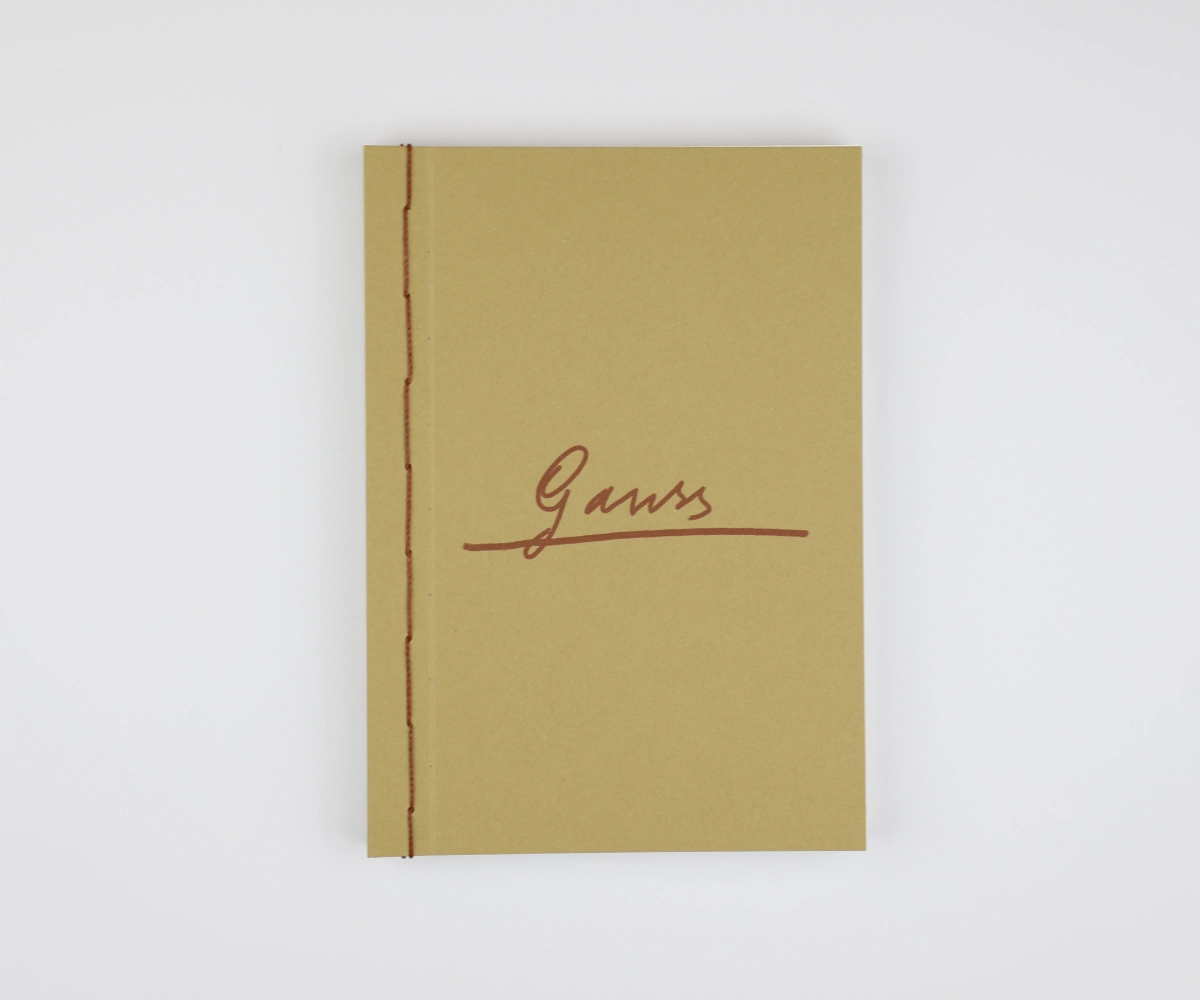
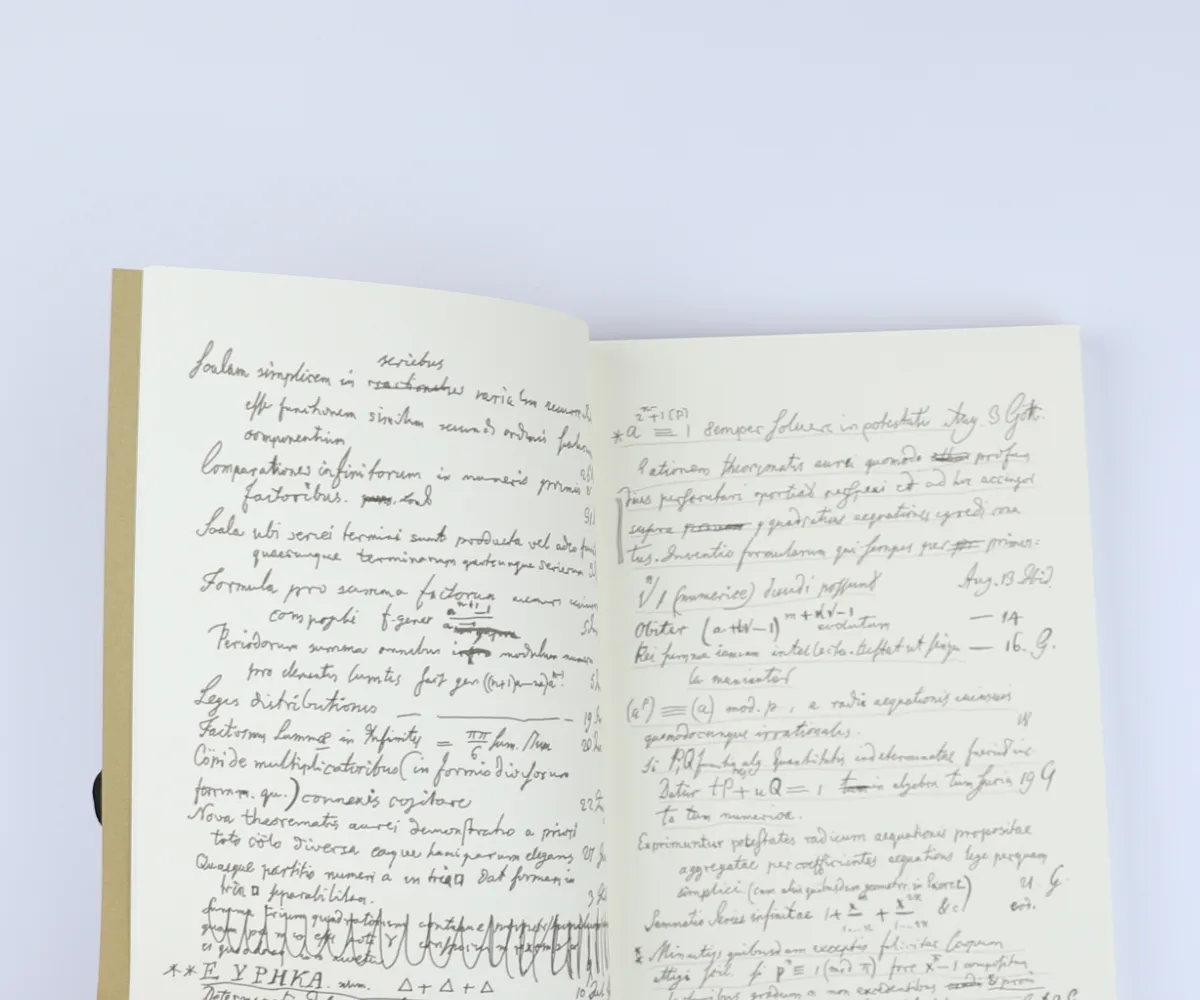
    One of the most labor-intensive projects in the catalog. Carl Friedrich Gauss kept private notebooks throughout his career and filled them with discoveries he never published. Five of these manuscripts, preserved at the University of Göttingen, are gathered here in a single handmade volume. The production method is the genuinely wild part: every page has been vectorized by hand from the original scans. Every word, every symbol, every diagram, every correction has been redrawn with a digital pen. Not a single pixel from the original scans remains in the finished book. Gauss's handwriting is preserved, and the print clarity is flawless.

    Gauss's Handwritten Notebooks — vectorized page

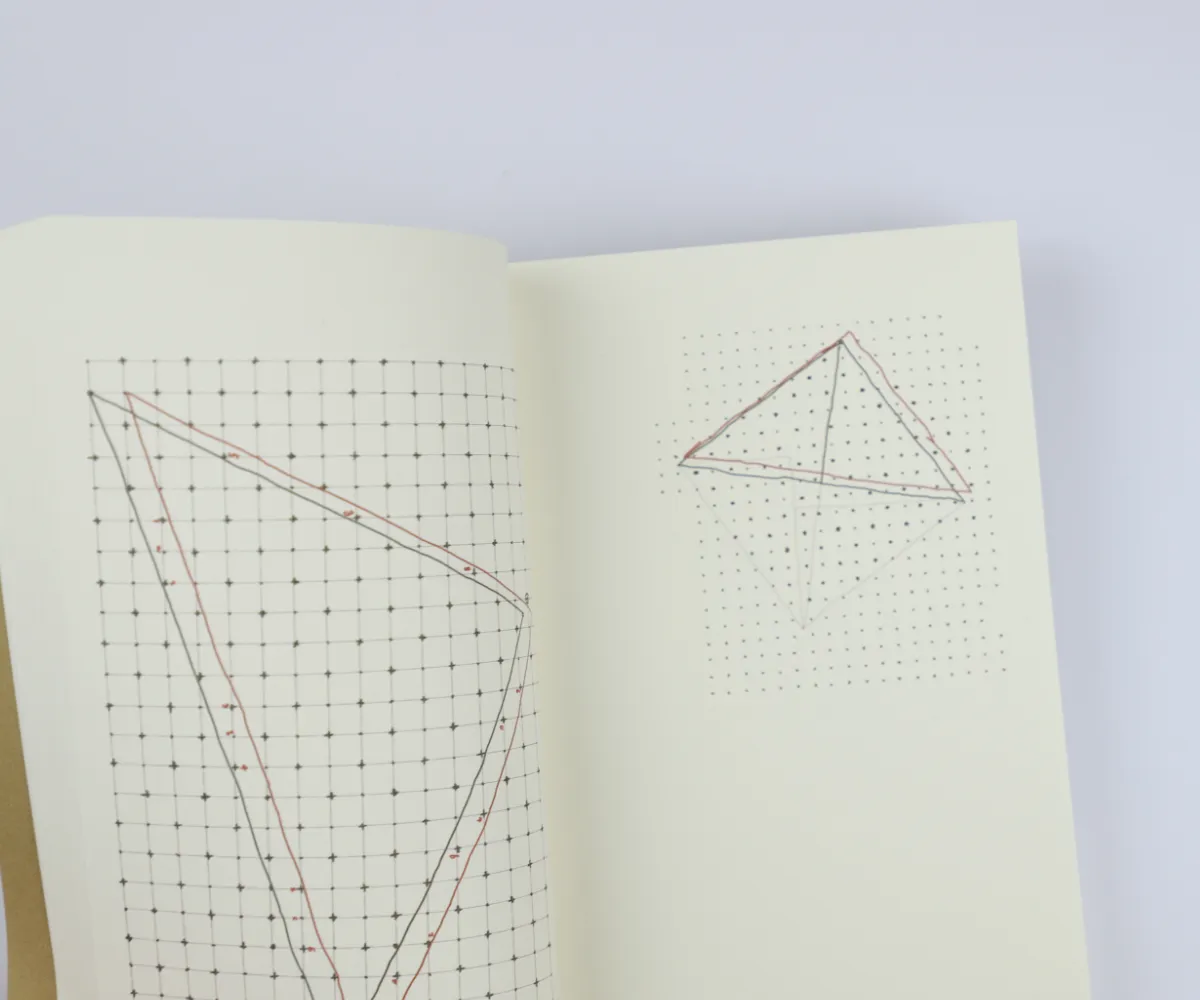
    The table of contents reads like a course of study on its own. The legendary mathematical diary, the Mathematisches Tagebuch, contains the note the nineteen-year-old Gauss made on July 10, 1796, at the moment he proved that every positive integer is the sum of three triangular numbers: "ΕΥΡΗΚΑ! num = Δ + Δ + Δ". Alongside it sit his unpublished explorations of non-Euclidean geometry, written decades before Bolyai and Lobachevsky published theirs, the theory of curved surfaces connected to the Theorema Egregium, geodesic survey networks, and the Geometria situs, which carries early traces of topology. The large drawings were not shrunk to fit. They are included as foldable A4 inserts within the A5 format, possible only because the Japanese stab binding leaves the spine unglued. Each copy is hand-sewn and numbered — a private notebook treated with the same care Roger Penrose gave his own working journal, a century and a half later.

    Gauss's Handwritten Notebooks — foldable A4 insert
    View on Kronecker Wallis →
PART II

Physics and Light

  1. 05

    Isaac Newton's Opticks

    PRICE 40€ · A5 · APPROX. 500 PAGES · HOLOGRAPHIC COVER · CLOTH SPINE

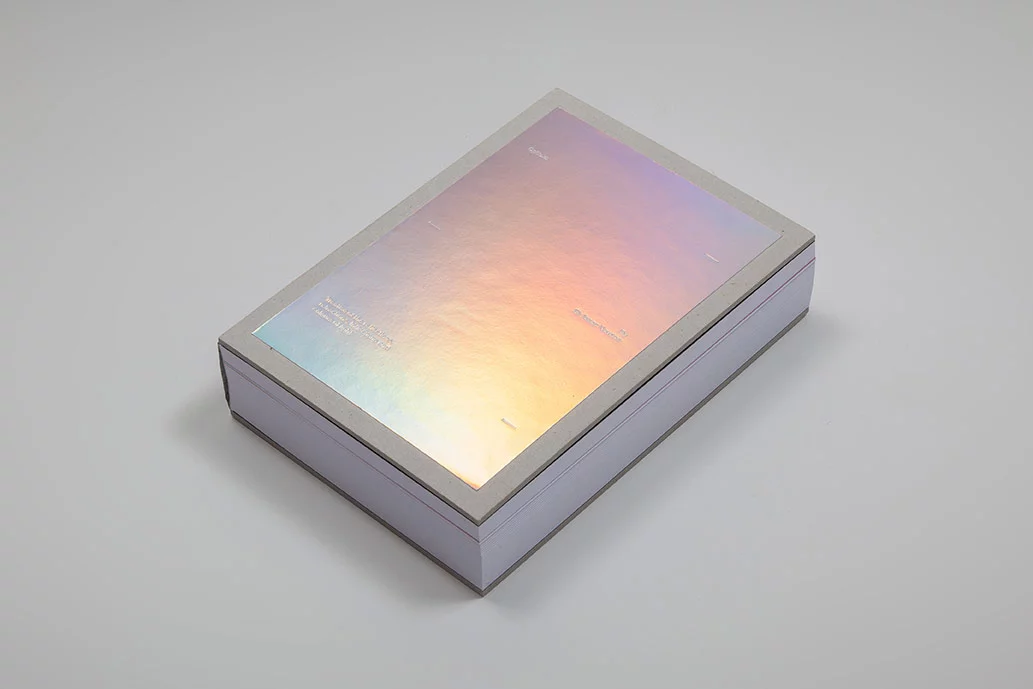
    Isaac Newton's Opticks — holographic cover
    View on Kronecker Wallis →

    Somebody decided that a book about light should play with light, and then actually did it. In the 1704 Opticks, Newton proved through prism experiments that white light is composed of a spectrum of colors. The cover of this edition performs the same trick: a holographic film decomposes the light falling on it and reflects shifting colors depending on the viewing angle. Every time you pick up the book, Newton's experiment repeats itself on your desk.

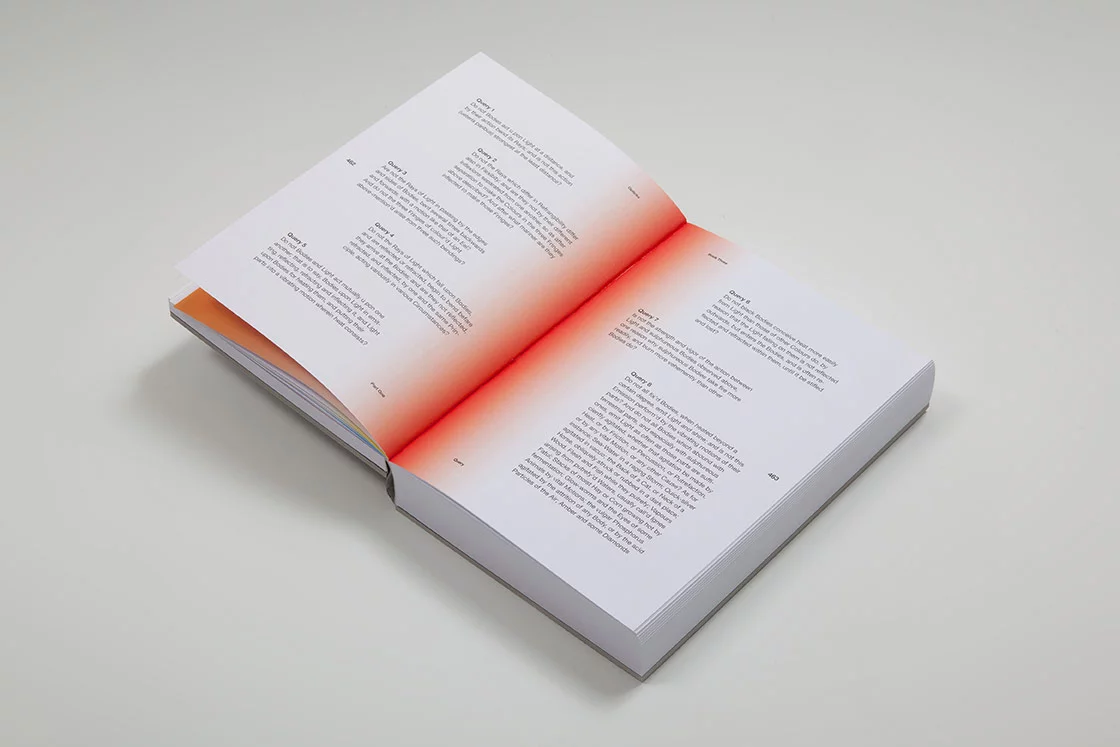
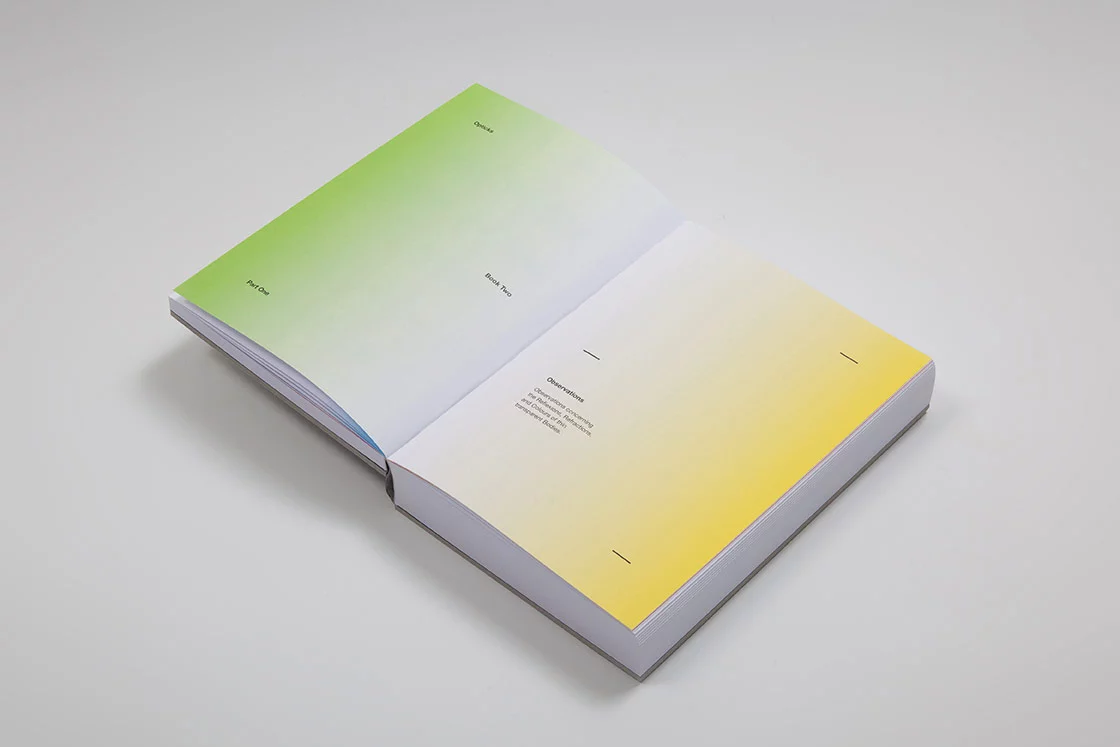
    Isaac Newton's Opticks — color gradient pages

    The idea continues inside. The pages are printed with gradients that change color from chapter to chapter, and the transitions are visible from the outside along the cloth-lined spine. Even closed on a shelf, the book sits there like a spectrum. The text is complete: reflection, refraction, color phenomena in thin films, Newton's rings, and the famous queries on the nature of light. The starting point of modern color theory, in an object designed for physicists and designers alike.

    Isaac Newton's Opticks — cloth spine detail
    View on Kronecker Wallis →
  2. 06

    Huygens's Treatise on Light: Bilingual French-English Edition

    PRICE 65€ · A5 · FACING PAGES · HAND-SEWN EXPOSED SPINE

    Made to order, numbered
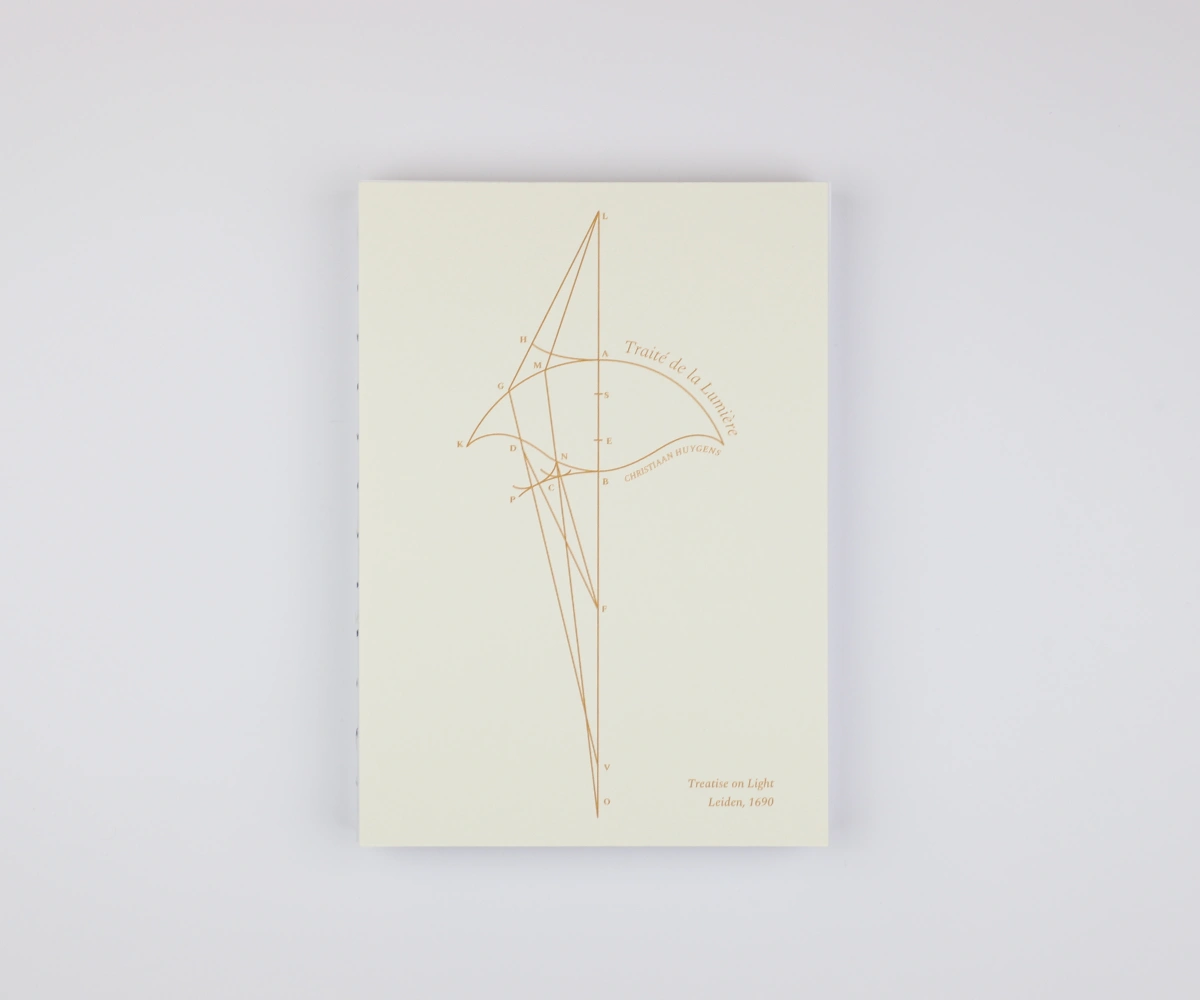
    Huygens's Treatise on Light, bilingual French-English edition — cover
    View on Kronecker Wallis →

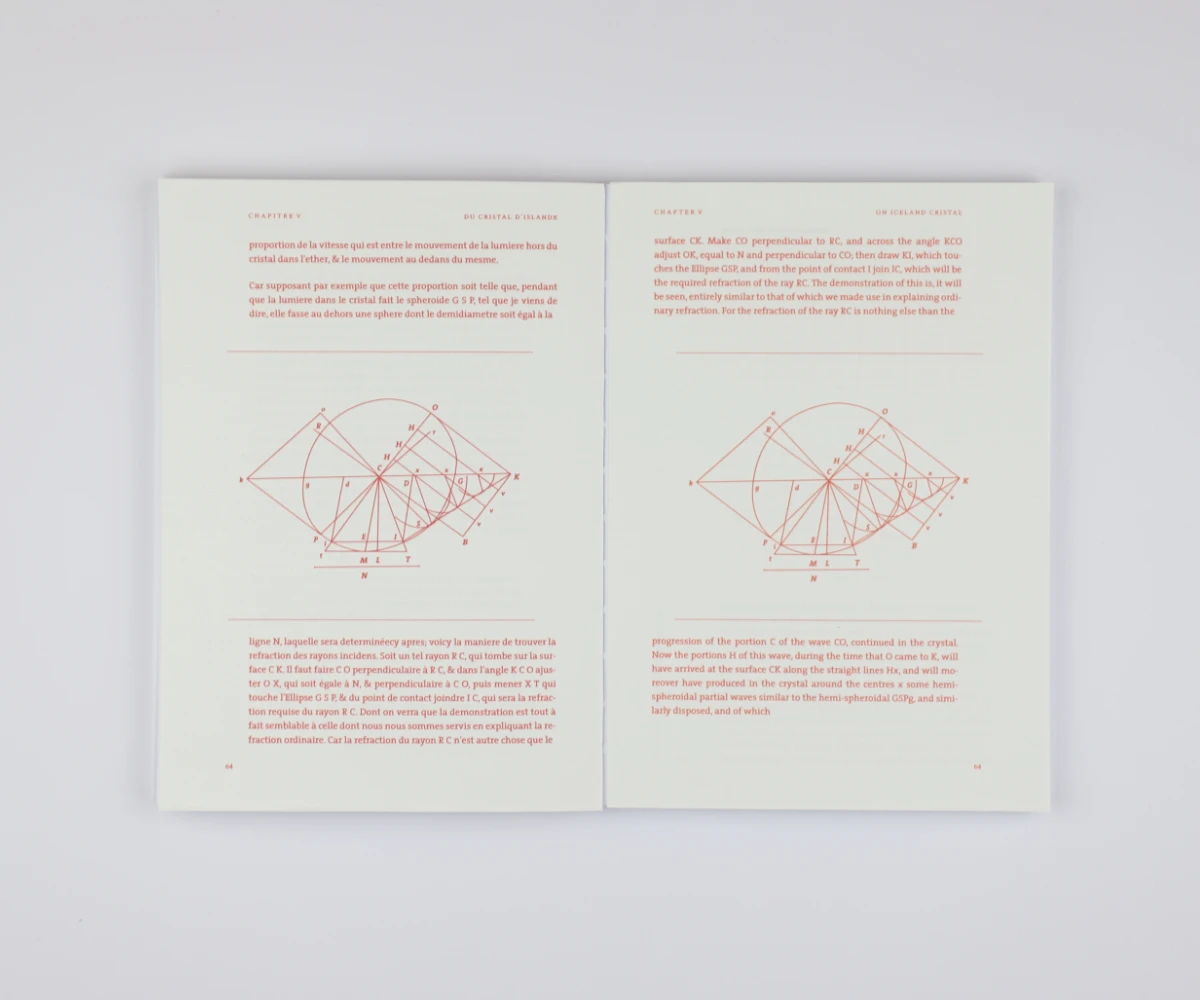
    The other side of the Opticks. In 1690 in Leiden, Christiaan Huygens published the Traité de la Lumière, proposing that light travels as a wave. Newton disagreed and defended his particle theory, and the dispute shaped optics for two centuries. Today we know Huygens was closer to the truth. It was the wave theory that explained diffraction and interference, and the double refraction in Iceland crystal was something Newton's particles could never account for.

    Huygens's Treatise on Light, bilingual French-English edition — facing pages

    The edition is set in facing pages in the tradition of the Loeb Classical Library: the 1690 French on the left, and on the right Silvanus P. Thompson's 1912 translation, the standard academic reference. A book whose subject is light gets to play with color: each of the five chapters has its own palette, the French and English texts are set in different tones within each chapter, and the colors drift as you turn the pages. The typeface is Spectral, evoking the seventeenth-century Dutch printing tradition. Each copy is hand-sewn with an exposed spine, numbered, and made to order.

    View on Kronecker Wallis →
  3. 07

    Relativity: The Special and General Theory

    PRICE 20€ · A5 · APPROX. 100 PAGES · ONLY 90 COPIES PRINTED

    Sold out
    Relativity: The Special and General Theory — cover
    View on Kronecker Wallis →

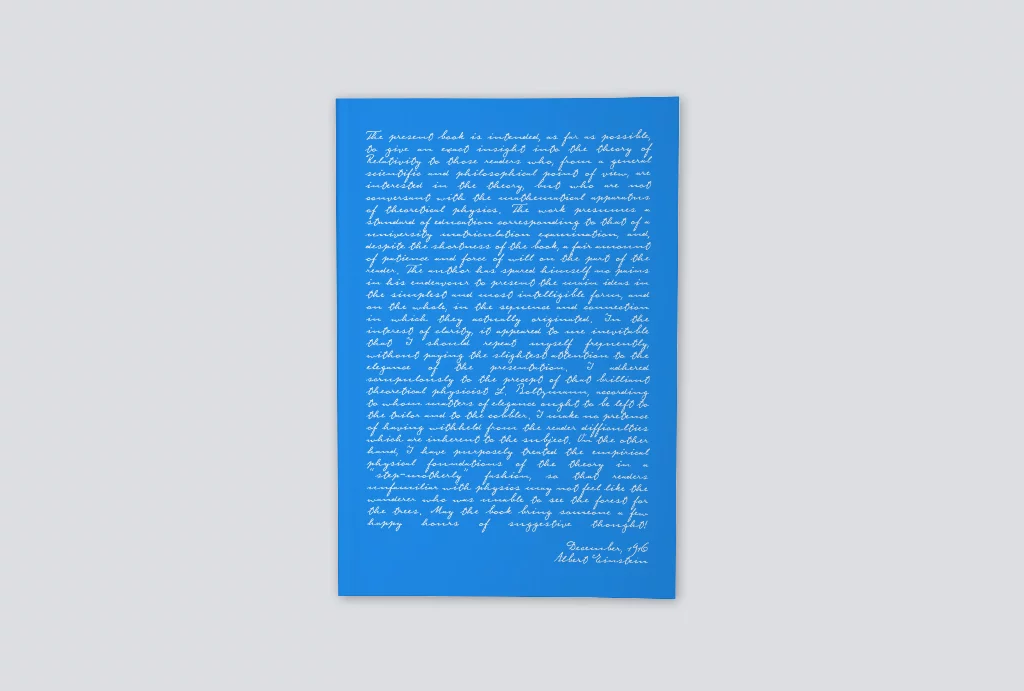
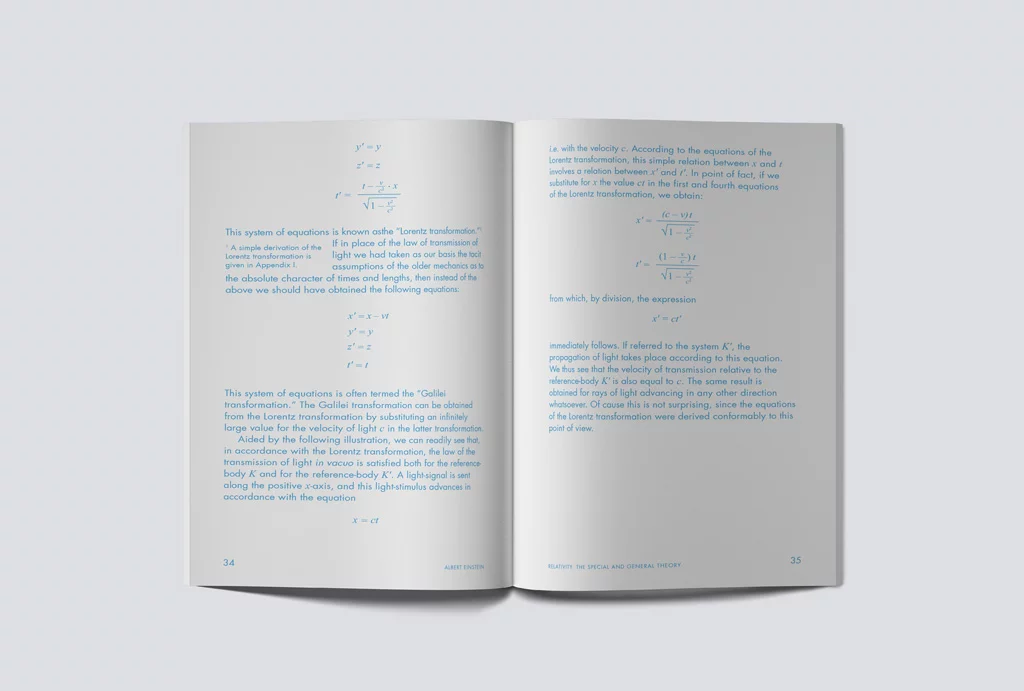
    The 1920 English edition of the book in which Einstein explained relativity to a general audience in his own words, printed in 2021 in a run of exactly 90 copies. Ninety. That number is not a typo, and it explains the sold-out status all by itself.

    Relativity: The Special and General Theory — Einstein's handwriting typeface on the cover

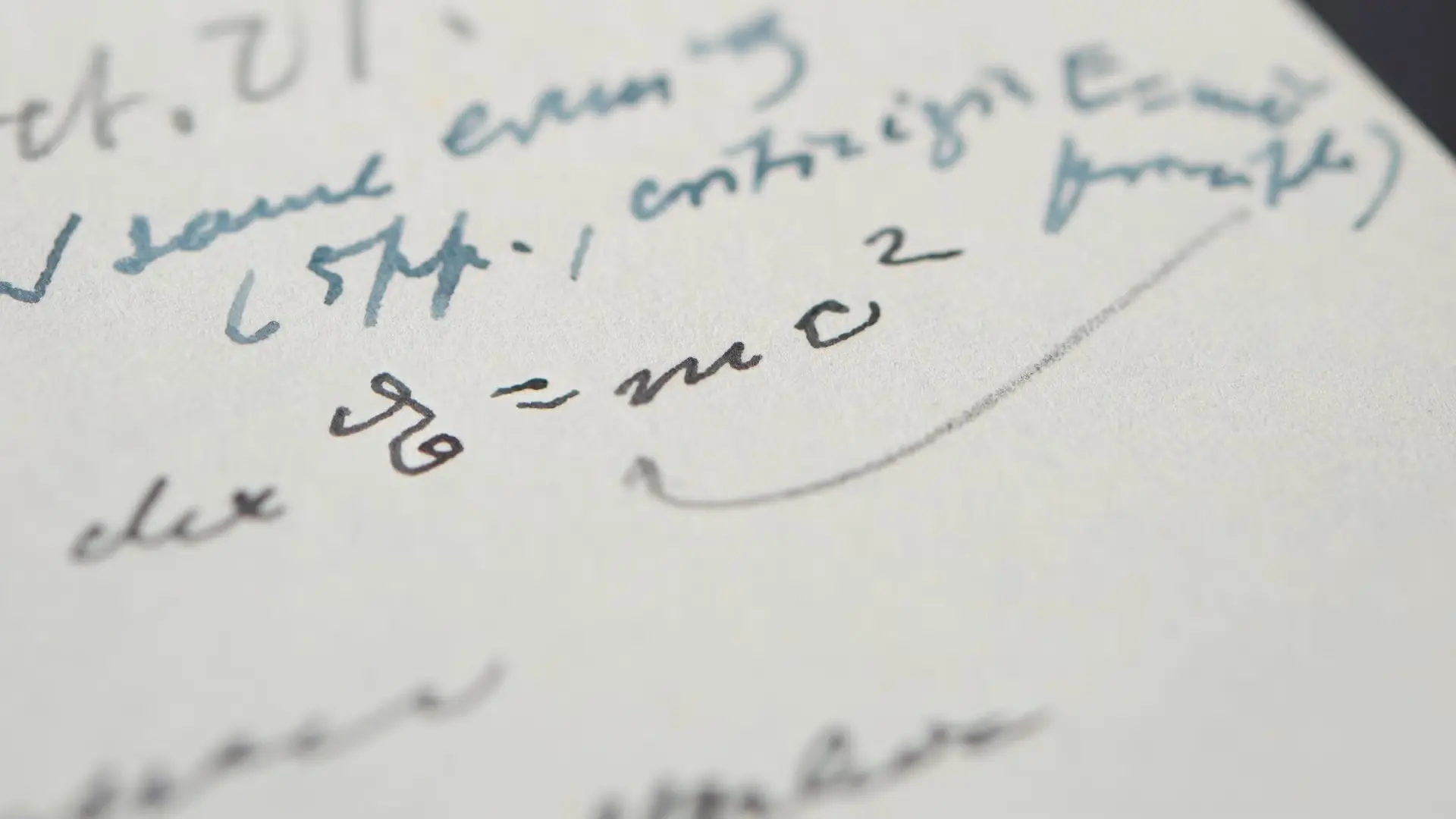
    The most elegant detail is on the cover. The preface Einstein wrote for the book is set in a font digitized from his own handwriting. That font is no casual affair: it is a project Harald Geisler and Elizabeth Waterhouse completed over seven years with the support of the Albert Einstein Archive, funded by a Kickstarter campaign with 2,334 backers. Inside, the core ideas of special and general relativity unfold in Einstein's famously clear prose, built on thought experiments — the same handwriting whose trail from journal paper to letter eventually produced E = mc². For whoever manages to find one.

    Relativity: The Special and General Theory — interior page
    View on Kronecker Wallis →
  4. 08

    Marie Curie's Thesis: Bilingual Edition

    PRICE 40€ · A5 · DUAL-SIDED FORMAT · FRENCH + ENGLISH (1904)

    Marie Curie's Thesis, bilingual edition — one front cover
    View on Kronecker Wallis →

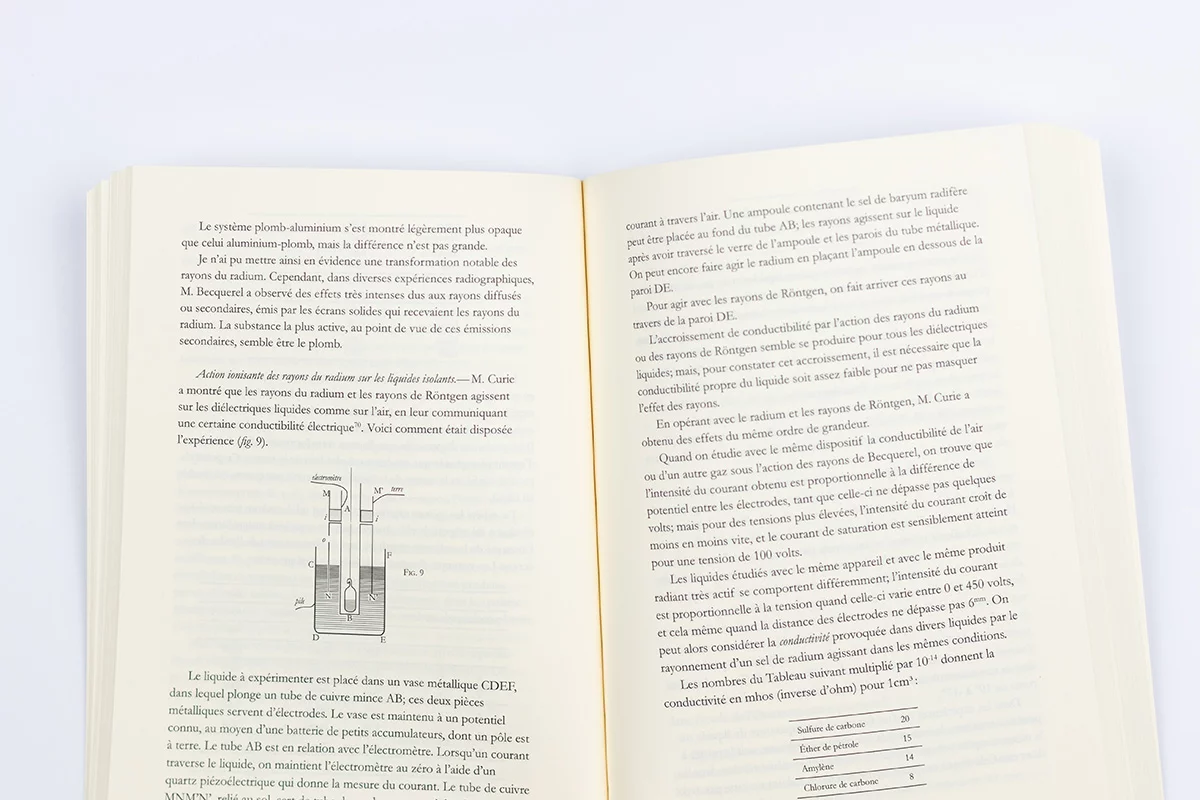
    On June 25, 1903, Marie Skłodowska Curie defended her doctoral thesis at the Sorbonne. The committee included names like Gabriel Lippmann and Henri Moissan, and the thesis was awarded the highest distinction. Five months later, Curie became the first woman to receive the Nobel Prize in Physics. This book is that very thesis: Recherches sur les substances radioactives. The document in which the term radioactivity was coined, the discoveries of polonium and radium were announced, and radioactivity was shown to be an atomic property rather than a chemical one. Its pages hold the data behind that famous labor: years of processing eight tons of pitchblende residue in an unventilated shed to isolate pure radium.

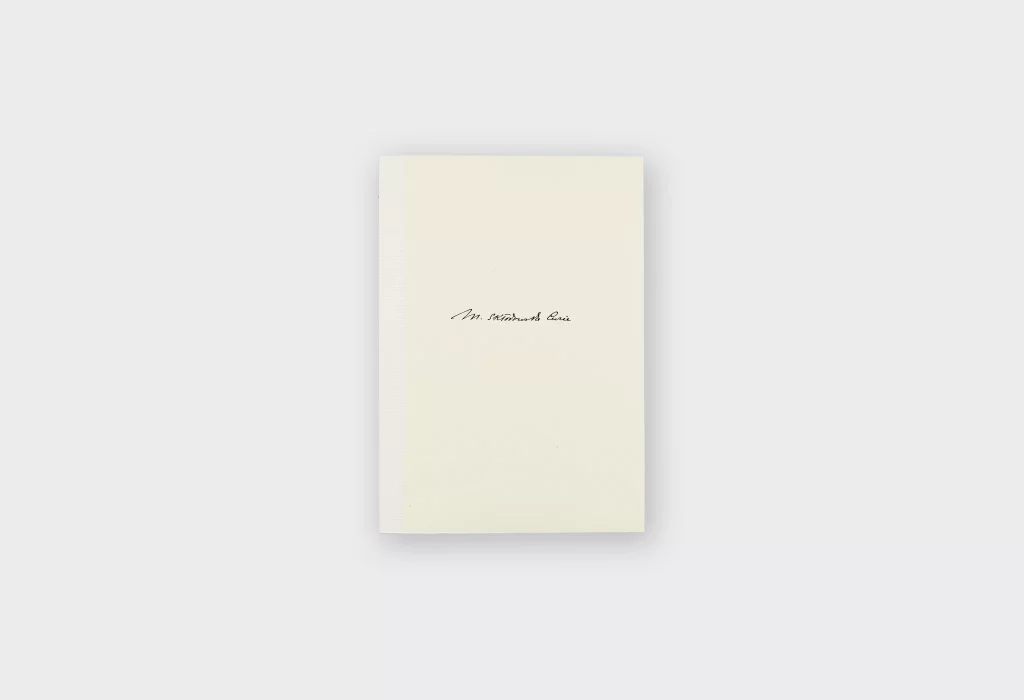
    Marie Curie's Thesis, bilingual edition — the other front cover, flipped

    The design turns bilingualism into a physical joke. The French original starts from one side of the book; flip it over and the English translation, published in Chemical News in 1904, starts from the other. The two texts meet in the middle. Two languages, two front covers, one book. Curie won a second Nobel in chemistry in 1911 and remains the only person to win Nobel Prizes in two different sciences. Her laboratory notebooks are still too radioactive to handle without protection.

    View on Kronecker Wallis →
PART III

Technology and the Birth of Computing

  1. 09

    Alan Turing's Enigma Treatise: The Prof's Book

    PRICE 45€ · A4 · APPROX. 150 PAGES · VECTORIZED ANNOTATIONS · WARTIME AESTHETIC

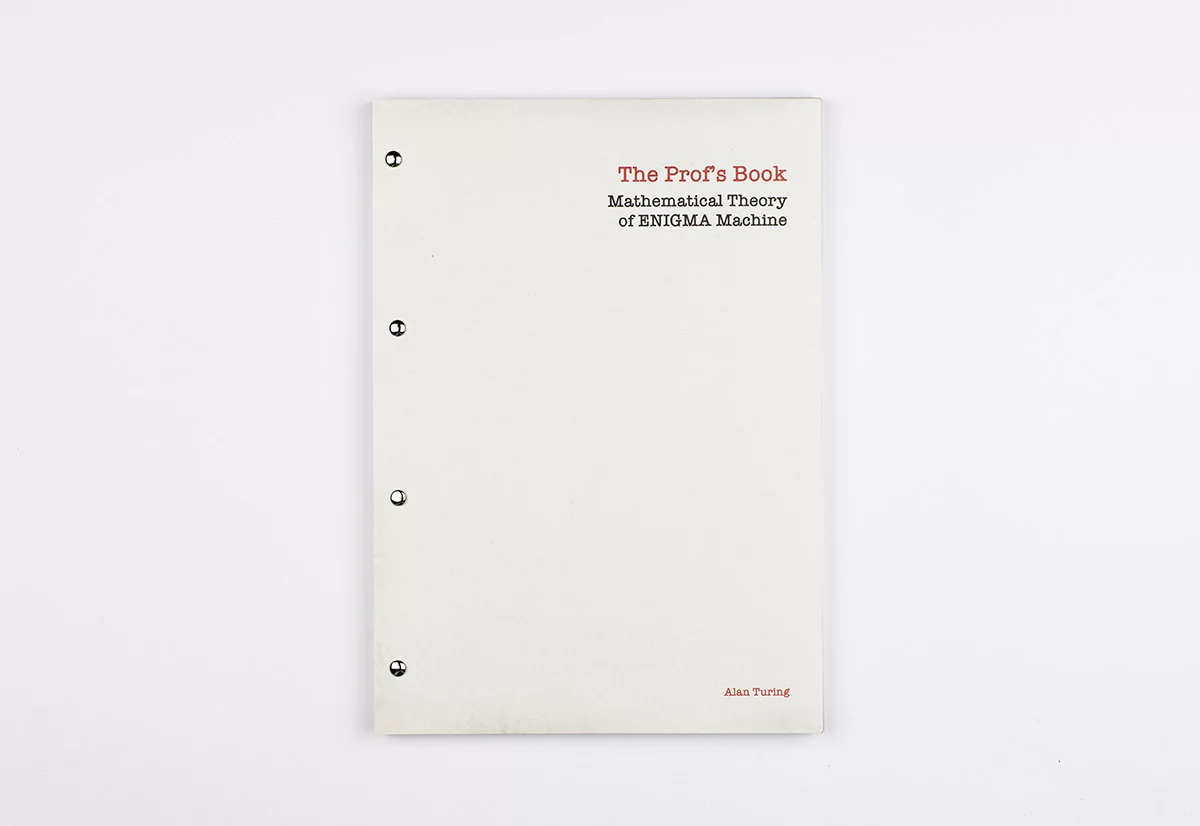
    Alan Turing's Enigma Treatise: The Prof's Book — cover
    View on Kronecker Wallis →

    Known at Bletchley Park simply as "The Prof's Book," this treatise is Turing's own analysis of the Enigma machine and the mathematical techniques used to break its encryption. It was written during the Second World War, remained classified for decades, and went down in history as the primary source on how the Allies cracked the code the German military believed unbreakable — a story The Imitation Game later dramatized for a much larger audience. Rotor configurations, plugboard settings, and the mathematical weaknesses Turing exploited, laid out systematically across these pages.

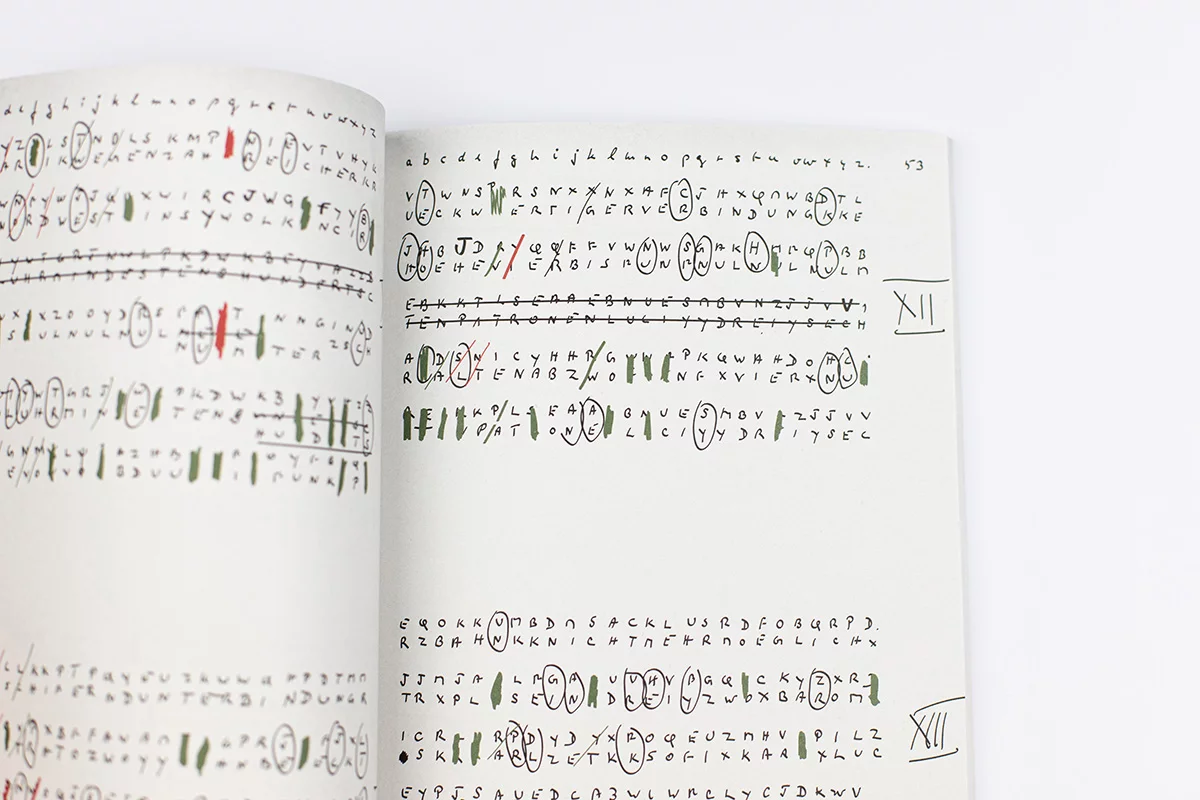
    Alan Turing's Enigma Treatise: The Prof's Book — vectorized annotations

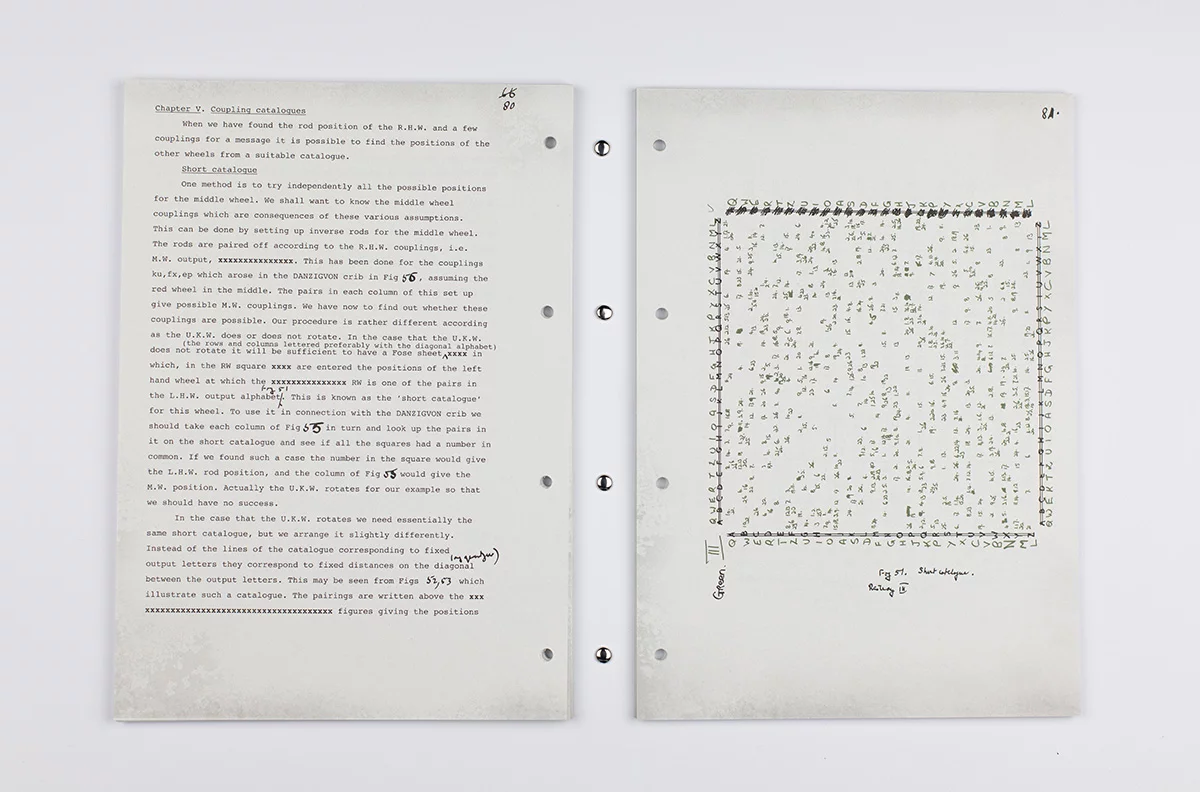
    The restoration approach matches the rigor of the Gauss book. The typewritten text has been reset in a period-appropriate typeface for readability, but Turing's handwritten notes, margin comments, tables, and diagrams have been vectorized one by one and kept exactly where he placed them. Even the typing mistakes remain, with Turing's handwritten corrections above them. The original manuscript is held at the UK National Archives. This edition turns that document into a readable, collectible object.

    Alan Turing's Enigma Treatise: The Prof's Book — interior page
    View on Kronecker Wallis →
  2. 10

    Von Neumann's EDVAC Report: The Blueprint for Every Computer

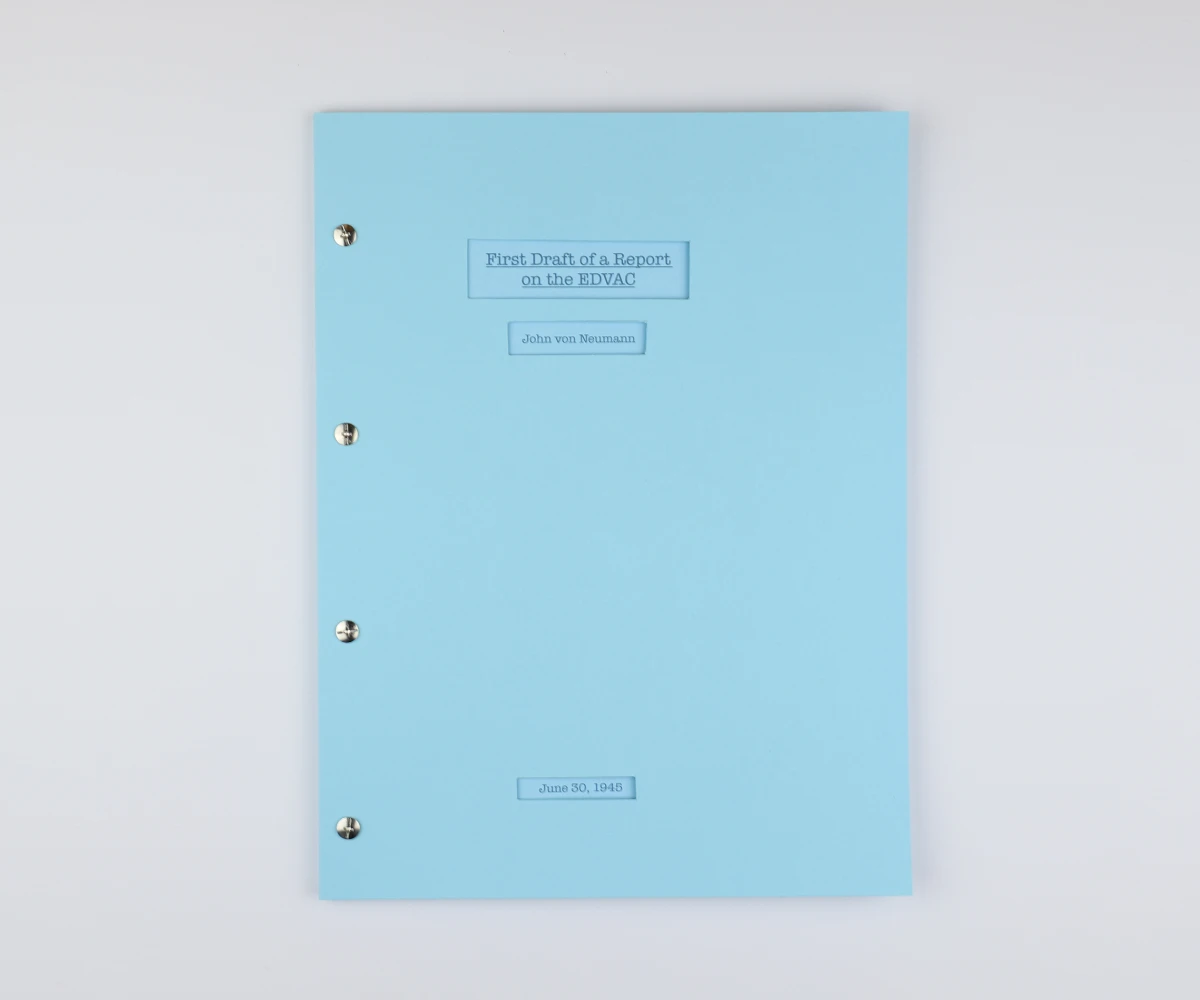
    PRICE 30€ · A4 · 107 PAGES · BLUE PAPER + METAL SCREW FASTENERS

    Made to order
    Von Neumann's EDVAC Report: The Blueprint for Every Computer — cover
    View on Kronecker Wallis →

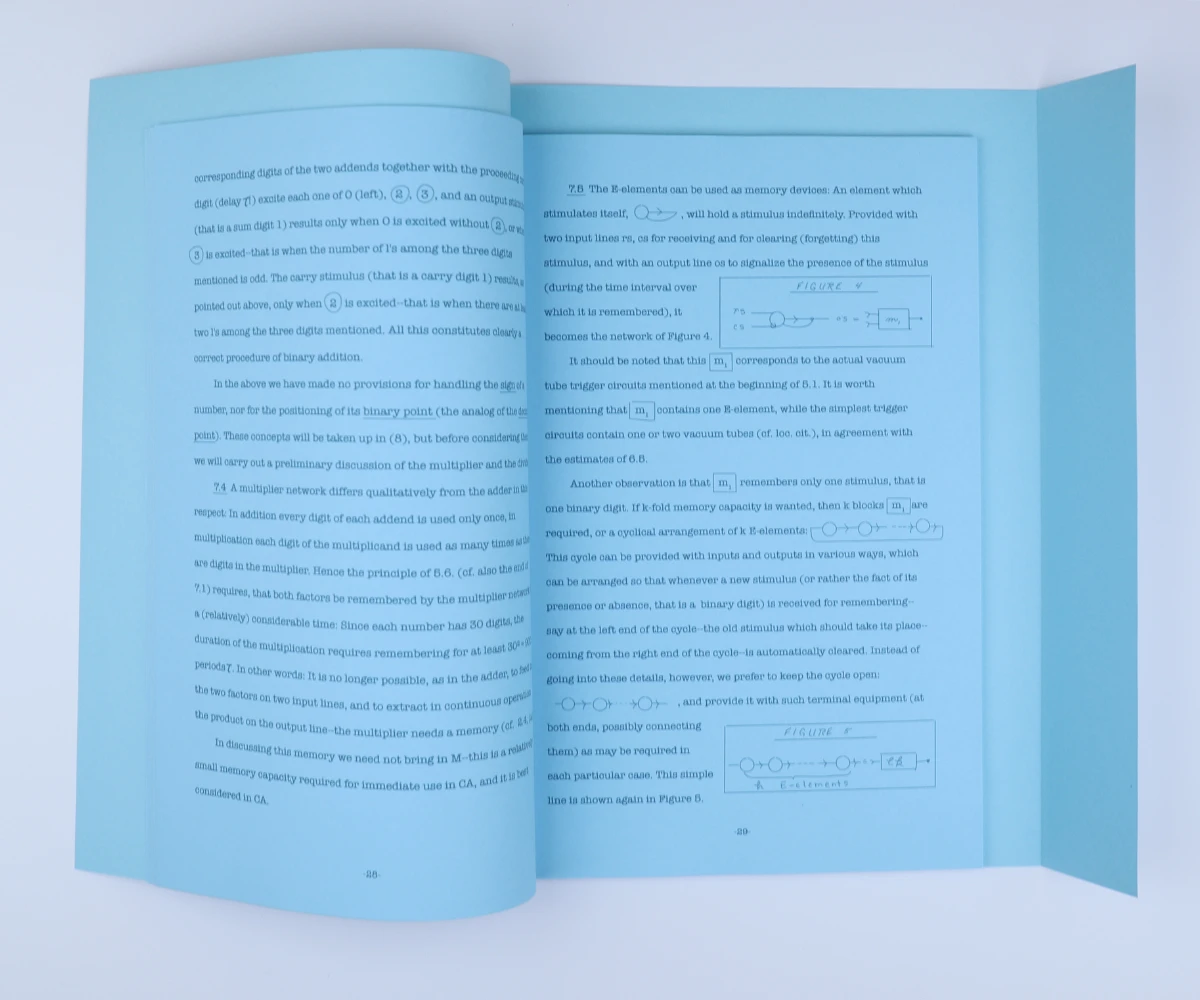
    On June 30, 1945, John von Neumann circulated a 107-page document that defined computer architecture for the next eighty years. The First Draft of a Report on the EDVAC described, for the first time, a computer that stores its program in the same memory as its data. The architecture inside your phone, your laptop, and every server the internet runs on came out of this report. Arithmetic unit, control unit, memory, input, output: the five-component diagram taught in every computer science curriculum lives here.

    Von Neumann's EDVAC Report — metal screw fasteners detail

    The edition turns a historical fact into design: the document was never formally published, only circulated internally. So it is printed like a classified technical report from the forties, on sky-blue paper in a monospace typewriter font, bound to a blue cardboard cover with four metal screw fasteners. The cover even carries the original U.S. Army contract number: W-670-ORD-4926. Together with the Turing treatise, these are two complementary documents from the same era and the same world. Turing proved what could be computed; von Neumann wrote down how to build the machine.

    View on Kronecker Wallis →
  3. 11

    Nikola Tesla's Patents Book

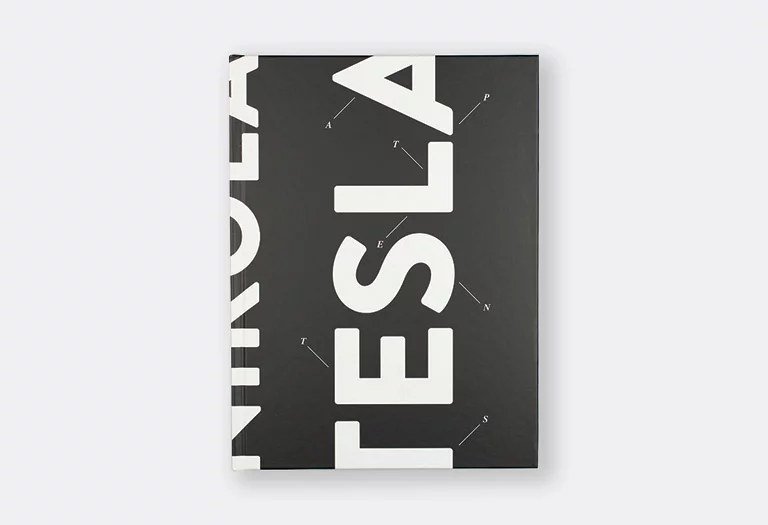
    PRICE 45€ (was 50€ · 10% off) · 20×27 CM · 500 PAGES · MUNKEN POLAR

    10% off — last 98 copies, cover flaws
    Nikola Tesla's Patents Book — cover
    View on Kronecker Wallis →

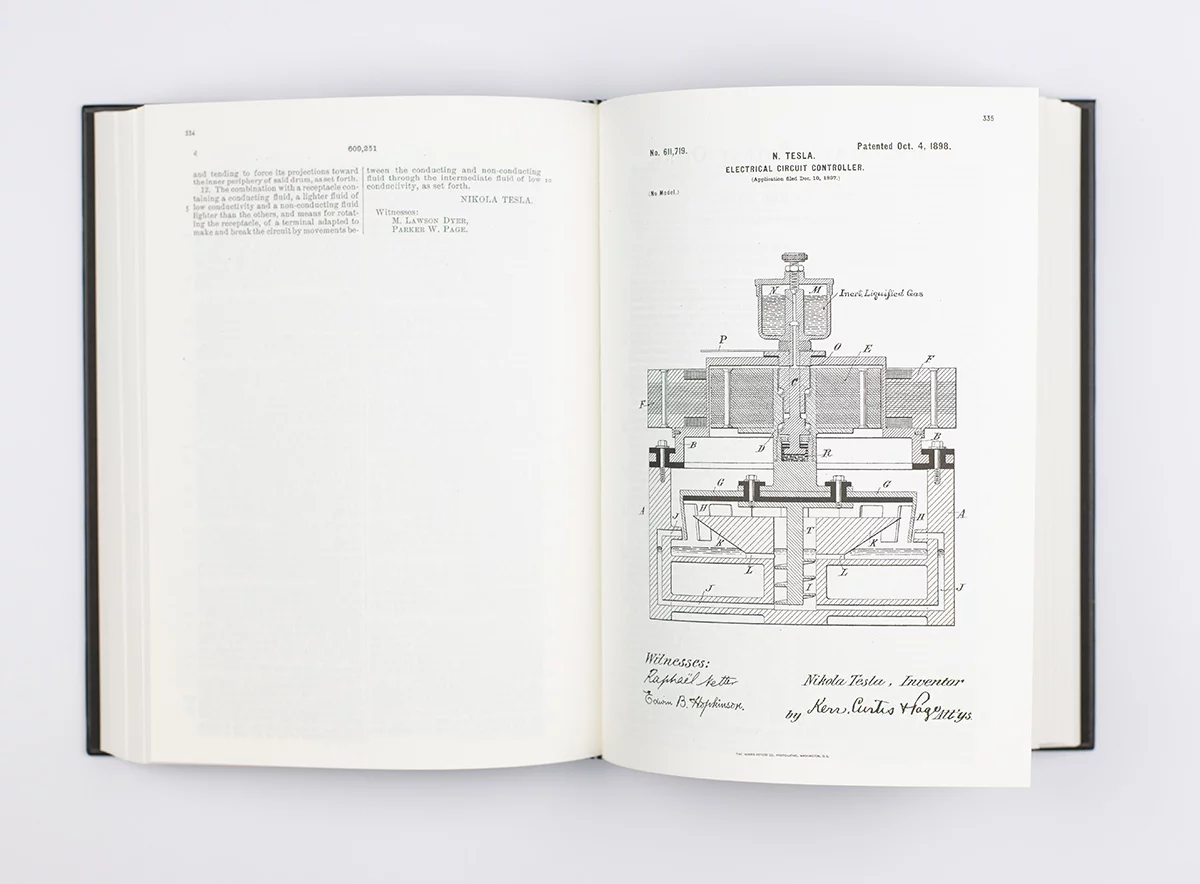
    The documents that best explain Tesla's mind are his patents, and the United States Patent Office has 112 of them on record. This book collects all of them in chronological order, with the original technical illustrations and patent descriptions, across 500 pages. The publisher considered adding patents from other countries and decided against it: the source material was of lower quality and the content largely repeated the American filings. Choosing to prune a book rather than fatten it is a decision consistent with the character of this whole catalog.

    Nikola Tesla's Patents Book — patent illustrations spread

    The real draw is those old technical illustrations. Cut-away drawings, coils, motors, circuit diagrams: some of the most refined examples of nineteenth-century engineering draftsmanship, behind a black cover with enormous typography. One honest footnote: the copies currently on sale are the last 98 found in the warehouse, with millimetric printing flaws on the covers. The interiors are perfect, the cover flaws are the reason for the discount, and there is no reprint planned any time soon.

    View on Kronecker Wallis →
  4. 12

    Nikola Tesla: Experiments with Alternate Currents of High Potential and High Frequency

    PRICE 20€ · A5 · 140 PAGES

    Sold out
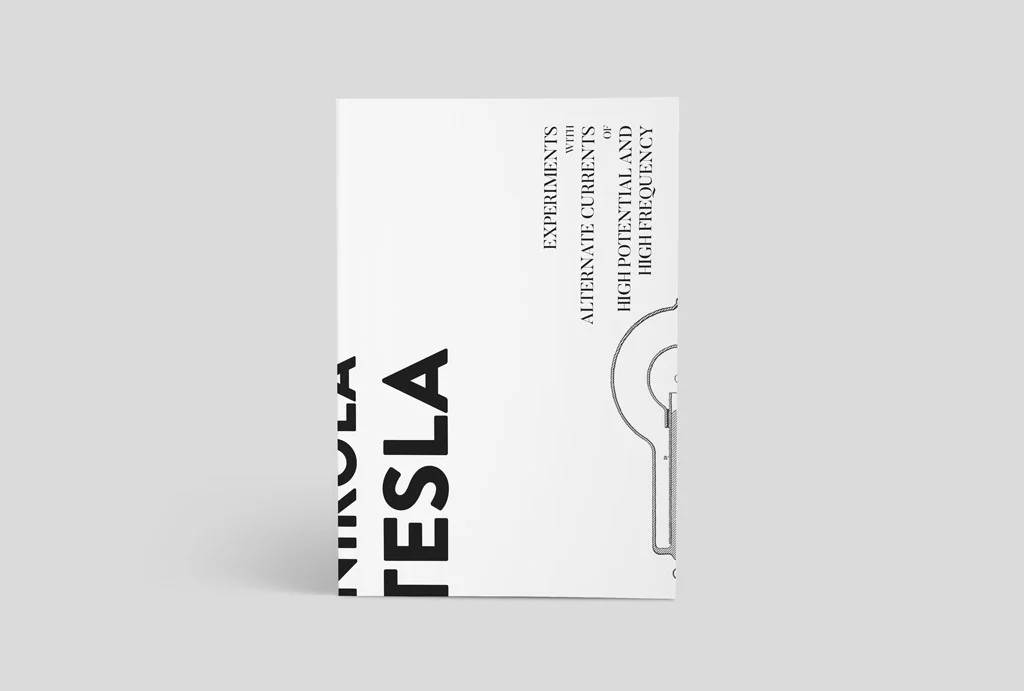
    Nikola Tesla: Experiments with Alternate Currents — cover
    View on Kronecker Wallis →

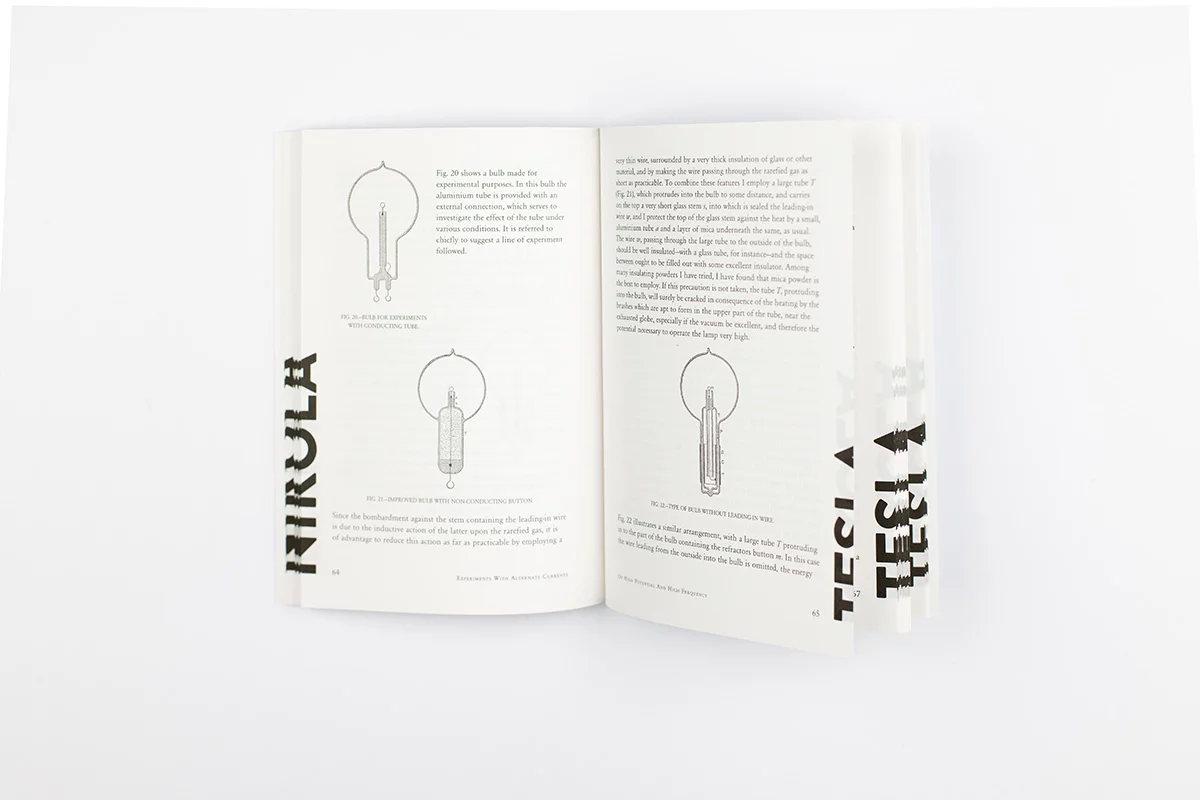
    Tesla's most celebrated lecture. Delivered in 1892, it laid out his experiments and theories on high-frequency alternating current, ideas that would transform how electricity is transmitted while also planting the foundations of wireless communication. The detailed descriptions of the Tesla coil, the case for alternating current over direct current, and the logic of long-distance power transmission are all in this text.

    Nikola Tesla: Experiments with Alternate Currents — next to the patents book

    Kronecker Wallis designed it as a companion to the patents book: the same clean aesthetic, an elegant 140-page volume in A5. Currently sold out, but knowing it was designed to stand next to the patents book on a shelf says something about the internal consistency of this catalog.

    View on Kronecker Wallis →
PART IV

Space

  1. 13

    Apollo 13 LM Systems Activation Checklist

    PRICE 40€ · A5 · 80 PAGES · INCLUDES LOVELL'S HANDWRITTEN CALCULATIONS

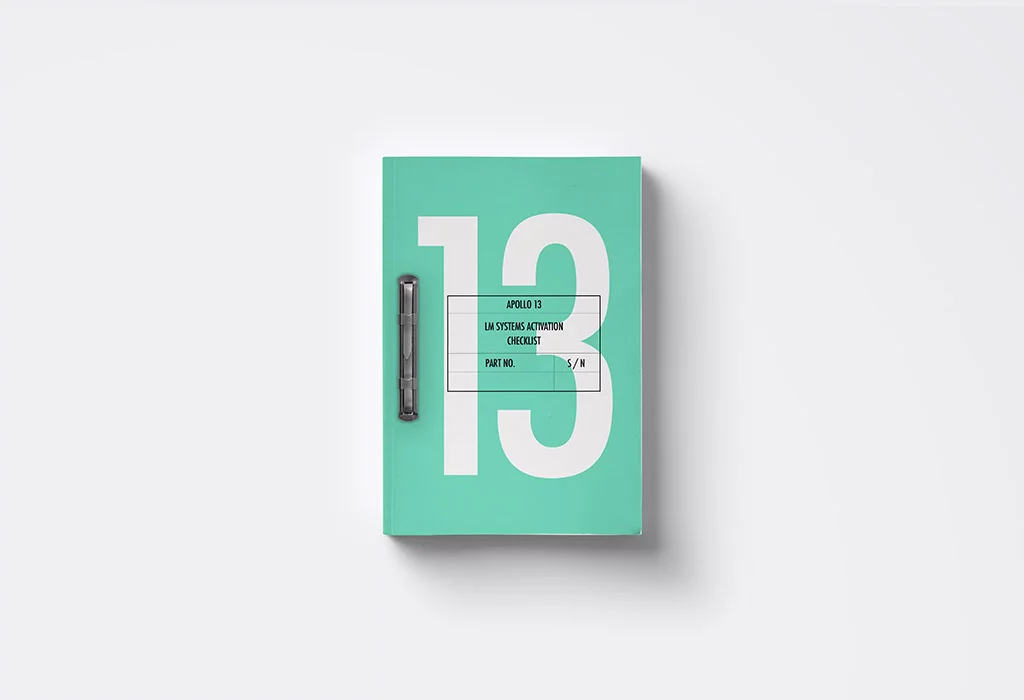
    Apollo 13 LM Systems Activation Checklist — cover
    View on Kronecker Wallis →

    Launched on April 11, 1970, Apollo 13 was meant to be the third crewed mission to land on the Moon. When an oxygen tank exploded, the mission became a rescue operation, and the crew returned to Earth after 5 days, 22 hours, 54 minutes, and 41 seconds. One of the documents that made that return possible was this checklist, the step-by-step guide for activating the Lunar Module's systems. Power configuration, communications checks, life support: the crew's survival manual in the middle of a crisis — the same corridors and switches you can now retrace, safely, on a modern Street View walkthrough of a spacecraft mock-up.

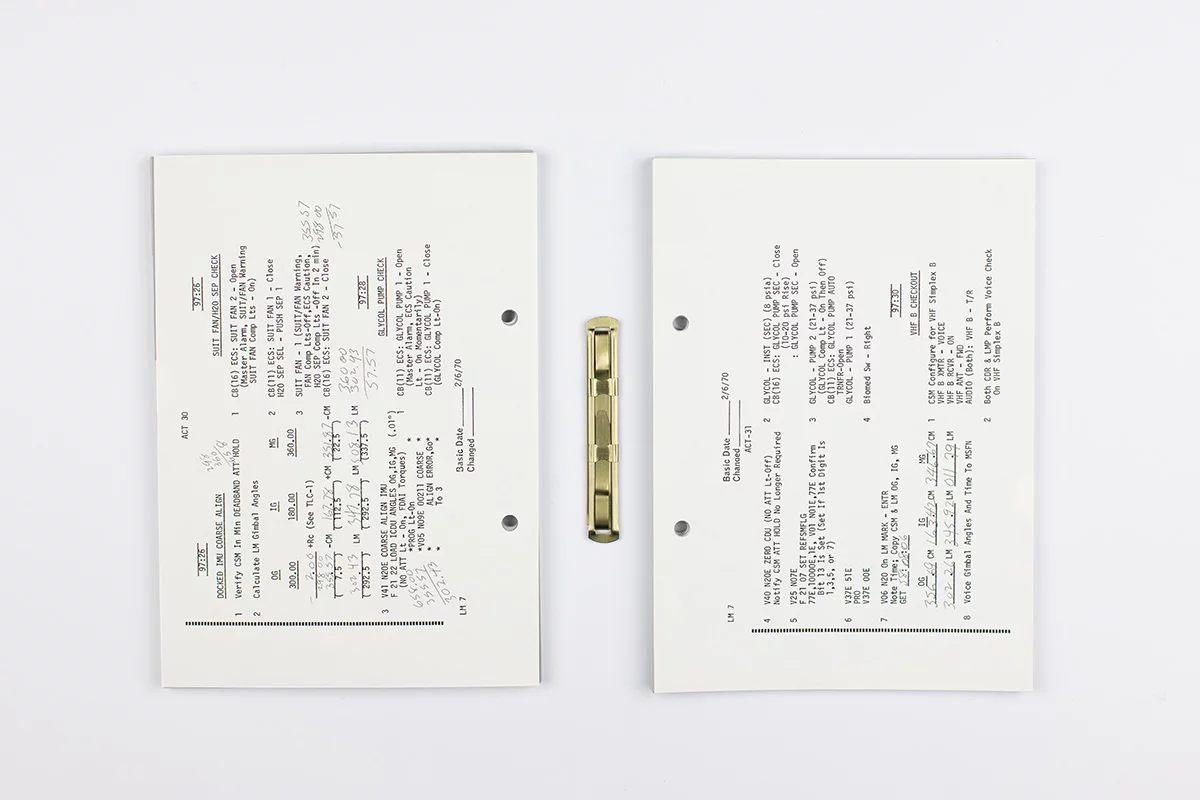
    Apollo 13 LM Systems Activation Checklist — Lovell's handwritten calculations

    Prepared for the mission's fiftieth anniversary, this facsimile is an 80-page A5 publication. The most striking detail is what has been layered over the original pages: Commander James Lovell's handwritten calculations for determining the spacecraft's angle of descent back to Earth, reproduced exactly where he wrote them. Those figures, put to paper roughly two hours after the explosion, may be the highest-stakes arithmetic in the history of engineering.

    View on Kronecker Wallis →
PART V

Nature and Portraits

  1. 14

    Illustrating Nature: The World Through the Eyes of Alexander von Humboldt

    PRICE 60€ · APPROX. 300 DRAWINGS · TRILINGUAL: ENGLISH, GERMAN, SPANISH

    Sold out
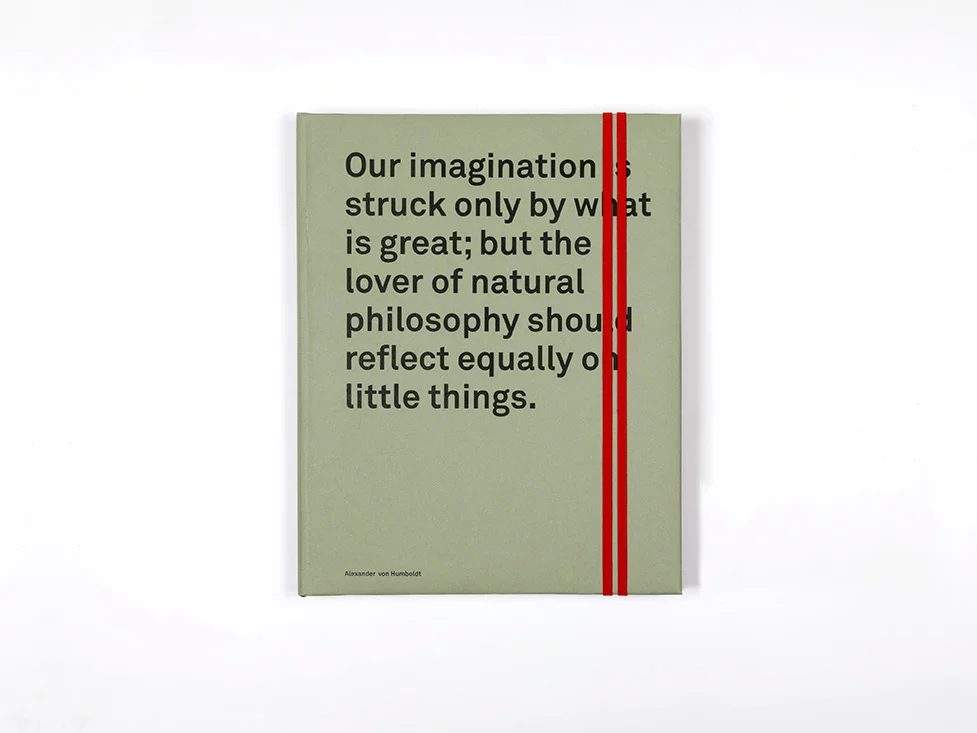
    Illustrating Nature: The World Through the Eyes of Alexander von Humboldt — cover
    View on Kronecker Wallis →

    Alexander von Humboldt set out in 1799 to describe the world through the eyes of a modern scientist. On his five-year expedition through South America he covered more than 9,650 kilometers with Aimé Bonpland, published his findings in 34 volumes between 1807 and 1833, and in 1829, at the invitation of the Russian Tsar, made a second 15,000-kilometer journey across Siberia to the Chinese border. He backed his diaries and letters with a vast number of drawings, and he influenced the minds of an entire era, from Gauss to Goethe, from Thoreau to Bolívar.
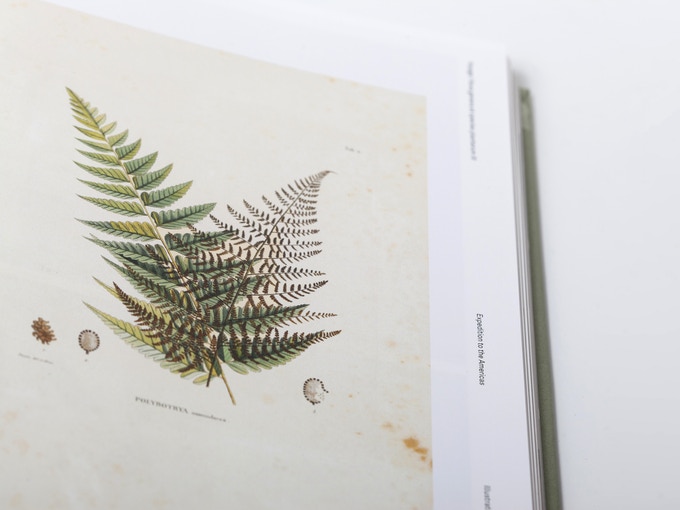
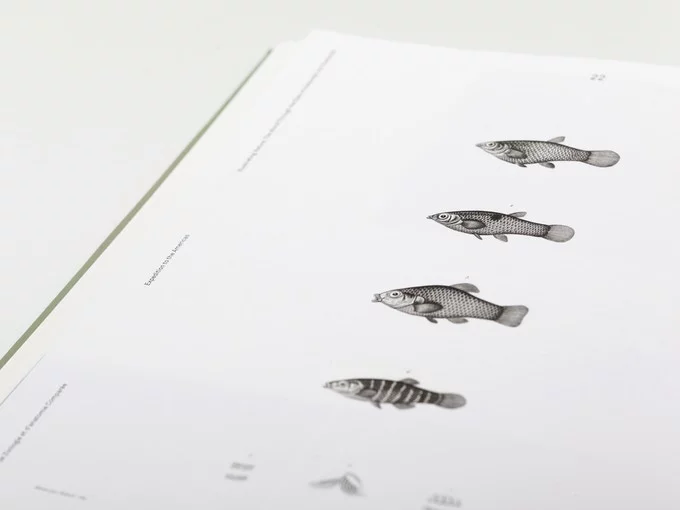
    Illustrating Nature — interior drawing

    This book gathers roughly 300 representative drawings into a visual travel companion, in the same spirit as Ernst Haeckel's plates of radiolarians and jellyfish. It is also the most tactile object in the catalog: different paper types, different textures, and different dimensions are bound into a single volume to set the sections apart. The aim is a kind of kinship between Humboldt touching the texture of a leaf in the rainforest and the reader feeling the material shift between the book's pages. The trilingual edition is currently sold out.
    Illustrating Nature — mixed paper textures
    View on Kronecker Wallis →
  2. 15

    Portraying Science: Scientist Portraits Book

    PRICE 60€ · 20×15 CM · 400+ PAGES · 16TH–19TH CENTURY

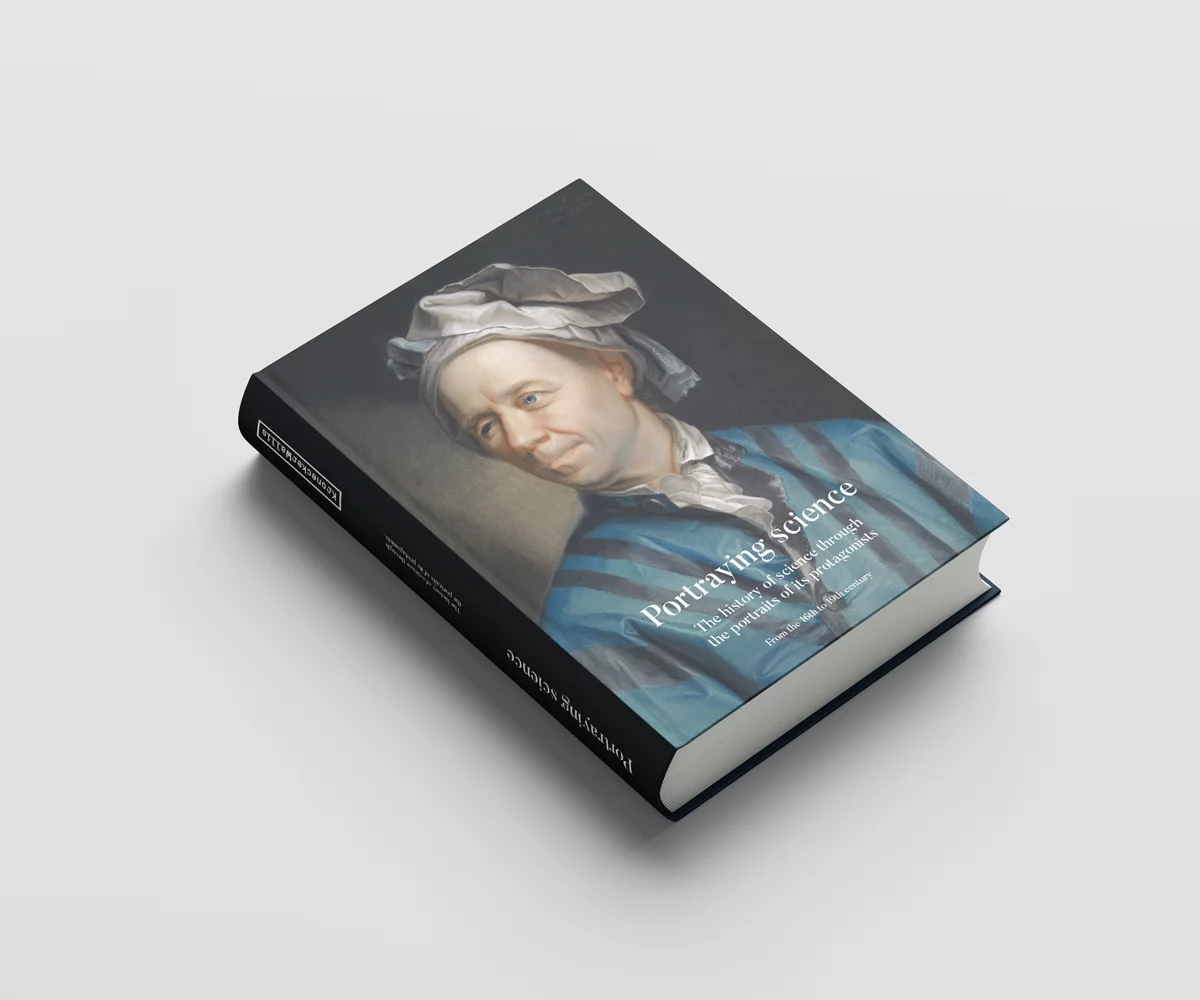
    Portraying Science: Scientist Portraits Book — cover
    View on Kronecker Wallis →

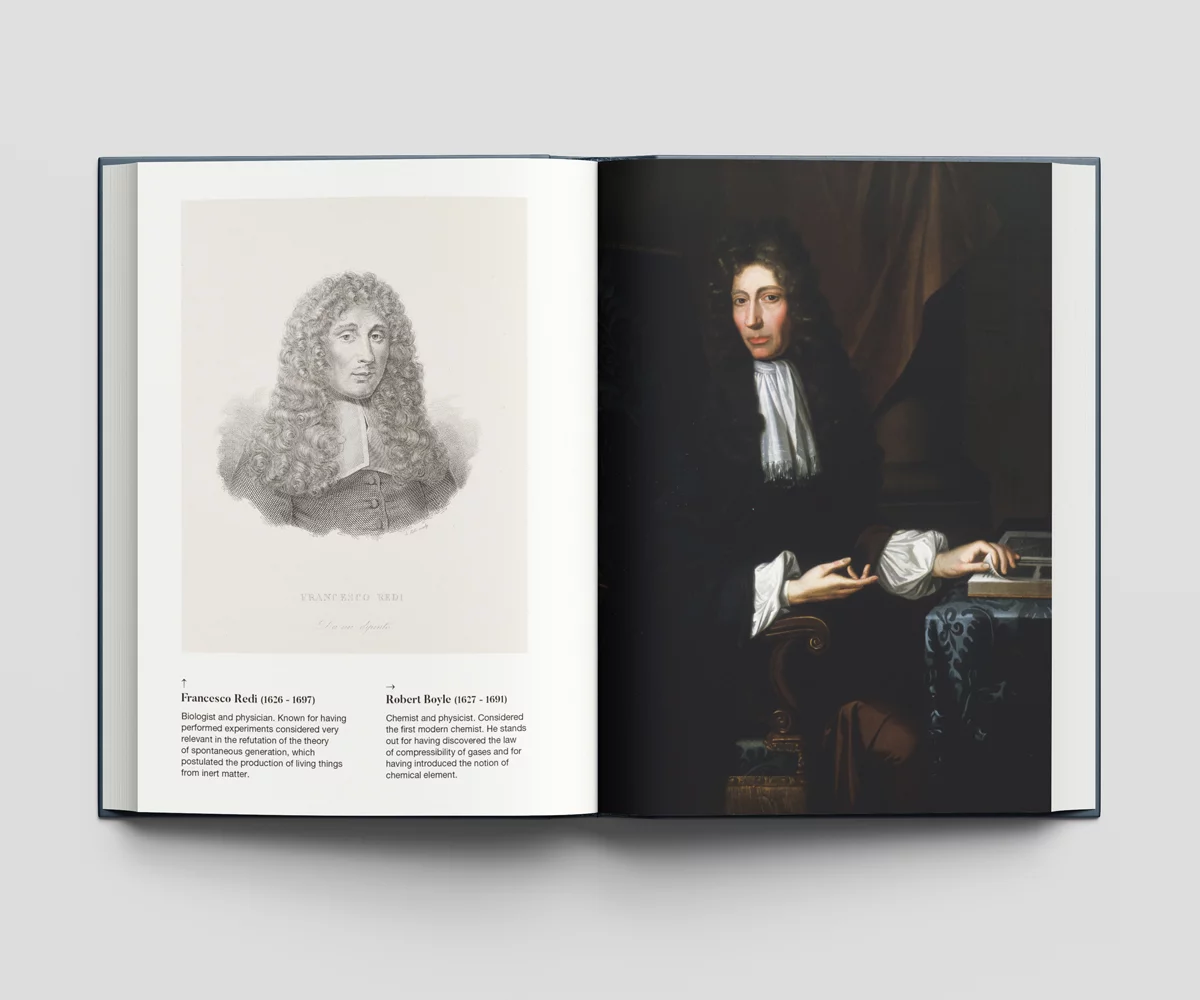
    A 400-page book that tells the history of science through the faces of its protagonists. For centuries, the best painters of each era portrayed the best minds of each era, and those portraits are now scattered across museum walls and archive catalogs. This book collects them in chronological order: from Copernicus to Kepler, from Galileo to Newton, from Euler to Gauss, from Lavoisier to Mendeleev, six disciplines spanning the sixteenth to the nineteenth century.

    Portraying Science: Scientist Portraits Book — portrait spread

    The list is not limited to the expected names. Pioneering women such as Ada Lovelace, Mary Somerville, Caroline Herschel, Laura Bassi, Maria Mitchell, and Émilie du Châtelet are a natural part of the book. Each portrait comes with context on both the scientist and the artistic medium: oil on canvas, tempera, engraving, studio photograph — a painted counterpart to what Alejandro Guijarro did with a camera and a physicist's blackboard. The 20-by-15-centimeter format fits the book on a coffee table and on a shelf alike. One of the densest objects you can put in a study.

    View on Kronecker Wallis →

Why I Care

What impresses me most about this catalog is not any single book but the stubbornness behind it. A handful of people in Barcelona take the most important scientific texts in the world, decide "this text deserves better," and give years to the job. They redraw Gauss's notebooks pixel by pixel. They hand-sew and number the Huygens. They complete the work Byrne left unfinished 170 years ago with a team of mathematicians they assembled for the purpose. None of these are shrewd commercial decisions in the short term. That is exactly the point.

Most of science publishing is in a hurry to package content and push it onto shelves. Kronecker Wallis does the opposite: it slows down, reduces, prunes, and reworks. The decision not to pad the Tesla book with foreign patents carries the same principle. A thicker book is not always a better book. The cost of this approach is that half the catalog is permanently sold out. The reward is that every book you get your hands on will still be kept somewhere decades from now.

These people deserve the attention, in the fullest sense. The entire catalog is sold at kroneckerwallis.com and ships worldwide from Barcelona. When you see something in stock, do not wait. In this catalog, waiting usually ends in a sentence like "a reprint is expected in mid-2027."

Prices and stock information reflect what was published on kroneckerwallis.com at the time this piece was prepared and may change. Made-to-order books (Gauss, Huygens, EDVAC) add a few days of workshop time.