Have you ever thought about the difference between rigatoni and penne?
Both are tubes. Both are pasta. But one paired with the wrong sauce becomes a disappointment. Short, wide, ridged rigatoni waits to be bitten with sauce pooled inside it. Penne is more delicate, faster — a different feeling, demanding a different sauce. Shape is not just aesthetic. Shape is the mathematics of flavour.
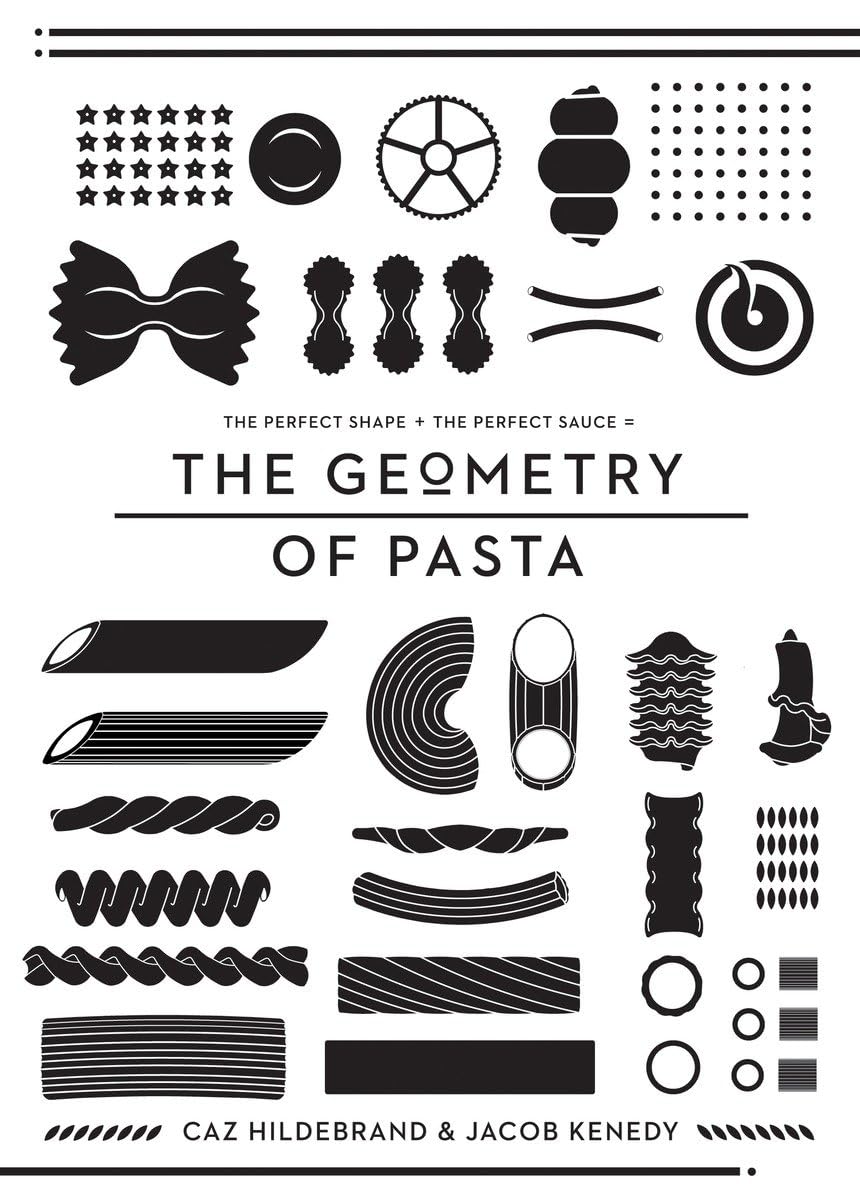
The Geometry of Pasta by Caz Hildebrand and Jacob Kenedy is built entirely on this idea: every pasta shape has a logic, and without understanding that logic, you cannot choose the right sauce. It sits on a shelf alongside Pasta by Design — George Legendre's parametric-equation catalogue of 92 shapes — as the warmer, more edible half of the same obsession.
Anatomy of three shapes
Rigatoni
Wide tube, ridged — holds chunky sauces inside and out
Fusilli
Spiral form traps sauce in every groove along the helix
Orecchiette
Small cup — cradles both sauce and vegetables at once
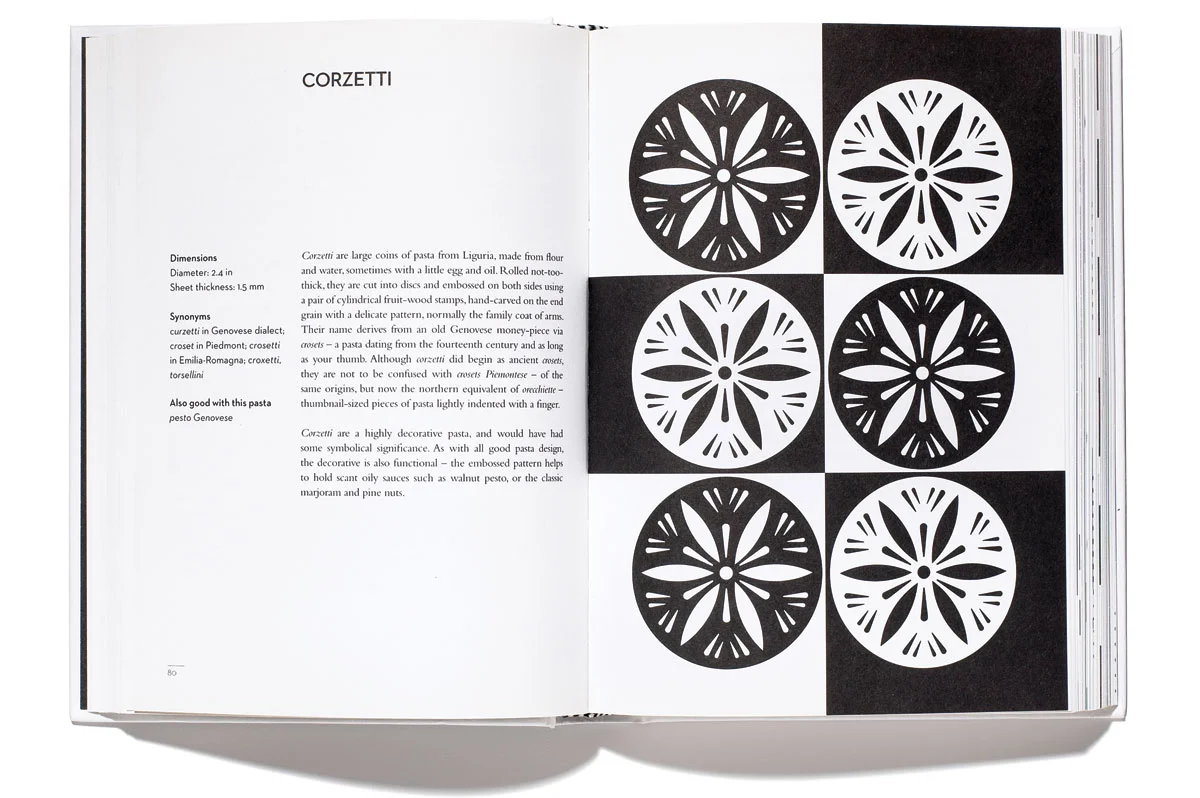
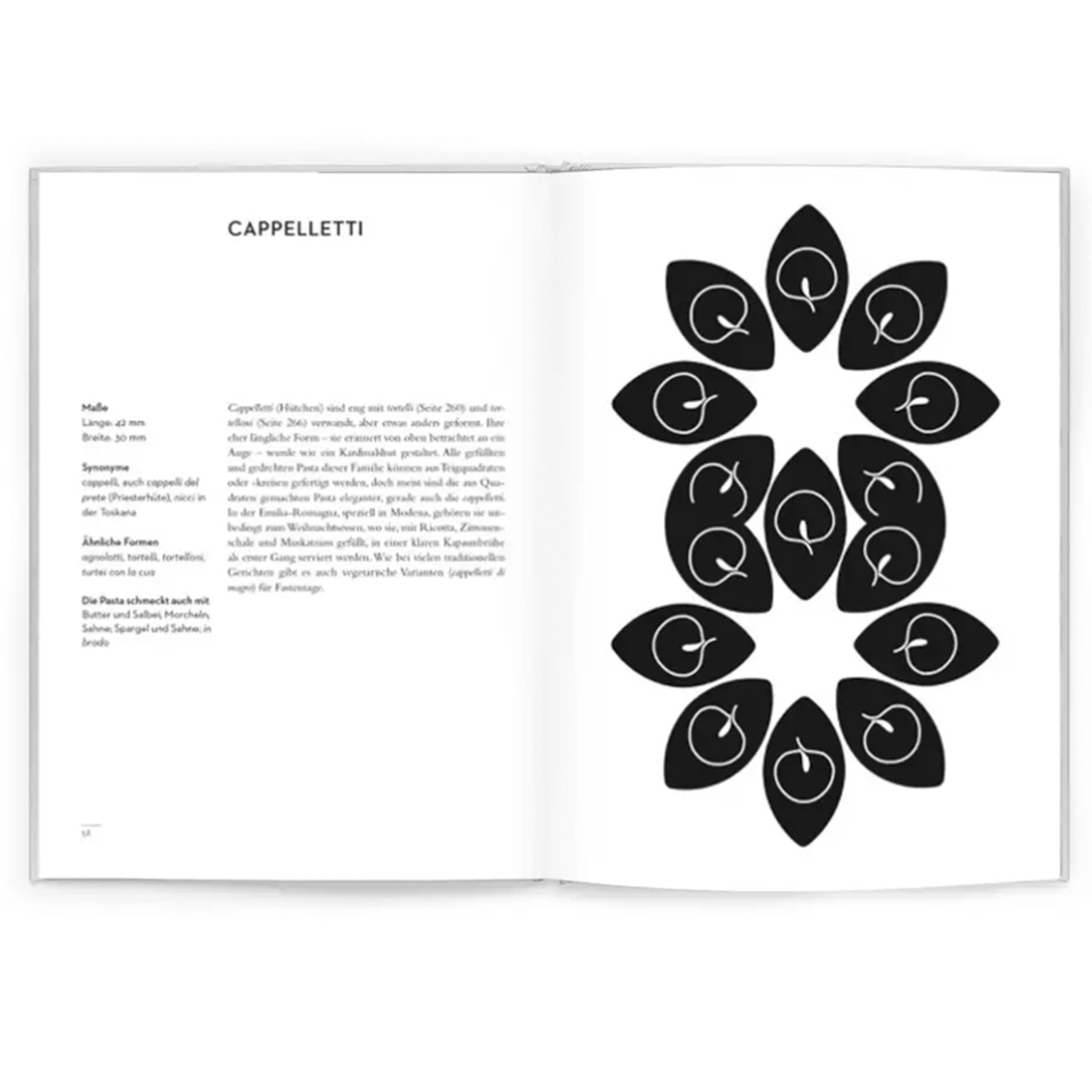
The book hits the eyes first. Hildebrand's background in graphic design is felt on every page. Black-and-white, nearly anatomical drawings — each pasta shape presented like an architectural plan. Farfalle looks not like a butterfly but like an engineering marvel. Fusilli's spiral is rendered with mathematical elegance. No colour, no decoration — only form, only geometry.
This aesthetic choice is not accidental. If Hildebrand wants you to focus on shape, she must remove every distraction. She does. The result is a cookbook that reads like a design monograph — both things at once, neither apologising for the other.
Shape is not decoration. Shape is what decides whether the sauce stays or slides, whether the bite is satisfying or empty.
Shape meets sauce
Spaghetti
Long, smooth, round
Oil-based, light tomato
Rigatoni
Wide tube, ridged
Chunky meat ragù
Orecchiette
Small concave cup
Greens, sausage, crumbs
Tagliatelle
Flat, wide ribbon
Bolognese, butter
Fusilli
Tight helix spiral
Pesto, thick tomato
Kenedy's role is to warm what the visuals keep cool. The recipes alongside each pasta shape are short, trustworthy, and deeply Italian — meaning the ingredient lists are not long, the technique is not fussy, but the result is always correct. Kenedy's approach rests on a single question: what does this shape hold? What does it lose? Which sauce serves it — and which drowns it?
The answers sometimes surprise. Spaghetti does not go with every sauce — in fact, by most careful accounts, it is a fairly restricted shape. Orecchiette, that small ear-shaped pasta, is remarkably versatile — its hollow embraces both sauce and vegetable in the same bite.
On the design
Hildebrand's black-and-white illustration style — clinical, almost architectural — was a deliberate act of restraint. In a world of glossy food photography, this book insists on geometry over appetite. The result is a cookbook that reads like a design monograph. Both things at once. Neither apologising for the other.
If Euclid had eaten pasta, he would probably have written this book.
Abakcus · April 2026
One more thing about this book: while reading it, you feel compelled to go to the kitchen. This is the highest achievement a cookbook can reach.
But The Geometry of Pasta is not merely a cookbook. It is a design manifesto, a meditation on form and function, and the world's most delicious geometry lesson — served in a single, quietly brilliant volume.
In short
A book that makes you think differently about both design and dinner. Hildebrand's rigour and Kenedy's warmth balance each other perfectly — and the result is one of the most distinctive cookbooks ever printed.
Caz Hildebrand & Jacob Kenedy — The Geometry of Pasta
Boxtree, 2010 · abakcus.com