A quick note: some links on this page are affiliate links. If you buy through them, Abakcus earns a small commission at no extra cost to you. It helps keep the site free, and it never decides what we recommend.
The whole guide
22 more pages, one for each question.
This page is the big picture. When you need the detail, each topic below has its own page.
By age
Pick your kid’s stage
What math looks like at each age, what to buy, and how long a lesson should take.
Curriculum
Choose a program
Every popular curriculum compared side by side, then reviewed one at a time.
Shopping lists
Stock the shelf
The hands-on tools, games and books worth owning, sorted by age.
Hard days
When it isn’t working
Tears, gaps, boredom, or a parent who dreads the subject. All fixable.
The basics
What homeschool math actually is
Not a mini classroom. Not hours of worksheets. Something much simpler, and honestly much nicer.
When people picture homeschool math, they often imagine a parent at a whiteboard trying to remember long division. That’s not really how it goes. For most families it’s a short lesson most days, from a curriculum that does the explaining, with a parent sitting next to the kid instead of thirty kids sitting in rows.
That one difference changes everything. You notice the moment your kid gets confused. You can spend a week on something that needs a week, and skip what they already know. Nobody is timed in front of the class. Nobody is left behind or held back. It’s the reason so many families say math, of all subjects, got better at home.
It also isn’t one fixed thing. Some families use a traditional textbook, some use video lessons, some use games and stories, and most end up mixing a few. You get to choose, and you’re allowed to change your mind.
It isn’t…
It is…
Recreating a classroom at your kitchen table
A short, steady lesson most days, at a pace that fits your kid
You standing at a whiteboard lecturing
A good book or video doing the explaining, while you sit beside them
Keeping up with what the school down the road is doing
Moving on when they’ve got it, and slowing down when they haven’t
Hours of worksheets
Twenty to sixty focused minutes, depending on age
Something you have to figure out alone
A huge community, co-ops, online classes and tutors when you need them
How it works, in five steps
- 1
Check the rules
Every state is different. Some need a notice, some a yearly test.
- 2
Pick a curriculum
One core program. You can always switch later.
- 3
Place your kid
A placement test finds the right level, not the grade on paper.
- 4
Set a rhythm
Same time, most days. Short and steady.
- 5
Adjust as you go
Slow down, speed up, add games, get help.
The big worry
Can I really do this?
If math is the subject keeping you up at night, you’re in very good company. Here’s why it’s less scary than it looks.
Ask almost any parent thinking about homeschooling what they’re most nervous about, and it’s math. Reading feels natural. History feels like an adventure. Math brings back timed tests, red pen, and that one year where it all stopped making sense.
Here’s the thing, though. Your job isn’t to be a math teacher. Your job is to choose good materials, show up every day, and notice when your kid is stuck or bored. The book does the explaining. And when it gets beyond you, which for many parents happens somewhere around algebra, there are great video courses, online classes and tutors ready to take over.
Six myths that scare parents off
I have to be good at math to teach it.
Actually: You need to be one lesson ahead and willing to say “let’s find out.” The curriculum holds the explanations. You hold the routine.
My kid has to keep pace with the school year.
Actually: There’s no bell. Going slower and actually understanding beats racing ahead with gaps, and gaps are exactly what trip kids up in algebra.
The right curriculum will fix everything.
Actually: It helps a lot. But most bad weeks are fixed by a shorter lesson, a calmer time of day, or going back a step, not by buying something new.
Homeschooled kids fall behind in math.
Actually: Some do, and some race ahead. What makes the difference is consistency: a little math almost every day, year after year.
I’ll have to teach calculus one day.
Actually: Probably not. By high school most parents hand the lessons to a video course, an online class or a tutor and become the project manager.
If it gets hard, we’ve failed.
Actually: Every homeschooling family hits rough patches in math. It’s part of the deal, and there’s a fix for almost all of them (chapter 14).
If you’d like to brush up your own math along the way (lots of parents secretly enjoy it), our guide on how to learn mathematics as an adult is a friendly place to start. And if math genuinely makes you feel sick, read how to homeschool math when you hate math.
Your plan
Your first steps, in three taps
Tell us your kid’s stage, how you feel about math, and your budget. You’ll get your role, a curriculum shortlist and a two-week to-do list.
Your plan
15–40 minutes a day
Your role
Teach it yourself from an open-and-go book. Keep lessons short and steady, and let your kid explain answers back to you.
Curricula worth a look
Worth buying first
Your first two weeks
- 1Check your state’s homeschool rules (chapter 04)
- 2Pick a curriculum and download the free sample
- 3Give the placement test, then order the right level
- 4Choose one time of day for math and protect it
- 5Put books, pencils and cubes in one box
- 6Keep week one short and easy on purpose
Rules and requirements
What the law asks of you
Homeschooling is legal in every US state, but the rules are very different from one state to the next. Here’s the lay of the land.
In the US, homeschool laws are set by each state. Some ask for nothing at all. Others want a yearly notice, a list of subjects, a standardized test or a portfolio review. Math is almost always on the list of required subjects in the states that have one, so in practice: yes, you’ll teach math every year.
No notice
You don’t have to tell anyone you’re homeschooling. You still teach, and keeping records is smart.
Notice only
You file a notice or letter of intent with the state or district, usually once a year.
Notice + subjects or testing
Notice, plus required subjects (math is almost always one), and sometimes a yearly test or evaluation.
Higher oversight
More paperwork: things like a yearly assessment, a portfolio review or approval of your plan.
Light oversight → more oversight
What this means for math
- If your state lists subjects, expect math (often called “mathematics” or “arithmetic”) to be one of them.
- Some states, such as New York and Pennsylvania, ask for a yearly assessment or evaluation. A math test is usually part of it.
- Keep simple records anyway: what you used and a few work samples. It takes minutes and covers you if you move states.
- For high school, check whether your state has graduation requirements for homeschoolers. Many leave it to the parent.
Daily rhythm
What a normal math day looks like
Shorter than you think, more relaxed than school, and the same shape every day. Plus a planner you can print.
How long, roughly, by age
Yes, really, that short. Without a class to manage, a 20-minute lesson at home can cover what takes an hour at school. Watch your kid more than the clock: once their attention is gone, the learning goes with it.
The shape of a typical lesson
- Warm-up. Something easy they can already do. Confidence first.
- New lesson. From the book or the video. You sit next to them, not across the room.
- Practice. A handful of problems done carefully. You don’t have to assign every single one.
- Check & chat. Mark it together and ask them to explain one answer to you.
The week
Four lesson days and one lighter day works for most families. Use day five for a game, a quiz, a math movie, or catching up. Plan your week below and print it for the fridge.
Week planner
Plan a week, then print it
Tap a day to change what happens. Add a note for each day.
150 minutes of math this week · 4 lessons
Want the full set? Our free printable homeschool math planner has a year plan, daily log, skills tracker and high school record too.
Teaching styles
The main ways families teach math
You’ll hear words like mastery, spiral and living math in every homeschool group. Here’s what they mean in plain English.
Mastery
One topic at a time, until it’s solid, then the next.
- Feels like
- Deep, calm, fewer things going on at once.
- Great for
- Kids who like to really understand something before moving on.
e.g. Singapore Math, Math Mammoth, Math-U-See, RightStart
Spiral
Lots of topics in small doses, revisited again and again.
- Feels like
- A bit of everything, every day. Constant review.
- Great for
- Kids who forget things quickly if they don’t keep practising.
e.g. Saxon, Horizons, Teaching Textbooks
Puzzle-first
Hard, interesting problems come first, and the explanation after.
- Feels like
- Challenging and fun, sometimes frustrating.
- Great for
- Curious kids who are bored by easy worksheets.
e.g. Beast Academy, Art of Problem Solving
Online & video
A teacher on screen teaches; the program often grades the work.
- Feels like
- Independent. Less on your plate.
- Great for
- Parents who are nervous about math, busy families, older kids.
e.g. Teaching Textbooks, CTCMath, Khan Academy
Living math
Math through stories, real books, games, cooking and everyday life. Popular with Charlotte Mason families.
- Feels like
- Gentle and warm, with lots of talking.
- Great for
- Young kids, and as a joyful extra alongside any program.
e.g. Life of Fred, picture books, board games (see chapter 09)
Relaxed / eclectic
You mix and match: one core book plus whatever works.
- Feels like
- Flexible. This is where most families end up after year one.
- Great for
- Pretty much everyone, once you know your kid.
e.g. A core curriculum + games + a video channel for hard days
By stage
Elementary, middle school and high school
Each stage asks something different of you. Find yours: what it’s about, your role, the usual worries, and a quick on-track check.
Ages 5–10 · Grades K–5
Elementary
The years where you build the foundation, and where you can absolutely teach it yourself.
This is the easiest stage to homeschool and the most important one to get right. Lessons are short, lots of it is hands-on, and you already know all the math involved. What matters most here isn’t speed. It’s that your kid ends up understanding numbers, not just memorizing steps, and that they still like math at the end of it.
Your role
Teacher, mostly. Sit with them for every lesson. Pick an open-and-go curriculum with a teacher’s guide so you never have to plan from scratch.
What’s covered
- Counting and number sense
- Adding and subtracting
- Place value
- Times tables
- Division
- Fractions
- Measurement, time and money
Popular curricula for this stage
Is my kid on track?
0/6
Tick what your kid can do. Saved in this browser only.
Should my 5-year-old be doing worksheets?
Not much. At this age most of it happens with hands, games and talking. A gentle program a few times a week is plenty.
My kid still counts on their fingers.
Totally normal early on. If it’s still the only strategy by about 8 or 9, slow down and give it more time with objects and pictures.
Times tables are a battle.
Short daily games beat timed drills. Understand first, then a few minutes of practice every day for months.
Ages 11–13 · Grades 6–8
Middle school
The bridge to algebra, and usually the moment you start stepping back.
Middle school math gets abstract: negative numbers, ratios, percentages, then pre-algebra and the first real equations. It’s also when lots of parents start to feel out of their depth. Good news: this is exactly the age when kids can start working more on their own, with a video lesson or a student-friendly book, while you check in.
Your role
Coach. You don’t have to deliver every lesson anymore. Make sure it happens every day, check the work, and talk through mistakes. Use video for the parts you don’t want to teach.
What’s covered
- Fractions, decimals and percentages
- Ratios and rates
- Negative numbers
- Pre-algebra
- Intro to equations
- Basic geometry and data
Popular curricula for this stage
Is my kid on track?
0/5
Tick what your kid can do. Saved in this browser only.
When should they start Algebra 1?
When fractions, negatives and percentages feel easy, which is often around 13 or 14. A strong year of pre-algebra is never wasted.
I don’t remember any of this.
That’s what video-based programs are for. Many parents also relearn it one lesson ahead and find it way less scary the second time.
My kid wants to work alone. Is that okay?
Yes, as long as you check the work daily. Independent doesn’t mean unchecked.
Ages 14–18 · Grades 9–12
High school
Real courses, real credits, a transcript, and you as the project manager.
High school math is the stage that worries parents most, and honestly it’s the one where you need to teach the least. Most families use a complete video course, an online class, a co-op or a tutor for the lessons. Your job shifts to planning the sequence, keeping a steady schedule, checking tests, and keeping records for the transcript.
Your role
Project manager. Choose the courses, set weekly targets, keep the grades and credits, and plan for tests like the SAT, ACT, CLEP, AP or dual enrollment.
What’s covered
- Algebra 1
- Geometry
- Algebra 2
- Precalculus
- Calculus or Statistics
- Personal finance (often an extra)
Popular curricula for this stage
Is my kid on track?
0/5
Tick what your kid can do. Saved in this browser only.
Will colleges accept homeschool math?
Yes. Colleges admit homeschoolers all the time. A clear transcript plus outside proof, like SAT/ACT scores, AP or CLEP exams or community college classes, makes it easy for them.
How many years of math do they need?
Most colleges expect at least Algebra 1, Geometry and Algebra 2. More selective ones like to see four years, including precalculus or beyond.
What if my teen hates math?
Aim for the essentials, done well, plus something practical like statistics or personal finance. Not every teen needs calculus.
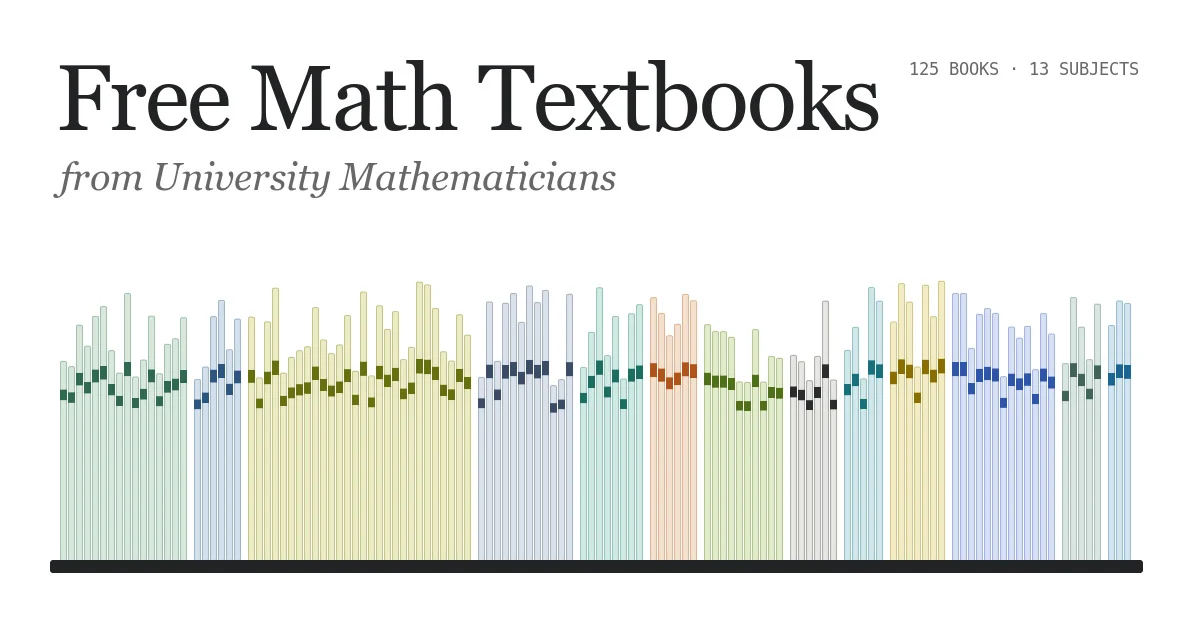
Planning high school with a self-motivated teen? Our self-learner’s roadmap maps the whole route book by book, and 125 free math textbooks covers every course from Algebra to Calculus at no cost.
The best curriculum is the one you’ll actually open every morning.
Choosing a curriculum
How to choose a homeschool math curriculum
The question every homeschool parent asks. There’s no single best one, but there’s almost always a best one for your kid.
Three questions narrow it down fast. How does your kid learn? (Deep and slow, lots of review, puzzles, hands-on.) Who’s going to teach? (You, a video, or your kid on their own.) What’s your budget? Answer those honestly, look at a couple of free samples, and you’re most of the way there.
Curriculum finder
Four questions, a shortlist
Stage
My kid…
Who does the teaching?
Faith-based content
Strong fits
Singapore Math
MasteryK–8 · $$ · Secular
Visual thinkers. Famous for its bar-model drawings and building understanding step by step.
Heads up: The student books are compact. If you’re nervous, get the teacher’s guide too.
See it on Amazon ↗Math Mammoth
Mastery1–7 · $ · Secular
Families on a budget. Written to the student, so many kids can work on it largely on their own.
Heads up: Lots of text and black-and-white pages. Hands-on kids may want some blocks alongside it.
See it on Amazon ↗RightStart Mathematics
MasteryK–5 · $$$ · Secular
Young kids. Built around an abacus, card games and lots of hands-on play.
Heads up: You lead every lesson, so it asks more of your time than workbook programs.
See it on Amazon ↗Math-U-See
MasteryK–12 · $$$ · Neutral
Parents who want a teacher on video and kids who learn with their hands, using the program’s own blocks.
Heads up: One topic per level is very focused; some families add extra word problems.
See it on Amazon ↗Also covers this stage: Saxon Math, Horizons Math, The Good and the Beautiful, Beast Academy, Teaching Textbooks, CTCMath, Khan Academy, Life of Fred.
A starting point, not a verdict. Look at the free samples and use the placement test.
13 popular programs, side by side
| Program | Style | Grades | Taught by | Cost | Best for | |
|---|---|---|---|---|---|---|
| Singapore Math | Mastery | K–8 | You | $$ | Visual thinkers. Famous for its bar-model drawings and building understanding step by step. | See it ↗ |
| Math Mammoth | Mastery | 1–7 | Self · You | $ | Families on a budget. Written to the student, so many kids can work on it largely on their own. | See it ↗ |
| Math-U-See | Mastery | K–12 | Video | $$$ | Parents who want a teacher on video and kids who learn with their hands, using the program’s own blocks. | See it ↗ |
| RightStart Mathematics | Mastery | K–5 | You | $$$ | Young kids. Built around an abacus, card games and lots of hands-on play. | See it ↗ |
| Saxon Math | Spiral | K–12 | You · Self | $$ | Kids who forget quickly. Small steps and daily review of everything learned so far. A homeschool classic. | See it ↗ |
| Horizons MathChristian publisher | Spiral | K–6 + Pre-Algebra | You | $$ | Kids who like colorful pages and variety. Fast-moving with lots of review. | See it ↗ |
| The Good and the BeautifulChristian publisher | Gentle | K–7 | You | $ | Open-and-go families who want something gentle, pretty and affordable. | See it ↗ |
| Beast Academy | Puzzle-first | 1–5 | Self · You | $$ | Curious, puzzle-loving kids. Comic-book lessons and genuinely hard problems. Books or online. | See it ↗ |
| Art of Problem Solving | Puzzle-first | Prealgebra → Calculus | Self | $$ | Strong, motivated students who love a challenge. Great for math-competition kids. | See it ↗ |
| Teaching Textbooks | Online | Elementary → Precalculus | Video · Self | $$ | Independent kids and parents who don’t want to teach math. Lessons on screen, grading done for you. | See it ↗ |
| CTCMath | Online | K–12 | Video · Self | $ | Big families: one subscription covers several kids. Short video lessons for every grade. | See it ↗ |
| Khan Academy | Online | K–12 | Video · Self | Free | Free. Short videos and practice for every topic. A solid spine for teens, or a backup for anything else. | See it ↗ |
| Life of Fred | Story | Elementary → College | Self | $ | Kids who think they hate math. A quirky story carries the lessons along. | See it ↗ |
Cost per child per year, roughly: $ under ~$100 · $$ ~$100–250 · $$$ $250+. Grades and prices change, so check the publisher.
Before you buy: a checklist
Beyond the curriculum
What else you’ll need
The curriculum is the core. These are the extras that actually get used: hands-on tools, games, books for you, and books your kids will read for fun.
You don’t need a closet full of stuff. A handful of well-chosen things, used often, beats a giant kit that sits in a cupboard. Here’s what’s worth having at each stage.
Elementary
Middle school
Games that sneak in real math
Books for you, the parent
Books your kids will read for fun
Homeschoolers call this “living math”: real stories where math is part of the adventure. Perfect for read-aloud time, car rides and kids who think math is boring.
Want projects instead of things to buy? Our DIY section has math you can build together from stuff you already own: a Galton board, a Menger sponge from business cards, or Napier’s bones. And for Friday afternoons, pick something from our 25 math documentaries or best math movies.
Money
What homeschool math costs
Anywhere from nothing to a few hundred dollars a year. Here’s what each budget gets you, and how to save.
Free
$0
- Khan Academy as the core
- Free textbooks for older kids
- Library picture books and math novels
- Homemade manipulatives: dried beans, paper strips, a deck of cards
Completely doable. You trade money for a bit more of your time to keep things organized.
Lean
under ~$100 a year
- A budget core like Math Mammoth or a used Saxon set
- A tub of linking cubes
- One or two math games
- Free videos for hard days
Where lots of families start. Used curriculum groups and resale sites are your friend.
Comfortable
~$100–250 a year
- A full program with a teacher’s guide (Singapore, Saxon, Beast Academy)
- A good manipulative kit
- A handful of games and living books
The sweet spot for most families: open-and-go, with everything you need on the shelf.
All-in
$250+ a year
- A video program like Math-U-See or a live online class
- Full manipulative kit
- A tutor for tricky topics or high school
Mostly what you’re paying for is someone else doing the teaching. Worth it if your time is tight.
Ballpark figures per child, per year. Prices change, so always check.
Ways to spend less
- $Buy used. Last year’s teacher’s guide works just as well, and many sell on for nearly what they paid.
- $Buy the teacher’s guide once, then only the student workbook for each younger sibling.
- $Use the placement test before buying, so you don’t pay for a level you’ll skip.
- $Start with free samples. Almost every publisher lets you download a few lessons.
- $One family subscription (like CTCMath) can be cheaper than separate books for three kids.
- $Your library has more math picture books and games than you’d think.
On a zero budget? Start with our 125 free math textbooks and the 17 best math YouTube channels. Plenty of families get all the way through high school this way.
Getting help
Online classes, tutors and co-ops
Bringing in help isn’t giving up. It’s one of the most common moves experienced homeschoolers make, usually around algebra.
It might be time if any of these sound familiar:
- The same topic has been stuck for over a month, even after trying a different approach
- Math time is hurting your relationship with your kid
- Your teen has reached material you can’t check yourself
- You’re running on empty and need your evenings back
Video curriculum
A teacher on screen, practice and often automatic grading.
Good for: Parents who don’t want to teach math themselves.
Live online class
Scheduled classes with a real teacher, classmates and deadlines.
Good for: Teens who need structure, especially from Algebra 2 on.
Tutor
One-to-one, in person or online, often an hour a week.
Good for: A stubborn topic, test prep, or a teen beyond your comfort zone.
Co-op class
A group of homeschool families shares the teaching, once or twice a week.
Good for: Kids who miss a group, and parents who need one subject off their plate.
Community college
Dual enrollment: real college courses that count for high school and college credit.
Good for: Older teens ready for Precalculus, Statistics or Calculus.
Math circle or club
Problem-solving sessions just for the fun of it.
Good for: Curious kids who need more than the book offers.
Big families
Teaching math to several kids at once
Three kids, three levels, one of you. It works, as long as nobody is ever sitting around waiting.
Stagger, don’t stack
Give each kid a 15–20 minute slot with you while the others do independent work, reading or a game. Rotate. Nobody waits around.
Older kids go independent
Your time is the scarcest thing in the house. Video or student-led programs for the older ones free you up for the little ones, who need you most.
Do some things together
Games, a measuring project, a documentary on Friday. Everyone joins in at their own level, then goes back to their own book.
Let big kids teach little kids
Explaining something is the best way to learn it. Everybody wins.
One box per kid
Today’s work ready in a box or folder. When they finish, they know what’s next without asking.
Same time every day
When math is always right after breakfast, it stops being a negotiation.
A sample morning with three kids
Proof of progress
Tests, records and high school transcripts
No report cards? No problem. A few simple habits show what your kid has learned, keep you covered, and make college applications easy.
Keep a few samples
A piece of work from the start, middle and end of each year. Simple, and it makes progress visible to everyone.
Log what you did
Which book, which chapters, roughly how many days. Ten seconds a day in a planner or spreadsheet is plenty.
Save tests and quizzes
Especially in middle and high school. They’re your proof and your grade book.
A yearly check
A standardized test or an end-of-level placement test. Use it as a map of gaps, not a judgment.
Need a template? The free printable planner includes a daily lesson log and a high school math record.
What goes on a high school transcript
Outside proof colleges like to see
SAT or ACT
The standard college admission tests. Most students take one in junior year.
CLEP exams
Pass one exam, get college credit. College Algebra is a popular one.
AP exams
Homeschoolers can sit them by arranging a seat at a participating school.
Dual enrollment
Community college math classes count twice: for high school and for college.
You don’t need all of these. One or two pieces of outside proof next to a clear transcript is usually more than enough.
Troubleshooting
When it gets hard
Every homeschooling family hits a wall in math at some point. It’s part of the process, not a sign you’re failing.
My kid cries or shuts down at math time.
Stop the lesson, not the relationship. For a couple of weeks, cut lessons in half, start with something they can already do, and end on a win. Tears usually mean the work is a step too far ahead, so quietly go back a level.
We’ve been stuck on the same thing for weeks.
Try a different way in: a video, a game, real objects, a drawing. If it still won’t click, park it for two weeks and do something else. It’s surprising how often it makes sense when you come back.
I don’t understand the lesson myself.
Watch a short video on it before your kid does, or do the first few problems the night before. And it’s okay to say “I don’t know, let’s find out together.” That’s a great lesson on its own.
We’re behind where school would be.
There’s no bell. A solid foundation matters far more than the grade printed on the book. Lots of homeschooled kids take longer on arithmetic and then move through algebra faster because of it.
They’re racing ahead and getting bored.
Go deeper before going faster: harder problems at the same level, a puzzle-first program like Beast Academy, competitions, or a great popular math book.
This curriculum isn’t working. Should we switch?
Give any program six to eight weeks first. If it’s still a struggle, switching mid-year is completely fine. Use the new program’s placement test so you start at the right level.
Math is a fight every single day.
Change something about the setting: a different time, a different room, a timer for 20 minutes and not a minute more. If it’s still a battle, hand math to a video course or a tutor for a term and protect the relationship.
I think my kid might have a learning difficulty.
If basic number sense is still a real struggle long after it should have clicked, talk to your doctor or an educational psychologist about an assessment for dyscalculia. In the meantime: slower pace, more hands-on, short daily practice. Many kids do really well with the right support.
Math anxiety, yours and theirs
If it’s you
- Relearn it alongside them. It’s surprisingly fun the second time around.
- Never say “I’m bad at math” in front of them. Try “I haven’t figured this one out yet.”
- Use the answer key without guilt. Checking is part of math.
- Hand the topics that scare you to a video or a tutor. That’s good teaching, not failure.
If it’s your kid
- Drop the timer. Timed drills are the most common trigger of math anxiety.
- Start every lesson with something they can already do.
- Praise effort and strategies, not speed or being “smart.”
- Make mistakes normal, even funny. Make some yourself.
- Shorter sessions for a while. Ten calm minutes beat forty tearful ones.
Free stuff
Free math resources for homeschoolers
You can homeschool math well on a tiny budget. These are the best free things we know of, all collected on Abakcus.
Questions parents ask
Homeschool math FAQ
Short, honest answers to the questions we hear most.
Can I homeschool math if I’m not good at math?
Yes. A good curriculum does the explaining; your job is a steady routine, patience and checking the work. Choose a program with a scripted teacher’s guide or video lessons, stay one lesson ahead, and bring in an online class or tutor for high school if you need to.
Do I have to teach math if I homeschool?
In practice, yes. Homeschooling is legal in all 50 US states, and in the states that list required subjects, math is almost always one of them. Some states also ask for a yearly test or evaluation. Check your own state’s homeschool law, since the rules vary a lot.
How long should homeschool math take each day?
Roughly 15 to 20 minutes for ages 5 to 7, 30 to 40 minutes for ages 8 to 10, 45 to 60 minutes for middle school and about an hour for high school. Short daily lessons work much better than long weekly ones.
What is the best homeschool math curriculum?
There isn’t one best program, only the best fit. Mastery programs like Singapore Math or Math Mammoth suit kids who like depth, spiral programs like Saxon suit kids who need lots of review, video programs like Teaching Textbooks suit parents who don’t want to teach, and Beast Academy suits puzzle lovers. Use the placement test and give it six to eight weeks.
How much does homeschool math cost?
Anywhere from free to a few hundred dollars per child per year. You can do it for free with Khan Academy and library books, for under about $100 with a budget program and a few manipulatives, or spend more on video programs, online classes and tutors.
Should I choose a mastery or a spiral math curriculum?
Mastery programs stay on one topic until it’s solid; spiral programs revisit many topics in small doses. If your kid likes depth and remembers well, try mastery. If they forget quickly, try spiral, or add a few review problems each day to a mastery program.
Do I need to buy math manipulatives?
For young kids they really help, but you don’t need much. A tub of linking cubes, some base ten blocks and fraction tiles cover most of elementary school, and dried beans or LEGO bricks work in a pinch.
Will colleges accept homeschool high school math?
Yes. Colleges regularly admit homeschooled students. A clear transcript with course names, grades and credits, plus outside proof such as SAT or ACT scores, AP or CLEP exams, or community college classes, makes their decision easy.
Can we switch math curriculum in the middle of the year?
Absolutely. Give the current one a fair six to eight weeks first, then use the new program’s placement test so you start at the right level. Many families switch at least once before finding their fit.
What if my child is behind in math?
Use a placement test to find where the foundation is solid, start there even if it’s below grade level, and move quickly through review. Filling gaps now saves years of struggle later, and homeschooling gives you the time to do it.
One last thing
You’ve got this.
Years from now, your kid won’t remember which curriculum you picked or how many worksheets they did. They’ll remember whether math felt like something they could figure out, and whether you were sitting next to them when they did.
So start small. Check your state’s rules, pick one program, give the placement test, and choose a time of day. The rest you’ll figure out together, one lesson at a time.