Ages 5–8
Sum Swamp
Learning Resources
Adding · subtracting
A board game where you roll number and operation dice to move through the swamp. Kids do dozens of sums without noticing. Perfect for early addition and subtraction.
See it on Amazon ↗
A good game can do in twenty minutes what a worksheet can’t do in a week: make kids want more math. These are the ones homeschool families keep coming back to, sorted by age.
Some links on this page are affiliate links. If you buy through them, Abakcus earns a small commission at no extra cost to you. It never changes what we recommend.
Math games are the secret weapon of homeschool. They give you fact practice without the groans, they build strategy and logic, and they turn Friday into the day everyone looks forward to.
None of these replace a curriculum, and they don’t need to. Use them for the fifth day of the week, for the after-dinner slot, or for the days when a lesson falls apart and everyone needs a reset. Every one below teaches something real.
Start here
If you only buy a few games, start here. Together they cover ages 5 to adult.
Counting, adding and recognizing numbers, all while having fun.
Learning Resources
Adding · subtracting
A board game where you roll number and operation dice to move through the swamp. Kids do dozens of sums without noticing. Perfect for early addition and subtraction.
See it on Amazon ↗Gamewright
Simple addition · strategy
A card game invented by a six-year-old, about waking up sleeping queens. You play cards that make simple addition sentences. Funny, quick, and genuinely strategic.
See it on Amazon ↗Number recognition · matching
The classic color-and-number matching card game. Great for the youngest players: recognizing numbers, matching and turn-taking.
See it on Amazon ↗Counting · matching · adding
Classic tiles with dot patterns. Little kids learn to recognize dot patterns at a glance. Older kids can play adding games.
See it on Amazon ↗Number bonds · strategy
Roll two dice and flip down tiles that add up to the total. A sneaky way to practise number bonds. Kids keep looking for combinations that make 9.
See it on Amazon ↗Multiplication, strategy and logic, with games the whole family enjoys.
Math for Love
Multiplication · primes
A colorful board game where you add, subtract, multiply and divide to race to 101. Every number is colored by its factors, so kids start seeing primes and multiples everywhere. Adults enjoy it too.
See it on Amazon ↗Adding · probability
The classic five-dice game. Adding, multiplying and early probability (“should I go for the large straight?”).
See it on Amazon ↗Spatial thinking · strategy
Place colored pieces on a grid, corner to corner. Builds spatial reasoning, which predicts later success in geometry and STEM.
See it on Amazon ↗Sequences · grouping
Number tiles you arrange into runs and sets. Number patterns, flexible thinking and planning ahead.
See it on Amazon ↗Patterns · adding scores
Match tiles by color or shape. Pattern spotting, plus surprisingly good mental math when you add up your score.
See it on Amazon ↗Planning · logic · focus
The original strategy game. Thinking several steps ahead is the same muscle as solving a multi-step problem.
See it on Amazon ↗Logic, deduction and mental math for kids who like a real challenge.
Logic · patterns
A fast card game about spotting sets of three. Pure logic and pattern recognition. Kids often beat adults, which they love.
See it on Amazon ↗Deduction
Crack the hidden color code. Teaches careful reasoning from evidence, which is exactly what proofs are.
See it on Amazon ↗All four operations
Make 24 from four numbers on a card. The ultimate mental math workout, and very addictive once kids get going.
See it on Amazon ↗Arithmetic · logic
Grid puzzles like sudoku, with arithmetic clues. Practice with all four operations, disguised as a puzzle.
See it on Amazon ↗ThinkFun
Logic · planning
A single-player sliding car puzzle. Step-by-step planning and problem solving. Great for independent quiet time.
See it on Amazon ↗No shopping needed. A regular deck of cards is a full math kit.
Make 10
Lay out cards face up. Find pairs that add to 10. Great for number bonds (ages 5–7).
Addition war
Each player flips two cards and adds them. Highest sum wins the cards (ages 6–9).
Multiplication war
Same game, but multiply. Instant times-table practice (ages 8–11).
Salute
Two players put a card on their forehead without looking. A third says the product. Who can work out their card first? (ages 8+)
Integer war
Black cards are positive, red are negative. Add them up. The best way to make negatives make sense (ages 10+).
Closest to 100
Deal six cards, make two 2-digit numbers that add closest to 100 (ages 8+).
Family favorites include Sum Swamp and Sleeping Queens for young kids, Prime Climb and Yahtzee for elementary ages, and Set, Mastermind and the 24 Game for older kids. A plain deck of cards also makes dozens of free math games.
Not usually. Games are brilliant for practice, motivation and logic, but most families use them alongside a core curriculum rather than instead of it.
Many homeschool families do one game day a week, often on Friday, plus quick card games whenever there’s a spare ten minutes.
Prime Climb, Multiplication War with a deck of cards, Salute, Yahtzee and the 24 Game are all great for multiplication practice.
Keep wandering
A few more pieces in the same spirit — math, design, and slow attention.
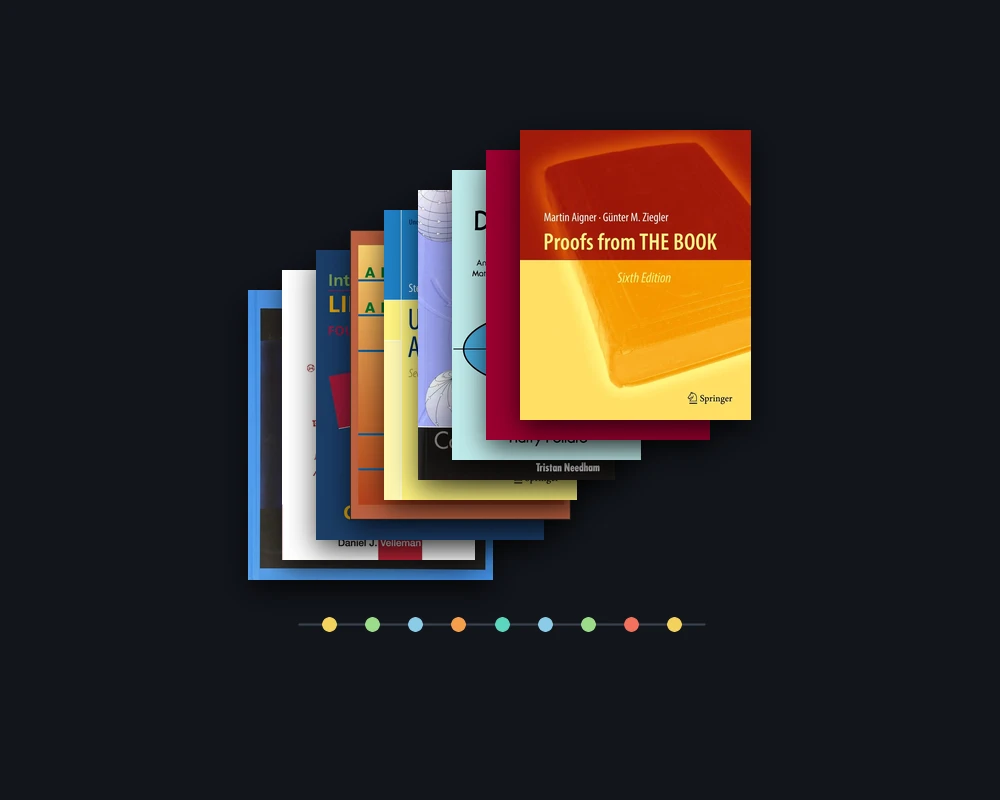
How to Learn Mathematics: A Self-Study Roadmap
A course-by-course, book-by-book roadmap for learning undergraduate mathematics on your own, with a prerequisite map, a readiness check and a study planner.
Open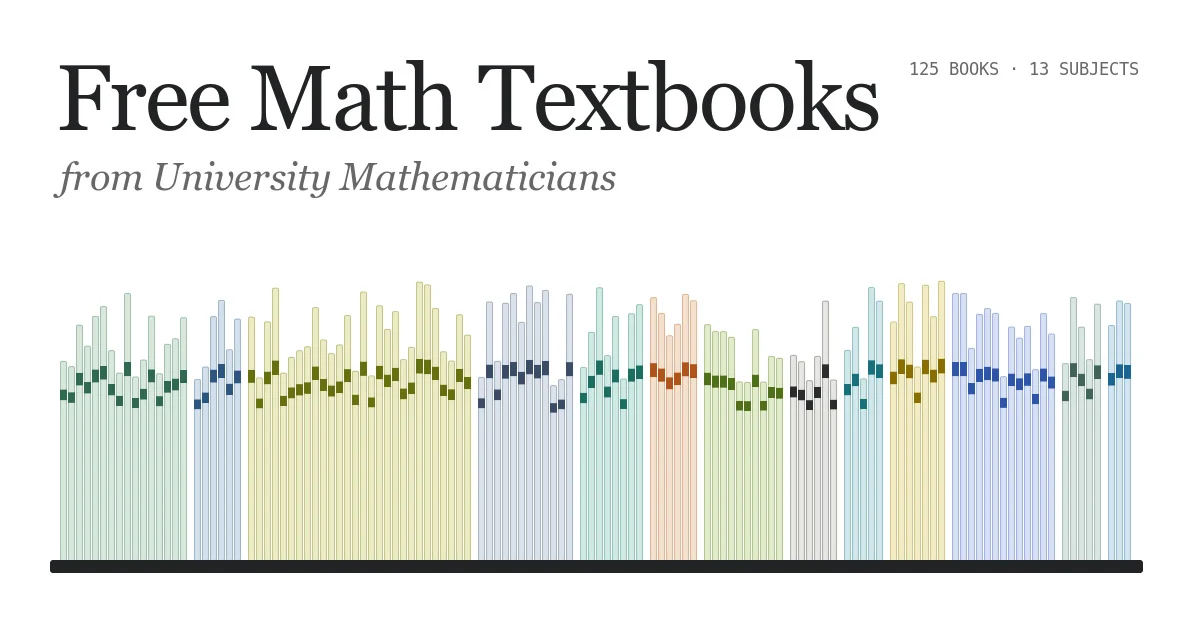
Free Math Textbooks from University Mathematicians
125 textbooks that mathematicians give away on their own pages, from high school algebra to graduate analysis, sorted by subject, level and format.
Open
A Self-Learner's Roadmap Through 30+ Great Math Books
Not a pile of recommendations. A path — the order to read in, the choices to make, and the places people quietly give up.
Open
25 Beautiful Math Documentaries to Make Students Love Mathematics
A Trip to Infinity, The Proof, N Is a Number — 25 documentaries that show the other face of mathematics: obsession, beauty, and the particular madness of chasing a question.
Open
The Feynman Technique: A Complete Guide
The four-step learning method developed by Nobel Prize-winning physicist Richard Feynman. How it works, why it works, and how to apply it to anything.
Open
Free Math Courses on Coursera: The 26 Worth Taking
Twenty-six Coursera math courses from Stanford, Penn, Imperial and Johns Hopkins, sorted into a curriculum, with what free really means on Coursera now.
Open