Some links on this page are affiliate links. If you buy through them, Abakcus earns a small commission at no extra cost to you. It never changes what we recommend.
The big picture
You’re the project manager now
Real courses, real credits, and outside help for the lessons. Your job is the plan.
High school math is where many families think homeschooling has to end. It doesn’t. Very few homeschool parents teach Algebra 2 or Precalculus themselves. They choose a good video course, an online class, a tutor or a community college class, and they manage the plan.
Managing the plan means four things: choosing the sequence of courses, keeping a steady weekly schedule, keeping grades and records for the transcript, and planning outside tests that show colleges what your teen knows.
It’s also a stage where you can tailor things in a way schools can’t. A STEM-bound teen can race to calculus. A teen headed elsewhere can do the essentials well and add practical statistics or personal finance.
Your role
Project manager. Choose the courses, set weekly targets, keep the grades and credits, and plan for tests like the SAT, ACT, CLEP, AP or dual enrollment.
Daily time
About an hour a day, five days a week
The courses
The high school math courses
The building blocks most transcripts are made of. Each is usually a year-long course worth one credit.
- Linear equations and inequalities
- Graphing lines
- Systems of equations
- Exponents
- Polynomials and factoring
- Quadratics
Don’t panic: This course is the foundation for everything after it. If it needs a year and a half, give it a year and a half.
- Proofs and logic
- Triangles and congruence
- Similarity
- Circles
- Area and volume
- Intro trigonometry
Don’t panic: Proofs feel strange at first to almost every student. They get easier with practice.
- Functions
- Quadratics in depth
- Exponential and logarithmic functions
- Polynomials
- Sequences
- Intro statistics
Don’t panic: Most colleges want to see this course. It’s also the most common point to bring in outside help.
- Trigonometry
- Advanced functions
- Vectors
- Limits (intro)
- Polar coordinates
Don’t panic: Needed for STEM paths. Optional for many others.
- Calculus: limits, derivatives, integrals
- Or Statistics: data, probability, inference
Don’t panic: Often taken as AP or dual enrollment. Statistics is a great choice for non-STEM teens.
Planning four years
Three common course sequences
Pick the path that fits your teen. You can change lanes later.
Standard
Most college-bound teens
- 9Algebra 1
- 10Geometry
- 11Algebra 2
- 12Precalculus or Statistics
Accelerated
Algebra 1 done in 8th grade; STEM-minded
- 9Geometry
- 10Algebra 2
- 11Precalculus
- 12Calculus (AP or dual enrollment)
Steady
Teens who need more time, or aren’t math-focused
- 9Pre-algebra or Algebra 1 (part 1)
- 10Algebra 1
- 11Geometry
- 12Algebra 2, Statistics or Personal Finance
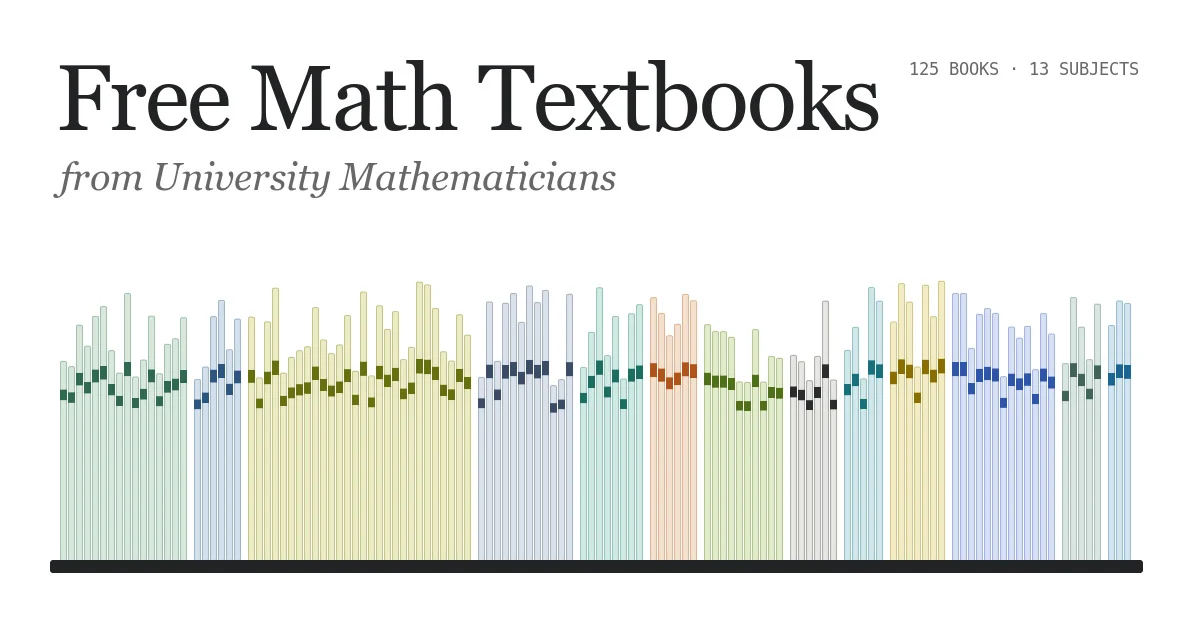
For a self-motivated teen, our self-learner’s roadmap lays out the whole route book by book, and 125 free math textbooks covers every one of these courses at no cost. When trigonometry arrives, the unit circle guide and Calculus Made Easy are good friends to have.
Paperwork, made simple
Credits and the transcript
It sounds official and scary. It’s really a one-page table you fill in as you go.
What the math part of a transcript looks like
| Year | Course | Grade | Credit |
|---|---|---|---|
| 8th | Algebra 1 | A | 1.0 |
| 9th | Geometry | B+ | 1.0 |
| 10th | Algebra 2 | A− | 1.0 |
| 11th | Precalculus (dual enrollment) | A | 1.0 |
| 12th | Statistics | A | 1.0 |
An example only. Your teen’s will look different.
Outside proof
Tests, and when to take them
Outside scores back up your transcript. Here’s a simple year-by-year plan.
9th
- Start the transcript and gradebook
- Pick the four-year sequence
- Optional: PSAT 8/9 for practice
10th
- Optional: PSAT 10 for practice
- Consider a first CLEP exam
- Look into dual enrollment options near you
11th
- PSAT/NMSQT in October (arrange through a local school)
- SAT or ACT in the spring
- AP or dual enrollment math if on the fast track
12th
- Retake SAT/ACT in the fall if needed
- Finish transcript and course descriptions
- Send scores and transcripts with applications
SAT / ACT
The main college admission tests. Many colleges are test-optional, but a good score is strong proof for a homeschooler.
CLEP
One exam, real college credit. College Algebra and Precalculus are popular. Check that target colleges accept it.
AP exams
Homeschoolers can sit them at a participating school. Contact schools early, usually by the fall.
Dual enrollment
A community college math class counts for high school and college. Often the strongest proof of all.
Day to day
Your role, day to day
It looks more like managing a project than teaching a class.
On a typical day your teen does a lesson (video, textbook or live class), works the problem set, and corrects their mistakes. You check that it happened, look over the work or the gradebook, and keep the weekly target on track.
Once a week, sit down for 15 minutes: what was covered, what was hard, what’s next. Keep test scores in a gradebook as you go. It makes the transcript easy later.
A typical week
- MonLesson and full problem set
- TueLesson, problem set, corrections from Monday
- WedLesson, problem set, a few review problems
- ThuLesson and problem set
- FriQuiz or test, then a 15-minute weekly check-in
Set weekly targets
“Lessons 41–45 by Friday” works better than “do some math.” Teens like knowing the finish line.
Grade from tests
Use the program’s tests and answer keys. Keep scores in a simple spreadsheet for the transcript.
Plan the year in August
Know which course, which resource, and roughly how many lessons per week to finish on time.
Don’t be the only safety net
Know where your teen can get help: a tutor, a forum, a video channel, an online class teacher.
You don’t teach it. You run it.
What to use
The best homeschool math curricula for high school
At this stage, look for complete courses with clear lessons, solutions and tests, so you don’t have to teach.
Teaching Textbooks
Online · $$Algebra 1 through Precalculus, taught and graded on screen. Very parent-friendly.
Saxon Math
Spiral · $$Algebra 1, Algebra 2, Advanced Math and Calculus. Thorough, with tests built in.
Art of Problem Solving
Puzzle-first · $$The rigorous path for STEM-minded and competition kids, with optional online classes.
CTCMath
Online · $Video lessons for every course, one family plan.
Khan Academy
Online · FreeFree courses from Algebra 1 to Calculus and Statistics.
Beyond the book
Supplies and books for high school
Two key tools, test prep, and a couple of books that make teens see math differently.
Worth having
Games for this age
Books they’ll read for fun
Honest answers
The worries every high school parent has
The big questions, answered honestly.
Will colleges accept homeschool math?
Yes. Colleges regularly admit homeschoolers. Give them a clear transcript with course names, grades and credits, and back it up with outside proof like SAT/ACT scores, CLEP or AP exams, or community college classes.
How many years of math does my teen need?
Most colleges expect at least Algebra 1, Geometry and Algebra 2. Selective colleges and STEM programs usually want four years, including Precalculus or Calculus.
I can’t teach Algebra 2. What do I do?
You don’t have to. Use a video course, an online class, a tutor, or a community college class. Your job is the schedule and the records.
How do I grade high school math?
Use the curriculum’s tests and quizzes as most of the grade, plus homework completion. Keep the scores. Colleges mostly care that grading is consistent and backed by outside scores.
My teen hates math. Do they really need all this?
They need the essentials done well. For non-STEM teens, Algebra 1, Geometry, Algebra 2 and then Statistics or personal finance is a strong, sensible path.
What is dual enrollment?
Your teen takes a real college course, often at a community college or online, and it counts for both high school and college credit. It’s great outside proof for math.
Looking ahead
After high school
The finish line: what to have ready by senior year.
- ✓A transcript listing every math course, year, grade and credit
- ✓Short course descriptions naming the curriculum used
- ✓SAT or ACT scores (if colleges ask for them)
- ✓Any CLEP, AP or dual enrollment results
- ✓A gradebook or test file to back it all up
That’s the whole package. Many homeschooled teens graduate with college math credit already in hand through CLEP or dual enrollment, which saves real money. And if a younger sibling is just starting out, the elementary guide is waiting.
Questions parents ask
Frequently asked questions
Short, honest answers.
What is the typical homeschool high school math sequence?
The most common path is Algebra 1, Geometry, Algebra 2, then Precalculus or Statistics. Students who take Algebra 1 in 8th grade can often reach Calculus by senior year.
How many math credits does a homeschooler need for college?
Most colleges expect at least three years of math through Algebra 2. Selective colleges and STEM programs usually prefer four, including Precalculus or Calculus.
How do I give homeschool math credits?
A year-long course of roughly 120 to 180 hours of work is usually one credit. Record the course name, the year, the grade and the credit on the transcript, along with a short course description.
Can homeschoolers take AP exams?
Yes. Homeschoolers can take AP exams by arranging to test at a participating school in their area. Contact local schools early, usually by the fall.
What is CLEP and is it worth it for math?
CLEP exams let students earn college credit by passing a single test. College Algebra and Precalculus are popular choices for homeschoolers. Check that the colleges your teen is considering accept CLEP credit.
Keep going
Everything else, in one place.
State rules, daily rhythm, costs, outside help, and what to do on the hard days are all in the full parent guide.