Mathematics · YouTube
Five YouTube Channels That Make You Love Mathematics
In 1994, Andrew Wiles announced that he had solved a problem that had gone unsolved for 358 years. Fermat’s Last Theorem. Most of the journalists in the room had no idea what it meant. But everyone noticed that Wiles was crying. On camera, mid-sentence, his voice breaking. A man who had worked alone for years, telling almost no one — and it was finally over.
Mathematics has a side that looks nothing like what most of us experienced in school. From the outside, it looks like formulas to memorize, exams to survive, symbols standing on a board that seem to belong to someone else’s world. From the inside, it’s something else entirely: questions worth chasing for a lifetime, problems that swallow hours whole, and a particular kind of relief when something finally clicks — felt physically, not just understood.
Every channel on this list shares one preoccupation: showing that mathematics doesn’t look the way it looks from the outside. Some do it with animations. Some with a pen and brown paper. Some from a classroom where students ask the wrong questions in exactly the right ways. But in all of them you sense the same thing — that the person talking genuinely believes in what they’re showing you. None of these channels were built around the idea of teaching mathematics. They were built by people who loved it first, and only then turned the camera on.
“The person talking isn’t there for you. They’re there for the subject. That small difference changes everything.”
A fair warning: if you open any of these channels intending to watch just one video, don’t be surprised to find yourself still there half an hour later.
Numberphile
Numbers · CuriosityBrady Haran is a journalist. Not a mathematician. And that’s precisely what makes Numberphile different from everything else.
In each video, Haran sits down with a mathematician and asks a single question: can you explain this to me? Brown paper comes out, a pen appears, and someone from Cambridge or Oxford starts getting lost inside numbers. Why 42 is so peculiar. The existence of infinities of different sizes. The strange regularity hiding inside the distribution of prime numbers. The topics are chosen so that every one of them leaves you thinking: I never thought about this before, and now I can’t think about anything else.
Numberphile’s secret isn’t production — it’s selection. A journalist who knows which questions are worth asking, paired with a mathematician who still finds the answers genuinely exciting. Everything else follows.
www.youtube.com/@numberphile ↗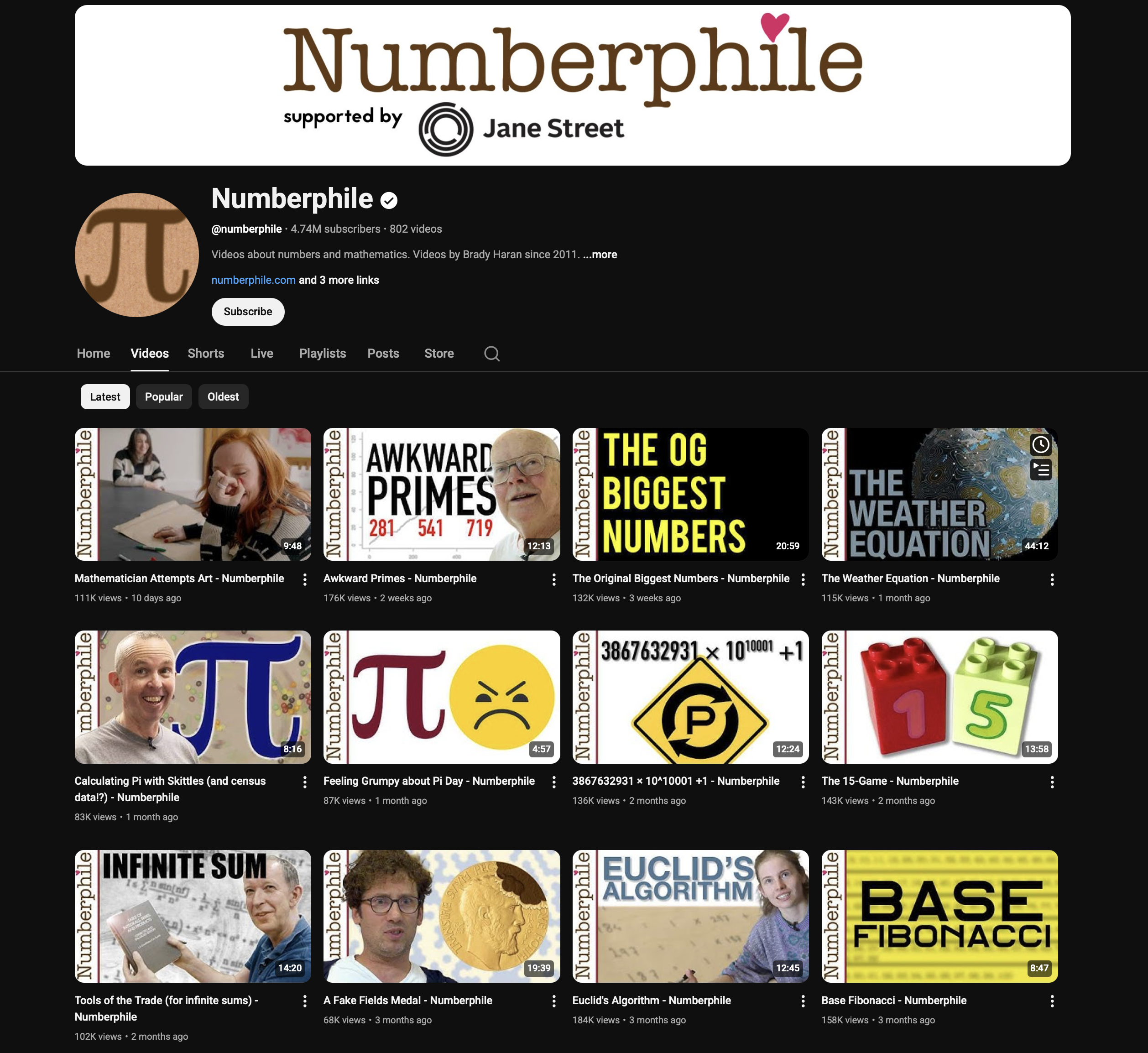
3Blue1Brown
Visualization · IntuitionGrant Sanderson believes in something: that genuinely understanding a piece of mathematics is a completely different experience from memorizing a formula. To prove it, he taught himself to write animations.
The videos on 3Blue1Brown are built around making abstraction visible. What is a derivative — not symbolically, but as something that moves? What is a Fourier transform actually doing? What does the determinant of a matrix mean geometrically? Most textbooks answer these questions with definitions. Sanderson builds each one from scratch, spending hours on animations, until the viewer reaches the moment: I should have always seen it this way.
The channel’s name looks arbitrary until you learn that Sanderson has one blue eye and one brown. A small detail — but it says something about the kind of person who finds meaning in everything, including his own name.
www.youtube.com/@3blue1brown ↗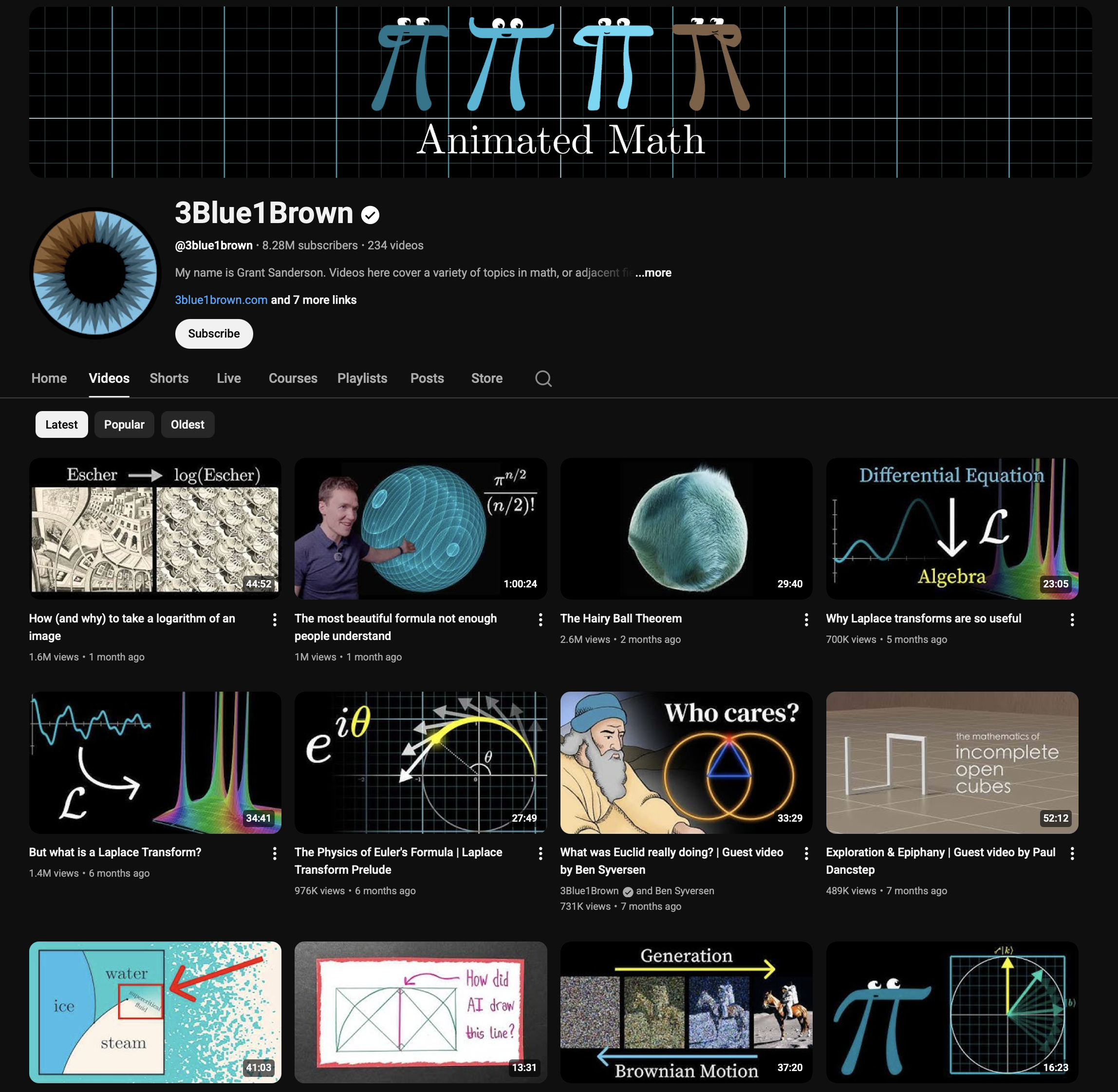
Eddie Woo
Classroom · HumanEddie Woo is a high school teacher. The reason he started his channel in 2012 is not remarkable: a student was sick and missing class, so he set up a camera to record the lessons. Then he never stopped.
Woo’s videos aren’t polished. The audio is imperfect, the whiteboard is worn, student voices drift in from the background. But Woo does one thing exceptionally well: he turns wrong answers into the lesson. When a student misunderstands something, he pauses. He asks, “interesting — why did you think that?” And then he builds the correct idea out of the misunderstanding itself. Watching this happen is more instructive than any textbook chapter on pedagogy could be.
Especially for anyone who grew up thinking a great mathematics teacher was something other people got.
www.youtube.com/@misterwootube ↗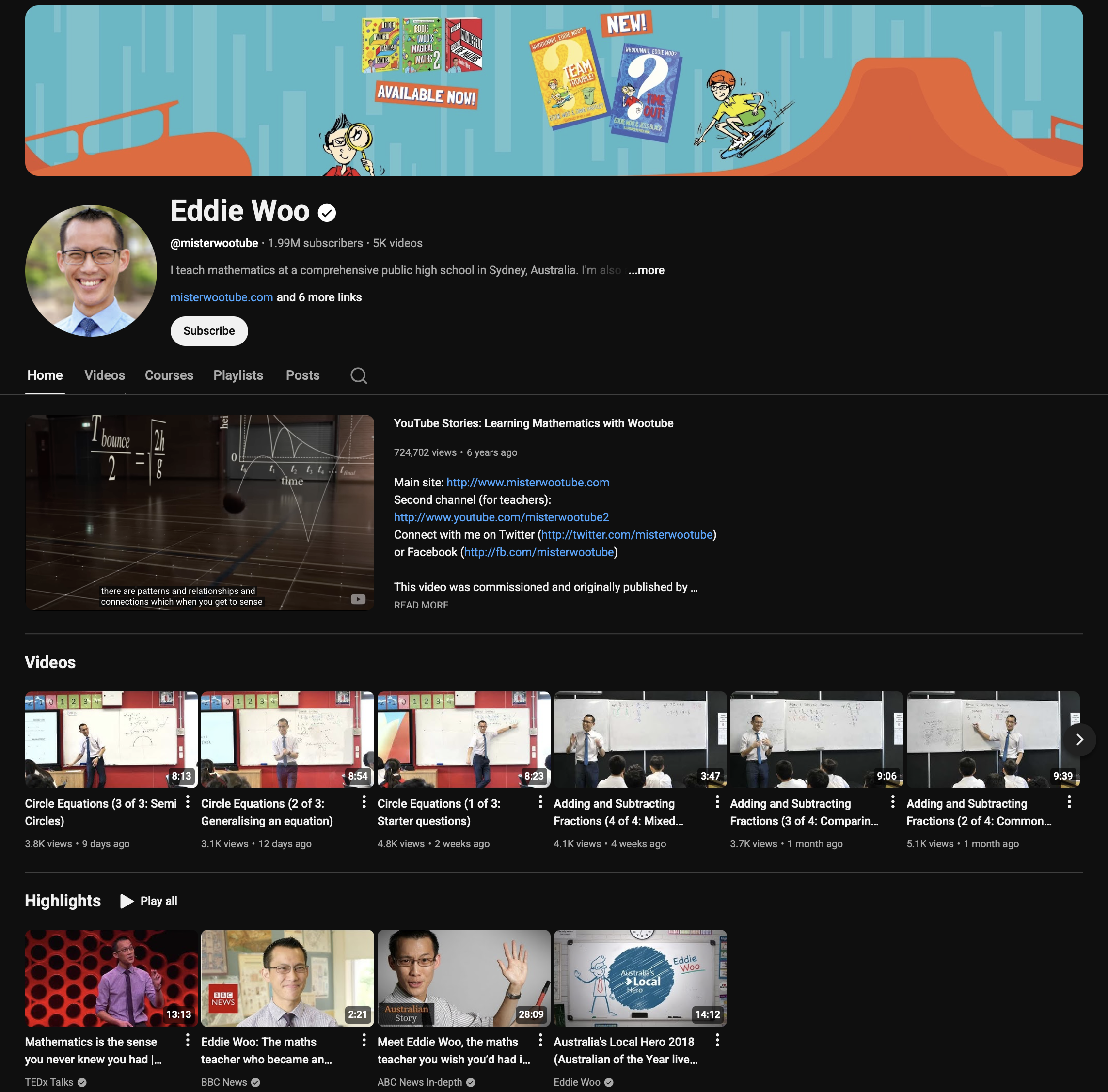
Socratica
University · DepthSocratica is for the people who keep asking: what comes after this?
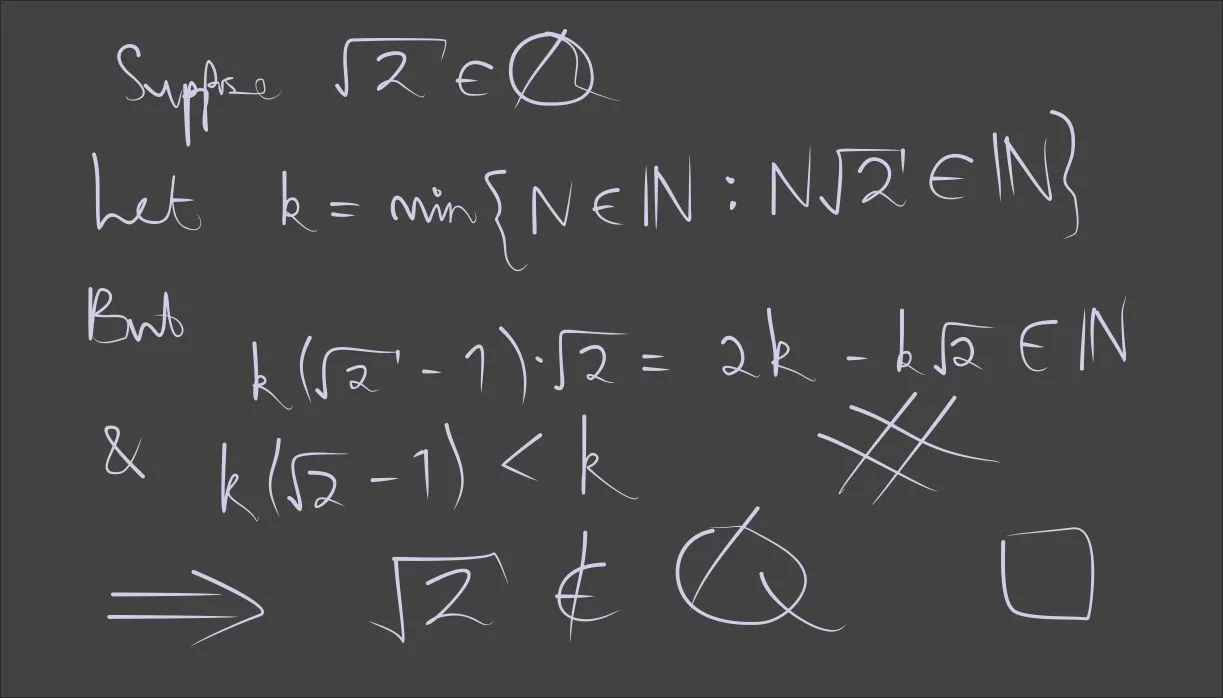
Where most resources stop — at the end of secondary school mathematics — Socratica continues. Abstract algebra, number theory, topology: subjects that usually live inside thick university textbooks or impenetrable academic papers. Socratica translates them into short, carefully made videos. Nothing is skipped. Every definition is stated. Every example is chosen deliberately. Each step rests on the one before it. If the irrationality of √2 once felt like a trick, here it becomes a consequence.
The tone is quieter than most channels here — less dramatic, more methodical. But that’s not a weakness. Some things are understood not through excitement, but through patience. Socratica knows the difference.
www.youtube.com/@Socratica ↗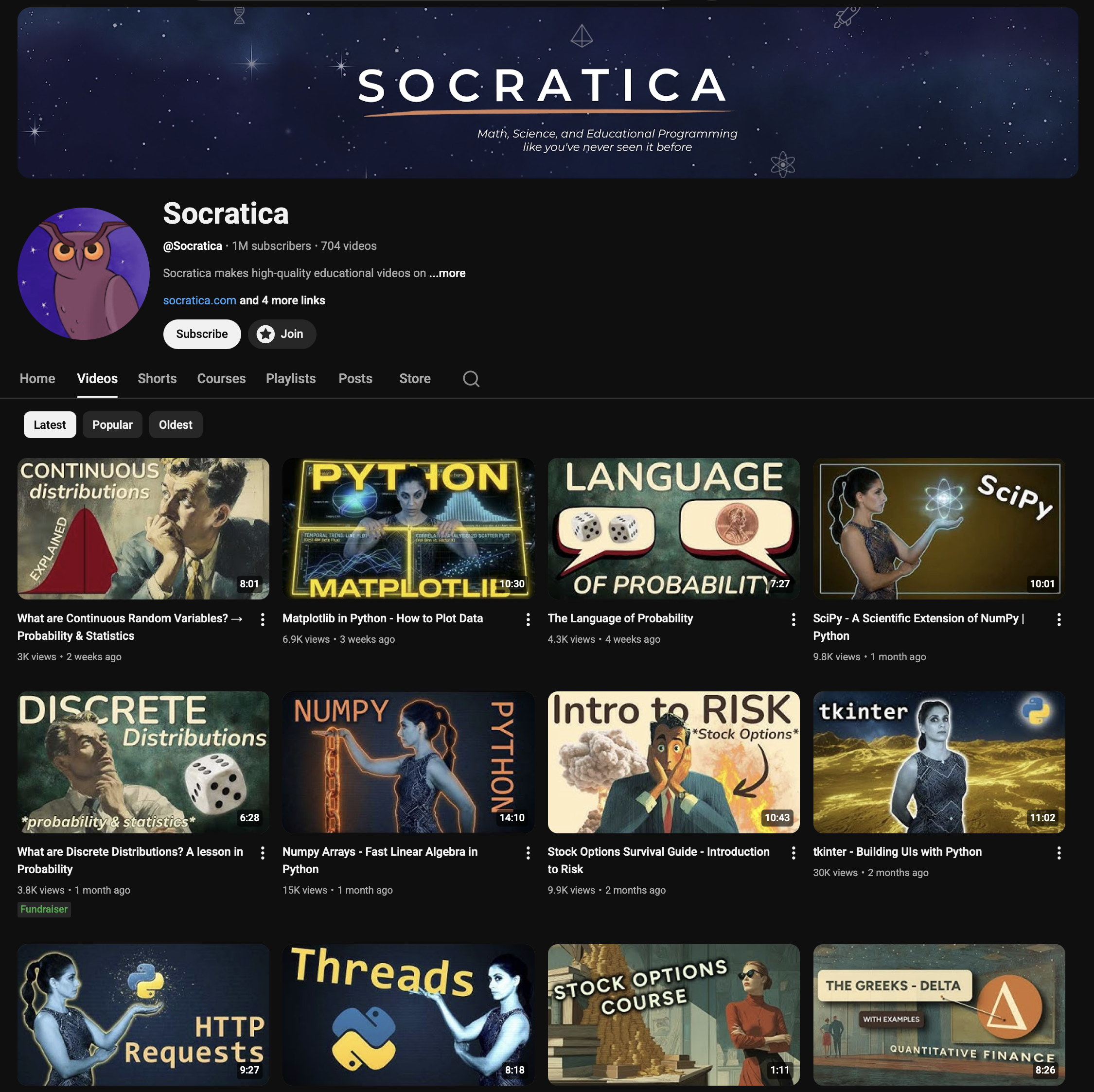
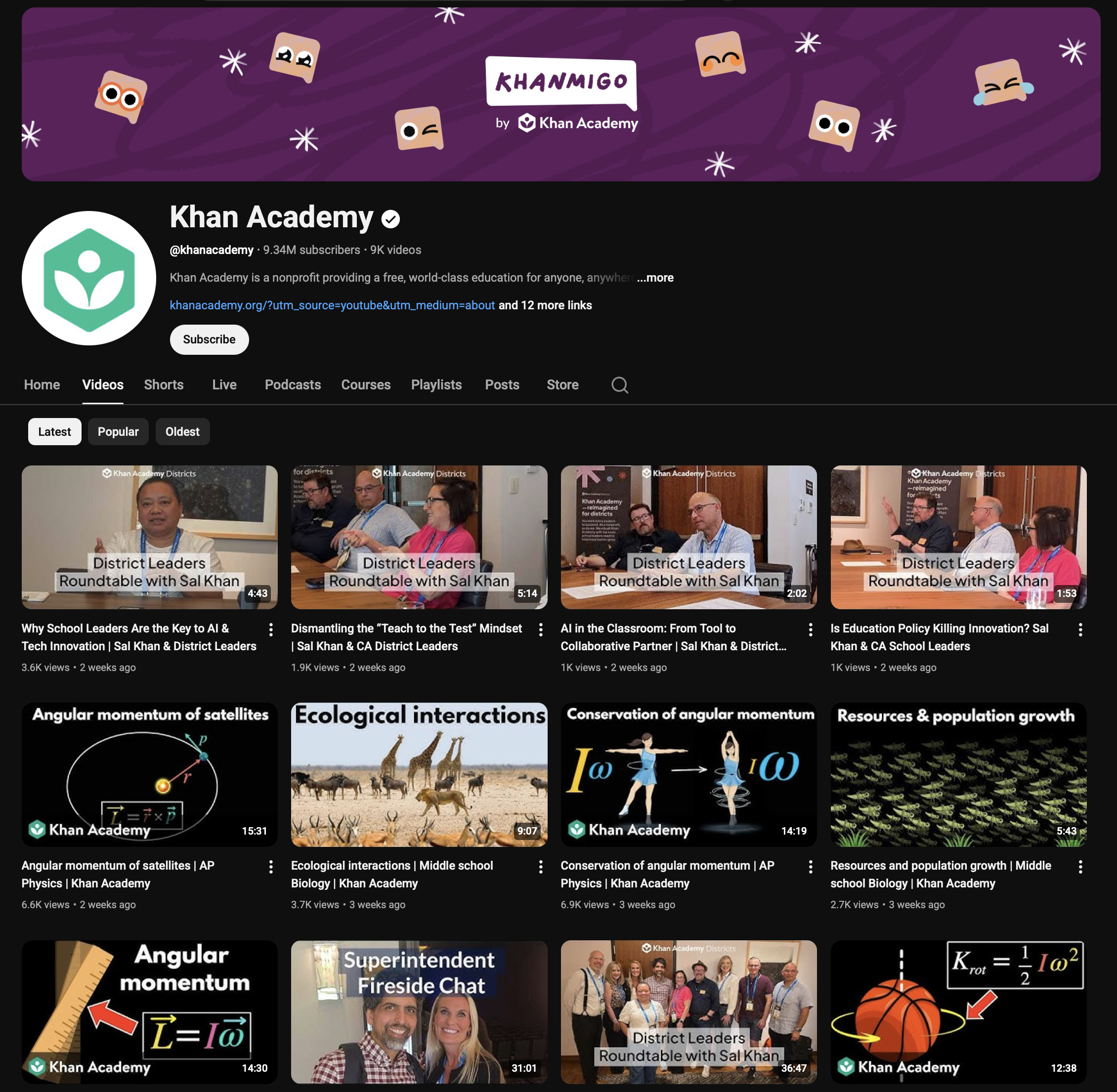
Khan Academy
Foundation · ReliableIn 2004, Sal Khan started recording videos to help a cousin who lived far away. When the cousin said she preferred the videos to the live sessions, he understood something: perhaps everyone could learn this way. Khan Academy is now one of the largest free educational platforms on earth.
What separates Khan Academy from everything else on this list is its nature: it isn’t a place for discovery, it’s infrastructure. From basic arithmetic to differential equations, everything is here — step by step, patiently, with nothing assumed and nothing skipped. For returning to a topic you haven’t touched in years, for going back to the point where something stopped making sense, or for starting entirely from scratch — it remains the most reliable address there is.
No spectacle. But there’s a reason it’s still here after more than twenty years.
www.youtube.com/user/khanacademy ↗