In the spring of 1617, at Merchiston Castle just outside Edinburgh, a bedridden man was reviewing the proofs of his last book. John Napier was sixty-seven, gout was finishing him off, and he had no idea that the two inventions he was leaving behind would change mathematics forever. The first was the logarithm, published three years earlier. The second was a handful of rods described in a slim volume headed to the printer that spring. The book was called Rabdologiae, Greek for “calculation with rods.”2 Napier died the year it was published. The rods outlived him by two centuries.
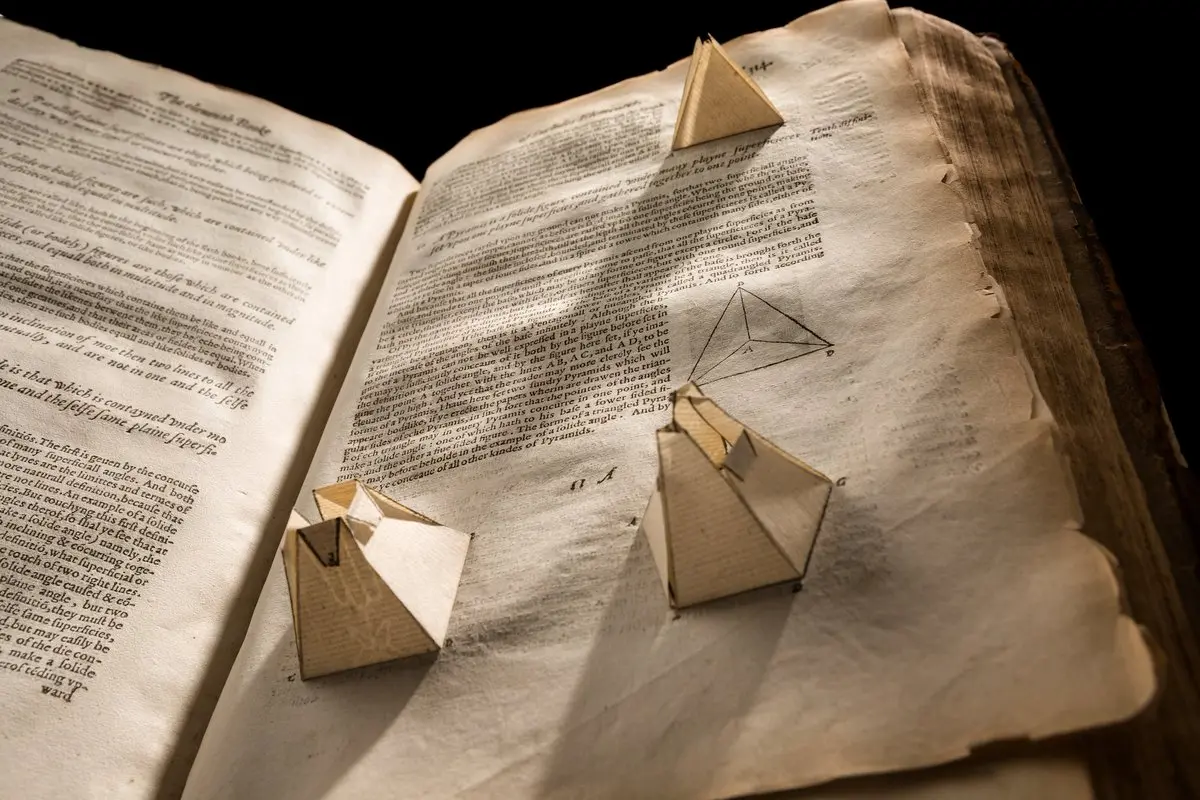
On Abakcus this sits alongside Henry Billingsley’s 1570 English Euclid, folded paper solids and all and Buffon’s Needle, which pulls π out of a floor of ruled planks — two other reminders that the history of mathematics is full of people trying to make abstraction something you can hold.
I · The Man
The Laird They Called a Wizard
Napier was a strange man. He was the eighth Laird of Merchiston, and he spent most of his life managing his estates and writing theology. In his own eyes, his most important work was his 1593 commentary on the Book of Revelation, in which he declared the Pope to be the Antichrist. Mathematics he considered something of a side pursuit. History disagreed.
His neighbors were convinced he was a wizard. He walked the castle grounds alone at night, and a black rooster was never far from his side.3 According to one story, when he suspected one of his servants of theft, he sent them into a dark room one by one and told each to touch the rooster. The bird, he said, would crow and expose the thief. In truth, Napier had coated the rooster in soot. The innocent servants touched the animal without hesitation and came out with blackened hands. The thief did not dare touch it and walked out with his hands perfectly clean. It was not magic. It was an experiment.
His great work, the logarithm, grew out of the same practicality. At the end of the sixteenth century, astronomers were drowning under the monstrous multiplications that sank ships and threw calendars off course. Napier spent twenty years computing tables that turned multiplication into addition, and in 1614 he announced the result to the world in Mirifici Logarithmorum Canonis Descriptio.1 When the London mathematician Henry Briggs read the book, he committed to a four-day journey and traveled to Edinburgh. As the story goes, when the two men finally met, they stared at each other for a quarter of an hour without saying a single word.4
By shortening the labors, logarithms doubled the life of the astronomer.5
Pierre-Simon LaplaceThe logarithm was an abstract revolution, and it required working with tables. But not everyone had tables, and not everyone had the mathematics. The merchant, the engineer, and the tax clerk needed something more concrete. Napier’s answer was the rods.
II · The Method
The Rods They Called Bones
The set described in Rabdologiae consisted of ten four-sided rods engraved with numbers. Cheap sets were made of wood, fancy ones of ivory and bone. That is where the name came from: Napier’s bones.
Each rod carries a digit at the top. Below it, the multiples of that digit from 1 to 9 are listed in order. But the multiples are not written the ordinary way. Each cell is split in two by a diagonal, with the tens digit written above the line and the units digit below it. This arrangement was not Napier’s invention. It was the lattice multiplication method developed by medieval Arab mathematicians and carried into Europe by Fibonacci’s Liber Abaci.6 Napier’s genius was to lift the lattice off the paper and pour it into portable rods. Instead of drawing the grid every single time, you simply lined the rods up side by side.
Say you want to multiply 4,839 by 7. You line up the rods headed 4, 8, 3, and 9. Then you look at the seventh row. In that row, each rod carries 7 times its own digit: 28, 56, 21, 63. Only one task remains: adding along the diagonals. You start from the right, each diagonal hands you one digit of the answer, and you carry whatever spills over to the next. Multiplication has been dismantled into addition. Try it yourself below.
Interactive · Line Up the Rods, Read the Row
Type a number and the rods line up. Pick a multiplier. The diagonal sums in the highlighted row give you the answer — no multiplication required, only addition.
Diagonal sums (right to left)
4839 × 7 = 33873
III · The Legacy
A Two-Century Lifespan
The rods spread. Six years after the book was printed, in 1623, Wilhelm Schickard of Tübingen designed the first gear-driven calculating machine and built Napier’s rods, wrapped around cylinders, into its multiplication unit.7 The first machine of mechanical calculation carried the Scottish laird’s bones inside it.
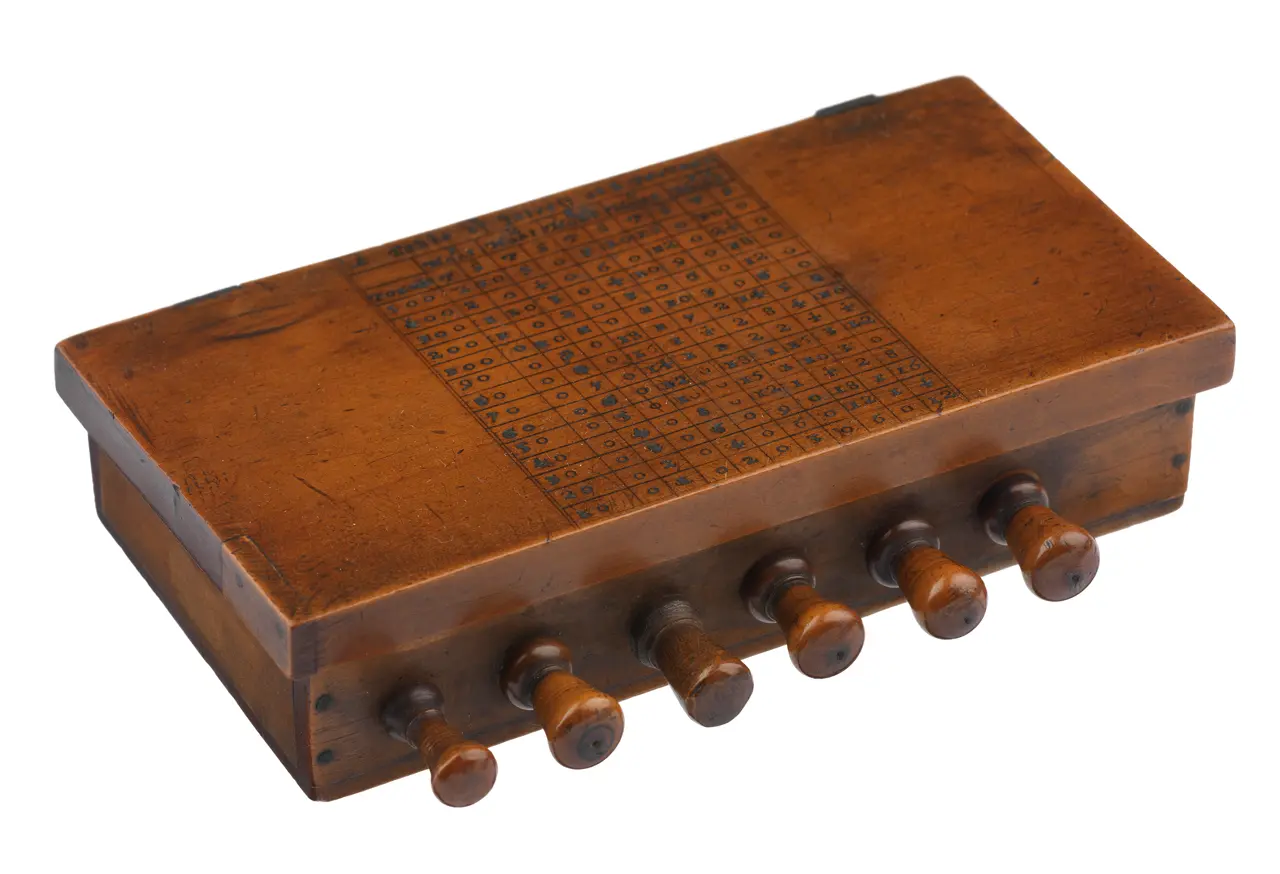
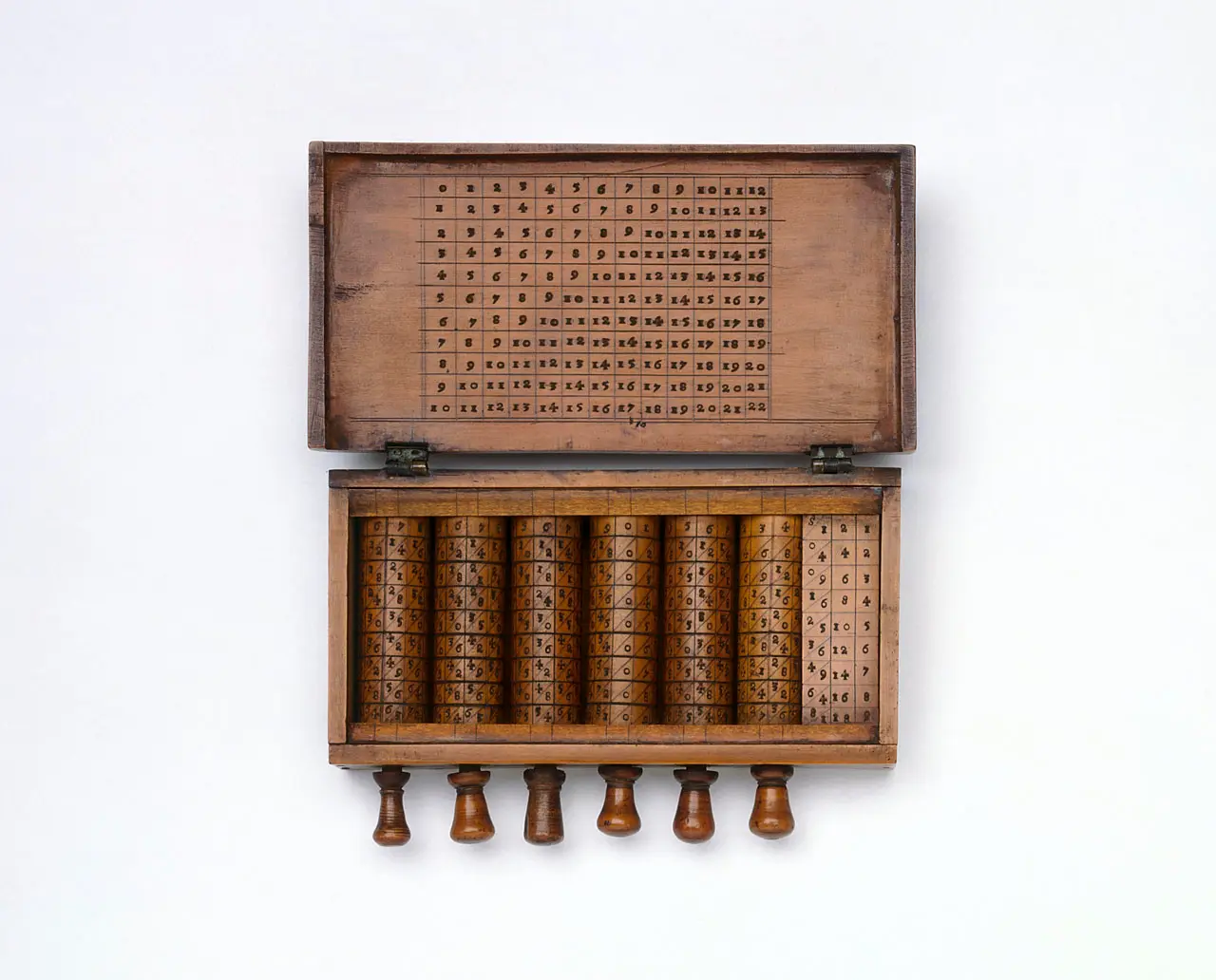
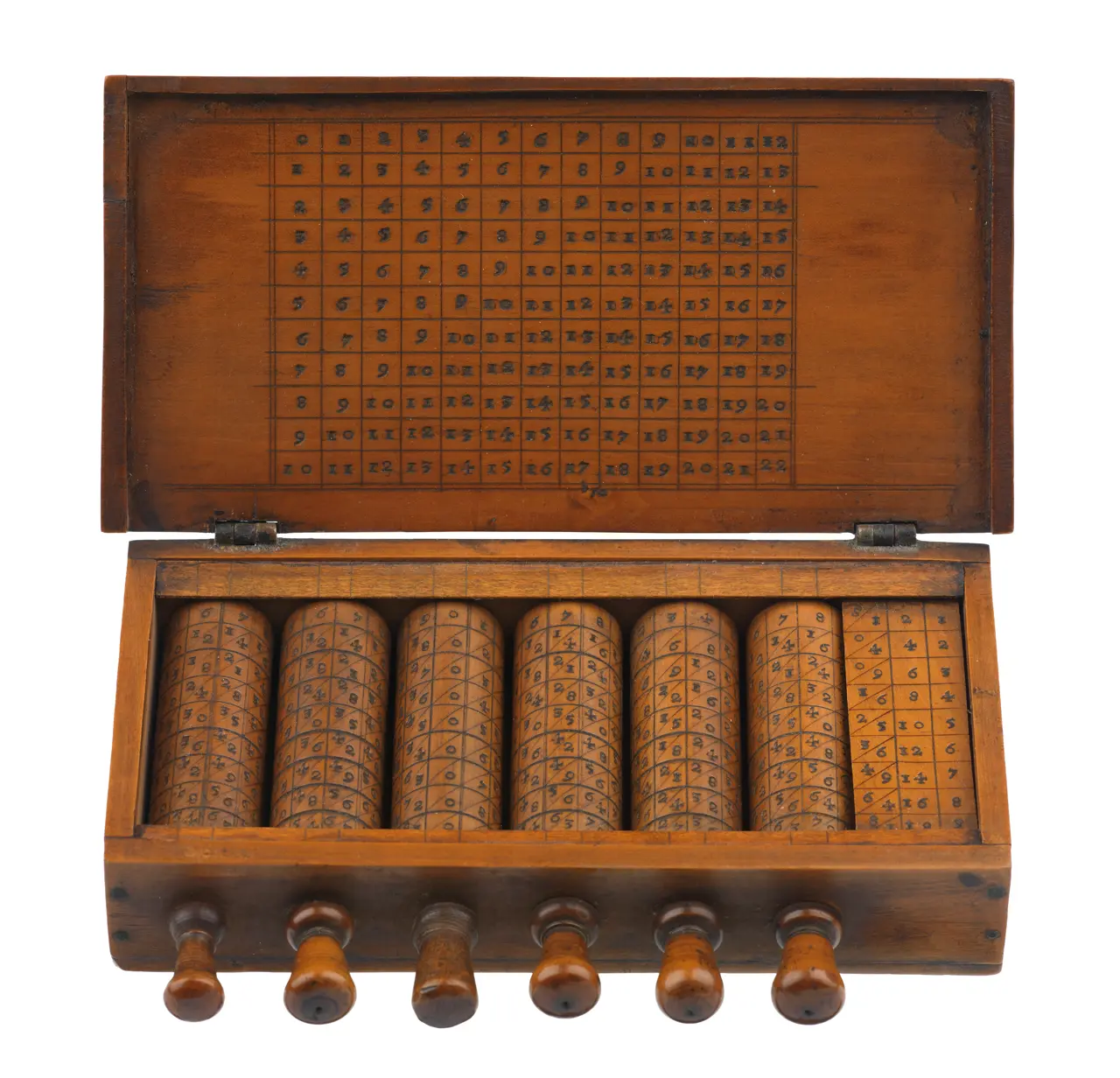
Sets were manufactured all across Europe. Pocket-sized wooden boxes, desktop models with rotating cylinders, even an advanced version Napier called the promptuarium, which handled multi-digit multipliers in a single pass. The rods remained in practical use well into the middle of the nineteenth century. In 1891, the Frenchman Henri Genaille, solving a problem posed by Édouard Lucas, designed a version that made even carrying in your head unnecessary. On Genaille-Lucas rulers, your eye follows the arrows and the answer simply appears.8
The point we use today when writing decimal numbers is also a habit we owe largely to Napier. The section of Rabdologiae dealing with decimal fractions is among the earliest texts to popularize the dotted notation.9
There is one more idea Napier squeezed into the same book, and I find it at least as far-sighted as the rods. He describes an arithmetic performed on a board resembling a chessboard, where numbers are broken into powers of two. You multiply, divide, and even extract square roots by sliding counters.10 Napier wrote that the whole thing might be dismissed as a plaything. He had no way of knowing that three hundred years later the same idea, the binary system, would become the foundation of the machine you are reading this on.
Merchiston Castle stands today in the middle of a university campus, and the university takes its name from Napier. The ivory sets sit in museum cases. The devices that now do the rods’ work in a billionth of a second sit in our pockets. But the principle has not changed. Break the hard operation into simple pieces, prepare the pieces in advance, line them up when needed. Napier called that calculation. We call it an algorithm.
Sources and Notes
- 1.Napier, John. Mirifici Logarithmorum Canonis Descriptio. Edinburgh: Andrew Hart, 1614 — the original publication of the logarithm, digitized copy via Internet Archive.
- 2.Napier, John. Rabdologiae, seu Numerationis per Virgulas Libri Duo. Edinburgh: Andrew Hart, 1617 — the primary source for the rods, the promptuarium, the decimal-point notation, and the chessboard “local arithmetic” described below, digitized copy via Internet Archive.
- 3.The soot-covered-rooster story is a standard piece of Merchiston folklore, repeated in the MacTutor biography of Napier and in most popular accounts of his life; see also Havil, Julian. John Napier: Life, Logarithms, and Legacy. Princeton University Press, 2014.
- 4.The account of Napier and Henry Briggs meeting in silence is recounted in early biographical sketches of both men; see the overview of Napier’s life and Havil, Julian. John Napier: Life, Logarithms, and Legacy. Princeton University Press, 2014.
- 5.The remark crediting logarithms with lengthening astronomers’ working lives is widely attributed to Pierre-Simon Laplace and repeated across histories of the subject; its exact original wording and source are not firmly documented.
- 6.On the transmission of lattice (“gelosia”) multiplication from Arab mathematics through Fibonacci’s Liber Abaci (1202) into European practice, see Ifrah, Georges. The Universal History of Numbers. John Wiley & Sons, 2000.
- 7.Wilhelm Schickard described his calculating machine, which incorporated cylindrical Napier’s rods, in letters to Johannes Kepler in 1623 and 1624; the correspondence was lost for centuries and rediscovered by Franz Hammer in 1935. See the overview of Schickard and his calculating clock.
- 8.On Henri Genaille and Édouard Lucas’s 1891 rulers, see Genaille–Lucas rulers and Ifrah (2000).
- 9.On Napier’s role in popularizing the decimal point, see Cajori, Florian. A History of Mathematical Notations, vol. I. Open Court, 1928.
- 10.On the binary-like “local arithmetic” board described in Rabdologiae, see the Mathematical Association of America’s John Napier’s Binary Chessboard Calculator.