Free Resource · Mathematics · algebrica.org
Algebrica: A Quiet Place to Learn Mathematics
One man has written about 250 mathematics entries, drawn every figure himself, and given the whole thing away.
Entries
~250, since Oct 2023
Price
Free · No account
Ads
None
Figures
Editable SVG
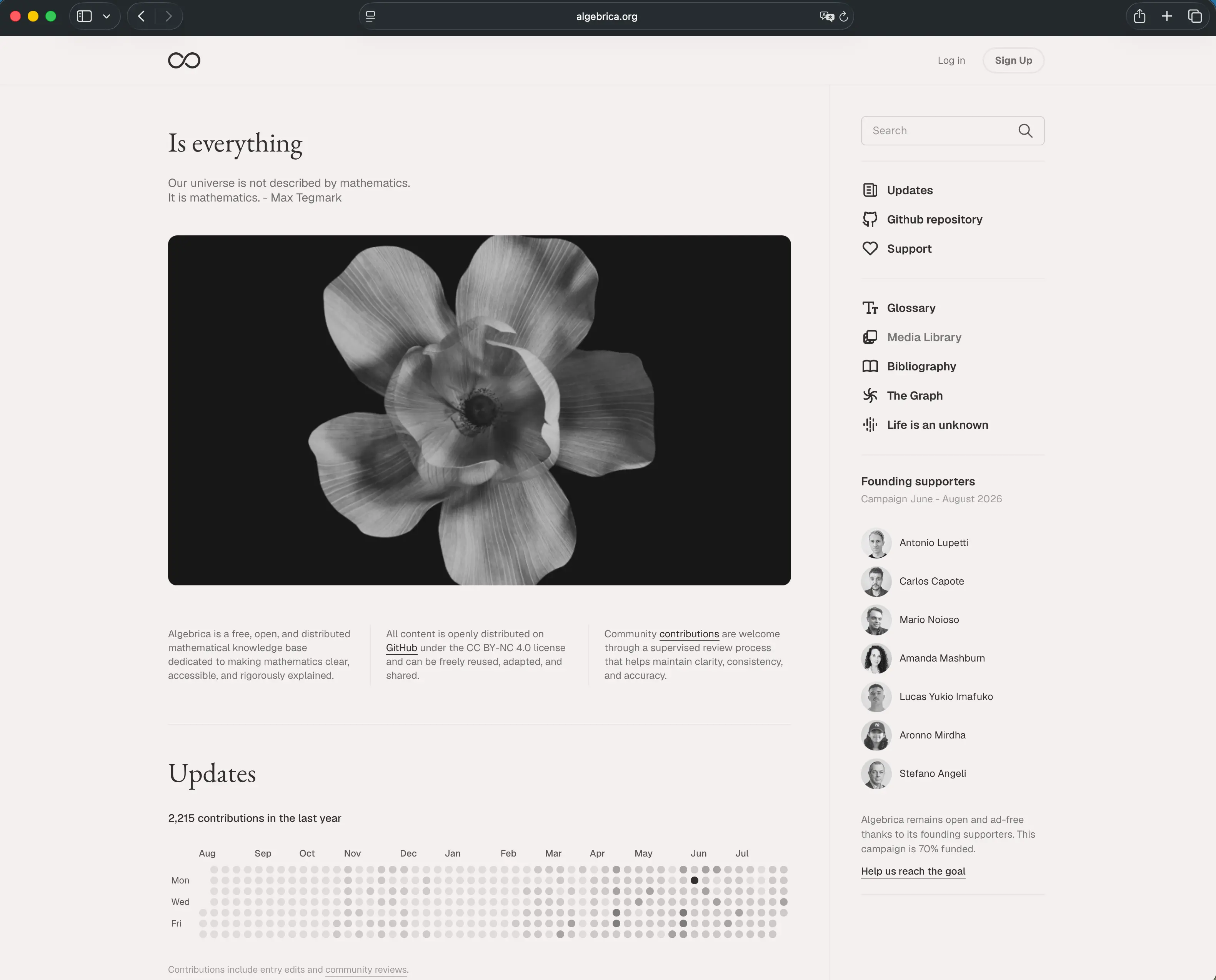
Almost every mathematics site on the internet wants something from me. An account, a subscription, a streak, an emailed reminder that I have not practised today. Algebrica wants nothing. You open a page, the mathematics is there, and that is the end of the transaction. No advertising, no badges, no cartoon congratulating me. I had forgotten how much easier it is to think when a page is not trying to hold on to me.
It is the work of one person. Antonio Lupetti started writing the first entries in October 2023 and has kept at it in his spare time since, and there are now around 250 of them, running from sets and the types of numbers through groups, trigonometry, sequences, limits, integrals and probability distributions. This is not the thin, padded material that fills the first page of search results. It is written carefully, by someone who understands what he is explaining.
“Nobody is trying to keep me on the site. That turns out to be the best feature it has.”
The Pages Move Forward Without Gaps
What makes it good to learn from is that the pages move forward without gaps. The entry on the unit circle begins with a definition and arrives at Euler’s formula, and every step on the way is the previous step looked at again: the Pythagorean identity comes out of the triangle in the drawing, radians come out of arc length, and the circle turns into the complex numbers of modulus one without any sleight of hand. Each entry also tells you which entries it depends on, so when you get stuck you know exactly what to read first.
That is the same instinct behind our own walk around the unit circle: one drawing, held still, until sine and cosine stop being formulas to memorize and become two shadows of a single moving point. Read the two together and the second one costs you nothing.
It Hands You the Picture and the Pencil
Then there are the drawings, which are the reason I will keep going back. They are plain line figures with nothing decorative in them, and the source of every one of them sits in a public repository as an SVG you can open and change. Rename the angle, translate the labels into Turkish, drop it into a worksheet. The license allows all of it so long as nobody sells the result. Most sites of this kind hand you a picture. This one hands you the picture and the pencil.
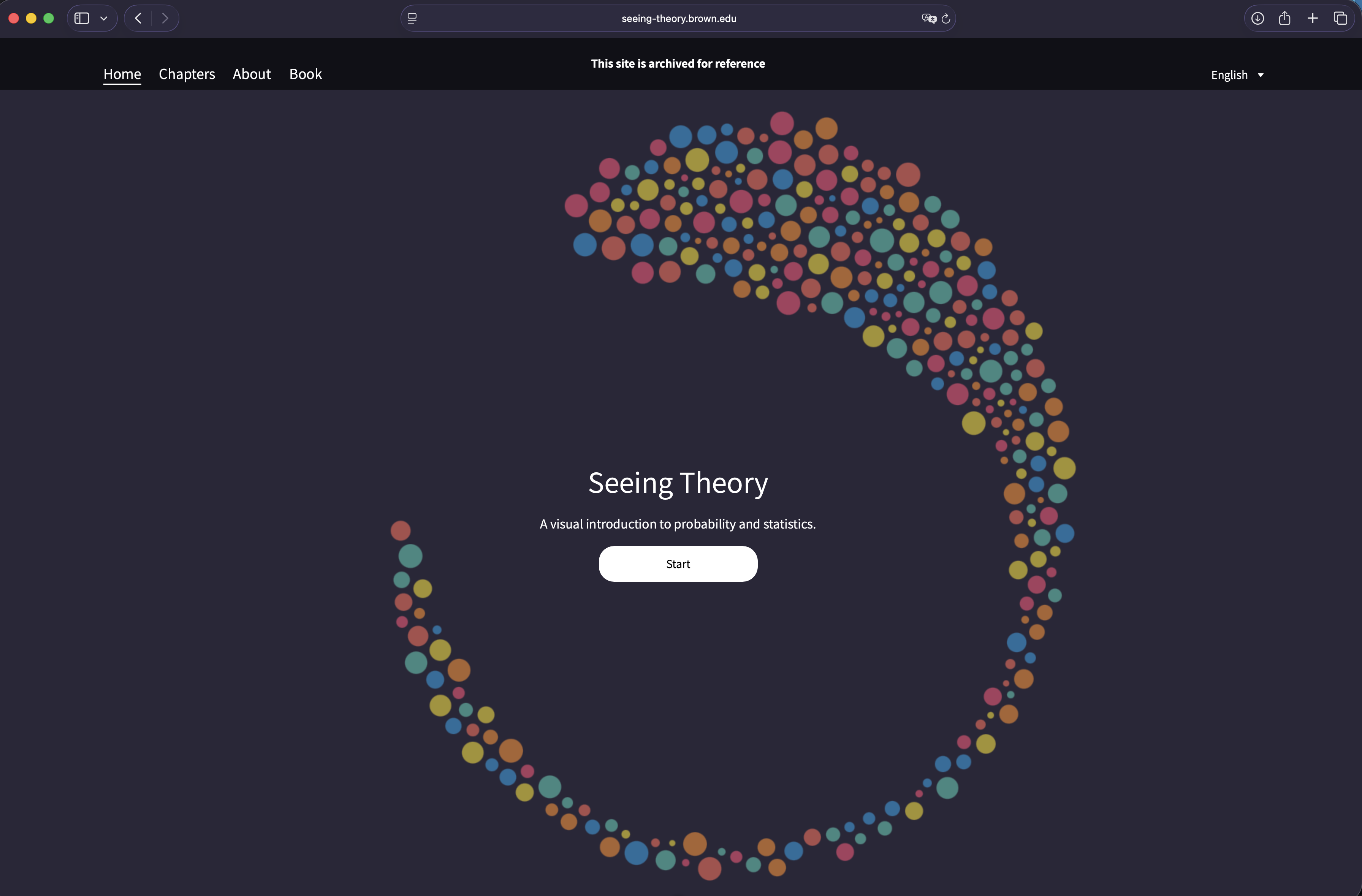
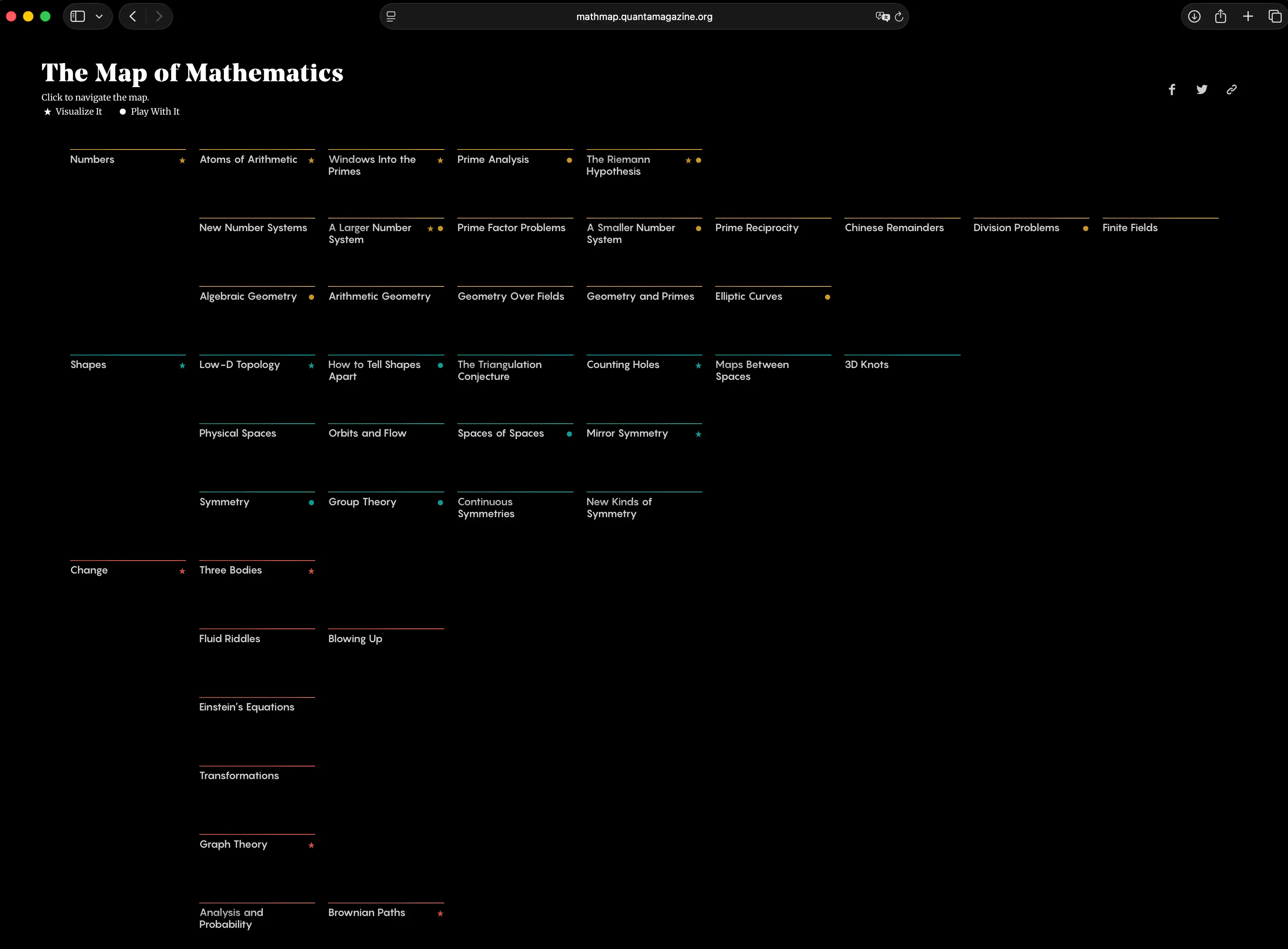
A teacher who can edit the figure can teach with it. Everything else on this shelf — Seeing Theory, The Map of Mathematics — gives you a beautiful thing to look at. Algebrica gives you the file.
What Is Not There Yet
The coverage is uneven, and the site does not pretend otherwise. Differential equations is still two entries long, and there is little number theory or geometry beyond the conics. Analysis and elementary algebra are the finished parts. Look at the contents before you promise a student that a topic is there.
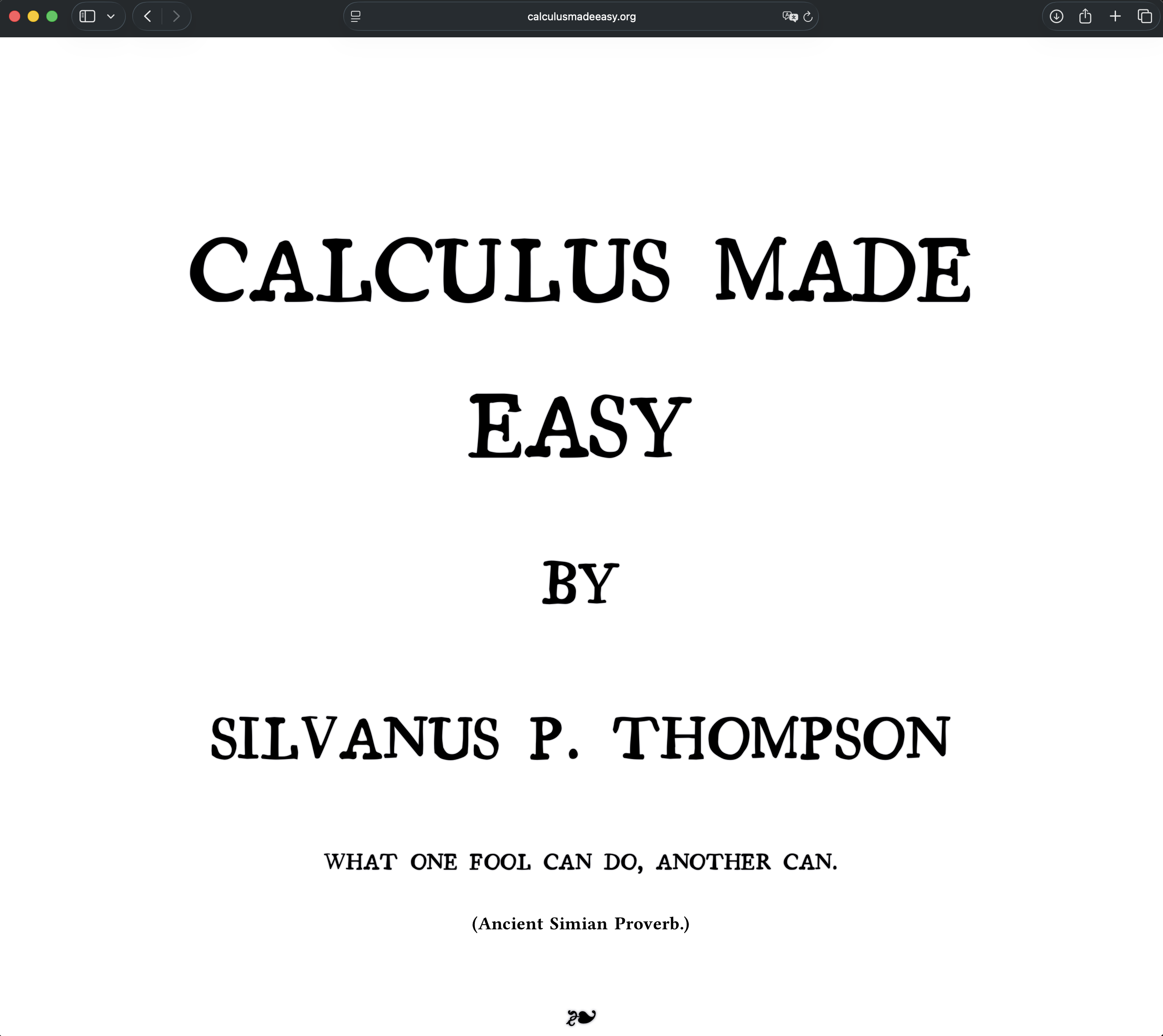
For the gaps, the old books still hold up. Calculus Made Easy, Silvanus P. Thompson’s 1910 primer, is free online (or in print on Amazon) and covers the derivative and the integral with the same refusal to hurry; and Infinite Powers tells you why any of it was worth inventing.
Still, this is the page I will send someone at eleven at night when they tell me they have lost the thread of a proof. Free, clear, and built by a person who wanted it to exist. That is a good thing to find on the internet in 2026 — and it sits in the same small category as the handful of tools that ask nothing of you while you use them.
¹ Algebrica is free to read at algebrica.org. No account, no subscription, no app.
² Every figure is published as an editable SVG in the project’s public repository, under CC BY-NC 4.0 — reuse and adapt freely, but do not sell the result.
³ Antonio Lupetti has been writing the entries in his spare time since October 2023. The about page is the honest account of what is finished and what is not.