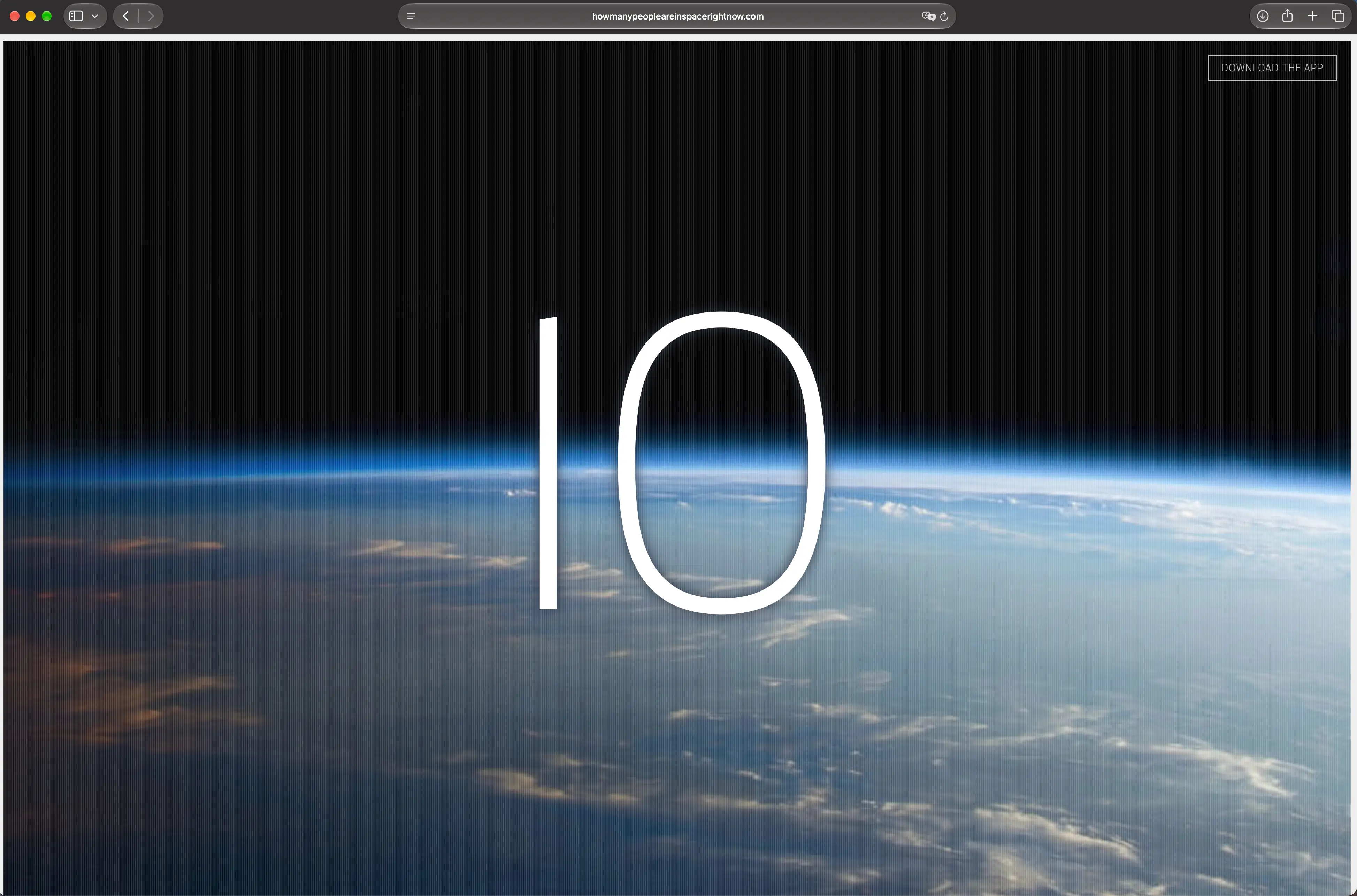
One of the longest addresses on the internet is also one of the most honest. The site called howmanypeopleareinspacerightnow.com answers the question in its name by putting a single huge numeral in the middle of the screen and tries to do nothing else. No menu, no explanation, just the number and behind it a photograph of Earth taken from space — the same kind of view Benjamin Grant’s Overview is built on. When I wrote a short note about this site back in the old Abakcus, the number was seven, today it is ten.
The domain is registered in August 2009 and when the site first goes up it shows 13 people, all of them on the International Space Station, with Brad Eshbach as its owner and Joshua Hathaway behind the design and code. Eshbach says he has tracked every single human spaceflight since 2009 and logged it on the site, and that the whole thing started as a long URL joke. The bottom of the page still says the site is powered by high fives and Brad Eshbach, which I think is the best credit line a website could ever carry.
The whole idea of the site sits in its name. Someone gets this question stuck in their head one night, types it into the search bar exactly as it is and the answer comes straight back. There is no institution behind it, no app store strategy, no news feed, just one number kept correct, and a site doing this little still standing after seventeen years — on a web where even Google keeps burying its own products — reminds me of the part of the internet I love most.
Today’s ten
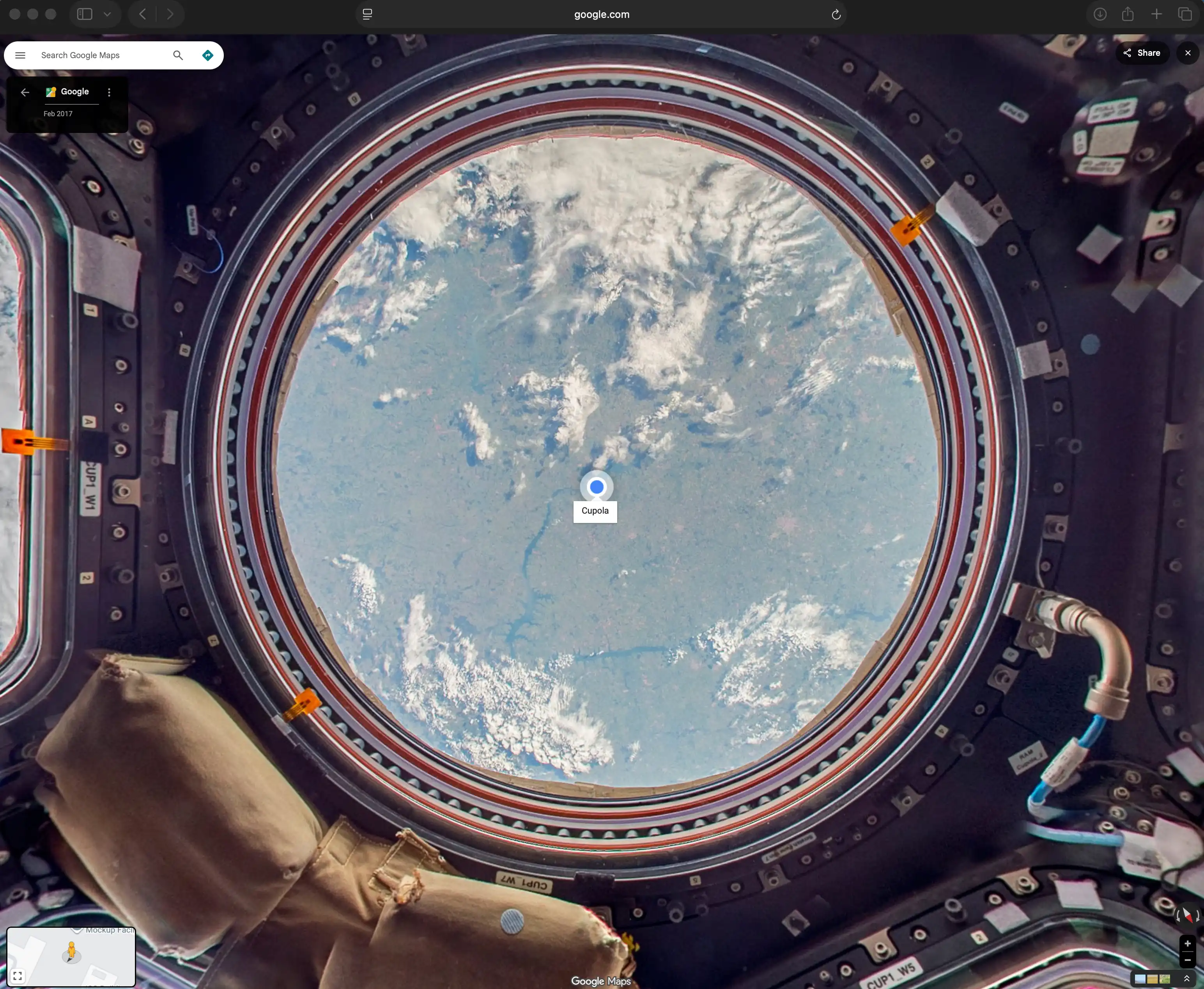
As of September 18, 2026 there are ten people in space and all of them are on two stations, seven living on the International Space Station and three on China’s Tiangong. The ten come from four countries, the United States, France, Russia and China. The International Space Station circles about 400 kilometres above the ground, about as far up as a four-hour drive on the highway, but the price of being up there is moving sideways at kilometres per second so as not to fall down. If you want to see where those seven actually live, you can walk the modules yourself in ISS Street View.
The last day the number was zero
What I love most about this site is not the number itself but that it is never zero. The Soyuz TM-31 spacecraft lifts off from Baikonur on October 31, 2000, docks with the station on November 2 and the station’s first long-duration crew, Expedition 1, begins, and the station has never been empty since. Just before the rocket carrying Bill Shepherd, Yuri Gidzenko and Sergei Krikalev left the pad, on the morning of October 31, 2000, all of humanity was on the ground. Not since.
The arithmetic is simple but heavy. Nobody born after November 2000 has lived through a single moment when every human stood on the same planet. For someone who is 25 today, part of humanity always circling overhead is as ordinary a fact as there always being a ship somewhere at sea. In this quarter century the station has hosted more than 290 astronauts.
Records and where space begins
The number usually hovers around ten but sometimes it jumps. In May 2023, while Tiangong held two three-person crews at once and 11 people lived on the station, the number of people in orbit reached 17. In September 2024 a Soyuz launch pushed that record to 19.
Stranger still is that on January 26, 2024 there were 20 people in space for a few minutes, because the 6 people on Virgin Galactic’s hour-long suborbital flight were added to the 11 on the station and the 3 on Tiangong. Those six cross the edge of space, stay a few minutes and come back, so if you plotted the number against time you would see a spike thin as a needle on top of a stepped graph. Whether a flight like that counts at all depends on where space begins, and the 100-kilometre Kármán line is not a law of physics, it is an agreement.
While you are on this page
The station moves at about 8 kilometres per second and goes around Earth about once every 90 minutes. Twenty-four hours a day and 90 minutes a lap means every astronaut sees 16 sunrises and 16 sunsets a day. The counter below has been running since you opened this page and it counts both stations at roughly the same speed.
Speed and orbit time are rounded values. Tiangong flies a little lower, but the difference doesn’t show at this scale.
The number’s future
The International Space Station is planned to stay inhabited until at least 2030. When it retires the number probably won’t fall to zero thanks to Tiangong, but for the first time since 2000 everyone in orbit may be on a single country’s station. I have no doubt the site will show one numeral that day too.
Eshbach describes his own site as a website so exclusive it started the billionaire space race.