The source
The exact words
“…con su álgebra y su fuego…”
“…with its algebra and its fire…”
“Tlön, Uqbar, Orbis Tertius”. First published in the magazine Sur, No. 68, Buenos Aires, May 1940; collected in Ficciones (1944).
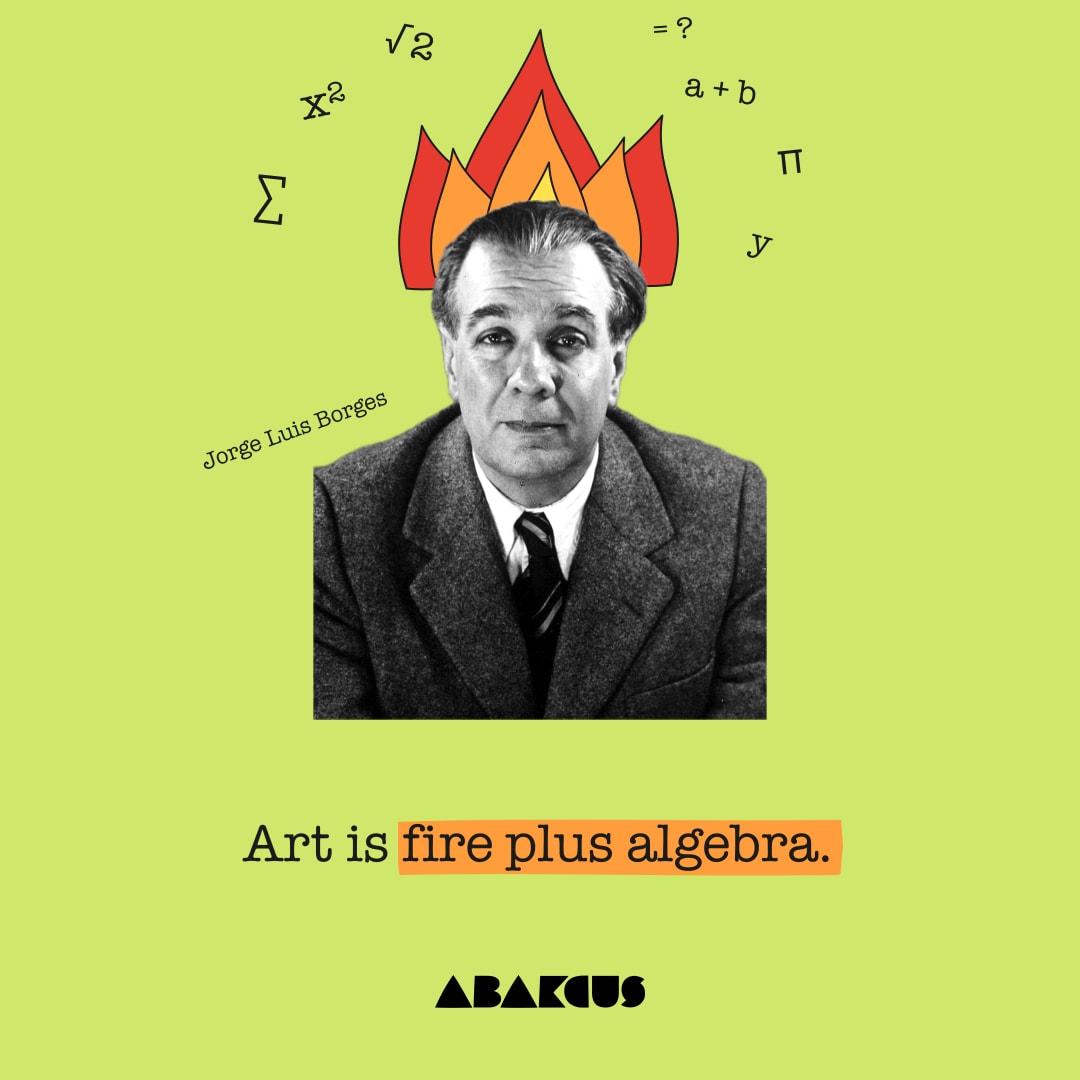
We could not find “Art is fire plus algebra” in any of Borges's published stories, essays or poems, and it is best read as a modern summary rather than his sentence. The pairing itself is genuinely his. In “Tlön, Uqbar, Orbis Tertius” the narrator holds an encyclopedia of an invented planet, a methodical account of its architecture, its mythologies, its languages, its birds and fish, and “its algebra and its fire.”
The story
Why Borges said it
The short line travels well: fire for passion and inspiration, algebra for structure and calculation, and art as the sum. It fits Borges so neatly that it is printed on posters and in books under his name. But no one has traced it to a page he wrote, so treat it as a summary of his taste rather than a quotation.
The pair it summarizes is real. In “Tlön, Uqbar, Orbis Tertius,” published in 1940, the narrator comes across the eleventh volume of an encyclopedia describing a planet that does not exist. He lists what it contains: architecture and playing cards, mythologies and languages, emperors and seas, minerals, birds and fish, its algebra and its fire. Algebra and fire stand for the two halves of a whole world, the reasoned and the elemental.
Borges returned to the same pair later. In the poem “Mateo, XXV, 30,” collected in El otro, el mismo (1964), “álgebra y fuego” appears in a long list of everything the poet has been given, a list that ends with the reproach that he still has not written the poem. Critics have read the pairing ever since as Borges's formula for writing itself: intellect and emotion, each useless without the other.
Few writers used mathematics as well. Borges built stories on infinite libraries, the paradoxes of Zeno and sets that contain themselves, and he wrote about Bertrand Russell's answer to Achilles and the tortoise. Guillermo Martínez, a novelist and mathematician, traces all of it in Borges and Mathematics, one of the picks in our list of math books for artists, architects and writers.
Writer
Who was Jorge Luis Borges?
- Born
- 24 August 1899, Buenos Aires
- Died
- 14 June 1986, Geneva
- Known for
- Ficciones, The Aleph
- The real line
- Tlön, 1940
Jorge Luis Borges was born in Buenos Aires and grew up reading English in his father's library. After years writing poems and essays, he turned in the late 1930s to the short fictions that made him famous: labyrinths, mirrors, infinite libraries and invented encyclopedias, collected in Ficciones (1944) and The Aleph (1949).
He lost his sight gradually and was nearly blind by the mid-1950s, the same years he became director of Argentina's National Library. International fame came in the 1960s, and he died in Geneva in 1986.
Read next
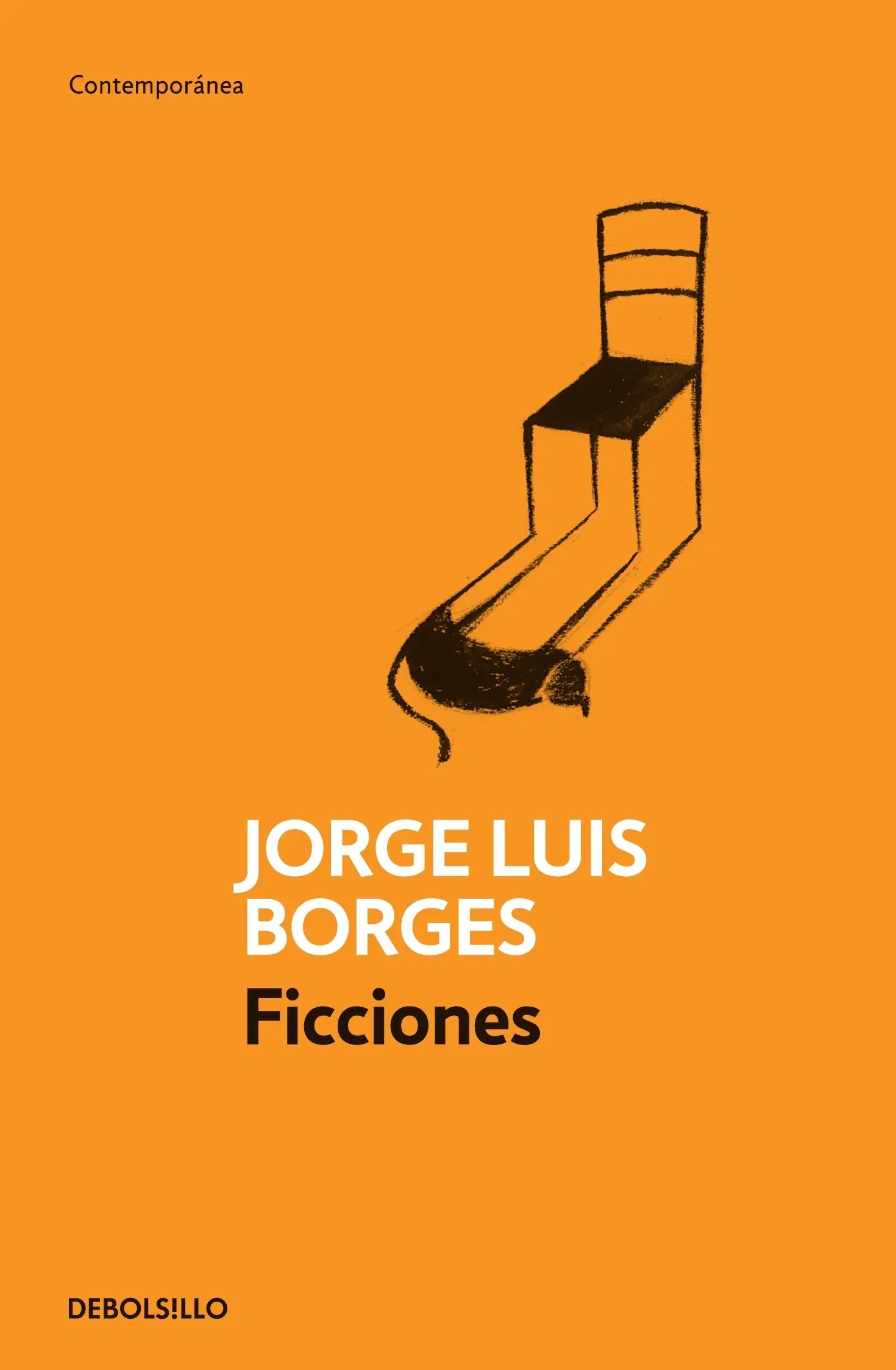
Ficciones
Jorge Luis Borges · 1944
The book where algebra and fire actually meet. Ficciones opens with “Tlön, Uqbar, Orbis Tertius” and also holds “The Library of Babel” and “The Garden of Forking Paths”, the most mathematical fiction ever written.
Questions
About this quote
Did Borges really say “Art is fire plus algebra”?
There is no known source for that exact sentence in his published work. It summarizes a pairing Borges really used: “algebra and fire” appears in his 1940 story “Tlön, Uqbar, Orbis Tertius” and again in his poetry.
Where does Borges write about algebra and fire?
In “Tlön, Uqbar, Orbis Tertius,” first published in Sur in May 1940 and collected in Ficciones (1944), the encyclopedia of the imaginary planet contains “its algebra and its fire” (“su álgebra y su fuego”). The pair returns in the poem “Mateo, XXV, 30” in El otro, el mismo (1964).
What does “fire plus algebra” mean?
Fire stands for passion and inspiration, algebra for form and calculation. The idea is that art needs both: emotion without structure is formless, structure without emotion is dead.