The source
The exact words
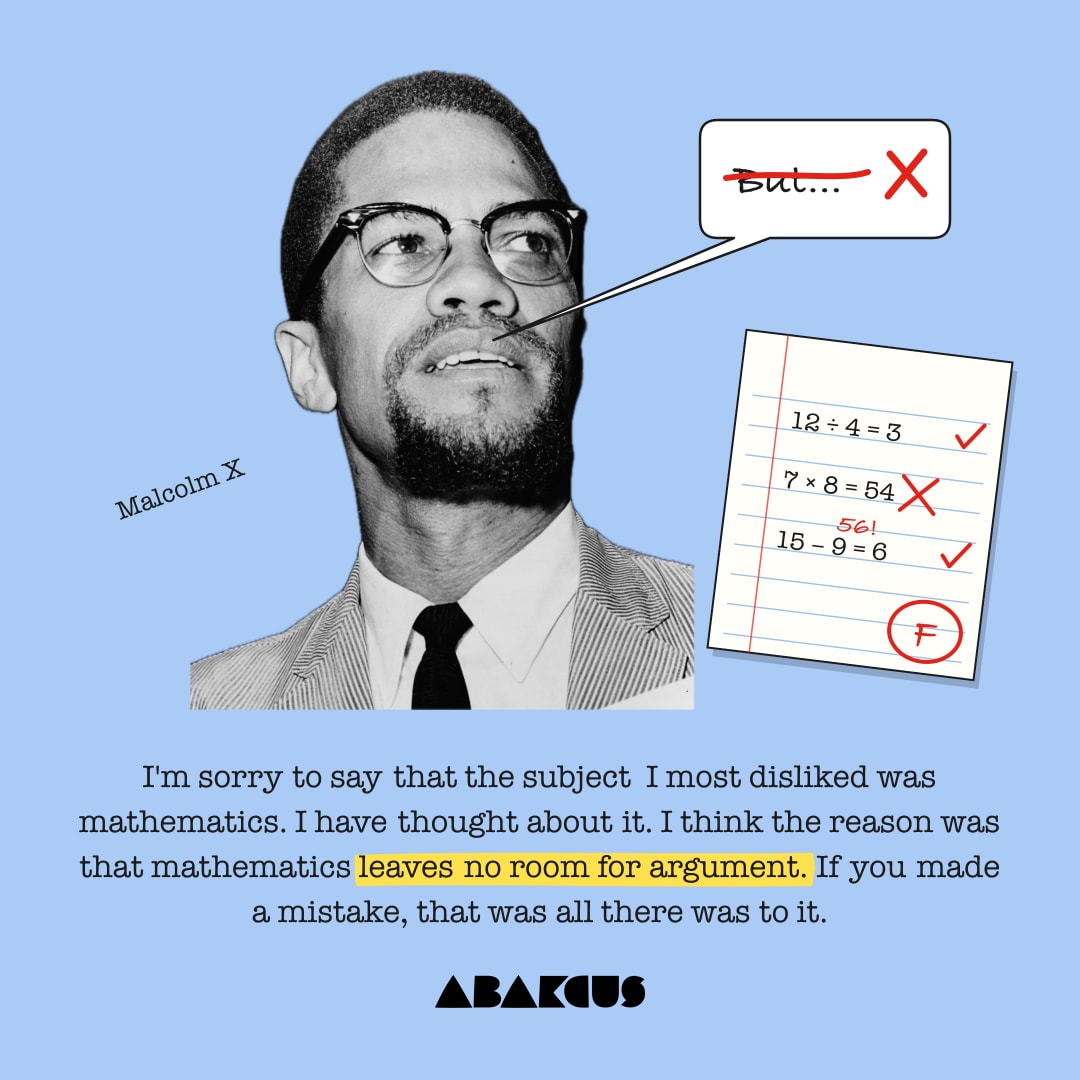
“I'm sorry to say that the subject I most disliked was mathematics. I have thought about it. I think the reason was that mathematics leaves no room for argument. If you made a mistake, that was all there was to it.”
The Autobiography of Malcolm X, as told to Alex Haley. Chapter 2, “Mascot”. New York: Grove Press, 1965.
The quote is accurate. It is told in Malcolm X's own voice in the book he dictated to Alex Haley, so the wording is Haley's transcription of Malcolm's spoken account.
The story
Why X said it
The line comes from the chapter about his early teens in Mason, Michigan, where Malcolm Little, as he then was, lived in a juvenile detention home run by a white couple and was one of very few Black students at the junior high school. He did well there. His grades were among the best in his class and he was elected class president.
Mathematics was the subject he disliked, and looking back he decided he knew why: it leaves no room for argument. A sum is right or wrong, and if you made a mistake, that was all there was to it. For a boy who already loved to talk his way through things, that was the least appealing kind of subject.
The same chapter holds the turning point of his schooling. When he told his English teacher he wanted to become a lawyer, the teacher told him that was not a realistic goal for a Black boy and suggested he become a carpenter. Malcolm said that was when he began to change inside, and he soon left Michigan for Boston.
The remark reads differently once you know the rest of the book. Years later, in the Norfolk Prison Colony in Massachusetts, he copied the dictionary page by page, read constantly and joined the prison debating team, and he became one of the most formidable debaters in America. Mathematics refused to be argued with, and argument was the thing he loved most.
Activist
Who was Malcolm X?
- Born
- 19 May 1925, Omaha
- Died
- 21 February 1965, New York
- Known for
- Civil rights, The Autobiography
- Said it
- The Autobiography, 1965
Malcolm X was born Malcolm Little in Omaha, Nebraska. His father died when he was six and his mother was later committed to a state hospital, and he spent his teens in foster care in Michigan before moving to Boston and New York. Imprisoned for burglary in 1946, he educated himself in prison and joined the Nation of Islam.
As its national spokesman he became one of the best-known voices of the civil rights era. He broke with the Nation of Islam in 1964, made the pilgrimage to Mecca, and was assassinated in Harlem on 21 February 1965, months before his autobiography was published.
Read next
The Autobiography of Malcolm X
Malcolm X with Alex Haley · 1965
Read the line in its place, a few pages before the teacher who told him not to become a lawyer. It is one of the great American books about education: a boy who disliked arithmetic, and a man who taught himself everything in a prison library.
Questions
About this quote
Where did Malcolm X say mathematics leaves no room for argument?
In The Autobiography of Malcolm X, written with Alex Haley and published in 1965, in Chapter 2, “Mascot”, which covers his junior high school years in Mason, Michigan.
Was Malcolm X bad at math?
The book does not say so. He was one of the top students in his class at Mason; mathematics was simply the subject he liked least, because it allowed no argument.
Who wrote The Autobiography of Malcolm X?
Malcolm X told his life story to the journalist Alex Haley in interviews between 1963 and 1965, and Haley wrote it in Malcolm's first-person voice. It was published in 1965, after Malcolm's assassination.