The source
The exact words
Original German
“Insofern sich die Sätze der Mathematik auf die Wirklichkeit beziehen, sind sie nicht sicher, und insofern sie sicher sind, beziehen sie sich nicht auf die Wirklichkeit.”
In English
“As far as the laws of mathematics refer to reality, they are not certain; and as far as they are certain, they do not refer to reality.”
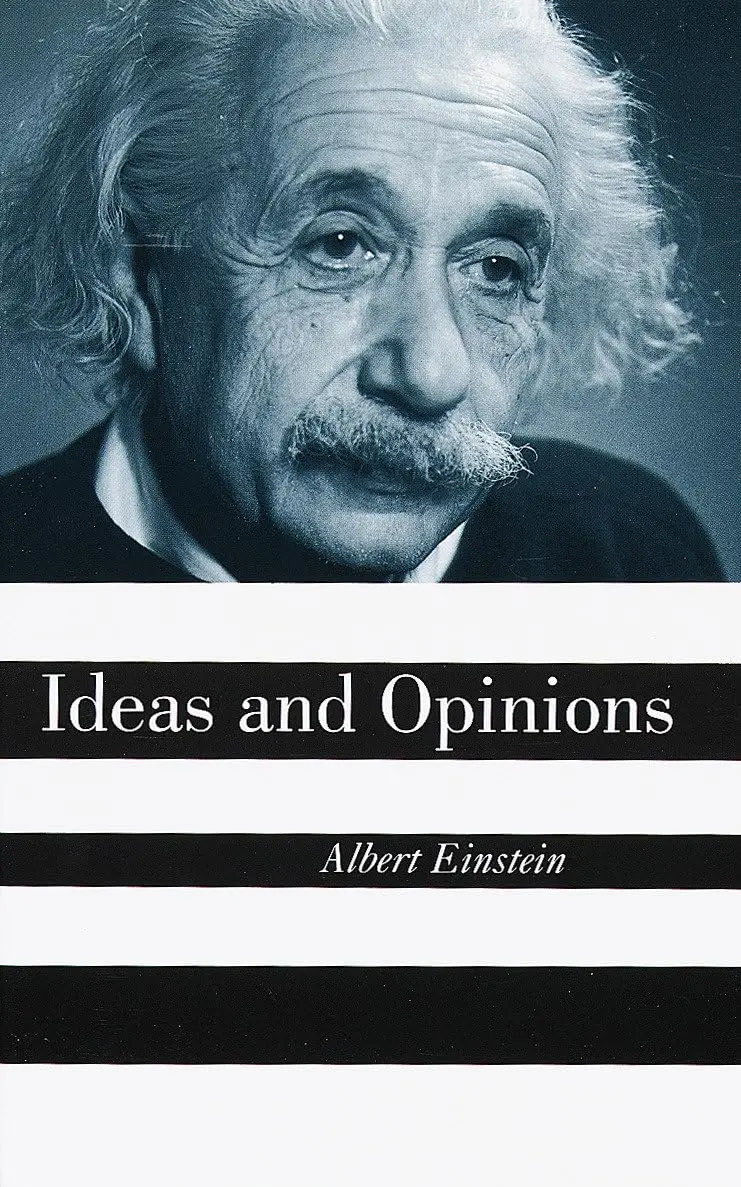
“Geometrie und Erfahrung” (Geometry and Experience). Lecture to the Prussian Academy of Sciences, Berlin, 27 January 1921. The English translation is collected in Ideas and Opinions (1954).
The story
Why Einstein said it
Einstein opened the lecture with a puzzle: how can mathematics, a product of pure thought independent of experience, fit the objects of reality so admirably? Is reason alone able to find out how the world works? His answer was this sentence.
He separated two geometries. One is axiomatic geometry in the style of Hilbert: start from axioms, deduce theorems, never ask what a “point” or a “line” really is. It is certain, but empty; it says nothing about the world. The other is practical geometry, the claim that measuring rods and light rays actually behave like Euclid's lines. That is a statement of physics, and like all physics it can be wrong.
For Einstein this was not philosophy for its own sake. General relativity, completed six years earlier, says that real space is curved and that Euclid's geometry fails near massive bodies. Only by admitting that geometry applied to reality is an experimental science could he ask which geometry the universe actually has.
You can watch him working out that curved geometry by hand in the Zurich Notebook, and see the other equation everyone knows in E = mc².
Physicist
Who was Albert Einstein?
- Born
- 14 March 1879, Ulm
- Died
- 18 April 1955, Princeton
- Known for
- Relativity, E = mc²
- Said it
- Geometry and Experience, 1921
Albert Einstein was born in Ulm and worked as a patent clerk in Bern when, in 1905, he published papers on the photoelectric effect, Brownian motion, special relativity and E = mc². In 1915 he completed the general theory of relativity, which describes gravity as the curvature of spacetime.
He received the 1921 Nobel Prize in Physics for the photoelectric effect. After the Nazis came to power he settled at the Institute for Advanced Study in Princeton, where Kurt Gödel became one of his closest friends.