The source
The exact words
“Io resto interamente appagato: e mi credano certo che se io avessi a ricominciare i miei studii, vorrei seguire il consiglio di Platone e cominciarmi dalle matematiche, le quali veggo che procedono molto scrupolosamente, né vogliono ammetter per sicuro fuor che quello che concludentemente dimostrano.”
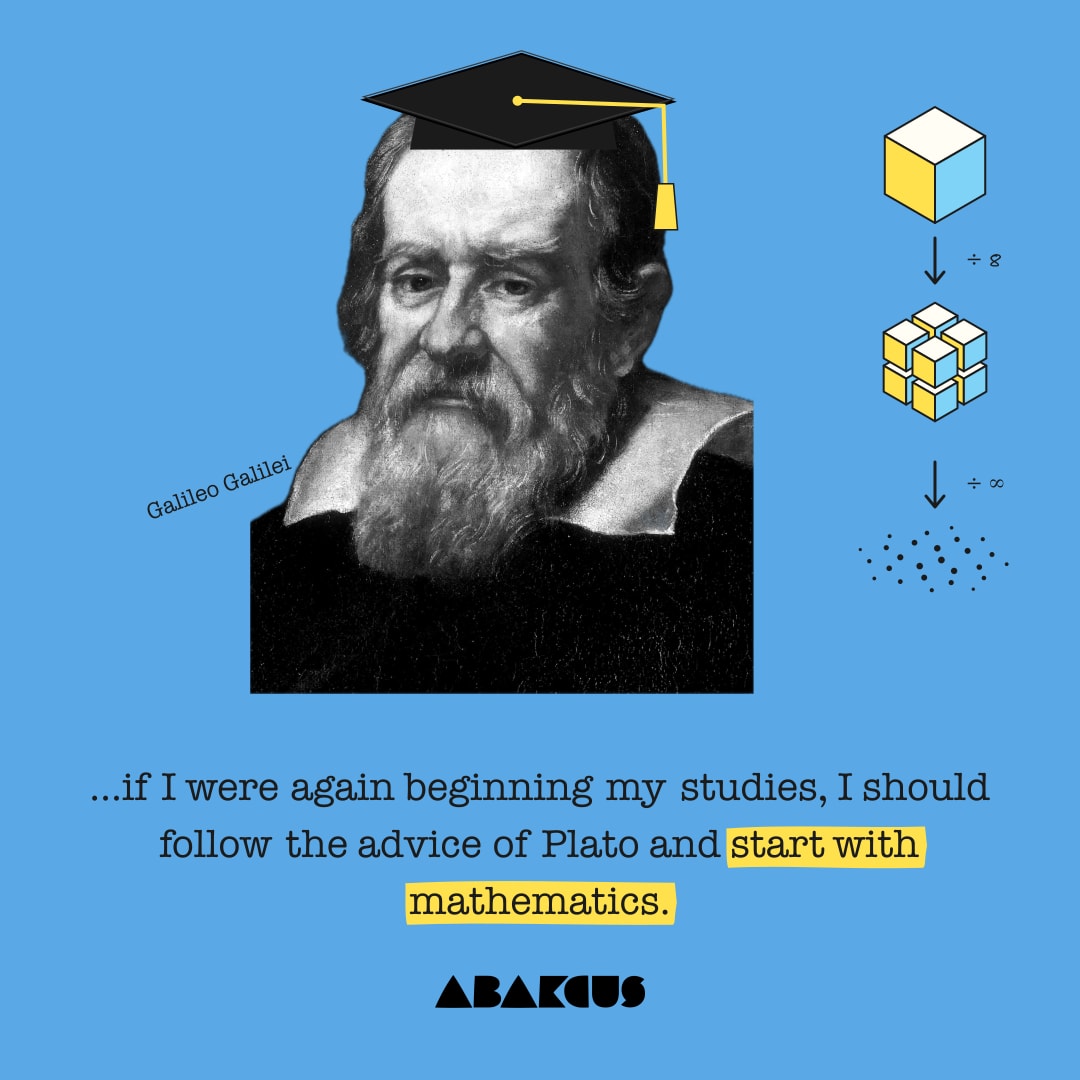
“I am quite convinced; and, believe me, if I were again beginning my studies, I should follow the advice of Plato and start with mathematics, a science which proceeds very cautiously and admits nothing as established until it has been rigidly demonstrated.”
Discorsi e dimostrazioni matematiche intorno a due nuove scienze (Two New Sciences). First Day, spoken by Simplicio. Leiden: Louis Elzevir, 1638. English translation by Henry Crew and Alfonso de Salvio, 1914.
Galileo wrote the sentence, but he did not give it to his own spokesman. In the book it is said by Simplicio, the defender of Aristotle, at the moment a geometric argument finally wins him over.
The story
Why Galilei said it
Two New Sciences is a conversation over four days between three men. Salviati speaks for Galileo, Sagredo is the curious, quick-witted amateur, and Simplicio defends Aristotle. In Galileo's earlier Dialogue Concerning the Two Chief World Systems (1632), Simplicio had been the butt of the argument, and that book brought Galileo before the Inquisition. Two New Sciences was written under house arrest and had to be smuggled out of Italy to be printed in Leiden.
On the First Day the three are puzzling over why fine dust and tiny grains sink so slowly through water and air. Salviati answers with a cube. Cut a cube into eight smaller cubes and each one has a quarter of the original surface but only an eighth of its volume. Keep cutting, down to powder, and the surface grows hundreds of times faster than the weight. A tiny grain is all surface: the medium grips it, and it barely falls.
It is the square–cube law, the same reason an ant can carry many times its weight and a giant could not stand. Simplicio, who has resisted Salviati all day, gives in completely: he is fully satisfied, and if he could begin his studies again, he would follow Plato and start with mathematics. Plato had put arithmetic and geometry at the start of education in the Republic, and the Academy was said to bar anyone ignorant of geometry.
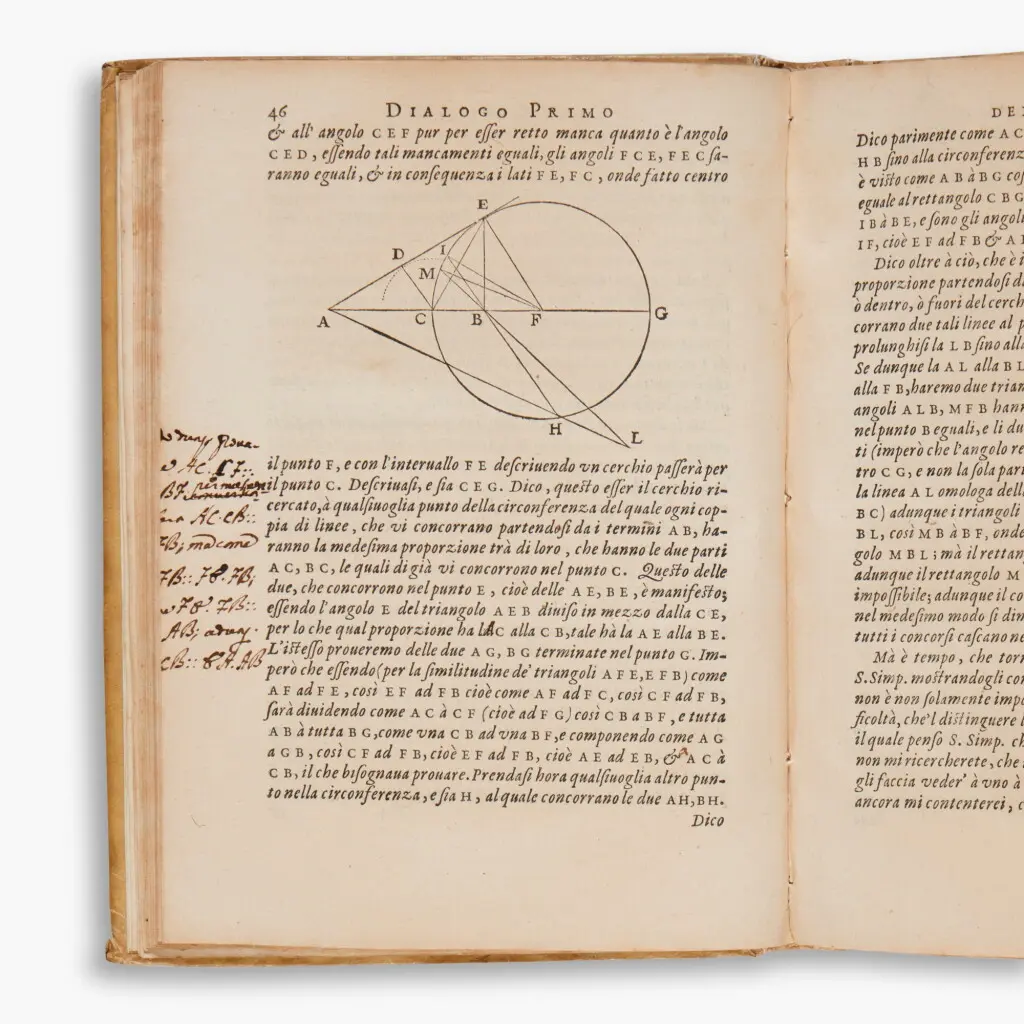
That is the joke, and the point. The most famous praise of mathematics in the book is put in the mouth of the Aristotelian, as if Galileo wanted the conversion to come from the hardest case. You can see a page from that First Day, diagram and a reader's notes in the margin, among the historic math books.
Astronomer & physicist
Who was Galileo Galilei?
- Born
- 15 February 1564, Pisa
- Died
- 8 January 1642, Arcetri
- Known for
- Telescope, laws of motion
- Wrote it
- Two New Sciences, 1638
Galileo Galilei was born in Pisa and taught mathematics at Pisa and Padua. He worked out the laws of falling bodies and the pendulum, and in 1609 turned an improved telescope to the sky, finding the moons of Jupiter, the phases of Venus and the mountains of the Moon.
His defense of a Sun-centered universe led to his trial by the Roman Inquisition in 1633. He was forced to recant and spent his last years under house arrest at Arcetri near Florence, where he finished Two New Sciences, the book that founded the modern study of motion and the strength of materials.
Read next
Dialogues Concerning Two New Sciences
Galileo Galilei, translated by Henry Crew & Alfonso de Salvio · 1638
Read the quote where it lives. The Dover edition reprints the classic Crew and de Salvio translation, and the First Day alone, with the cube argument, the pendulum and the speed of falling bodies, shows why Simplicio gave in.
Questions
About this quote
Where did Galileo write “if I were again beginning my studies, I should follow the advice of Plato”?
In the First Day of Two New Sciences (Discorsi e dimostrazioni matematiche intorno a due nuove scienze), published in Leiden in 1638.
Who says the line in the book?
Simplicio, the character who defends Aristotle. He says it right after Salviati, Galileo's spokesman, uses cubes to show why small bodies have far more surface for their weight than large ones.
What is the original Italian?
“Io resto interamente appagato: e mi credano certo che se io avessi a ricominciare i miei studii, vorrei seguire il consiglio di Platone e cominciarmi dalle matematiche, le quali veggo che procedono molto scrupolosamente, né vogliono ammetter per sicuro fuor che quello che concludentemente dimostrano.”
What advice of Plato does it mean?
That education should begin with mathematics. In the Republic, Plato puts arithmetic and geometry first in the training of future rulers, and tradition says his Academy barred anyone ignorant of geometry.