The source
The exact words
“It is more important to have beauty in one's equations than to have them fit experiment. … It seems that if one is working from the point of view of getting beauty in one's equations, and if one has really a sound insight, one is on a sure line of progress.”
“The Evolution of the Physicist's Picture of Nature”. Scientific American, Vol. 208, No. 5, May 1963.
The story
Why Dirac said it
Dirac made the remark while telling a story about Erwin Schrödinger. In 1926 Schrödinger first found a relativistic wave equation for the electron, worked out its predictions for hydrogen, and saw that they did not match experiment. Discouraged, he set it aside and published the simpler, non-relativistic version instead.
The relativistic equation was not wrong; it simply left out the electron's spin, which nobody understood yet. Dirac's moral: if your equation is beautiful and the numbers disagree, the disagreement may come from something you have not taken into account. Small discrepancies tend to clear up as understanding grows.
He had earned the right to say it. In 1928 Dirac wrote down his own equation for the electron, guided largely by mathematical elegance. It required a strange partner particle with the same mass and opposite charge. Many thought it a flaw. In 1932 Carl Anderson found the positron in cosmic rays, and Dirac shared the 1933 Nobel Prize with Schrödinger.
Dirac's taste for brevity was legendary: his PhD thesis, the first ever on quantum mechanics, is short and written by hand. See it in Dirac's Handwritten Thesis.
Physicist
Who was Paul Dirac?
- Born
- 8 August 1902, Bristol
- Died
- 20 October 1984, Tallahassee
- Known for
- Dirac equation, antimatter
- Said it
- Scientific American, 1963
Paul Dirac was born in Bristol, studied electrical engineering and then mathematics, and became one of the founders of quantum mechanics while still in his twenties. His equation united quantum theory with special relativity and predicted antimatter.
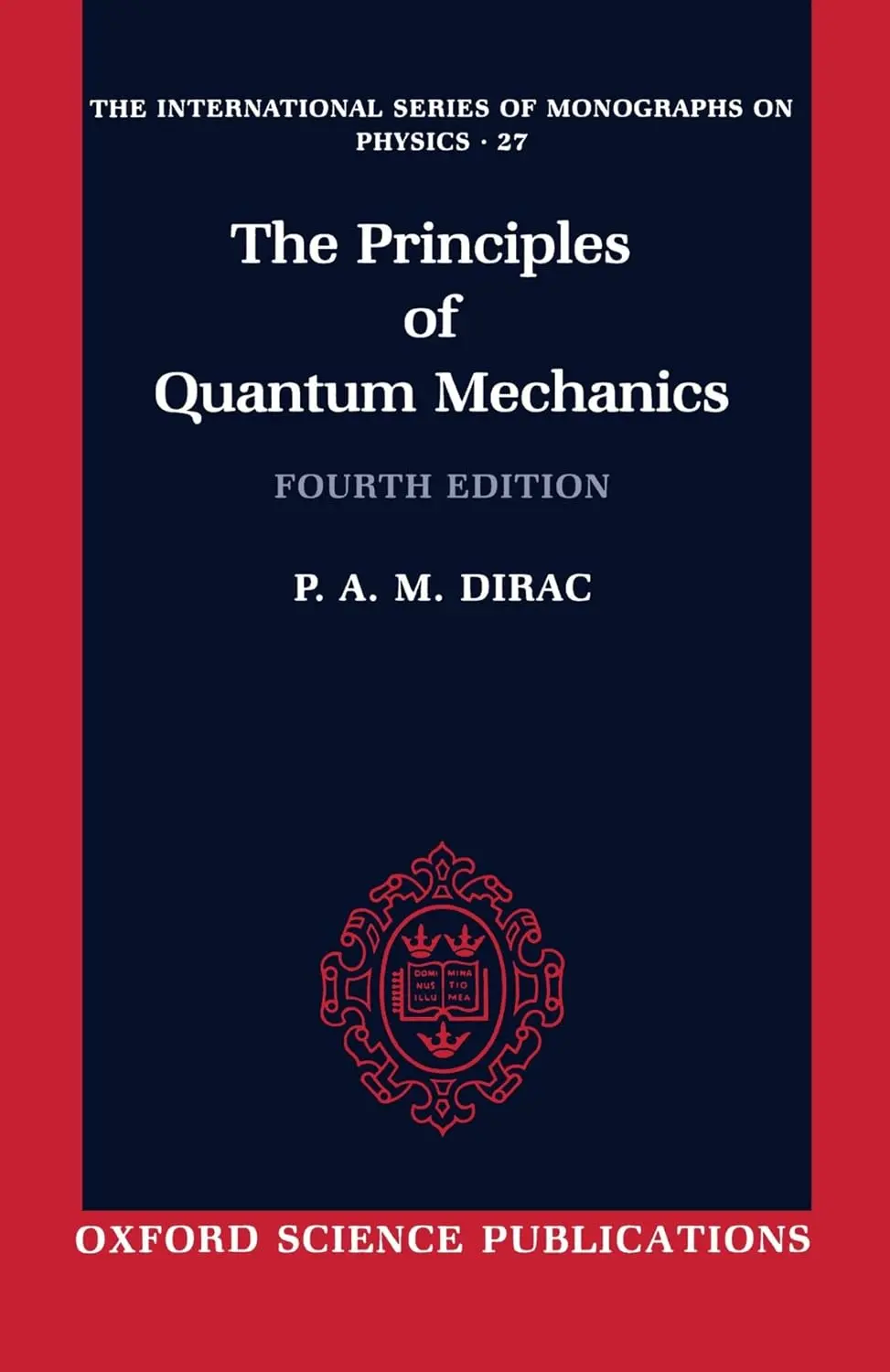
He held the Lucasian Chair of Mathematics at Cambridge from 1932 to 1969 and later moved to Florida State University. Colleagues joked that the unit of speech was the “dirac”: one word per hour. His book The Principles of Quantum Mechanics (1930) is still in print.