Curves that carry load show up in stadium roofs and in the snack aisle — if you know where to look.
For more on patterns and proportions, see Peng Wang's Fibonacci shelf; for curves on a circle, our unit circle; for geometry in print, Billingsley's Euclid. For a notebook full of gravity and wrong turns, Einstein's Zurich Notebook. And for another food object where geometry is the whole point, Martin's Chocolatier's solar system in Belgian chocolate— nine planets, Jupiter the largest truffle because it is the largest planet.
The problem Fredric Baur was actually solving
In the 1960s, Procter & Gamble chemist Fredric Baur was handed a brief that sounds mundane and turned out to be geometrically exacting: build a chip that doesn't break in the bag. Traditional chips — sliced from whole potatoes, fried, tumbled into foil bags with a cushion of nitrogen — arrived at their destination as a mixture of intact chips and chips that had failed at some structural point during transit.
The failure mode was predictable. A flat or randomly curved chip has no preferred axis of stress. When packed in a bag with dozens of identical chips, it encounters pressure from unpredictable directions. The chip doesn't know where to be strong, so it isn't strong anywhere in particular.
Baur's solution was not to find a tougher chip material. It was to give the chip a shape that directed stress — one where the geometry itself did the structural work. The shape he arrived at was already well-known to architects, bridge engineers, and mathematicians. It is called a hyperbolic paraboloid.
What a hyperbolic paraboloid actually is
The term sounds formidable. The geometry is, once seen, immediately intuitive. Take a flat square sheet of paper. Hold two opposite corners and push them up; hold the other two corners and push them down. The shape you've made — curving upward along one diagonal, downward along the other — is a hyperbolic paraboloid.
More precisely: it is a doubly-ruled surface defined by an equation of the form below. The two negative terms guarantee opposite curvature in the x and y directions. Slice the surface parallel to the z-axis and you see parabolas. Slice it horizontally (parallel to the xy-plane) and you see hyperbolas. That is where both halves of the name come from.
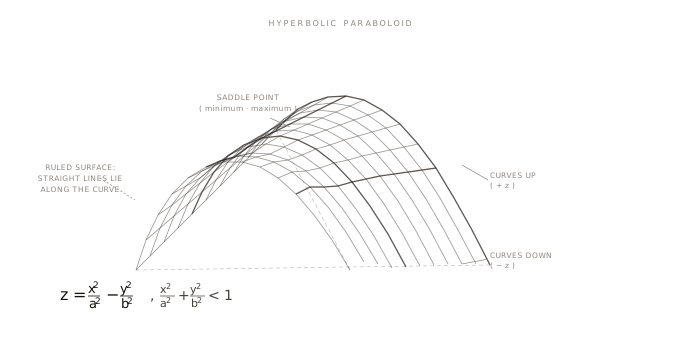
The key property is what differential geometers call negative Gaussian curvature. At every point on the surface, the two principal curvatures — the maximum and minimum — have opposite signs. The surface curves up in one direction and down in the perpendicular direction simultaneously. There is no way to bend flat paper into this shape without cutting it; the geometry cannot be flattened.
This also makes it a saddle surface. The center point is, simultaneously, a local minimum when approached along one direction and a local maximum when approached at 90 degrees to that. This is the mathematical definition of a saddle point — the same concept that appears in multivariable calculus when finding critical points of functions of two variables.
Why this shape is structurally strong
The structural properties of the hyperbolic paraboloid follow directly from its geometry. A flat sheet loaded from above deflects; the load concentrates at the center and the sheet bends, then breaks. A hyperbolic paraboloid under the same load distributes the force along its curves — the arch-like curvature in one direction transfers compression efficiently to the edges, while the opposing curvature provides tensile resistance that prevents the structure from inverting.
The opposing curvatures brace each other. The shape that looks structurally precarious — curves going two ways at once — is precisely the shape that makes the structure stable under load from any direction.
This is why the same geometry that appears in a snack food also appears in the roofs of major buildings. The saddle surface is a natural compression structure: it routes load to its supports along paths of minimum energy, the way a hanging cable finds its catenary shape under gravity. Invert the catenary and you get an arch that stands in pure compression; the hyperbolic paraboloid is the two-dimensional generalization of this principle.
For a chip 2 mm thick spanning roughly 70 mm, these structural considerations are not academic. A flat chip of the same dimensions and dough composition would fail under the weight of ten chips stacked above it. The Pringle shape allows a stack of dozens — the entire can — to sit on the bottom chip without fracturing it.
The stackability constraint
The second engineering requirement — stackability — adds a constraint that the geometry must satisfy simultaneously with the structural requirement. Two chips can be stacked only if each chip's surface is a constant vertical offset from the chip below it. In geometric terms: the surfaces must be congruent and the shape must tile itself in the direction normal to its mean plane.
A randomly curved surface doesn't do this. Two potato chip halves with slightly different random curvature will rock against each other and leave large air gaps. The hyperbolic paraboloid, because it is described by a precise equation with fixed parameters, produces chips that are geometrically identical — and because the surface has a uniform curvature profile, identical chips nest at a constant separation.
The canister itself is a geometric consequence of the chip shape. Stacked hyperbolic paraboloids, because they are elliptical in plan view and uniform in spacing, form a column. That column fits naturally in a cylinder. The cylinder is rigid. The result is a packaging system where the geometry of the chip, the geometry of the stack, and the geometry of the container are mutually consistent — each determined by the same initial shape decision.
How the shape is manufactured
The manufacturing process has to be compatible with the geometric requirements. A whole potato chip cannot be given a precise saddle shape; the irregular cellular structure of a potato slice doesn't allow precise geometric forming under a mold without tearing.
Pringles are not potato chips in the usual sense. They are potato-based chips: a dough made from dehydrated potato flakes, wheat starch, rice flour, and corn flour, mixed with water to a precise consistency, sheeted to a uniform thickness, and cut into oval blanks. These blanks are still flat and pliable.
- Forming on a saddle moldThe flat dough oval is placed on a convex saddle mold and a matching concave mold is pressed against it from above. The two molds are precisely machined to the target hyperbolic paraboloid geometry. The dough conforms to the mold shape while still pliable.
- Frying while constrainedThe shaped dough is transferred to a continuous fryer while held against the mold. The frying process simultaneously cooks the chip and sets the starch structure, freezing the saddle geometry in place. Without the mold constraint during frying, the chip would warp unpredictably.
- Stacking and canningAfter frying, seasoning, and cooling, chips are placed on a stacking belt that orients them consistently and feeds them into the cylindrical can. The orientation consistency is possible only because the chip shape is precise and repeatable.
The snap
There is a tactile property of Pringles that deserves its own section: the characteristic snap when you bite through one. This is not an accident of the dough composition, though the dough matters. It is a consequence of the geometry.
A flat cracker, loaded by biting, flexes locally before fracturing. The fracture propagates slowly along a crack that finds the path of least resistance through the material. The sound is a soft crunch — many small fractures propagating sequentially.
A hyperbolic paraboloid under biting load behaves differently. Because the structure has no neutral axis — every cross-section is either in compression or tension depending on orientation — the entire region near the bite point is uniformly stressed. When the material reaches its fracture threshold, it reaches it nearly simultaneously across a large area. The fracture propagates instantly, not sequentially.
The snap of a Pringle is the acoustic signature of a geometrically efficient fracture. The saddle shape ensures that stress concentrates nowhere — and is released everywhere at once.
This is also why Pringles that have absorbed moisture snap less decisively. Water plasticizes the starch matrix, reducing the elastic modulus and allowing local flexure before fracture. The geometry is the same; the material has changed. The structural argument fails when the material's properties no longer support it.
A geometry that shows up everywhere
The hyperbolic paraboloid was not invented for chips. It appears wherever the structural requirements of a surface — spanning, load distribution, minimal material — combine with a need for geometric precision and constructability.
The reason it keeps appearing is that it is a ruled surface: it can be constructed entirely from straight lines. Lay a series of straight boards across two curved beams and you can approximate a hyperbolic paraboloid closely. This is how Candela's thin concrete shells were built: by pouring concrete over straight wooden formwork arranged in a saddle pattern. The resulting shell is curved; the formwork was straight timber.
This is the deeper reason the hyperbolic paraboloid appears in both a Chilean concrete roof and an American snack food: it sits at an unusual intersection of geometric elegance and practical constructability. The shape is analytically precise, structurally efficient, and physically manufacturable from straight-line elements. These three properties rarely coincide, and when they do, engineers find uses for the shape in contexts that appear to have nothing to do with each other.
Fredric Baur probably didn't think of his chip as an architectural structure. He was solving a packaging problem. But the solution he found was the same one Felix Candela found when he was building a church in Mexico City — because the geometry of efficient surface structures is not context-dependent. A hyperbolic paraboloid distributes load efficiently whether the load is a snow roof in Calgary or a stack of forty chips in Ohio.
Source: US Patent 3,498,798 (Baur, 1975) · Geometric analysis after Candela, F., “Understanding the Hyperbolic Paraboloid,” Architectural Record, 1958.