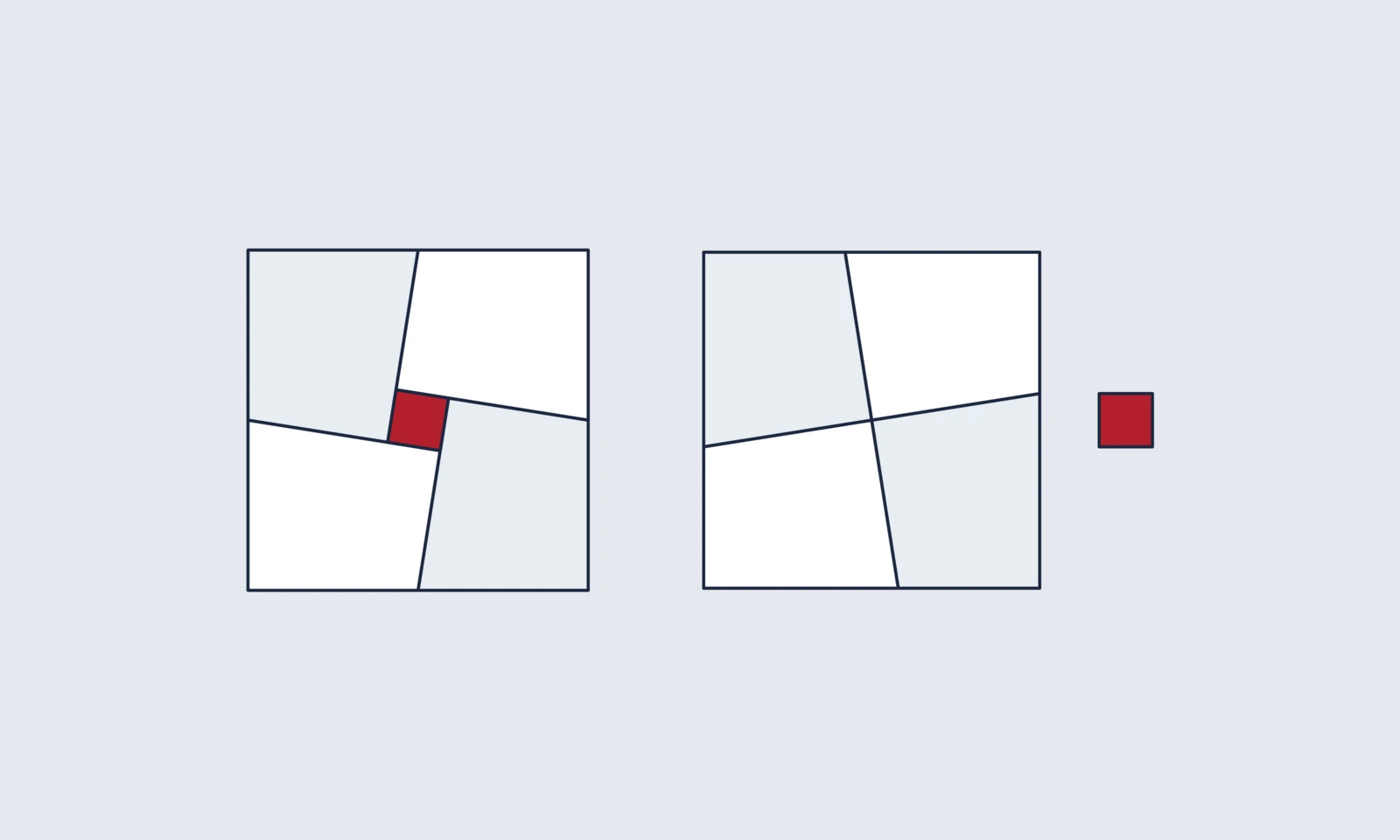
Here is the whole thing. A square is cut into four identical pieces with a small square sitting in the middle. You lift the pieces out, turn each one around and put them back. They close into a solid square that looks every bit as big as the first one, and the small square is left over in your hand.
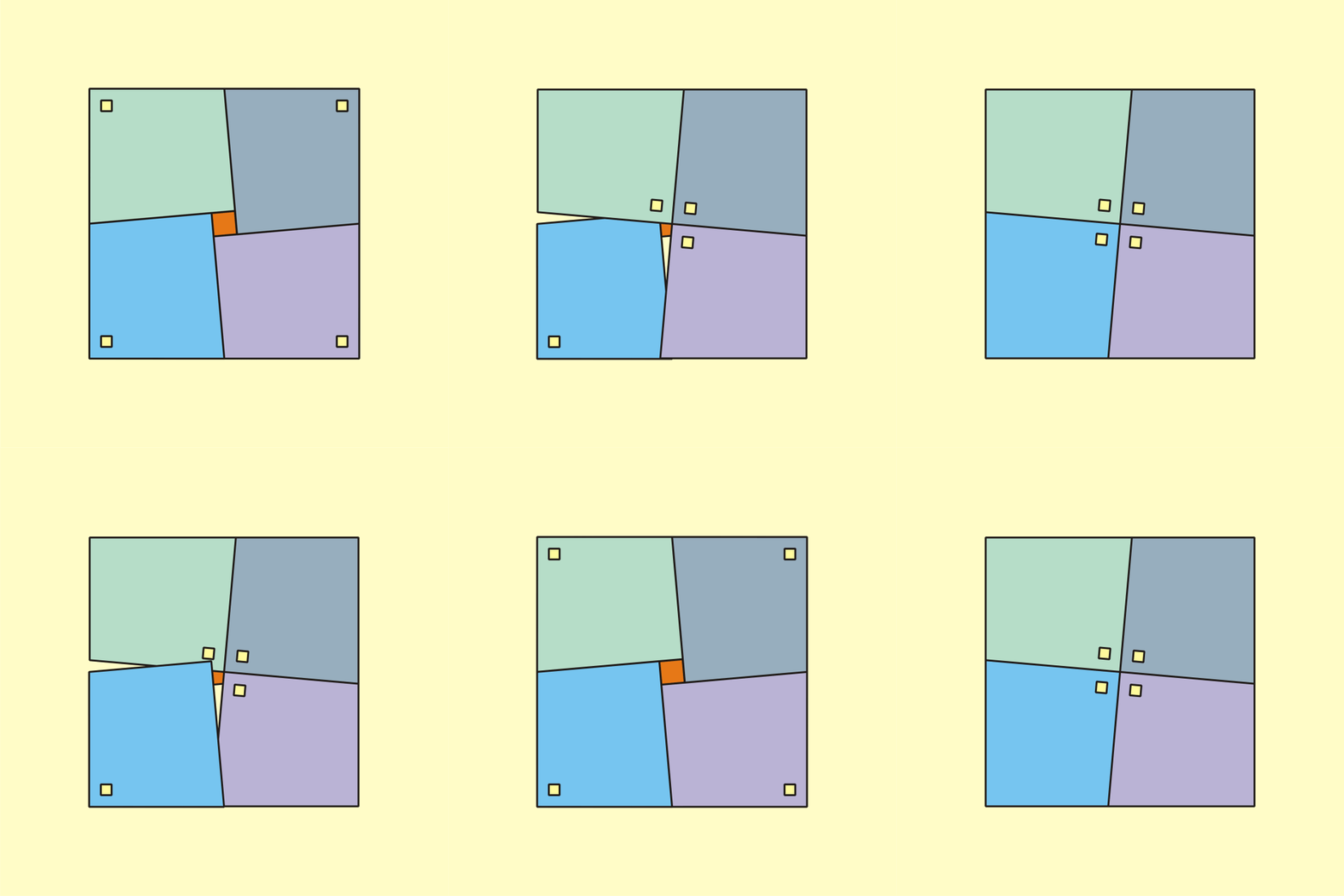
Of all the vanishing-area puzzles, this is the one I like best, because it cheats the least. In the famous missing-square triangle, the long edge that looks like a hypotenuse is bent, and the eye simply fails to notice the kink. Matsuyama’s version has no kink to find. Every edge is straight, the four pieces are congruent, and the pieces are only rotated, never squashed or stretched. If the pieces keep their area and the small square keeps its area, the only thing left that can change is the frame. It does.
Provenance
A name with almost nothing behind it
The puzzle carries the name of Mitsunobu Matsuyama, and the name is nearly all anyone has. One writer who set out to profile him gave up after finding hardly any information at all. What survives is a paper trail through magic journals. Matsuyama’s “Paradox” ran in issue 18 of Karl Fulves’s The Chronicles, and a magic historian tracing it back credits the idea first to Masao Atsukawa, whose version appeared in New Magic in September 1967, and then to Yasuo Kiga. For magicians it lived as a card trick — a large playing card cut into pieces that reassemble with a piece to spare — and Paul Daniels performed a version of it on television.
The family is much older than any of these names. Martin Gardner traced the missing-square triangle to Paul Curry, an amateur magician in New York, in 1953, while dissection paradoxes of this kind go back to the start of the sixteenth century — the same decades that produced the geometry packed into Dürer’s Melencolia I. Most people now meet Matsuyama’s puzzle as the looping animation above, which has been going around since at least 2015.
Construction
How the pieces are cut
Take a square with side L. Draw two perpendicular lines through its centre, both tilted a few degrees away from the sides, and call the tilt θ. The square falls apart into four congruent quadrilaterals. Each one has two right angles, one at the centre where the cuts cross and one at the old corner of the square.
The two cut edges that meet at the centre are equal, each L / (2 cos θ) long. The two outer edges are not equal. The tilt pushes one of them forward and pulls the other back, so one runs (L/2)(1 + tan θ) and the other (L/2)(1 − tan θ). Every piece carries one long outer edge and one short one, and the whole puzzle lives in the difference between them.
Identity
What the turn does
Now turn each piece so that its centre corner goes out to a corner of the frame and its old corner points inward. Two things happen together. The outside of the new square is now built from the equal cut edges, two to a side, so the side becomes L / cos θ, a little longer than L. On the inside, each long edge overhangs its neighbour’s short edge by L tan θ, which leaves a square hole exactly that wide in the middle. The small square drops into it and the square is whole.
Put the two arrangements side by side and write down the areas.
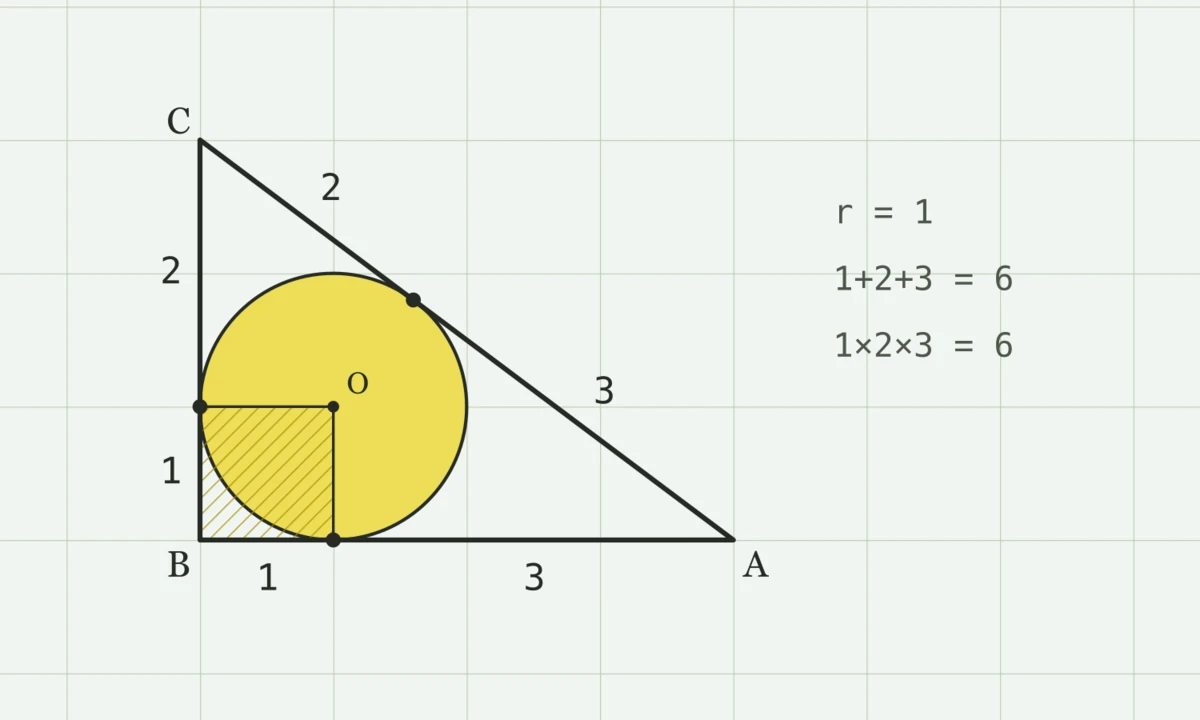
That is 1 + tan²θ = sec²θ, the Pythagorean identity, and it balances to the last decimal. The four pieces make the square on one leg of a right triangle, the small square is the square on the other leg, and the finished square is the square on the hypotenuse. The triangle has legs L and L tan θ, with the angle θ between the long leg and the hypotenuse. Matsuyama’s paradox is a proof of Pythagoras’s theorem for a very thin triangle, performed by someone who would rather you did not notice it was a proof. It belongs on the shelf with the proof a sitting congressman published in 1876 and with the ninety-nine ways of writing down a single argument.
Priority
Perigal got there first, on purpose
The cut is not new. Henry Perigal, a stockbroker and amateur mathematician who lived from 1801 to 1898, found this five-piece dissection, printed it on his business cards and had it carved on his tombstone. He published it in the Messenger of Mathematics in 1872, and J. W. L. Glaisher added a note pointing out that its elegance came from the four pieces being identical, which made the division symmetrical. Perigal picked a triangle that lets you see the argument, the way Byrne coloured Euclid so the proof could be read at a glance. Matsuyama keeps the angle so small that the argument disappears, and the same five pieces turn from a proof into a trick. Perigal also held on, to the end of his life, to the belief that the moon does not rotate on its axis.
Perception
Why the eye signs off on it
Put numbers on a real puzzle. Say the square is 10 centimetres across and the cuts are tilted 5 degrees. The hole in the middle is 8.75 millimetres wide. The frame grows from 100.00 to 100.38 millimetres, a difference of 0.38 millimetres, the width of the line a 0.38 gel pen draws. The small square’s 0.765 square centimetres is 0.77 percent of the puzzle, and it has not vanished. It has been spread into a strip 0.19 millimetres wide running around all four edges.
The reason for the mismatch is the most useful thing in the whole puzzle. The width of the hole grows with tan θ, which for small angles is about θ itself. The growth of the frame follows 1/cos θ − 1, which is about θ²/2. One is first order and the other is second order, so the ratio between them comes out near 2/θ, with θ in radians. At 5 degrees the hole is 23 times wider than the frame’s growth. Halve the angle and the hole gets half as wide, while the frame’s growth drops to a quarter.
The eye judges two squares by setting them next to each other, and a 0.4 percent change in a side is below what anyone sees without a ruler. The hole, meanwhile, sits in the middle in a different colour, exactly where attention goes. The puzzle puts the missing area where you are looking and the extra area where you are not — the same lever that makes two identical shapes refuse to look identical.
Try it
Turn the pieces yourself
Drag the angle and turn the pieces. The dashed outline is the original frame, so the thin gap between it and the pieces is where the red square ends up.
- Pieces alone
- 100.00 mm
- Pieces with the red square
- 100.55 mm
- Width of the red square
- 10.51 mm
- Hole width ÷ frame growth
- 19.1×
For a 100 mm puzzle, the width of the red square climbs in a straight-looking line while the growth of the frame hugs the floor. The first is order θ, the second order θ².
In the hand
It survives being handled
The physical versions hold up because a gap of 0.19 millimetres per side disappears inside the ordinary play of a tray. One maker cut the pieces on a laser to prove to himself it was not a trick, found that it is not, and has made it both 2 inches and 8 inches wide. Size cannot matter, because every length scales together and the fraction that goes into the frame depends on the angle alone. That is what makes it a good object to own rather than only to read about, like a set of calculating rods you work with your hands or a printed solid that only lines up from one angle.
If you have a printer, there is a ready model for it: Matsuyama’s Paradox Puzzle on MakerWorld, with the profile set up and ready to slice.
Shrink the angle to 1 degree and the hole on a 10 centimetre puzzle is still 1.75 millimetres wide, while the frame changes by 15 microns, less than the thickness of a human hair. The proof is still exact, and exactness is the part that never negotiates. Only your eyes do.
Sources
- Mitsunobu Matsuyama, “Paradox,” in Karl Fulves, The Chronicles, issue 18; with earlier versions credited to Masao Atsukawa (New Magic, September 1967) and Yasuo Kiga.
- Henry Perigal, dissection proof of Pythagoras’s theorem, Messenger of Mathematics, 1872, with J. W. L. Glaisher’s note on the symmetry of the four identical pieces.
- Martin Gardner on the missing-square triangle and its descent from Paul Curry, 1953.
- The geometry, the millimetre figures and the plot above, worked out for this piece.