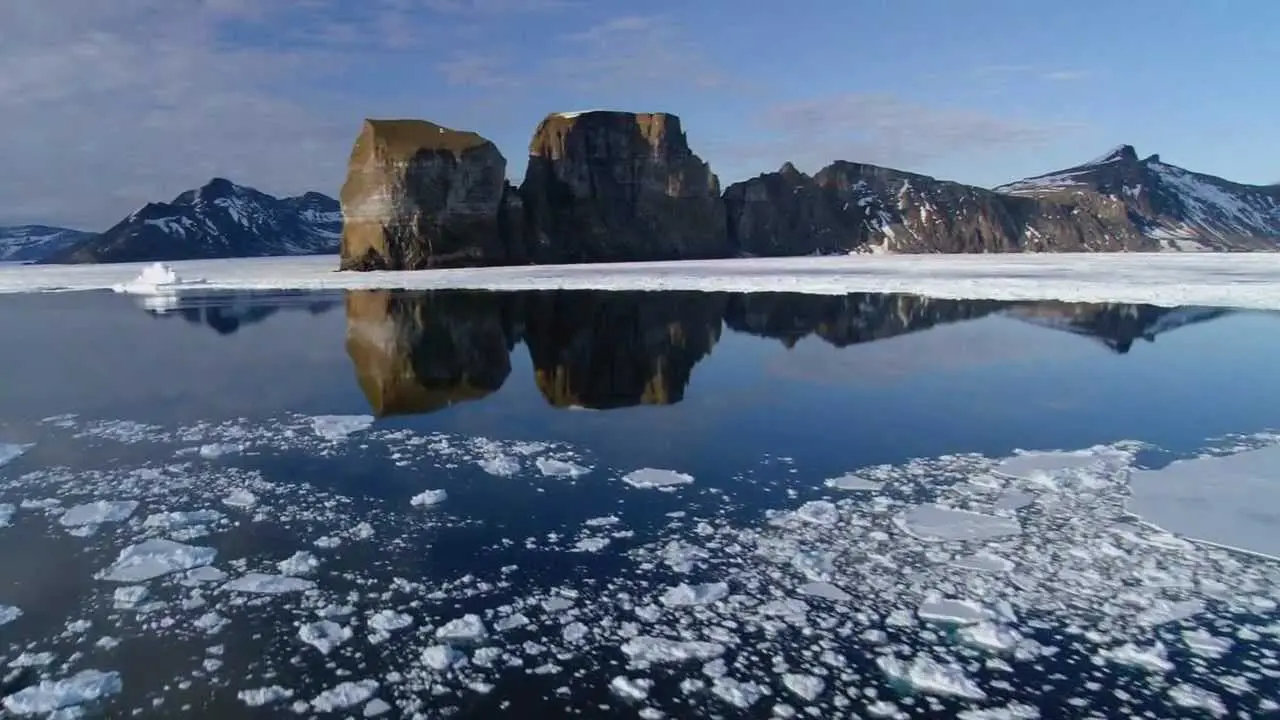
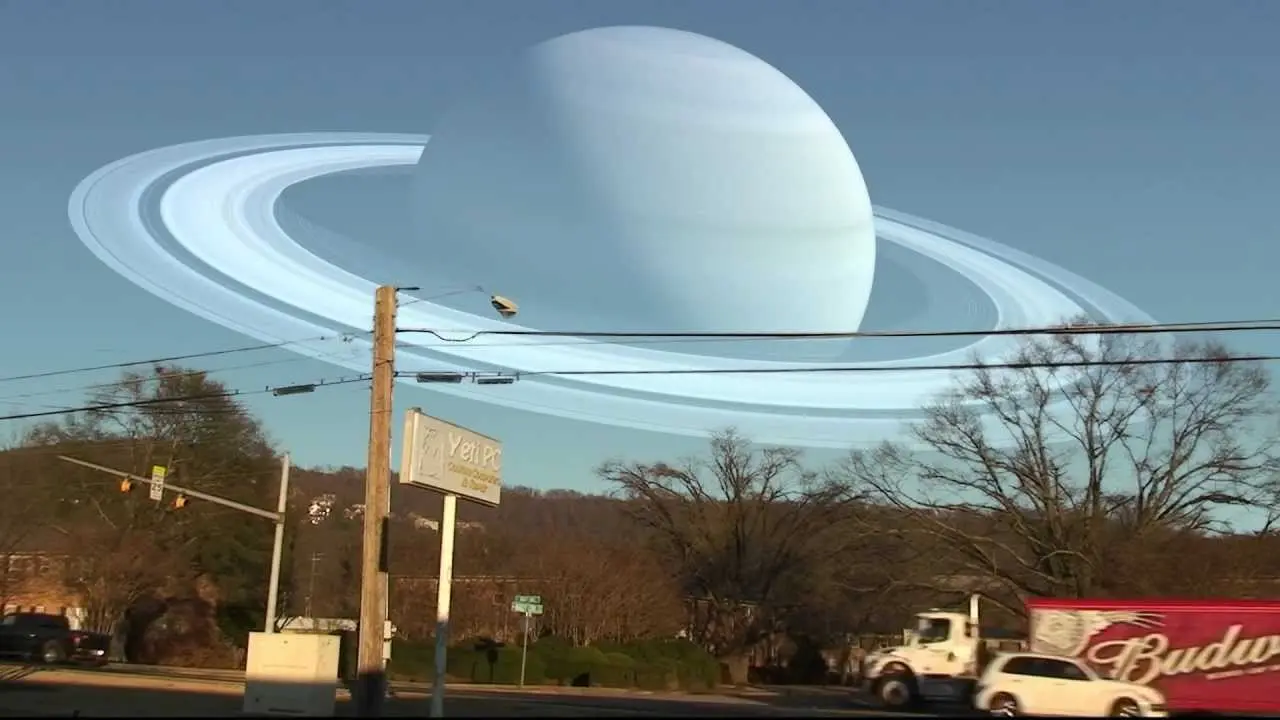
The idea fits in one sentence. Leave everything about the Earth alone, take the Moon away, and put another planet at exactly the same distance, 384,400 kilometres. Then look up. The animation does just that, one planet after another, above an ordinary street with power lines, bare trees and traffic going past. Nothing else changes. The sky simply gets bigger, and then it gets absurd.
It works because we have no feeling for how small the Moon really is. It looks big, especially low on the horizon, but it covers about half a degree of sky. Hold your little finger out at arm’s length and the full Moon hides behind the nail. Every planet in the video is measured against that tiny coin, and most of them are not small at all.
The arithmetic
How big would each planet look?
The size of something in the sky depends on just two numbers: how wide it is and how far away it is. Divide the radius by the distance, take the arctangent, double it, and you have its angular diameter. Since every planet here sits at the Moon’s distance, the only thing that changes is the width. A planet twice as wide as the Moon looks twice as wide. That is exactly what Mars is.
- Moon0.52°the coin behind your fingernail
- Mercury0.73°barely bigger; you might not notice
- Mars1.0°twice the Moon's width, four times its area
- Venus1.8°almost Earth-sized, and blindingly bright clouds
- Neptune7.3°fourteen Moons across
- Uranus7.6°a pale cyan ball the size of a fist
- Saturn17°the rings alone stretch about 39°
- Jupiter21°forty Moons across; a hand held out can't cover it
Area grows with the square of the width, which is why the gas giants feel so overwhelming. Jupiter is about 40 times as wide as the Moon on the sky, so it covers about 1,600 times as much of it. Pick a planet below and see it at true scale, in a 60° slice of night sky with the real Moon in the corner for comparison.
21°
across the sky
40×
the Moon's width
1,584×
the Moon's area in the sky
25,851×
the Moon's tidal pull
Jupiter at 384,400 km would look about an outstretched hand at arm's length.
Saturn
The rings would cross a fifth of the sky
Saturn is the frame everyone waits for. The planet itself would be about 17° wide, a little smaller than Jupiter. But its main rings reach out to roughly 137,000 kilometres from the centre, and at the Moon’s distance that is about 39° from edge to edge. Two outstretched hands, side by side, would not cover it. In the still above, the rings run from one side of the frame almost to the other.
The Moon fits behind a fingernail. Saturn’s rings would need both your hands.
What the video leaves out
The view is the gentle part
The animation is about the view, and that is the right choice. Physics would not be as kind. Tides depend on the mass of the body pulling on the oceans, and at the same distance the pull scales with mass alone. Mars would raise tides about nine times stronger than the Moon’s. Venus, about 66 times. Jupiter has roughly 26,000 times the Moon’s mass.
25,850×
Jupiter’s mass compared with the Moon’s. At the same distance, that is how much stronger its tidal pull on Earth would be.
And with a gas giant, the question of who orbits whom flips. The Earth would not have a new moon. It would be the moon. Jupiter’s own Io circles at about 421,700 kilometres, so an Earth at 384,400 would sit just inside Io’s orbit, one more world in a crowded system. The animation keeps the ground still and the sky calm. Reality would not.
Why it stays with you
A lesson in scale you can feel
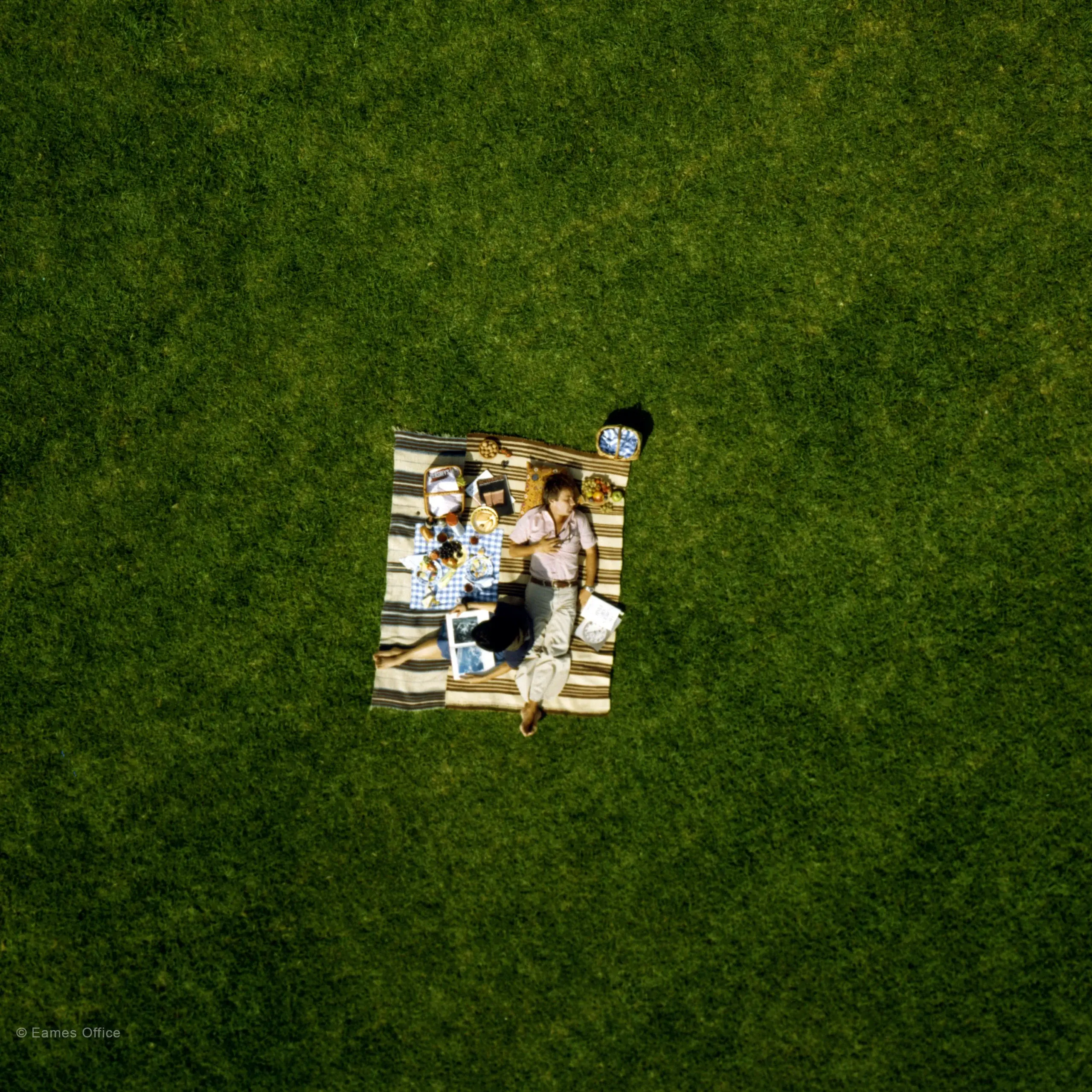
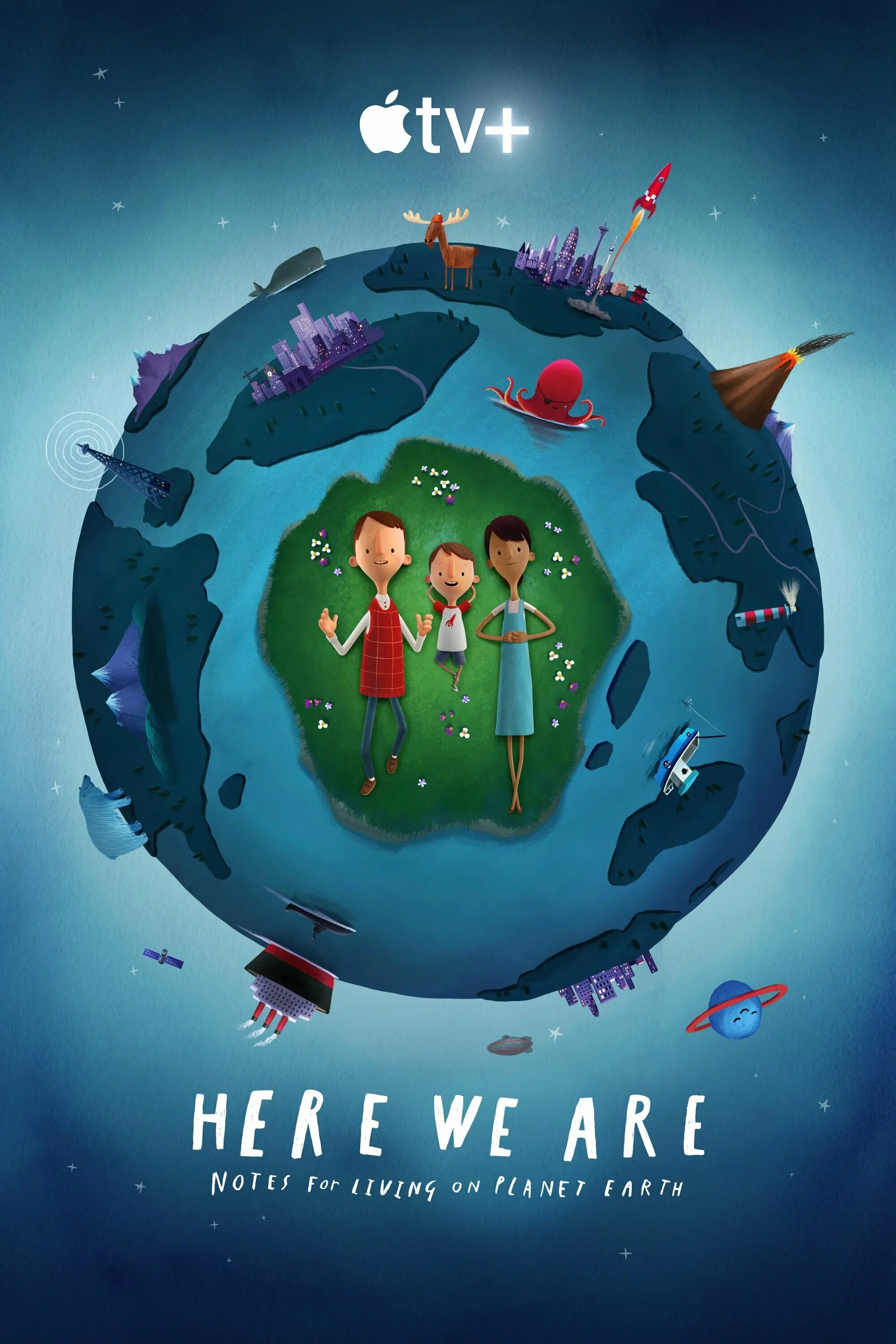
Most attempts to show the size of the Solar System use numbers that are too big to mean anything. This one uses your own sky. You know how the Moon looks over a road or a field, so when Jupiter rises in the same spot your body understands the ratio before your head does. It is the same trick as Powers of Ten, which moves you outward by factors of ten from a picnic blanket, and of Here We Are, which starts from the Earth itself.
It also makes the real Moon feel more special. It is small, close and just the right size to cover the Sun exactly during a total eclipse. Only twelve people have ever walked on it, and you can meet them in the people who walked on the Moon. If you like asking how real space looks next to the film version, try how realistic Interstellar is. And for the humans up there tonight, there is a live count of people in space.
Try it outside
Your hand is a built-in protractor. At arm’s length, your little finger covers about 1°, your closed fist about 10°, and your spread hand, from thumb tip to little finger tip, about 20°. Next time the Moon is up, cover it with your little finger. Then spread your hand: that is Jupiter.
Sources
- “If the Moon were replaced with some of our planets,” yeti dynamics, YouTube.
- NASA Planetary Fact Sheets: radii, masses and the mean Earth–Moon distance.
- Angular sizes and tidal ratios calculated by Abakcus from those values.