
Juggling seven balls is already something very few people on Earth can do. Throw all seven to the same height and pass each one from hand to hand, and you have the seven-ball cascade, which on its own takes years to hold steady. The pattern called 966 asks for more. Its seven balls don’t share a height. Three of them climb almost twice as high as the cascade and cross between the hands, while the other four turn lower down, and each of those four stays in one hand from the first throw to the last.
All of that motion, which looks like chaos at first, is written in three digits. Once you can read them, you can predict the pattern before you see it, check whether it is even possible, and count every pattern of its kind. That is the strange gift of siteswap: it turns a physical skill into a small piece of number theory, the kind of unexpected answer to what mathematics is good for that nobody planned.
01 · The notation
What the digits count
Siteswap was invented three times, almost at once. Paul Klimek worked it out in Santa Cruz in 1981. Bruce Tiemann and Bengt Magnusson reached it at Caltech in 1985, and Mike Day, Colin Wright and Adam Chalcraft arrived at the same idea in Cambridge around the same years, none of them aware of the others. The idea is to cut time into equal beats. On every beat one hand throws, and the hands take turns: right, left, right, left. Each throw gets a number, and the number says how many beats later that same ball will be thrown again. A 3 goes back up three beats later, a 9 nine beats later. A ball that must stay up longer has to go higher, so the bigger the digit, the higher the throw.
Because the hands alternate, odd and even decide where a ball lands. Odd numbers send it to the other hand, even numbers bring it back to the hand that threw it. The three-ball cascade everyone learns first is therefore a single digit, 3, repeated forever as 333…. The four-ball fountain, where each hand circles its own two balls, is 4, and the seven-ball cascade is 7. A few small digits are special. 0 is an empty hand, 2 is a ball simply held for a moment, and 1 is a ball handed straight across to the other hand.
To find how many balls a pattern needs, take the average of its digits. For 966 that is (9 + 6 + 6) / 3 = 7. The reason is a piece of bookkeeping. A ball thrown as an n belongs to that throw for n beats, then moves on to its next throw, and no ball is ever idle. Over one three-beat round, seven balls account for 7 × 3 = 21 ball-beats, and that has to be exactly the sum of the digits.
21 ÷ 3 beats = 7 balls
The average of the digits is the number of balls in the air. The rule holds for every valid siteswap.
02 · The test
Not every sequence is a pattern
A whole-number average is necessary, but it isn’t enough. 765 averages 6, and you still can’t juggle it with six balls or any other number. The 7 thrown on beat zero lands on beat seven. So does the 6 thrown on beat one, and so does the 5 thrown on beat two. Three balls arrive in the same hand at the same instant.
The check takes ten seconds. Number the digits 0, 1, 2 and so on, add each digit to its own position, and take the remainder when you divide by the length of the sequence. If every remainder is different, exactly one ball comes down on every beat and the pattern works. If a remainder repeats, two balls collide somewhere.
| Position | 0 | 1 | 2 |
|---|---|---|---|
| Throw | 9 | 6 | 6 |
| Sum | 9 | 7 | 8 |
| Remainder | 0 | 1 | 2 |
| Position | 0 | 1 | 2 |
|---|---|---|---|
| Throw | 7 | 6 | 5 |
| Sum | 7 | 7 | 7 |
| Remainder | 1 | 1 | 1 |
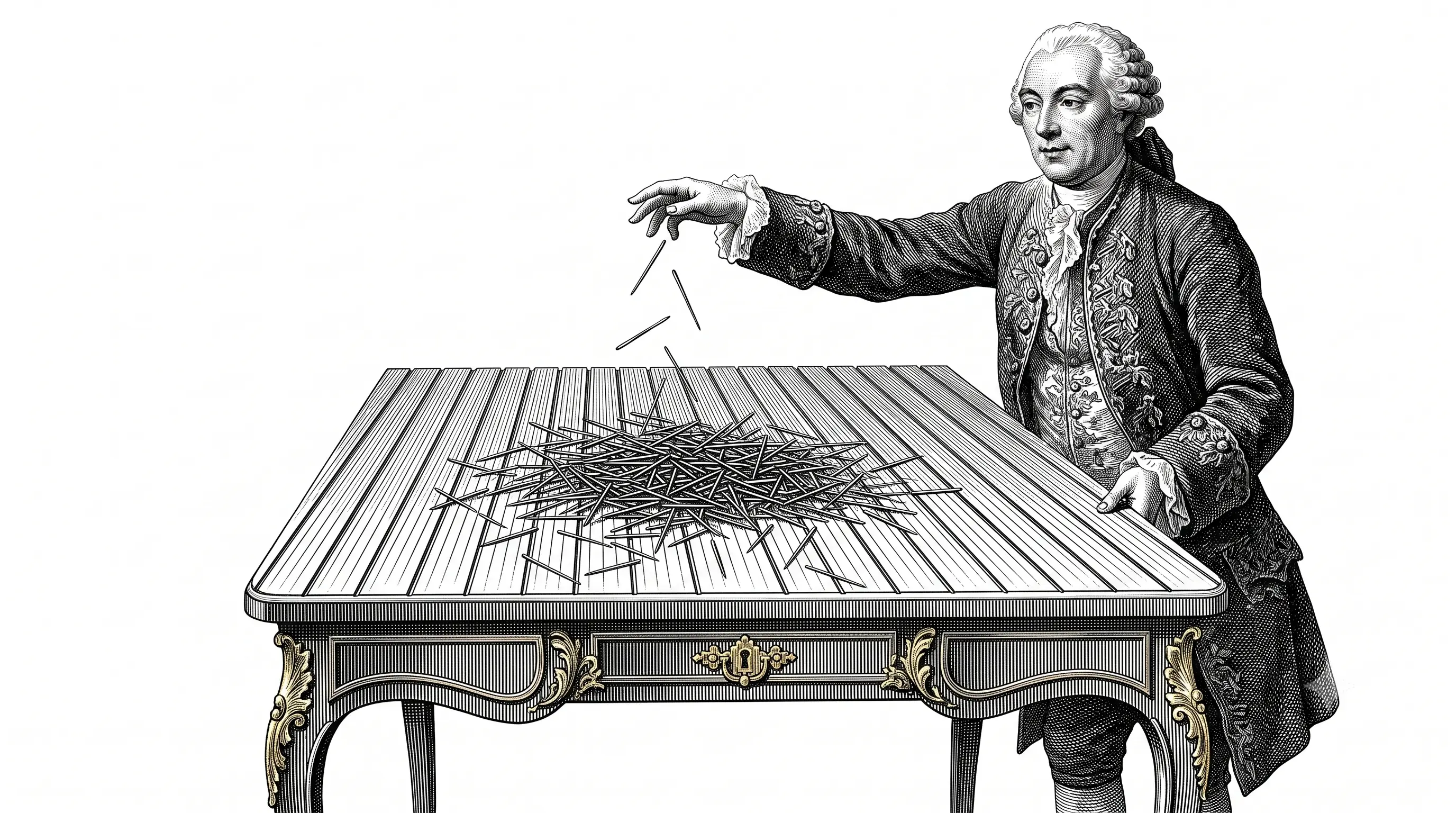
The same test makes it possible to count patterns. In 1994 Joe Buhler, David Eisenbud, Ron Graham and Colin Wright proved that the number of valid sequences of length n using exactly b balls is (b + 1)ⁿ − bⁿ. For seven balls over three beats that gives 8³ − 7³ = 512 − 343 = 169. The count treats rotations as different, so 966, 696 and 669 appear on the list as three sequences, with 777 and 975 right beside them. It is the same turn that Buffon’s needle takes, where a toss of the hand ends up as a clean formula.
03 · The physics
Why the nine goes twice as high
After catching a ball, a hand holds it for roughly one beat before throwing it again, so a ball marked n spends about n − 1 beats in the air. The height of a throw grows with the square of its flight time, so comparing two heights only takes two squares. In the seven-ball cascade every ball flies for about 6 beats. The 9s of 966 fly for 8 and the 6s for 5. That gives 8² / 6² = 64 / 36 ≈ 1.78 and 5² / 6² = 25 / 36 ≈ 0.69: the 9s rise almost twice as high as the cascade, the 6s about two thirds of it, which is exactly how jugglers describe the pattern.
The first person to write down the link between timing and the number of balls was Claude Shannon, whose information theory sits among the equations that changed the world. Around 1980 he wrote a paper on the science of juggling, built juggling machines in his home workshop and stated what is now called Shannon’s juggling theorem, (F + D) H = (V + D) N. F is the time a ball spends in the air, D the time it spends in a hand, V the time a hand stays empty, H the number of hands and N the number of balls. Siteswap is the same bookkeeping, sliced into beats like the ticks of a metronome.
(F + D) H = (V + D) N
Shannon’s juggling theorem
04 · The orbits
Who holds the seven balls
What makes 966 special is that its balls never swap roles. A ball thrown as a 9 on beat zero lands on beat nine, and since nine is a multiple of three, beat nine is a 9 position again. The ball is thrown as a 9 in the next round, and the next. The same arithmetic holds for the 6s: six is also a multiple of three, so a ball thrown from a 6 position always comes back to that same 6 position. Once a 9, always a 9. Once a 6, always a 6. Jugglers call these closed loops orbits.
To see how many balls ride each orbit, divide the throw by the length of the round. The 9s carry 9 / 3 = 3 balls, and each of the two 6 positions carries 6 / 3 = 2, so 3 + 2 + 2 = 7. Because 6 is even, those four low balls never cross. Each hand keeps one navy ball and one red ball of its own and never lets them visit the other side. The three high balls, thrown with an odd number, cross on every throw, and up above the rest they form a slow three-ball cascade of their own.
Because the round has an odd length, the two hands do the same job. The right hand throws 9, 6, 6, and the left hand throws the same 9, 6, 6 three beats later. In the ladder diagram at the top, the orange arcs always cross to the other line while the navy and red arcs always return to their own. Pick one of the low balls in a video of 966 and follow it, and you’ll see it turn in the same hand for as long as the pattern runs.
05 · The family
The middle of a family
966 doesn’t stand alone. Add the same number to every digit and all the remainders shift together, so a valid pattern stays valid, now with one extra ball for every unit added. That is why 744 is the five-ball cousin of 966. Read the family from the bottom: 633 with four balls, 744 with five, 855 with six, 966 with seven and a77 with eight. A second rule lets you add or subtract the length of the round from a single digit. Take 3 from the 9 of 966 and you get 666, the six-ball fountain. Add 3 to one of its 6s and you get 996, with eight.
966 also has a practical advantage: it is a ground-state pattern. A juggler running the seven-ball cascade can throw 966 at any moment without transition throws and drop back into the cascade just as cleanly. That is how most people learn it, by settling the cascade first, then slipping a single 966 into it, then two, then a run. The digits say the move is possible long before the hands agree.
Sources
- “966,” Juggling Wiki.
- Joe Buhler, David Eisenbud, Ron Graham and Colin Wright, “Juggling Drops and Descents,” American Mathematical Monthly, 1994.
- Claude E. Shannon, “Scientific Aspects of Juggling,” written around 1980, reprinted in his Collected Papers, 1993.
- Burkard Polster, The Mathematics of Juggling, Springer, 2003.