Ask a room full of people who has seen a rainbow and every hand goes up. Ask them which colour is on the outside, how big the bow is, or what the sky looks like just beyond it, and the hands come down. Most of us have looked at rainbows the way we look at paintings in a museum we wander through: pleasantly, and without seeing much. Seeing takes knowing what to look for.
A rainbow is one of the few spectacles in nature you can explain completely with school mathematics, and the explanation makes it more beautiful, not less. Once you know it, you will start checking every rainbow you meet against it, and finding things you never noticed: a second bow, a dark band, pale extra stripes, a sky that is brighter on one side of the arc than the other. It starts with six questions.
Try them now, honestly, before reading anything else. Most people get one or two right. We’ll come back to these at the end.
Six questions about rainbows
Answer before you read on
01What is the radius of a rainbow?
02In the main bow, where is the red?
03Is the sky brighter inside the bow or outside it?
04Where should you look for a second bow?
05What is the colour order of the second bow?
06Where is the sky darkest?
0 of 6 answered
Everything that follows comes from one beam of sunlight and one drop of water. The physics is old: a medieval monk, a Persian scholar, Descartes and Newton worked out most of it. The ideas fit on a single blackboard. You need one law, one bit of trigonometry and a willingness to follow a ray of light around the inside of a sphere.
Chapter I
Light bends
Two things happen whenever light reaches water: some bounces back, the rest goes in and changes direction.
Shine a narrow beam of light at a pool of water. Part of it reflects. The angle it bounces off at equals the angle it came in at, measured from the line perpendicular to the surface. Physicists call that perpendicular line the normal, and the incoming angle the angle of incidence. That much is a mirror.
The rest of the light enters the water and bends toward the normal. This is refraction, and it happens because light travels more slowly in water than in air. Every transparent material has an index of refraction, written n, that tells you how much slower: the speed of light in a vacuum divided by n. Air is about 1.00, almost exactly the same as a vacuum. Water is about 1.33, which means light inside it moves about a quarter slower, roughly 225,000 kilometres a second instead of 300,000.
1.00
index of refraction of air, practically the same as empty space
1.33
water: light travels about 25% slower than in air
225,000
kilometres per second, the speed of light inside a raindrop
In 1621 the Dutch mathematician Willebrord Snellius found the rule that connects the two angles. Call the angle in the air α and the angle in the water β. Then:
n₁ · sin α = n₂ · sin β
n₁ and n₂ are the indexes of the two materials. For air into water, n₁ = 1 and n₂ ≈ 1.33.
If you never learned what a sine is, here is all of it. Draw a right triangle with the angle α in one corner. Divide the side opposite α by the longest side. That ratio is sin α. If α is 0°, the opposite side has no length and the sine is 0. At 30° the sine is exactly 0.5. At 90° it reaches 1, and it never goes higher. If you want the longer version, with a circle that makes every angle at once, it’s in our guide to the unit circle.
A worked example. Light arrives from the air at 60°. Then sin 60° = 0.866. Divide by 1.33 and you get sin β = 0.651, so β is about 40.6°. The light comes in steep and leaves at a shallower angle, bent toward the normal. Shine a green laser pointer into a tank of water in a dark room and you can watch exactly this: a faint reflected beam going one way and the bright refracted beam bending down the other. Try it yourself:
Snell’s law, by hand
Bend a beam of light
1.00 × sin 60° = 1.33 × sin β
0.866 = 1.33 × sin β → sin β = 0.650
Light slows to about 224,900 km/s in water. The slower it goes, the harder it bends.
Flip the experiment around with the “Leaving it” switch and something remarkable appears. Going from water back into air, light bends away from the normal, and past about 48.6° it cannot get out at all. The surface turns into a perfect mirror. You won’t need that to explain a rainbow, but it’s worth knowing that the back wall of a raindrop is never fully a mirror and never fully a window. It always does a little of both, and that will matter later.
If you’d rather measure the speed of light than take the textbook’s word for it, you can do it in a kitchen with a bar of chocolate and a microwave.
Chapter II
Inside a single drop
In through the front, a bounce off the back, out again. Then measure the angle.
Now draw a circle. This is one raindrop, and a falling raindrop really is close to a sphere when it’s small. Sunlight floods the whole half that faces the sun. Pick one thin beam out of all that light, coming in at an angle of incidence of 60°.
At the first point, call it A, the two things from Chapter I happen. A little light reflects away and the rest refracts into the drop at an angle r, given by Snell’s law. It crosses to the back of the drop, point B. There, again, two things: some light escapes out the back, and some reflects. Because the drop is a sphere, the reflected beam makes the same angle r with the surface it just met. It crosses to point C, where most of it refracts back out into the air, and, a short exercise with Snell’s law shows, leaves at the same angle i it came in with.
The question is how much the light has turned. Measure the angle between the light leaving the drop and the direction straight back toward the sun. Call it φ. Count the angles around the triangle inside the drop (there are four copies of r and two of i in play) and the algebra settles into a one-liner:
φ = 4r − 2i
φ is the angle between the outgoing light and the line pointing straight back at the sun.
Check it on the easiest case. A beam that hits dead centre has i = 0, goes straight through to the back, reflects straight back the way it came and comes out along the line it went in on. Then r = 0 and φ = 0. The formula agrees. Now move the beam up the face of the drop and see what φ does.
One raindrop, one beam
Refract · reflect · refract
i = 60° · r = 40.57° · n = 1.3316
φ = 4r − 2i = 4·40.57 − 2·60 = 42.28°
The largest φ any red ray can reach is 42.3°, at i ≈ 59.5°. Try to beat it.
Something unexpected happens. As the beam strikes higher on the drop, φ grows: 0°, then 10°, 20°, 30°. But it doesn’t keep growing. Near i = 60°, φ stops climbing at about 42°, and as you push i higher still, φ turns around and shrinks. Press “Rainbow ray” to jump to the peak, then nudge the slider either way and watch the number fall.
Work it out with a calculator, ten degrees at a time, and you get the table below, with the curve behind it. The top of that curve is the most important number in this whole article.
The angle that refuses to grow
φ against i
■ red: φ = 35.45°
■ green: φ = 35.04°
■ blue: φ = 34.43°
| i | r | φ = 4r − 2i |
|---|---|---|
| 0° | 0.0° | 0.0° |
| 10° | 7.5° | 9.9° |
| 20° | 14.9° | 19.5° |
| 30° | 22.0° | 28.1° |
| 40° | 28.8° | 35.3° |
| 50° | 35.1° | 40.3° |
| 60° | 40.5° | 42.1° |
| 70° | 44.8° | 39.3° |
| 80° | 47.6° | 30.5° |
| 90° | 48.6° | 14.4° |
Ten-degree steps, n = 1.333. Up, up, up, then back down.
Light that bounces once inside a raindrop can come out at 42° or less. Never more.
Finding the peak exactly takes a little calculus (set the derivative of 4r − 2i to zero), which you can skip here. René Descartes found it in 1637 without calculus, by brute force, tracing ray after ray through a drop on paper and noticing where they crowded together. The rays near the peak are special: a whole range of incoming beams leaves at almost the same angle. Physicists call that ray the rainbow ray, and the crowding it produces is the rainbow.
Chapter III
Every colour has its own angle
Water bends blue a little more than red. That one fact paints the bow.
The index of refraction isn’t one number. It depends on colour. For red light in water it’s about 1.332; for blue it’s about 1.343. Small difference, big consequences. Run the same calculation and red’s maximum angle comes out at 42.3°, blue’s at 40.7°. Every colour in between has its own peak in between.
42.3°
the largest angle at which red light can leave a drop after one bounce (n = 1.332, i ≈ 59.5°)
40.7°
the largest angle for blue (n = 1.343, i ≈ 58.9°). Everything else sits between the two.
Why stop at blue and not violet? Sunlight does contain some violet, but not much, and our eyes are poor at seeing it, so violet is hardly ever visible in a real bow. This page stops at blue.
A cone of light
Here is the key question. One drop, sunlight falling on half of it. What does that one drop do with white light? Take red first. The beam we traced came in at 60° along one line on the drop’s face. But every point on a ring around the drop’s face also has an angle of incidence of 60°. Picture that ring drawn on a ball, a circle around its sunward side. Each of those beams does the same thing on its own side of the drop and comes out at 42°.
Put all those exit rays together and you get a cone: one drop throws back a cone of red light, 42° wide on each side of the line pointing back at the sun. Red light fills the whole cone, because smaller angles are allowed. Nothing red comes out beyond its edge. Blue makes a slightly narrower cone, 40.7°. Every other colour makes its own cone nested between them. Outside the widest cone the drop sends nothing at all.
So what colour is the light deep inside the cones? Every colour reaches there. They mix. It’s white. Only at the rims, where the red cone extends past the green and the green past the blue, does one colour stand alone.
The objection a smart physicist would raise
There’s a catch, and a careful reader will spot it. At the angle where blue reaches its edge, red and green are still allowed too. So that ring should look whitish, not blue. Why does anyone see a blue band at all?
Because light isn’t spread evenly across the cone. Remember how the curve flattens at the top: many incoming beams pile up at nearly the same exit angle. So each colour has a spike of brightness right at its own maximum. At 40.7° the blue light is spiking while red and green are only at their ordinary level, and blue wins. At 42.3° only red is left, also spiking. The rim is not only coloured; it is the brightest part of the whole pattern. Here is that pattern, computed for 60,000 rays per colour, as it would look thrown on a wall:
Why the edge outshines the middle
One drop, projected on a wall
Every colour lights the whole inside of its own cone, so the middle is white. But each colour also piles up at its own maximum angle, and those spikes sit side by side: blue at 40.7°, red at 42.3°. The edge is where colour wins.
You can see this pattern for real with one large drop of water. More on that at the end. For now, notice that a spectrum and a rainbow are different things. A prism, or the grooves of a CD, spread colours out side by side. You can build your own in an afternoon with an old CD and a cereal box. A rainbow does something more: it spreads them out and concentrates each one at a sharp edge.
Chapter IV
From one drop to a whole sky
Turn your back to the sun. The bow is centred on the shadow of your own head.
Now look up. The sun is so far away that its rays arrive parallel, and every raindrop in the sky receives light from the same direction. So every drop throws back the same cone, pointed the same way, back at the sun. You, standing with the sun behind you, are looking into a sky full of identical cones.
Draw a line from the sun through your head and keep going. It hits the ground at the shadow of your head. Physicists call the point it aims at the antisolar point. Now the question for each drop is simple: how far is it, in angle, from that line?
A drop that sits more than 42° from the line sends you nothing. You’re outside its cone. A drop well inside that angle sends you white light. You’re looking into the heart of its cone, where all colours mix. And a drop exactly 42° away sends you red, and only red, because you are standing right on the rim of its red cone. Look a little closer to the centre, at 40.7°, and the drops there send you blue.
Which drop sends you which colour?
Sweep your gaze
White light. Every colour leaves this drop toward you at once, so they mix.
It doesn’t matter whether the drop is a kilometre away or at your feet. Only the angle counts. And the angle doesn’t care about direction: 42° above the line, 42° to the left, 42° to the right are all the same. The drops that send you red therefore lie on a circle around your head’s shadow. That’s why a rainbow is a bow. It is the edge of a cone with its tip in your eye.
A rainbow isn’t an object in the sky. It’s a direction. Everyone who sees one sees their own.
That one idea explains a stack of things people find strange about rainbows. You can never reach the end of one, because it moves when you move. The person beside you sees a bow made by a slightly different set of drops. Each of your eyes, strictly, sees its own. And the bow is always exactly opposite the sun, with its centre as far below the horizon as the sun is above it.
Which is why rainbows belong to the morning and the late afternoon. Drag the sun higher in the sky machine below and watch the bow sink. Once the sun climbs past 42°, the top of the bow drops below the horizon and, from the ground, there is no rainbow at all. Lower the sun to the horizon and the bow becomes a perfect half circle. From a plane, or a hill, or a hose aimed downward, you can see more than half, and sometimes the whole ring.
The sky machine
Drag the sun · change the drops
Cross-section · brightness from 30° to 60° away from your shadow
Red outside, blue inside, a bright sky within the bow and a dark band between the two bows.
So the first three questions are answered. The radius is always about 42°. Red is always on the outside of the main bow. And the sky inside the bow is brighter than the sky outside, because every drop inside sends you some white light and every drop just outside sends you none. Next time, look for it. The difference is not subtle once you know it’s there.
Spot the fake
One of these can’t happen in the sky
Chapter V
The second bow and the dark band
Let the light bounce twice and a fainter bow appears, ten degrees higher, with its colours reversed.
Until now we’ve allowed exactly one reflection inside the drop. But at point C some light doesn’t leave. It reflects again, crosses the drop a third time and leaves from the far side. Refraction, reflection, reflection, refraction. Switch on “Two bounces” in the raindrop tracer above and follow it.
Repeat all the bookkeeping for that path and the curve turns upside down. Instead of a maximum angle there is now a minimum: about 50.5° for red and 53.4° for blue. The light can come out at that angle or more, but never less. So a second bow forms, about 51° from your head’s shadow, roughly 10° outside the first.
φ₂ = 180° + 2i − 6r
Measured from the antisolar point. It has a smallest value instead of a largest one.
Two things are different about it. First, it’s fainter, because light loses a share at every surface and this light has met one more. Second, its colours run backward. Red’s limit is now the smallest angle, so red sits on the inside of the secondary bow, facing the red of the primary. The secondary bow is there more often than people think. They miss it because it’s faint.
42°
primary bow, red outside
51°
secondary bow, red inside, much fainter
~8°
width of the dark strip between them
Darker than anywhere else
Now put the two rules together. One bounce: no light beyond 42°. Two bounces: no light short of 51°. In between, no drop can send you anything by either route. The sky there is noticeably darker than inside the primary bow or outside the secondary one. It has a name: Alexander’s dark band, after Alexander of Aphrodisias, who described it around the year 200.
Outside the secondary bow, the sky brightens again, for the same reason as inside the primary: drops beyond 51° send white light toward you by the two-bounce path. So the brightness of the sky around a double rainbow goes bright, colour, dark, colour, bright. That answers questions four, five and six. In the sky machine, toggle the secondary bow on and off to see the band appear and disappear.
There are third and fourth bows too, from three and four internal bounces. They sit on the sun’s side of the sky, are dim and drowned in glare, and were photographed for the first time only in 2011. So the fact that you have to turn your back to the sun to see a rainbow is true for the two you’ll actually meet.
Chapter VI
When light behaves like a wave
Shrink the drops and geometry stops being enough: extra bands, white bows and red ones.
Everything so far is geometric optics: light as rays that travel in straight lines and bend at surfaces. It works beautifully for big raindrops. But light is also a wave, and when drops get small, about a millimetre across or less, the wave nature shows.
Look closely at the inside edge of a bright rainbow and you may see thin pale bands, green and blue and faint again, stacked just inside the blue. Those are supernumerary bows. Two rays that leave the drop at the same angle but took slightly different paths through it arrive with their waves a little out of step. Where they line up, they add up to brightness. Where crest meets trough, they cancel into darkness. Red light can erase red light. Thomas Young used this in 1803 as evidence that light is a wave. If you have seen two waves adding in our piece on the Fourier transform, it’s the same idea painted across the sky.
Supernumeraries tell you something about the rain itself: if you can see them, the drops were small, roughly a millimetre or less. Shrink the drops much further, to about 30 thousandths of a millimetre, the size of droplets in fog, and the waves spread each colour so widely that every colour lies on top of every other one. The bow turns white. It’s called a fog bow, or a white rainbow, and it usually comes with faint dark bands of its own, because the whiteness is itself the work of diffraction.
Shrink the drops
From downpour to fog
Cross-section · brightness from 30° to 60° away from your shadow
Small drops: wave interference paints extra pale bands just inside the blue. Those are supernumerary bows.
In the second sky machine, start from drizzle and drag the drop size down. The pale bands creep inward, spread and multiply, the colours wash out, and somewhere around a few hundredths of a millimetre the bow goes white. Then press “Sunset light”.
Here is one to think about before reading on. At sunrise or sunset, when the light has crossed so much atmosphere that mostly red is left, what do you see? A red rainbow, yes. But what about all that white light inside the bow? It turns red too. The white was only ever the mix of every colour the sun provided, and at sunset the sun provides almost nothing but red.
Chapter VII
Rainbows on record
Eight pictures worth knowing, and what each one proves.
Theory is one thing. Here is the evidence: drawings, paintings, a toy and photographs, each showing one of the rules above in action, or breaking it.
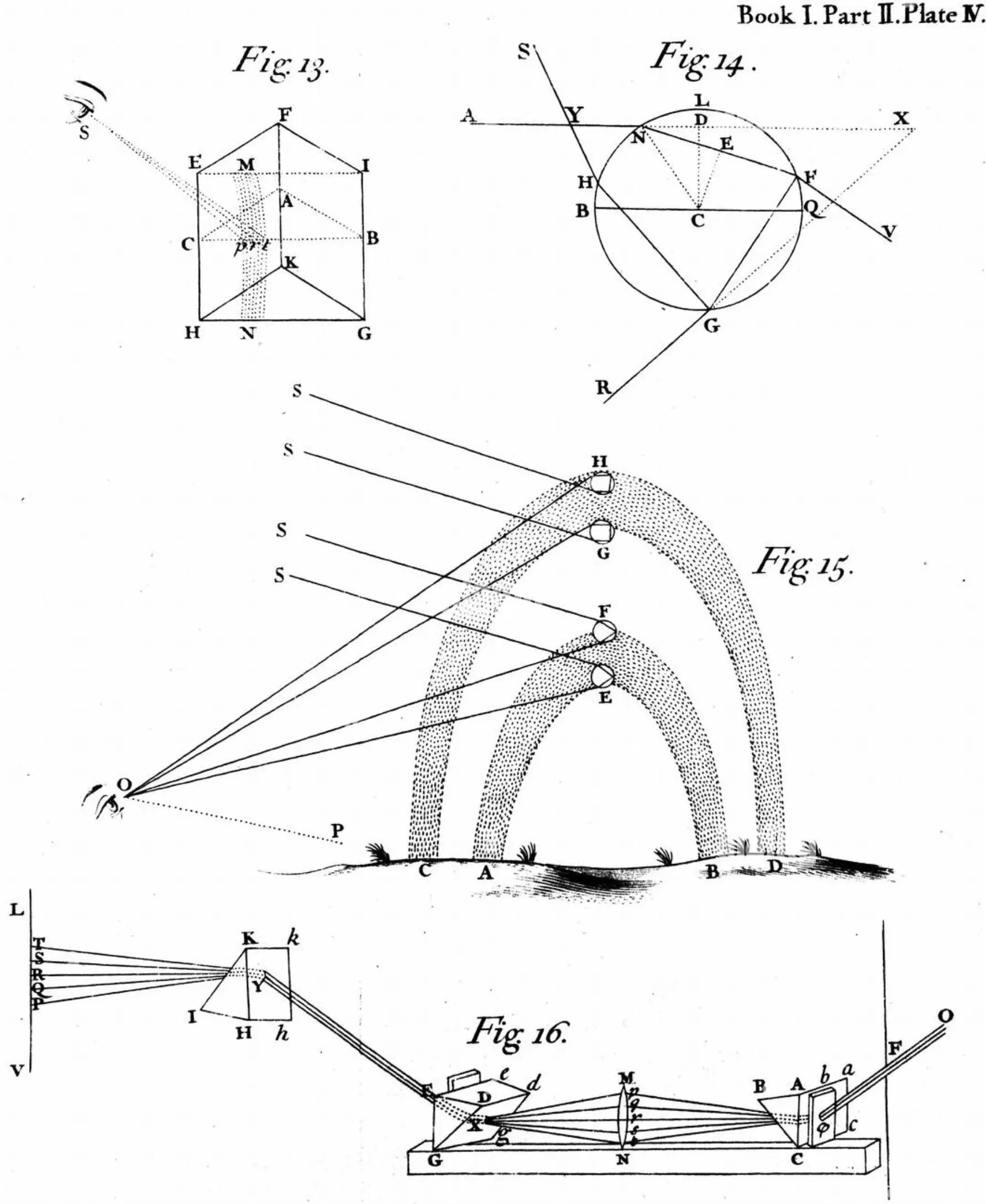
No. 01
Newton’s drawing
A plate from Opticks, 1704. Two drops, two paths: one with a single bounce inside for the main bow, one with two bounces for the outer bow. Everything on this page is already in that one drawing.
Count the reflections inside each drop.
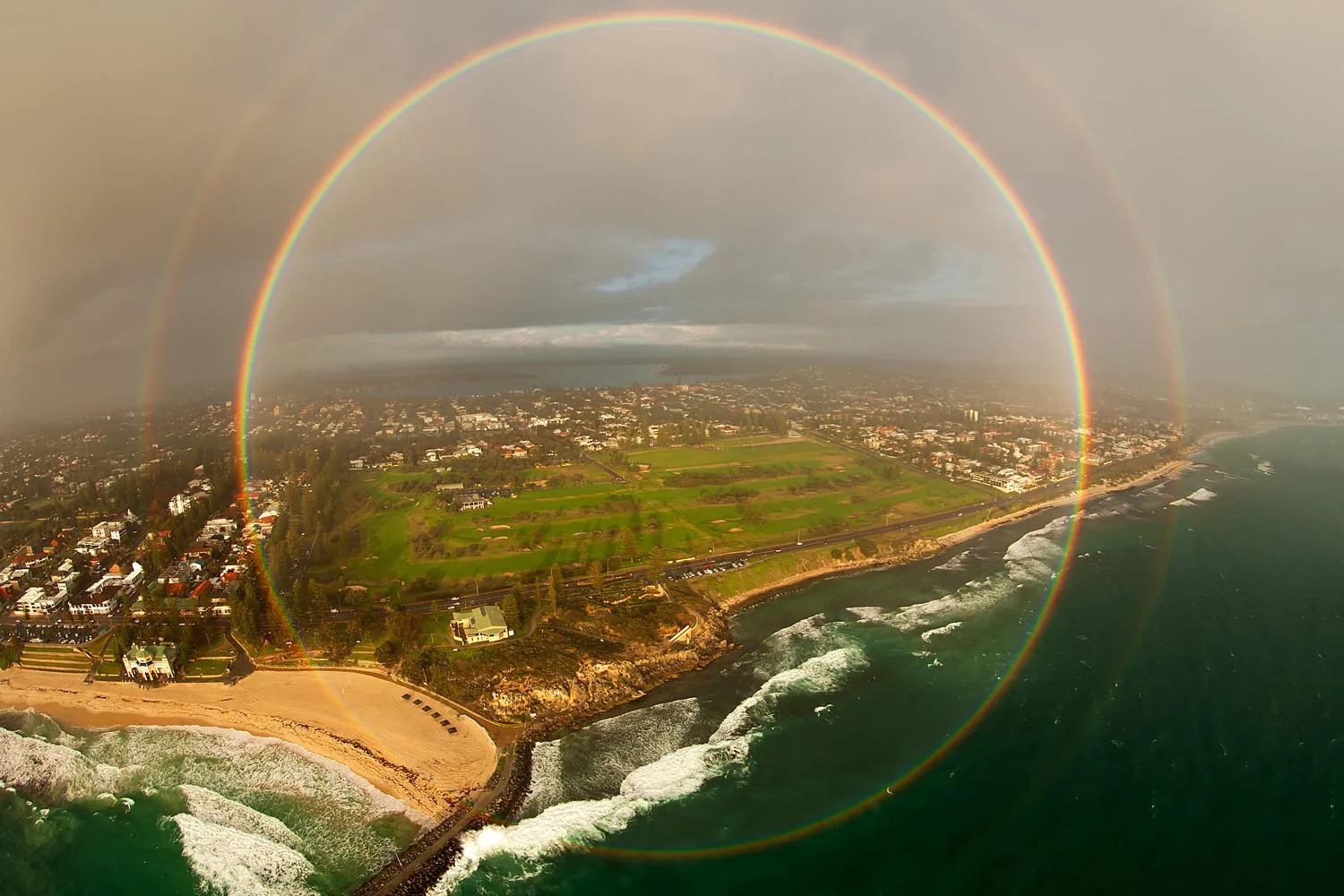
No. 02
A rainbow that goes all the way round
From the ground, the horizon cuts every rainbow in half. From a plane, a cliff or a tall building, the drops 42° from your shadow in every direction are all in view, and the bow closes into a full ring. A garden hose sprayed in a circle with the sun high behind you does the same thing at your feet.
The ground stops a rainbow, not the physics.
No. 03
A rainbow maker that makes no rainbows
Toys sold as rainbow makers often show an arc of colour with red on the inside. A lone bow with that order cannot exist in the sky. It is a spectrum, sold as a rainbow.
Red on the inside, with no outer bow: fake.
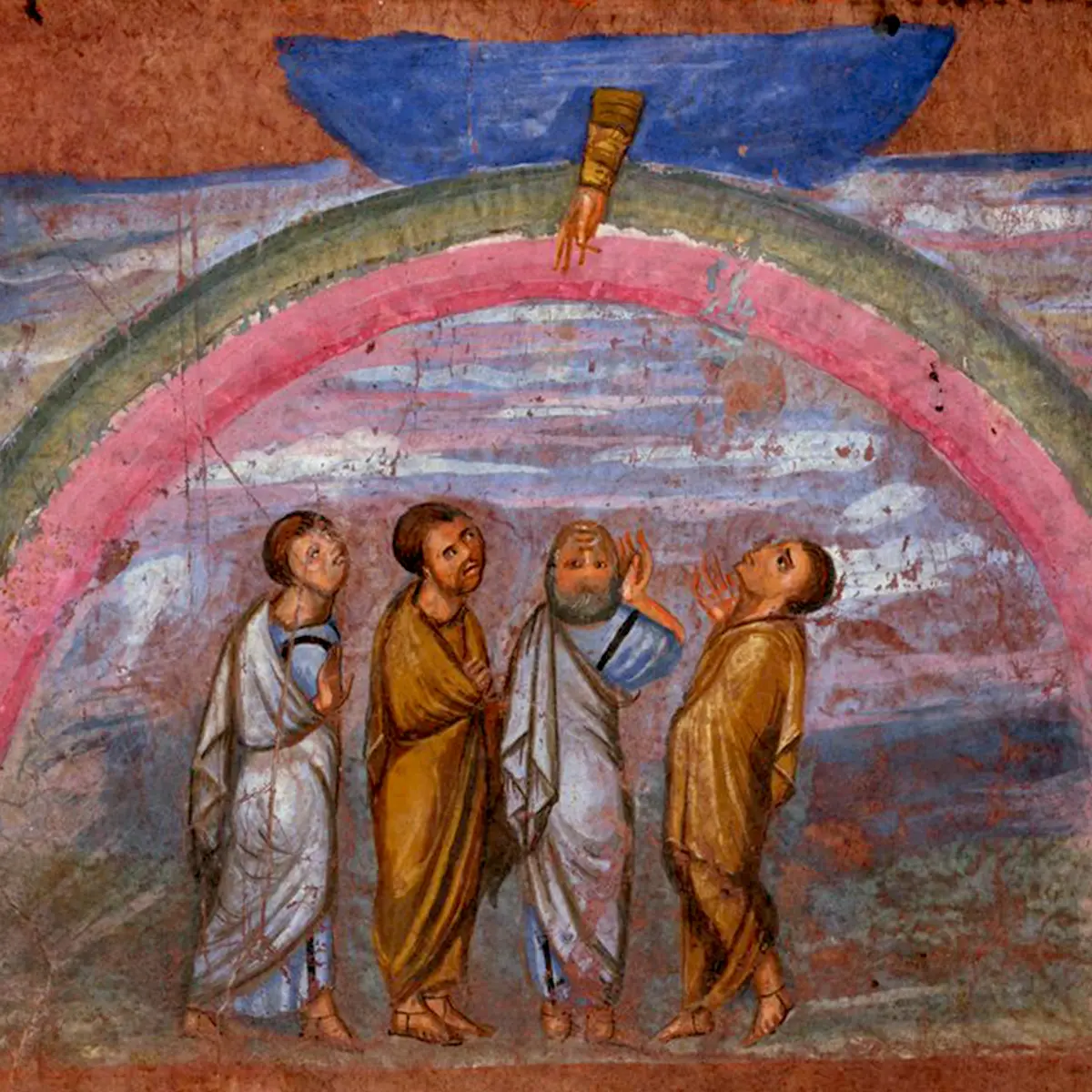
No. 04
A rainbow as a symbol
An early medieval painting of the covenant after the flood: the hand of God reaches down over Noah and his family, beneath a band of colour. Early artists painted the rainbow as a sign, not as something observed, and the colours and their order rarely match the sky.
Compare its colours with a real bow.
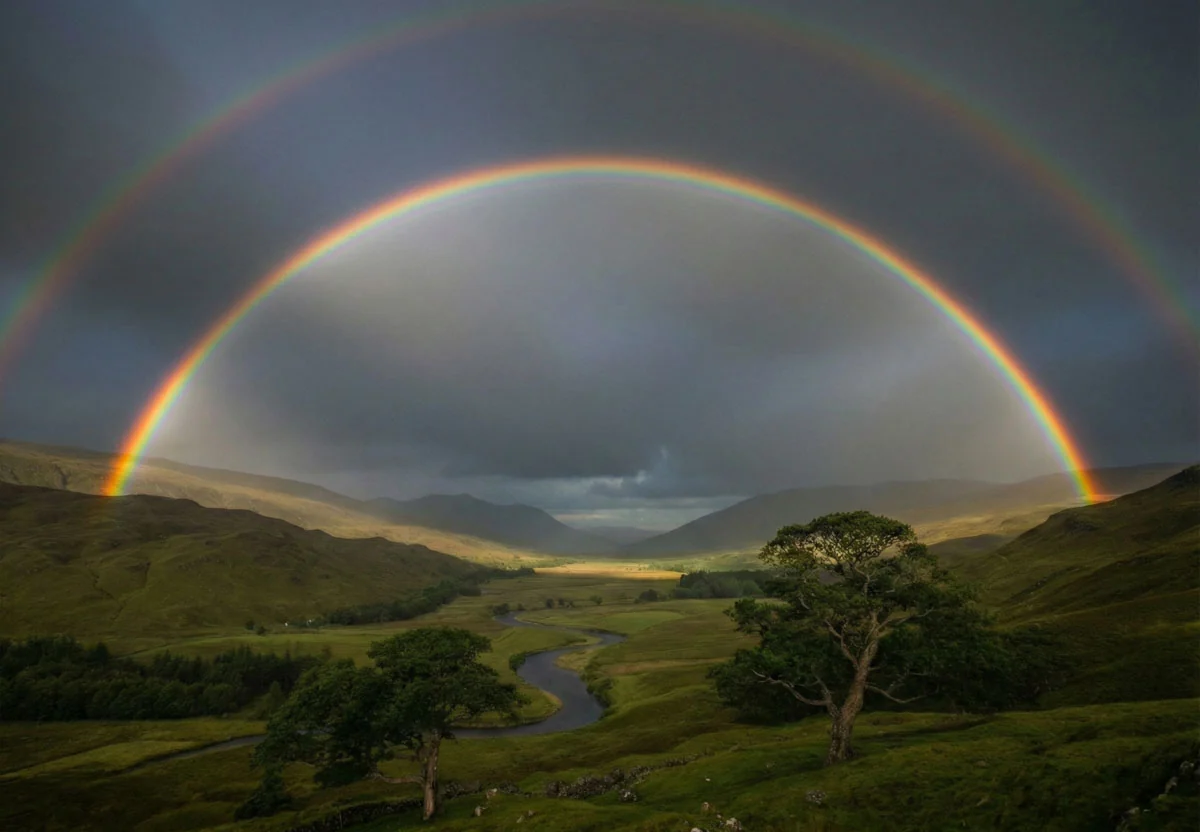
No. 05
Hunting the second bow
The secondary bow is faint, so it shows best against something dark: a forest, a hillside, a wet driveway. There it is: a weaker second arc outside the first, with red on its inside.
A dark background is the trick for faint light.
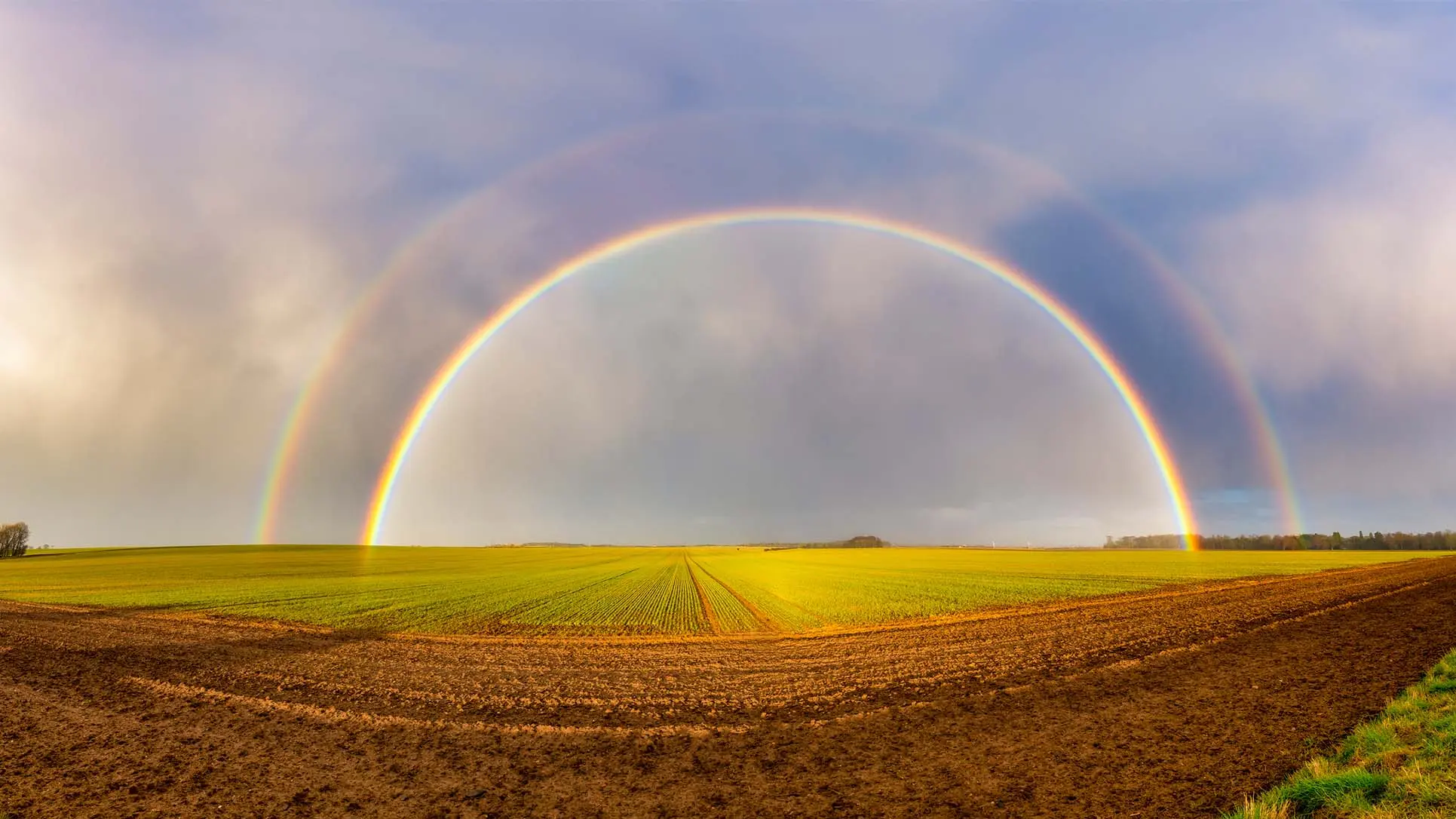
No. 06
Everything at once
A double rainbow over open fields. Primary bow, red outside. Dark band, unmistakable. Secondary bow, red inside. And the sky lighter again beyond it.
Compare the sky inside, between and outside the two bows.
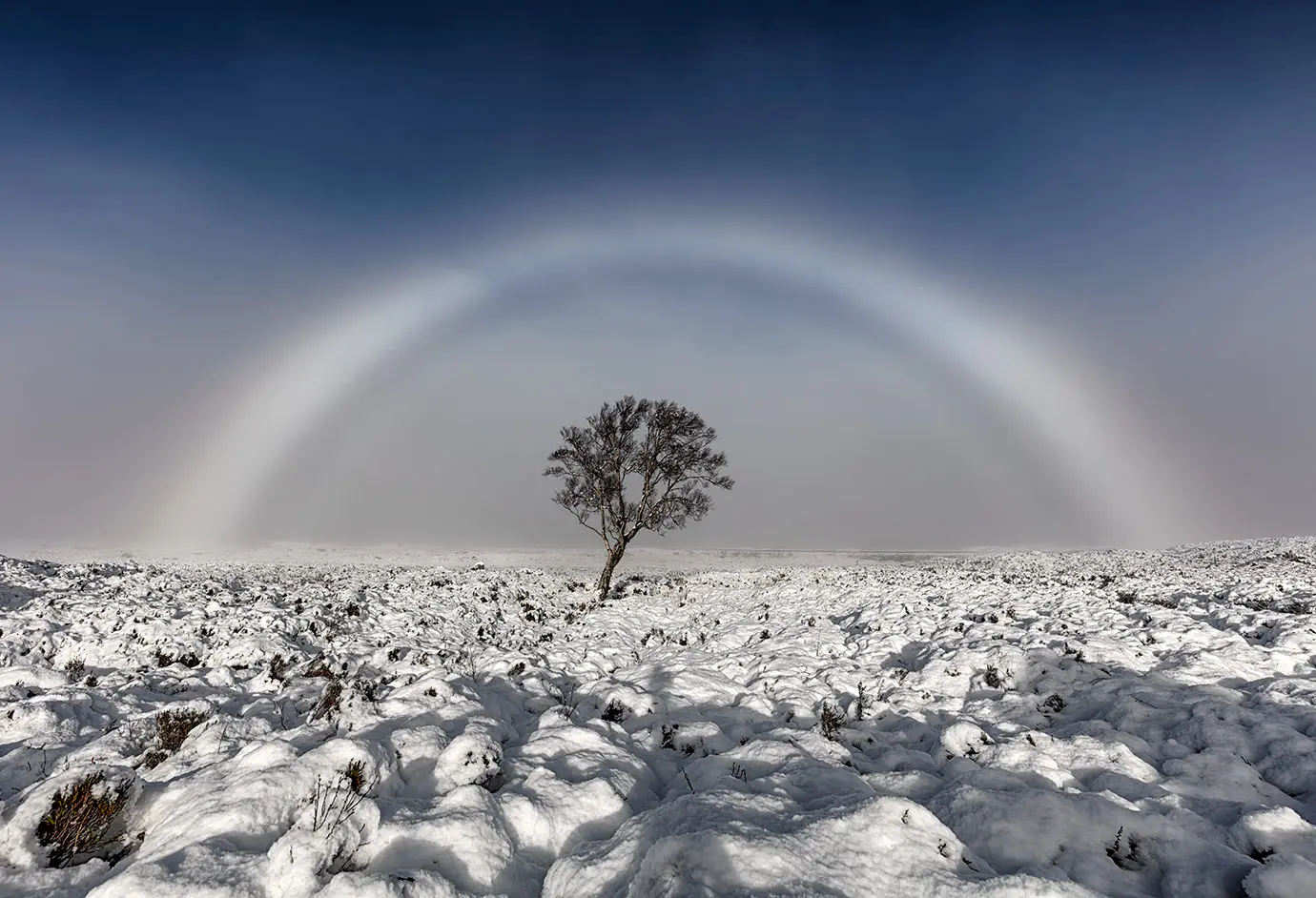
No. 07
A white rainbow
In fog or fine mist the droplets are far smaller than raindrops, and the bow turns almost entirely white. Fog bows appear over cold ground, on mountains and in the Arctic summer, often with faint dark bands of their own.
No colours at all: the drops were too small.
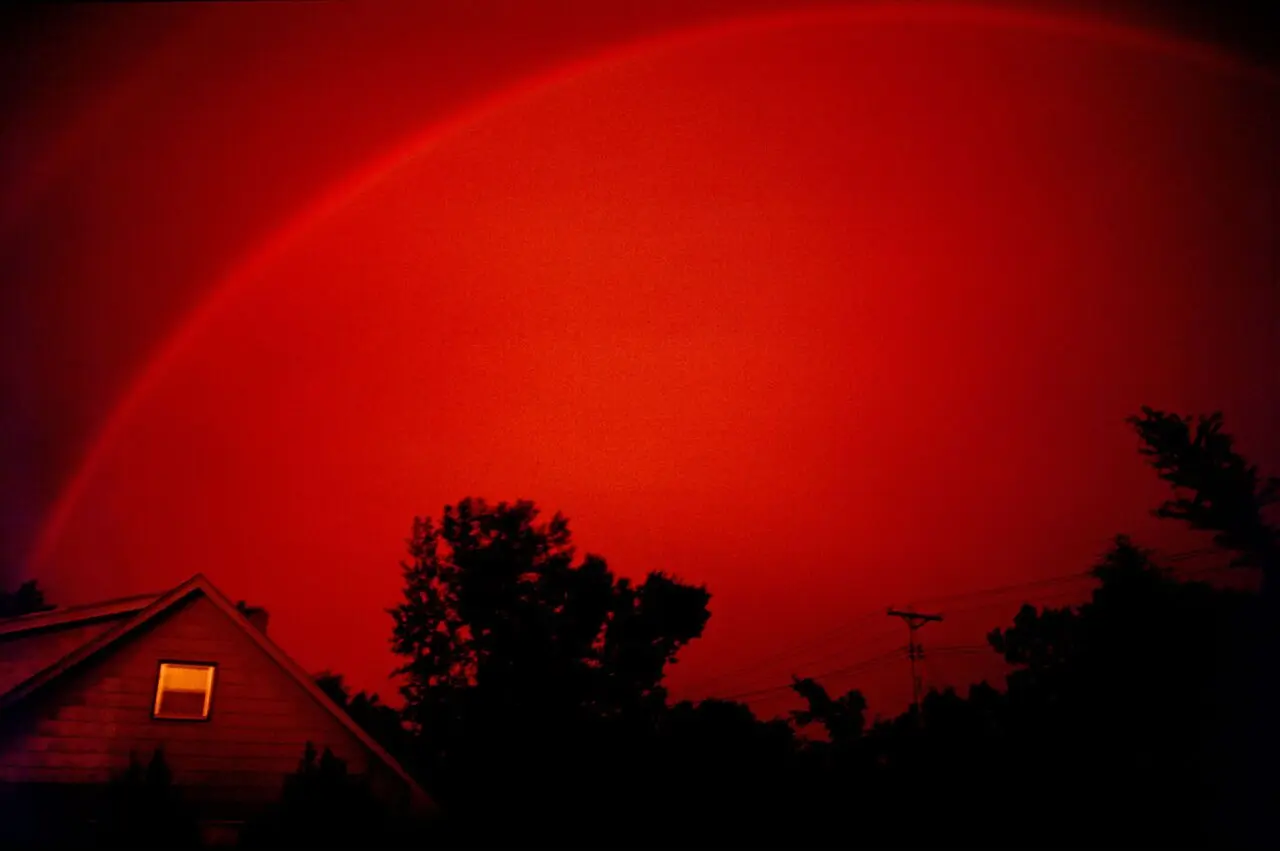
No. 08
A red rainbow
At sunrise or sunset the light has crossed so much air that mostly red is left. The bow turns red, and so does the bright sky inside it, because the white there was only ever the sum of whatever colours the sun provides.
The inside of the bow is red too.
One of these deserves a second look: the toy. Once you know the rule you can’t unsee it. A single bow with red on the inside is a spectrum pretending to be a rainbow, and plenty of packaging and clip art get it wrong.
Chapter VIII
One drop on a wall
A real raindrop, a bright lamp and a screen. Not a rainbow, but everything a rainbow is made of.
You can’t easily make rain indoors, but you don’t need to. Everything a rainbow is made of is already inside a single drop. Hang one large drop of water, or a round glass flask filled with water, in the path of a strong white light in a dark room, and catch the light it throws back on a white screen or card held near the lamp. Let your eyes adjust for half a minute; the pattern is faint.
What appears is a ring: red on the outside, blue on the inside, white light filling the middle, darkness beyond. It’s exactly the pattern in the one-drop simulation above. There’s no secondary ring; one drop doesn’t give enough light for that. But the entire rainbow is in that circle, waiting only for millions of drops and a sky to spread it across.
Theodoric of Freiberg did something very similar around 1304 with water-filled glass spheres. Or go outside with a garden hose on a sunny morning, put the sun at your back, set the nozzle to mist and spray upward and around. And if the spare light of a kitchen window is all you have, a kitchen-roll kaleidoscope is another way to see what a few mirrors can do to sunlight.
Two thousand years of one arc
Who figured out the rainbow
c. 350 BC
Aristotle
Notes that the bow is always part of a circle, always opposite the sun, and never more than a semicircle when the sun is up.
c. 200
Alexander of Aphrodisias
Describes the dark strip of sky between the two bows. It still carries his name.
c. 1304
Theodoric of Freiberg
Fills glass spheres with water as giant raindrops and shows the light refracts, reflects inside, then refracts again.
c. 1309
Kamāl al-Dīn al-Fārisī
In Tabriz, independently reaches the same picture of the path through a single drop, using a glass sphere in a camera obscura.
1621
Willebrord Snellius
Finds the law of refraction that every later calculation depends on.
1637
René Descartes
Traces ray after ray through a drop by hand and finds the pile-up near 42°: the first true explanation of the bow’s size.
1704
Isaac Newton
In Opticks, explains the colours: each one bends by a slightly different amount, so each has its own angle.
1803
Thomas Young
Explains the faint extra bands inside the blue as interference of light waves.
1838
George Airy
Works out the wave theory of the bow. Drop size now matters, and fog bows make sense.
1908
Gustav Mie
Solves exactly how light scatters off a sphere. Every detail of the bow, colours, bands and all, is in his equations.
Chapter IX
How to see a rainbow
The last part is up to you. Next time it rains with the sun out, here’s your list.
Next time you’ll look at a rainbow very differently. You will check that the red is on the outside. You will hunt for the second bow, ten degrees higher, and check that its colours are reversed. You will compare the sky inside the bow with the sky outside. And you will look for Alexander’s dark band. Fair warning: once this starts, it doesn’t stop.
To measure 42° without instruments, hold your arm straight out and spread your hand: thumb tip to little fingertip is about 20° for most adults. Put your thumb on your head’s shadow and step up two hand-spans and a little more. That’s where the red will be.
Your rainbow field card
0 / 8 spotted
Now scroll back up to the six questions at the top and take them again. They should feel easy. A rainbow is one law of refraction, one bounce, one maximum angle and a sky full of identical drops, and each answer falls out of that.
People sometimes worry that explaining a sunset or a rainbow takes away the magic. It works the other way: the colour is still there, and now so is the 42°, the dark band, the reversed second bow, the cone pointed at your eye. The same is true of why leaves change colour in the autumn. Once you know, you see more.
Knowing why never takes colour away. It adds a second rainbow to every one you see.
Further reading
Five books for people who now can’t stop looking at the sky.
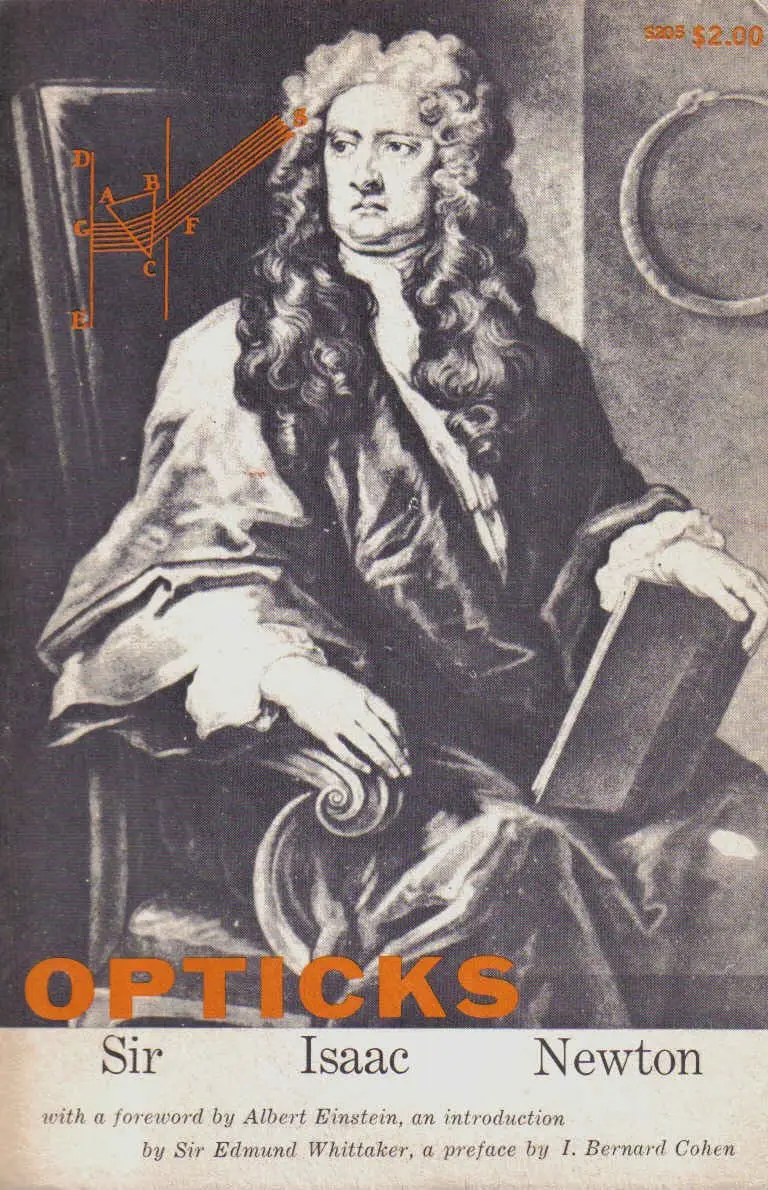 OpticksIsaac Newton · 1704 · Dover editionWhere the colours of the rainbow were first explained. Readable, experimental, and still surprising three centuries on.See it on Amazon →
 The Rainbow BridgeRaymond L. Lee Jr. & Alistair B. Fraser · 2001Rainbows in art, myth and science, from medieval painters’ mistakes to Airy’s waves. Gorgeous and exact.See it on Amazon →
 The Rainbow: From Myth to MathematicsCarl B. Boyer · 1959The classic history: two thousand years of people trying to explain one arc of light.See it on Amazon →
 Light and Color in the OutdoorsMarcel Minnaert · 1993 editionThe field guide for everything this article teaches you to notice, and hundreds of things it doesn’t.See it on Amazon →
 Color and Light in NatureDavid K. Lynch & William Livingston · 2001Halos, glories, green flashes and bows, each with a photograph and a clear diagram.See it on Amazon →
Rainbow questions, answered
Why is a rainbow always 42 degrees?+
Sunlight that enters a raindrop, bounces once off the back and comes out again can leave at many angles, but never more than about 42° from the direction opposite the sun. Light piles up right at that limit, so every drop that sits 42° from the shadow of your head flashes colour toward you. Those drops form a circle in the sky.
Why is red on the outside of a rainbow?+
Water bends blue light slightly more than red. Red's maximum exit angle is about 42.3°, blue's about 40.7°. The drops that send you red are therefore a little farther from the centre of the bow than the drops that send you blue, so red forms the outer edge.
Why are the colours reversed in a double rainbow?+
The fainter second bow comes from light that bounces twice inside each drop. With two reflections there is a smallest exit angle instead of a largest one, about 50.5° for red and 53.4° for blue. Red is now nearer the centre, so the order flips: red on the inside.
What is Alexander's dark band?+
The darker strip of sky between the primary and secondary rainbows. Drops at those angles can't send light to you with one internal bounce (too far out) or with two (not far enough). It is named after Alexander of Aphrodisias, who described it around 200 AD.
Why can't you see a rainbow at noon?+
The centre of the bow is the point directly opposite the sun, as far below the horizon as the sun is above it. When the sun is higher than about 42°, the whole primary bow falls below the horizon. From an aeroplane or a hilltop you can still see it, sometimes as a full circle.
What is a fog bow?+
A rainbow made by the tiny droplets in fog or mist, around 0.03 mm across. At that size light behaves as a wave and diffraction spreads each colour so widely that they all overlap. The result is a broad, pale, almost white bow.
Sources
- Isaac Newton, Opticks (1704).
- Raymond L. Lee Jr. and Alistair B. Fraser, The Rainbow Bridge: Rainbows in Art, Myth, and Science (Penn State University Press, 2001).
- Carl B. Boyer, The Rainbow: From Myth to Mathematics (1959).
- H. Moysés Nussenzveig, “The Theory of the Rainbow,” Scientific American, April 1977.
- Index of refraction for water: red ≈ 1.332, blue ≈ 1.343; angles on this page computed from Snell’s law.