
Mathematics · History · Calculus of Variations
In 1696 Johann Bernoulli dared Europe to find the quickest slide between two points. The answer was not a straight line, and Newton solved it overnight.
Same start, same finish, same gravity · the green bead always wins
Put a bead on a wire and let it go. Gravity pulls it down, the wire steers it, and some moments later it arrives at the other end. Now bend the wire. Make it straight, curve it like a bowl, drop it off a cliff and run it flat. The two ends stay where they are, but the trip takes a different time for every shape. One shape is faster than all the others. Which one?
That is the whole problem. A child can understand it, and the best mathematicians alive in 1696 could not solve it with the tools they had. To answer it, they had to invent a new kind of mathematics: one that searches through every possible curve instead of every possible number. It was a turning point in the history of mathematics, and it started as a dare.
1696
Johann Bernoulli prints the challenge in Leipzig
~12 h
How long Newton took, starting after a full day at work
6
Correct solutions, counting Johann's own
33%
How much slower the straight line is, in the race below
Leipzig · June 1696
Johann Bernoulli was twenty-eight, newly appointed professor at Groningen, brilliant and quarrelsome. He was also one of the very few people who had mastered the calculus Leibniz had published twelve years earlier. In the June 1696 issue of Acta Eruditorum, Europe's leading scientific journal, he printed a short notice with a grand title: a new problem that mathematicians are invited to solve.
Given two points A and B in a vertical plane, find the path AMB along which a moving body M, descending under its own weight, travels from A to B in the shortest possible time.
Johann Bernoulli, Acta Eruditorum, 1696 (our translation)
He gave the field six months. When the deadline came, only Leibniz had sent an answer, privately, and he asked Bernoulli to extend the contest to Easter 1697 so that mathematicians abroad would have a fair chance. Bernoulli agreed. In January 1697 he reprinted the problem as a broadside, addressed to “the sharpest mathematicians in the whole world”, and mailed copies across Europe. He hinted that he had a solution of his own, and he warned readers that the answer was not the obvious one.
He also gave the curve a name. Brachistochrone comes from the Greek brachistos, shortest, and chronos, time. The name is about time, not length. The shortest path is obviously the straight line, and the whole point of the problem is that the shortest path is not the fastest.
The trade-off
A sliding bead's speed depends only on how far it has fallen. Drop one metre and it moves at about 4.4 metres per second, whatever path it took to get there. That single fact turns the problem into a trade-off. A straight ramp is the shortest route, but it is shallow, so the bead creeps along for most of the trip. A path that plunges steeply at the start builds speed fast, but the plunge adds distance. The winner is a compromise between the two.
Galileo had come close sixty years earlier. In Two New Sciences (1638) he proved that a bead reaches the bottom of a quarter circle faster along two chords than along one, and faster along the arc than along any chain of chords. He concluded, reasonably and wrongly, that the arc of a circle must be the fastest path of all.
Race lab · drag B · draw your own slide from A
Frictionless beads, released from rest, g = 9.81 m/s². Grid squares are 50 cm. Shown at 45% speed.
Press Race to start. In the default setup the cycloid finishes in 1.002 seconds. Galileo's circle is three hundredths behind, the cliff-and-glide path takes 1.113, and the straight line comes in last at 1.332, a third slower than the winner. Now try to beat the cycloid. Draw any slide you like from A: deep, shallow, wavy. You will get close, but you will never win, because the cycloid is the fastest of every possible curve, not just these four.
Then drag B far to the right and close to A's height. The cycloid dives below B and climbs back up to meet it. Going down to come back up sounds wasteful, but the extra speed from the dive more than pays for the climb. That happens whenever B is more than about one and a half times as far across as it is down (the exact ratio is π/2).
London · 29 January 1697
One of Bernoulli's broadsides went to Isaac Newton. By 1697 Newton was fifty-four, Warden of the Royal Mint, and largely done with mathematics. He was also not on good terms with the Continental mathematicians who backed Leibniz. Many readers took the challenge to be aimed at him.
According to his niece Catherine Conduitt, who kept house for him, the letter was waiting when he came home from the Mint at four in the afternoon. He did not go to bed until he had solved it, at around four the next morning. That same day he sent the answer to Charles Montagu, President of the Royal Society, and it was printed in the Philosophical Transactions without his name: a short statement that the curve is a cycloid, with a recipe for drawing it and no explanation.
The unsigned answer convinced nobody that it was anonymous. When Bernoulli published the solutions in May 1697, he wrote that he recognised the author the way you recognise a lion from the mark of its claw.
Tanquam ex ungue leonem.
“As the lion by his claw.”
Johann Bernoulli on the anonymous English solution, 1697
Six correct answers appeared in the end. There was Johann's own, one each from his older brother Jakob, from Leibniz, from Ehrenfried Walther von Tschirnhaus and from the Marquis de l'Hôpital, and Newton's. All six found the same curve. The most interesting thing was how differently they reached it.
Johann's proof
Johann's solution is one of the most elegant arguments in all of mathematics. He did not attack the falling bead at all. He solved a problem about light instead.
Light is lazy in a precise sense: going from one point to another, it takes the path of least time, not least distance. That is Fermat's principle, and it is why light bends when it passes from air into water, the same bending that makes rainbows possible. At every boundary the ray obeys Snell's law: the sine of its angle divided by its speed stays the same on both sides.
So Bernoulli imagined the space between A and B as a stack of thin glass sheets, each one letting light travel a little faster than the sheet above, with the speed in each sheet matched to the speed a falling bead would have at that depth. A ray of light finds the fastest route through the stack automatically. Make the sheets thinner and more numerous, and the ray's zigzag smooths into a curve. That curve is the fastest path for light, and so it must be the fastest path for the bead.
Light through 4 layers, each one faster than the last
━ light ray ┅ cycloid
sin θ ⁄ √(2gy) = constant
Snell's law for the falling bead: the ray's angle from vertical, θ, against its speed at depth y.
Slide the layers up to sixty and the yellow ray lies almost on the green dashed curve. Bernoulli recognised the equation the limit satisfies: it is the equation of a cycloid. The argument takes half a page, and it borrows its whole idea from optics to settle a question in mechanics. That link between light and motion grew, over the next century, into the least-action principles that run through physics, from planetary orbits to the equations that changed the world.
The answer
The winning curve was already famous. Mark a point on the rim of a wheel and roll the wheel along a straight line: the point traces a row of arches called a cycloid. Roll the wheel along the underside of a ceiling instead, and each arch hangs down, the same shape as the slide that wins the race.
A wheel rolling along a ceiling · the dot on its rim draws the slide
Galileo named the curve around 1599 and tried to find the area under one arch by cutting the shape out of metal and weighing it. The scales said roughly three times the area of the wheel, but he suspected the true ratio was not a whole number. It is exactly three: Gilles de Roberval proved it in the 1630s. In 1658 Christopher Wren, before he became an architect, showed that one arch is exactly eight times the wheel's radius long. That same year Blaise Pascal ran a prize contest on the cycloid that ended in bitter disputes over who had solved what.
The curve caused so many priority fights that it was nicknamed the Helen of Geometers, after Helen of Troy, the beauty who started a war. The brachistochrone contest was one more fight over it, and it would not be the last.
3×
Area under one arch, compared with the wheel (Roberval)
8r
Length of one arch, for a wheel of radius r (Wren)
θ√(r/g)
Time down the slide, where θ is how far the wheel has turned
Huygens's clock
Twenty-three years before the contest, the Dutch physicist Christiaan Huygens had found a different property of the same curve. He was trying to build a clock accurate enough to find longitude at sea. An ordinary pendulum is almost, but not quite, regular: wide swings take slightly longer than narrow ones, so a ship's rolling makes the clock drift.
Huygens showed that a bead in a cycloid-shaped bowl reaches the bottom in exactly the same time wherever you release it. A bead dropped from the rim and a bead nudged from near the bottom arrive together. He called the curve the tautochrone, “same time”, and in Horologium Oscillatorium (1673) he built a clock around it: two curved metal cheeks beside the pendulum's pivot bend the string so that the bob swings along a cycloid.
Three beads, three heights, one bowl
Spread between first and last arrival: 0.000 s.
In the cycloid bowl the three beads reach the bottom together, every time. Switch to a round bowl of the same width and depth and they fall out of step: the bead released from highest up arrives last. When Bernoulli realised that his fastest curve was Huygens's same-time curve, he was delighted. He wrote that the reader would be astonished to learn that the brachistochrone was Huygens's tautochrone. Two unrelated questions, one about speed and one about regularity, had the same answer.
What it started
Johann's light trick was beautiful, but it worked only because this one problem happened to look like optics. His brother Jakob's solution was clumsier and far more important. Jakob treated the curve as a whole and asked how the travel time changes when you nudge it slightly anywhere along its length. On the fastest curve, every small nudge makes things worse. That idea works for any problem of the form “find the curve that makes this quantity as small as possible”.
The brothers were rivals more than collaborators. Jakob answered the challenge with a harder problem of his own and an open offer of a prize to Johann. Their quarrel over the solutions lasted until Jakob's death in 1705. The method outlived both of them. Leonhard Euler, Johann's student, made it systematic in 1744. In 1755, a nineteen-year-old Joseph-Louis Lagrange wrote to Euler with a cleaner approach. Euler was impressed, adopted it, and later gave the new field its name: the calculus of variations.
∂L⁄∂y − d⁄dx (∂L⁄∂y′) = 0
The Euler–Lagrange equation. Every curve that minimises a quantity, from the brachistochrone to a ray of light, obeys it.
That equation is now everywhere. Physicists build mechanics out of it, engineers use it to shape wings and bridges, and the shortest paths on curved surfaces in general relativity come from it. It belongs on the same shelf as the other great tools of analysis, like the Fourier transform and the Gaussian integral. The journal pages where the 1697 answers appeared belong next to the original papers that shaped modern mathematics. And the contest itself was a forerunner of puzzles like the overhanging branch problem, in which a simple-sounding question turns out to have a deep answer.
The curve's first 150 years
1599
Galileo names the curve traced by a rolling wheel: the cycloid.
1638
In Two New Sciences, Galileo shows an arc beats a chord and guesses the circle is fastest.
1658
Christopher Wren proves one arch of a cycloid is exactly eight times the wheel's radius long.
1673
Huygens publishes Horologium Oscillatorium: the cycloid is the tautochrone.
1696
June: Johann Bernoulli poses the problem in Acta Eruditorum.
1697
January: the challenge goes out again. Newton solves it in a night. May: the answers appear in print.
1744
Euler's Methodus inveniendi turns the trick into a general method.
1755
Lagrange, nineteen, writes to Euler with the δ-method. The calculus of variations is born.
Given two points at different heights, find the curve along which a bead, sliding without friction and starting from rest, gets from the upper point to the lower one in the least time. Johann Bernoulli posed it in June 1696. The answer is an upside-down cycloid.
A sliding bead's speed depends only on how far it has dropped. The cycloid starts almost vertically, so the bead picks up speed early and then covers the longer path quickly. The straight line is shorter, but the bead spends most of the trip moving slowly.
Johann Bernoulli, his brother Jakob Bernoulli, Gottfried Leibniz, Ehrenfried Walther von Tschirnhaus and the Marquis de l'Hôpital all found the answer. Isaac Newton solved it in a single night and sent his solution in without signing it. Bernoulli knew who had written it anyway.
The brachistochrone is the curve of fastest descent between two points. The tautochrone is a curve on which a bead reaches the bottom in the same time wherever it starts. The cycloid is both, which Bernoulli called astonishing.
Only when B lies directly below A, so that the fastest path is a straight vertical fall. In every other case some curve beats the straight line, and the cycloid beats every other curve.
Sources
Keep wandering
A few more pieces in the same spirit — math, design, and slow attention.
The History of Mathematics, Written in the Margins
From a student's clay tablet to the prize Perelman turned down, four thousand years of mathematics copied from hand to hand.
Open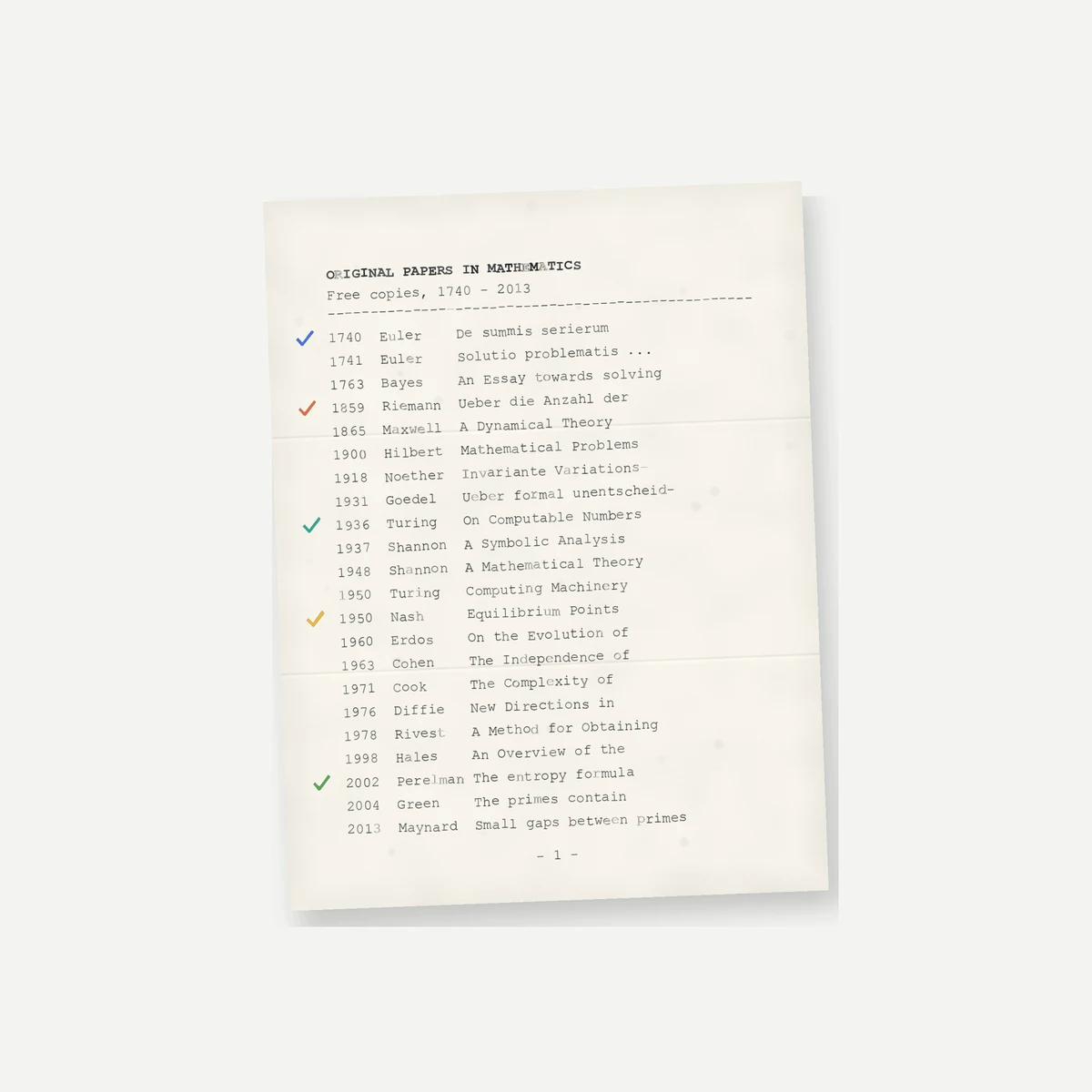
22 Original Math Papers You Can Read for Free
From Euler to Perelman, 22 papers that changed mathematics, each with its journal, language, page count and a free link to the original.
Open
17 Equations That Changed the World
From Pythagoras to chaos theory — the seventeen short lines holding up the skeleton of civilization, and where each one still lives in everyday life.
Open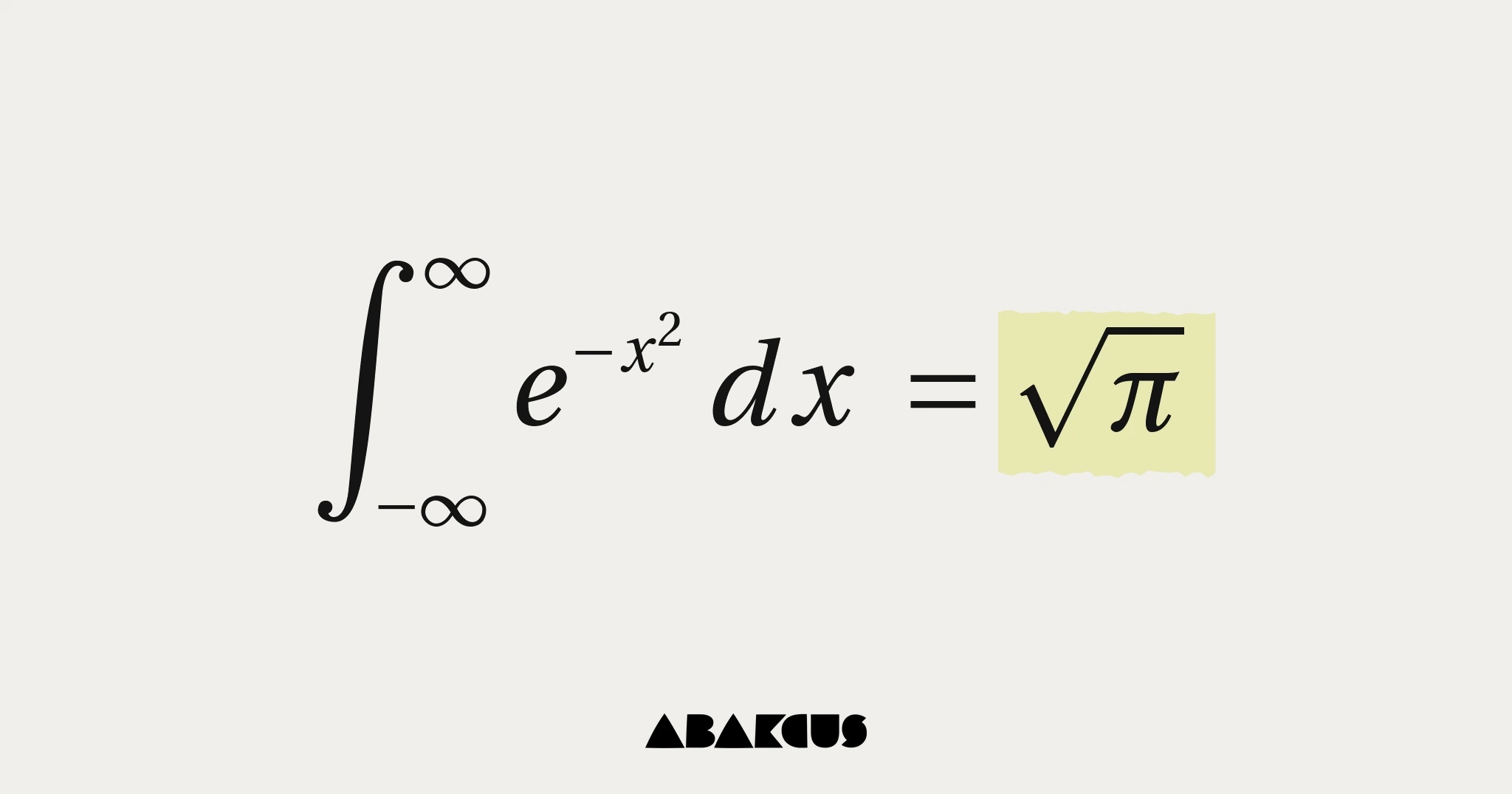
The Circle That Isn’t There
There is no circle in e^(−x²), and no elementary antiderivative either. Square the integral, move to the plane, switch to polar coordinates — and π walks out in four lines.
Open
Who Owns the Fruit on an Overhanging Branch?
Roman law, an English court, the Turkish Civil Code and the Swedish constitution look at one branch crossing one fence and give four different answers.
Open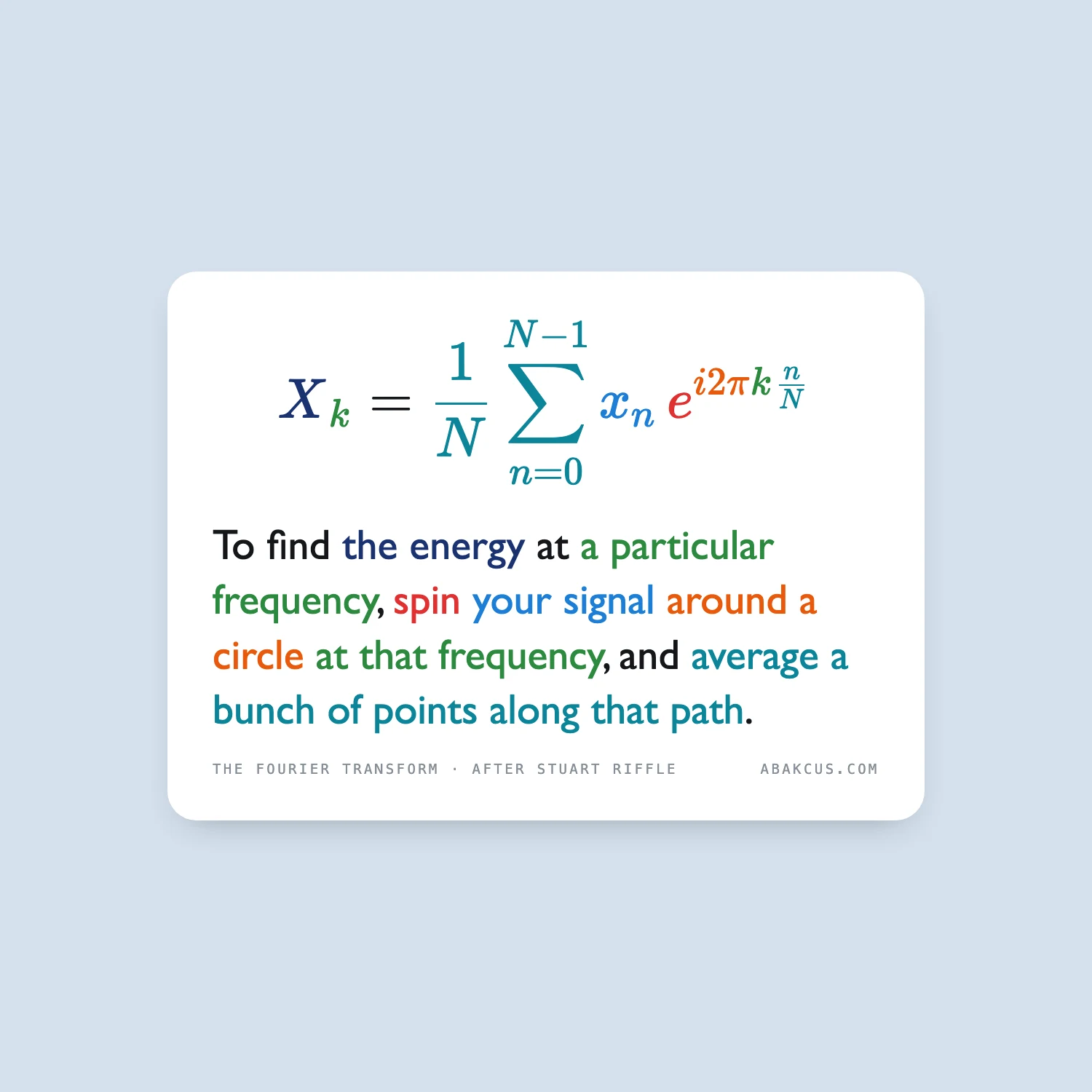
The Fourier Transform, Explained in One Sentence
Stuart Riffle color-coded the discrete Fourier transform so every symbol matches a phrase. Here is that sentence, unpacked one color at a time.
Open