A curve you cannot integrate
The function e−x² is the most familiar shape in science. It is the bell — the one draped over exam scores and measurement errors and the heights of conscripts. It peaks at 1, falls away symmetrically, and dies so quickly that by x = 4 it has already given up. The area underneath it is obviously finite. You can practically see it.
And you cannot find it. Not by any method you were taught. Try substitution and you go in circles; try integration by parts and it regenerates itself, a hydra with two new heads. Generations of students have lost an evening to this, convinced the trick was just out of reach.
It isn’t. In 1835, Joseph Liouville proved that e−x² has no antiderivative expressible in elementary functions — no combination of polynomials, roots, exponentials, logarithms, or trigonometric functions will ever produce one. This is not a confession of ignorance. It is a theorem. The thing you are looking for does not exist.
So the total area — from −∞ to ∞, the whole bell — cannot be obtained the honest way, by finding an antiderivative and subtracting endpoints. It has to be obtained some other way. And the other way is one of the loveliest maneuvers in mathematics.
Poisson’s maneuver
The move is usually credited to Siméon Denis Poisson, though Laplace had already extracted the value in 1778 while working on probability, and Abraham de Moivre had bumped into the constant decades before that, approximating coin flips. The idea is so contrary to instinct that it is worth stating plainly before doing it: the problem is impossible in one dimension, so we make it harder by moving to two.
Call the answer I. Squaring an unknown normally makes things worse — here it is the entire idea, because the second copy can use a different letter.
I² = (∫ e−x² dx) · (∫ e−y² dy)
Both integrals run from −∞ to ∞. Renaming x to y changes nothing — and changes everything.
A product of two independent integrals is one integral over the plane. The one-dimensional curve becomes a two-dimensional hill.
I² = ∬ℝ² e−(x² + y²) dA
Legal because the integrand is positive and the whole thing converges — Tonelli’s theorem does the paperwork.
This is the moment. x² + y² is the squared distance from the origin — it is Pythagoras, sitting in the exponent the entire time. The hill does not care which direction you walk; it only cares how far you are from the center. Its contour lines are circles.
x² + y² = r²
A function that ignores direction is begging to be measured in polar coordinates.
In polar coordinates the area element is not dr dθ but r dr dθ — a ring farther from the center is longer, so it carries more area. That stray r is not bookkeeping. It is the gift.
I² = ∫02π ∫0∞ e−r² r dr dθ
Because now substitute u = r², so du = 2r dr, and the inner integral becomes ½∫0∞ e−u du = ½. The r that geometry handed over for free is exactly the factor that makes the impossible integral trivial.
Nothing depends on θ anymore, so the outer integral is just the length of one complete rotation.
I² = 2π · ½ = π
And I is an area under a positive curve, so it is positive, so there is only one root to take.
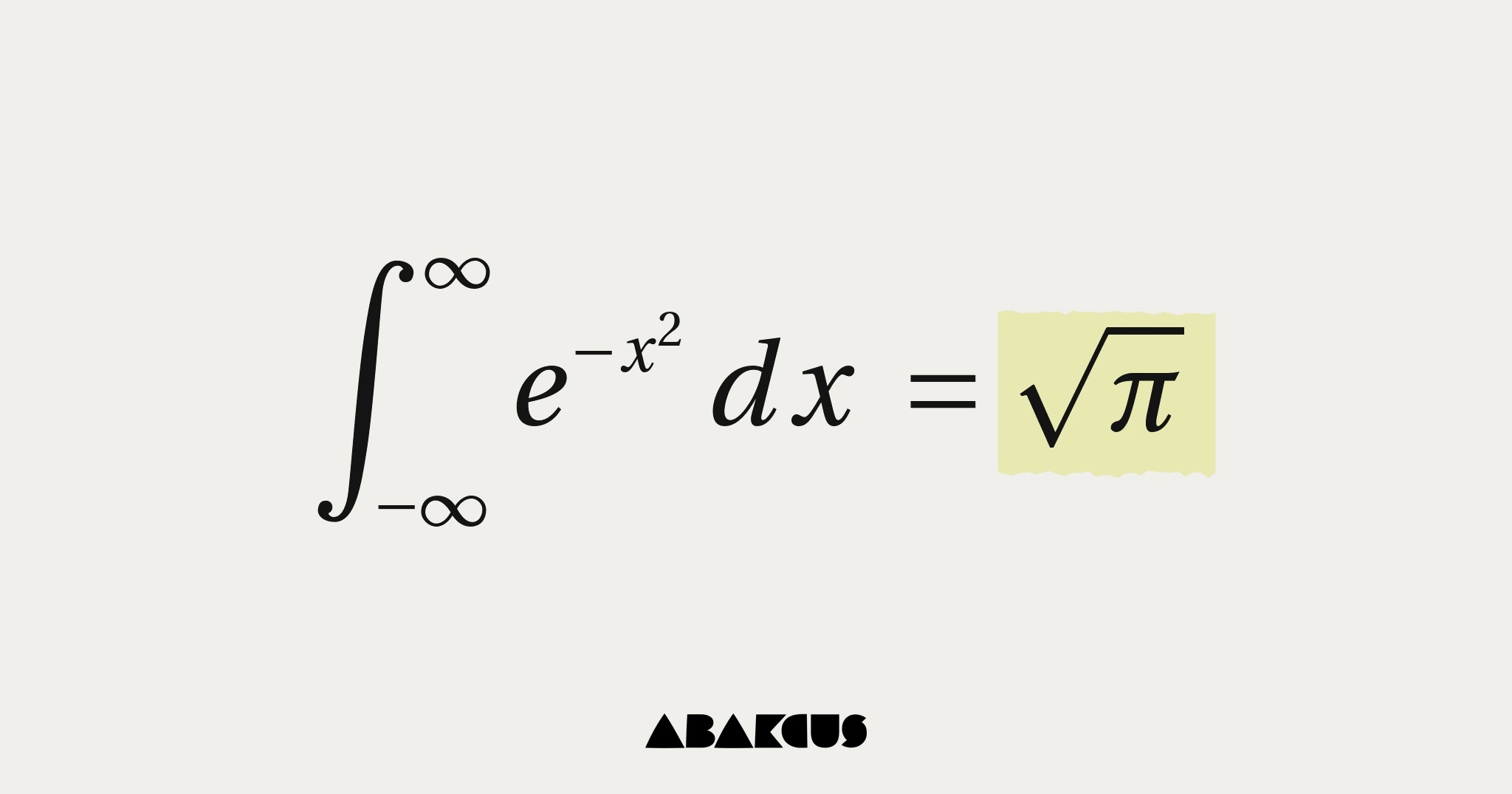
I² = π ⟹ I = √π
A curve with no circle in it, measured by the circle it was hiding.
■ Q.E.D.
Where the π was hiding
Look back and you can point to the exact instant π enters: the 2π in step five, which is nothing but a full turn around the origin. The circle was never in e−x². It was in the plane. We spun a curve into a hill, and a hill has a horizon.
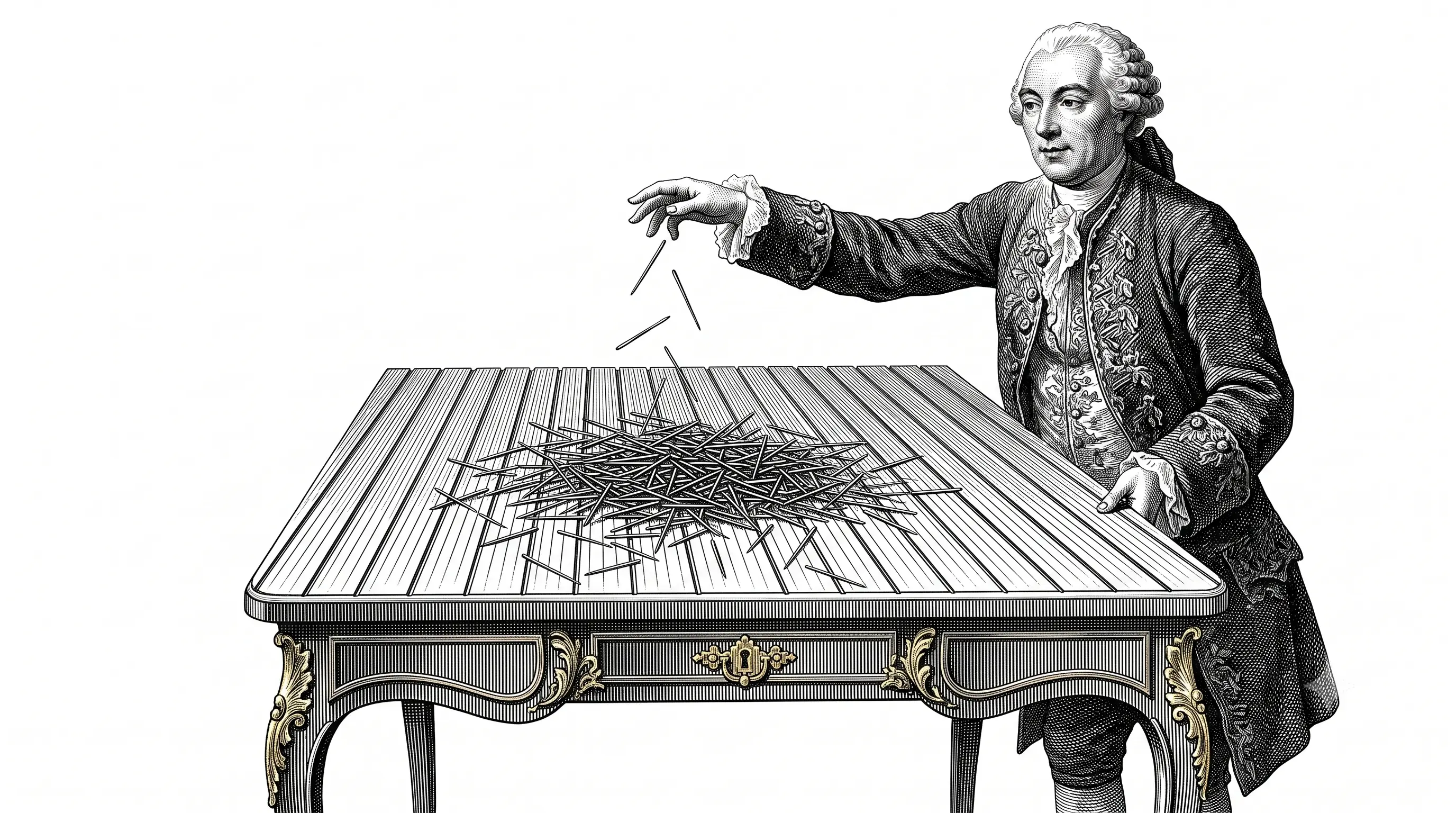
This is the better way to think about π generally. We meet it as the circle constant, taught alongside the unit circle, and then spend years being surprised when it turns up somewhere round-free. But π is the constant of rotational indifference — of answers that do not depend on direction. Drop a needle at random onto a lined floor and the probability that it crosses a line involves π, as Buffon discovered in 1777, for the same reason: the needle has no preferred angle. Wherever something is free to point anywhere, π is already in the room.
The most-used number you have never noticed
A probability distribution must have total probability 1. So when Gauss and Laplace built the normal distribution out of e−x², they had to divide by whatever the area happened to be — and the area was √π. That is the entire origin of the strange constant in the formula everyone half-remembers:
f(x) = 1 / (σ√(2π)) · e−(x−μ)²/2σ²
Every standard deviation quoted in a paper, every error bar on a graph, every polling margin, every 95% confidence interval is standing on this integral. The √(2π) is not decoration. It is the price of admission — the one number that turns a nice-looking curve into an honest probability.
It does not stop at statistics. The heat equation spreads temperature in a Gaussian; the ground state of the quantum harmonic oscillator is a Gaussian; Feynman’s path integrals are evaluated, in practice, by reducing them to Gaussian integrals over and over until something recognizable falls out. Among the equations that built the modern world, a surprising number are this one wearing a different hat.
A change of address
What I love about this proof is that it is not clever in the way hard problems are usually clever. There is no ingenious substitution, no series to sum, no inequality squeezed until it confesses. There is only a decision: to stop working on the problem where it was posed.
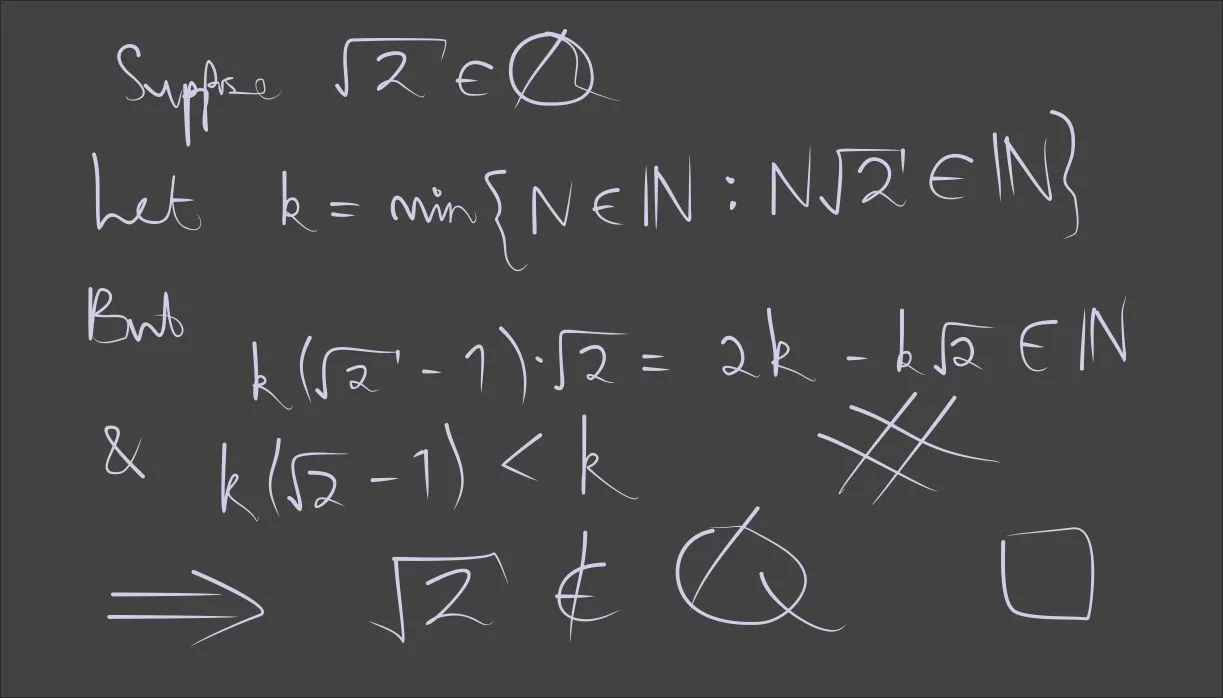
On the line, the integral is a wall. On the plane, it takes four lines. Same integral — the second dimension simply came with a tool, the factor r, that the first dimension had no way of supplying. The best mathematical tricks are rarely shortcuts. They are relocations. You do not solve the problem faster; you move it somewhere the answer already lives, the way the proof that √2 is irrational stops being arithmetic the moment you let the smallest natural number do the work.
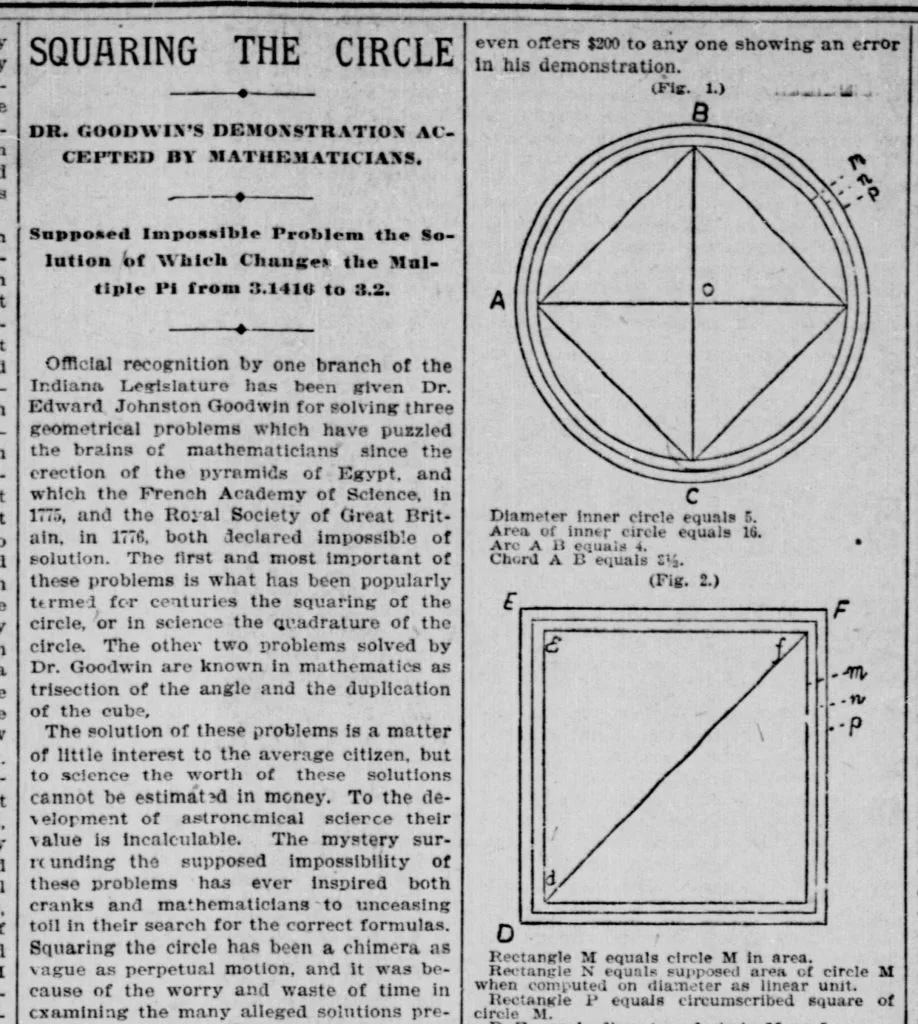
And there is the small, permanent pleasure of the result itself. A function with nothing round about it, integrated over a line with no curvature at all, returns the square root of the circle constant. π has a long history of appearing where it was not invited — it has been voted on by a state legislature and chased through half a dozen very good books. It never behaves. Here it does not even wait to be asked.