The Author Clock launched on Kickstarter with a $20,000 goal and raised $996,000. That number is not, by itself, an endorsement. But it does establish something: a large number of people saw a clock that tells time through book quotes and immediately decided they needed one in their home. The idea worked before the product existed.
Raised on Kickstarter from a $20K goal
Literary quotes across 2,500+ authors
Centuries of literature in the database
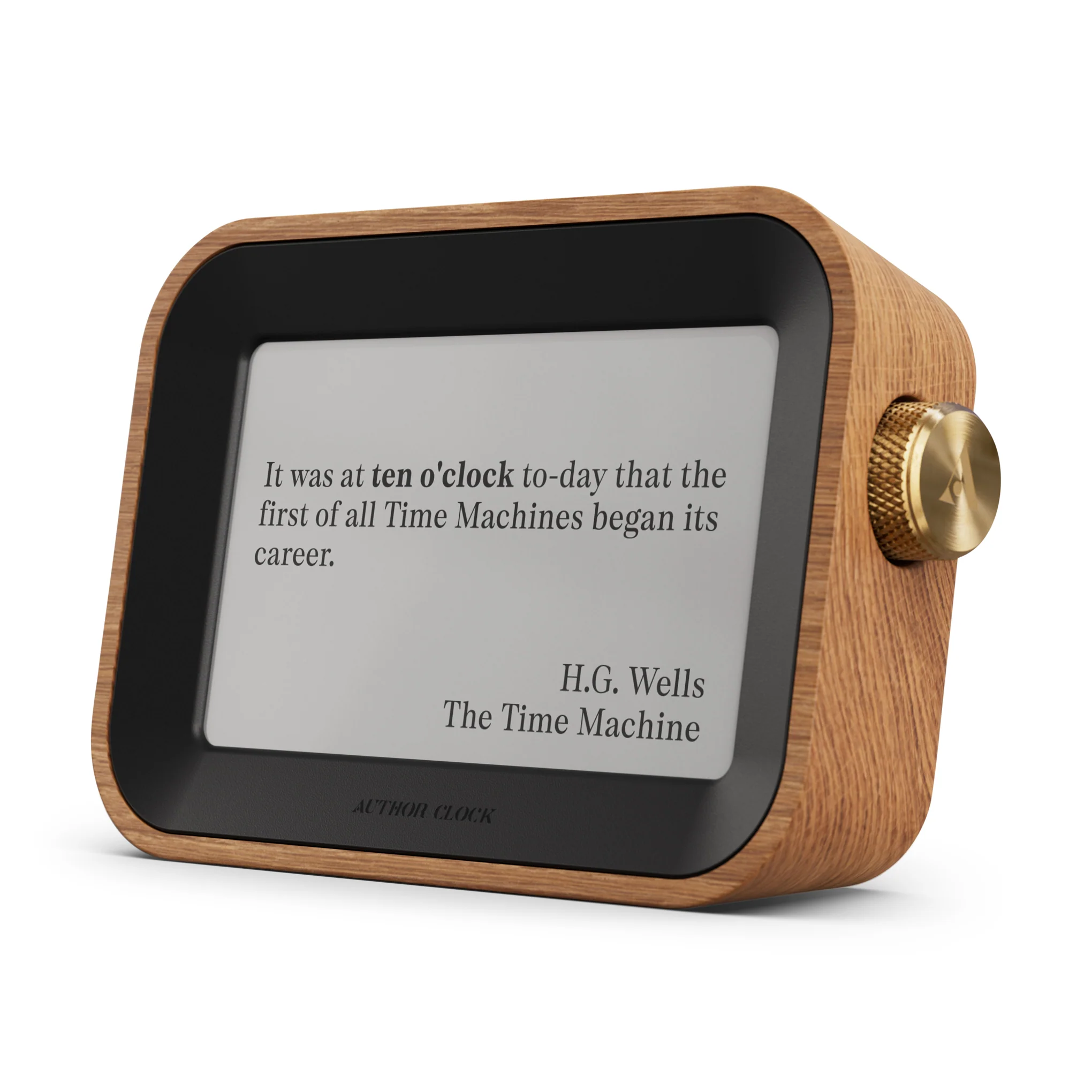
The idea fits in one sentence: every minute of the day, a literary passage containing that minute appears on screen — the time highlighted in the text, the author and title below it. 1,440 minutes, over 13,000 quotes; most minutes have several options the clock cycles through at random. The screen is e-paper — it looks like a printed page, not a screen. No glow. No ticking. No alarm. These are not oversights. They are the product's entire personality.
The idea itself is not new. Dutch designer Jaap Meijers built a desk clock from an e-reader in 2012. Johs Enevoldsen later moved it to the web as Literature Clock, free and open source. The Author Clock is what happens when the same concept is handed to a product team with access to a machinist and a supply chain: solid white oak housing, brass base and crown, WiFi connectivity, and a retail presence at the MoMA Design Store.
Most clocks tell you where you are in the day. This one tells you who else was there.
What actually happens when you own this clock is quieter than the pitch suggests. You don't read every quote. Most of the time the clock sits at the edge of your vision, doing its job: the time is there when you look, wrapped in a sentence you weren't expecting. Occasionally a glance catches on the sentence. You read the whole thing. You notice who wrote it. Once in a while you write down the title. This is not a transformative experience. But it is a different texture of day than a clock with hands gives you — each time-check a small interruption from some character's story rather than a number detached from any story at all.
What It Doesn't Do
No alarm. No backlight — which means in a dark room, without a lamp nearby, you can't read it. The e-paper refresh between quotes produces a brief flicker, standard for the technology but noticeable if the clock is in direct eyeline. The brass crown navigates settings at a deliberate pace. None of these are failures — they are the natural properties of the materials and the design priorities. The object is optimized for calm, not convenience. If you want to check the time quickly and move on, your phone is faster.
The parental controls are real and functional. Seven centuries of literature contain explicit and violent passages, and the clock lets you filter them. The existence of this feature reveals something: the curators took the full range of the literary canon seriously enough to include difficult material, then built a filter for households where that matters. Both decisions seem right.
MoMA
The MoMA Design Store placement matters as context rather than endorsement. MoMA sells objects it considers to have design merit — the selection is curatorial, not commercial. Someone with a considered view of what design means looked at this clock and found the concept well-executed. Whether the concept is one you want living on your desk is a separate question.
Who It's For
The honest answer to "who is this for" is narrow but clear. It's for someone who reads, who works at a desk, who has a relationship with books that goes beyond finishing them — someone for whom a sentence from Anna Karenina appearing at 9:47 on a Tuesday morning is not an interruption but a small, welcome thing. If that is not you, the clock is an expensive object that tells time. If it is, it's one of the few things you can buy that changes the ambient texture of a room without adding any noise.
The Author Clock's e-paper screen has no backlight — a deliberate choice. The screen wants to look like a page. That ambition connects it to the free alternative: Literature Clock does the same thing in a browser tab at no cost. What the Author Clock adds is presence — a physical object on a desk that is there even when you're not looking at a screen. Whether that presence is worth the price is the only real question.
Verdict
A desk object with a clear, well-executed concept and deliberate limitations. No backlight, no alarm, no touchscreen — these are a philosophy, not an oversight. Buy it knowing what it is — slow, quiet, literary — and it delivers exactly that.
↑ The concept holds up
Not a gimmick that wears off. The randomness of the library keeps the clock unpredictable across months of daily use.
↑ The materials are honest
White oak and brass age better than plastic. The e-paper display looks like paper. The object does what it looks like it does.
↑ WiFi updates silently
New quotes arrive automatically. The library grows without you doing anything. No subscriptions, no app required.
↓ No backlight
Unreadable in a dark room without a nearby lamp. A deliberate design choice — but one that matters if you use it as a bedside clock.
↓ E-paper flicker
The brief screen-dark between quote refreshes is noticeable if the clock is directly in your line of sight. Less visible from across the room.
↓ Not a utility clock
If you need to check the time quickly and move on, it's slower than a phone. The clock is not optimized for efficiency.
¹ The Kickstarter campaign was run by Mechanical Design Labs, which later became Author & Co. The campaign asked for $20,000 and received nearly $1,000,000 from over 7,000 backers. The product shipped.
² Vol. 2 product page: "Large enough to jostle for space with a copy of Anna Karenina." That is either the best or the worst marketing line depending on your tolerance for this kind of thing. It is at minimum accurate.