
DIY · Card 50 · Mathematics · Curves
Square wheels are a joke, until you change the road. Let a necklace hang, trace its curve, turn it upside down, and two cardboard squares roll over the bumps with their axle dead level.
01The brief
Make square wheels roll as smoothly as round ones.
0 mm
how far the axle rises and falls on the right road
41 %
how much higher the axle lifts on a flat floor, at each corner
1691
the year mathematicians found the true curve of a hanging chain
Roll a square wheel on a table and it lurches: up onto a corner, down onto a side, up onto the next corner. The axle bobs up and down with every quarter turn. That is why wheels are round.
But a wheel only needs to be round because the road is flat. Change the road, and a square rolls perfectly. The road it needs is a row of arches with a very particular shape, the shape of a hanging chain turned upside down. You can draw it with a necklace. Like the hyperbolic slot, it is a piece of geometry that looks impossible until you build it, and a very different set of wheels from the balloon car’s.
02Kit
Cardboard, a skewer and a necklace to draw the perfect curve.
Tick off what you have
0 of 5 ready
03Method
Make the wheels, let a chain draw the road, then roll.
Step 1 of 8 · Minute 0
You need corrugated cardboard, a long strip of stiff card or foam board about 45 × 10 cm, a bamboo skewer, a ruler, a pencil, scissors, glue, a thin chain such as a necklace, and two drawing pins.
The wheels jam in the valleys.
Why
The bumps are too short, or too tall, for the wheel.
Fix
Check the chain: pins 7 cm apart, 1.7 cm sag for an 8 cm wheel. The curved top of each bump should be exactly as long as a side.
The axle twists as it rolls.
Why
The two wheels, or the two tracks, are out of step.
Fix
Line the wheels up corner to corner on the skewer, and the bumps of the two tracks side by side.
The wheels slip instead of rolling.
Why
Smooth card has too little grip.
Fix
Use corrugated cardboard for the wheels, or stick a strip of masking tape along the road.
04The road
On a flat floor, a square wheel’s axle is lowest when a side lies flat, 4 cm up for an 8 cm wheel, and highest when it balances on a corner, 5.7 cm up. The catenary road fixes this exactly: it is highest under the middle of each side and drops into a valley under each corner, so the axle never moves up or down.
Roll a wheel on its road, then switch to a flat floor. Try other shapes too:
The axle stays exactly on the dashed line. Each side rolls over one arch and each corner drops neatly into a valley. More sides need lower, shorter arches: for 4 sides, each is 41 % as tall as the distance from the axle to a side.
Ready to build? Choose the size of your wheels and get the road to match, with the pin spacing and sag for the chain:
Bump length
7.05 cm
Bump height
1.66 cm
Chain: pins apart
7.1 cm
Chain: sag
1.7 cm
Bumps in 40 cm
5
Arc of each bump
8 cm
Or mark it by hand, from the crest
| Along, either way | Down from the crest |
|---|---|
| 0.00 cm | 0.00 cm |
| 0.88 cm | 0.10 cm |
| 1.76 cm | 0.39 cm |
| 2.64 cm | 0.91 cm |
| 3.53 cm | 1.66 cm |
Notice that the curved top of each bump is exactly as long as one side of the wheel, 8 cm. That is what makes each corner land in a valley just as the next side arrives.
05The big idea
Wheel and road
are a pair.
A circle is the right wheel for a flat road. A square is the right wheel for a road of catenaries. Every shape of wheel has its own road, and every road its own wheel, a partnership mathematicians have explored in detail.
And the hanging chain turns out to be everywhere: in arches, bridges and power lines. A necklace on two pins is doing a calculation that took the greatest mathematicians of the seventeenth century to solve.
06The math
1 · The road
y = −a cosh(x ⁄ a)
Depth below the axle, for a wheel with half-side a, one arch per side.
2 · One arch
2a·arsinh 1 ≈ 1.76 a, a(√2 − 1) ≈ 0.41 a
Its length along the ground, and its height.
3 · Its curve length
2a·sinh(arsinh 1) = 2a
Exactly one side of the square.
For an 8 cm wheel, a = 4 cm. Each arch is 1.76 × 4 ≈ 7.05 cm long and 0.41 × 4 ≈ 1.66 cm high, and measured along its curve it is exactly 8 cm, one side of the wheel. At the crest the road is 4 cm below the axle, the distance to the middle of a side; in the valley it is 4√2 ≈ 5.66 cm below, the distance to a corner.
A wheel with n sides uses the same curve, cut into shorter arches: each spans 2a·arsinh(tan(180° ⁄ n)). More sides means lower, shorter arches, until, with endless sides, the wheel is a circle and the road is flat.
07Real life
From a museum floor to a tricycle to the tallest arch in the world.
The Exploratorium
San Francisco’s science museum has long had a square-wheel exhibit: a pair of square wheels joined by an axle, rolling over an inverted-catenary roadbed. It is where the idea first caught the eye of mathematician Stan Wagon.
A square-wheeled trike
At Macalester College in Minnesota, Stan Wagon and bike mechanic Loren Kellen built a rideable tricycle with square wheels on a catenary road. The current version, built in 2004, sits in the college’s science centre, and anyone can ride it.
The Gateway Arch
St Louis’s 192-metre Gateway Arch, completed in 1965, is shaped like an upside-down chain, a flattened catenary. An arch in that shape is squeezed straight along its length, with no tendency to bend.
Gaudí’s chains
The architect Antoni Gaudí designed arches and vaults by hanging weighted chains and strings, then turning the shapes upside down. In 1675 Robert Hooke had put the idea in a riddle: as hangs the flexible line, so, inverted, will stand the rigid arch.
Power lines
Every cable strung between two pylons, every washing line and necklace, hangs in a catenary. Engineers calculate the sag carefully: too tight and the cable strains, too loose and it swings too low.
A drill for square holes
A Reuleaux triangle, a curved triangle the same width in every direction, rolls on a flat floor like a circle, though its centre wobbles. Turned inside a square guide, a drill bit of that shape cuts holes with almost square corners.
1691
Galileo believed a hanging chain took the shape of a parabola. The young Christiaan Huygens showed in 1646 that it couldn’t, but couldn’t say what it was. In 1690 Jakob Bernoulli set the problem as a public challenge, and in June 1691 three answers appeared together: from Leibniz, from Huygens, and from Jakob’s younger brother Johann.
The curve they found is the catenary, from the Latin for chain. Three centuries later, G. B. Robison showed in 1960 that a square could roll smoothly on it, and in 1992 Leon Hall and Stan Wagon worked out matching roads for wheels of many shapes.
08Is and isn’t
Only round wheels can give a smooth ride.
Round wheels need a flat road. Change the road and almost any regular polygon, from a square upwards, can roll with its axle perfectly level.
A hanging chain makes a parabola.
Galileo thought so, and the two curves do look alike. But the chain’s curve is a catenary, y = a cosh(x ⁄ a), worked out in 1691. The difference matters for square wheels.
Any bumpy road will do.
Only arches of exactly the right shape and size work: each must be a catenary as long, along its curve, as one side of the wheel.
Square wheels are just a joke.
They make a serious point about mathematics: a wheel and its road come as a pair. Mathematicians have worked out matching roads for all sorts of wheel shapes.
09Go further
A
A hexagon road
Use the rolling wheel above to see the road for a hexagon. Hang a chain with less sag and build one. Is the ride different?
B
Draw the axle’s path
Tape a felt pen to the end of the skewer. Roll the wheels on the table, then on your road, past a sheet of card. Compare the two lines.
C
Chain or parabola?
Hang a chain next to a parabola drawn on graph paper, y = x² scaled to fit. Where do they differ?
D
A bigger wheel
Use the road template to design a road for a 15 cm wheel. How many bumps fit on a 1-metre road?
E
A Reuleaux roller
Draw a Reuleaux triangle with a compass and cut three. Roll a book on them. Does it ride level?
10Questions
Yes, on the right road. A square wheel rolls with its axle perfectly level on a road made of upside-down catenaries, the curve a hanging chain makes. Each side rolls over one arch and each corner drops into the valley between two arches.
A row of inverted catenary arches. For a square of side s, each arch is about 0.88 s long and 0.21 s high, and its curved length is exactly s. For an 8 cm wheel that is arches 7.05 cm long and 1.66 cm high.
The curve a chain or rope makes when it hangs freely between two points. Galileo thought it was a parabola, but it is not. Its true equation, y = a cosh(x ⁄ a), was found in 1691 by Leibniz, Huygens and Johann Bernoulli, answering a challenge from Jakob Bernoulli.
They do. The mathematician Stan Wagon of Macalester College in Minnesota built a tricycle with square wheels that rides smoothly over a road of inverted catenaries. Steering is the hard part: turn too far and the wheels fall out of step with the bumps.
Not cleanly. Every regular polygon has its own catenary road, but for a triangle the arches are so tall that a corner swings into the next arch before it reaches the valley. Squares, pentagons, hexagons and up all work.
Safety · Take care with scissors on thick cardboard, and with drawing pins. Trim the sharp point off the skewer before you thread the wheels on.
All DIY cards →Keep wandering
A few more pieces in the same spirit — math, design, and slow attention.
How to Show the Area of a Circle Is πr² With Paper Slices
A paper circle, three folds and a pair of scissors. Cut it into slices, lay them top to tail, and the circle becomes a rectangle that shows why its area is πr².
Open
How to Make a Hyperbolic Slot: A Straight Rod Through a Curve
A pencil, a skewer and a sheet of foam board. Spin a perfectly straight stick and it glides through a perfectly curved slot, thanks to the shape of a cooling tower.
Open
Balloon Car Race: How to Make a Balloon-Powered Car
Half a cup, four bottle tops, two skewers and one balloon. Blow it up, let it go, and a jet of your own breath sends the car racing across the floor.
Open
How to Construct the Spiral of Theodorus With a Ruler
A ruler, a square corner and a pencil. Build one right triangle on another and draw every square root from √2 to √17, curled into a snail shell.
Open
How to Build a Marble Run From Cardboard Tubes
Split tubes, a wall and some tape: a zigzag run that keeps a marble busy for half a minute on a one-metre drop it could fall in less than half a second. Height is the fuel; the trick is spending it slowly.
Open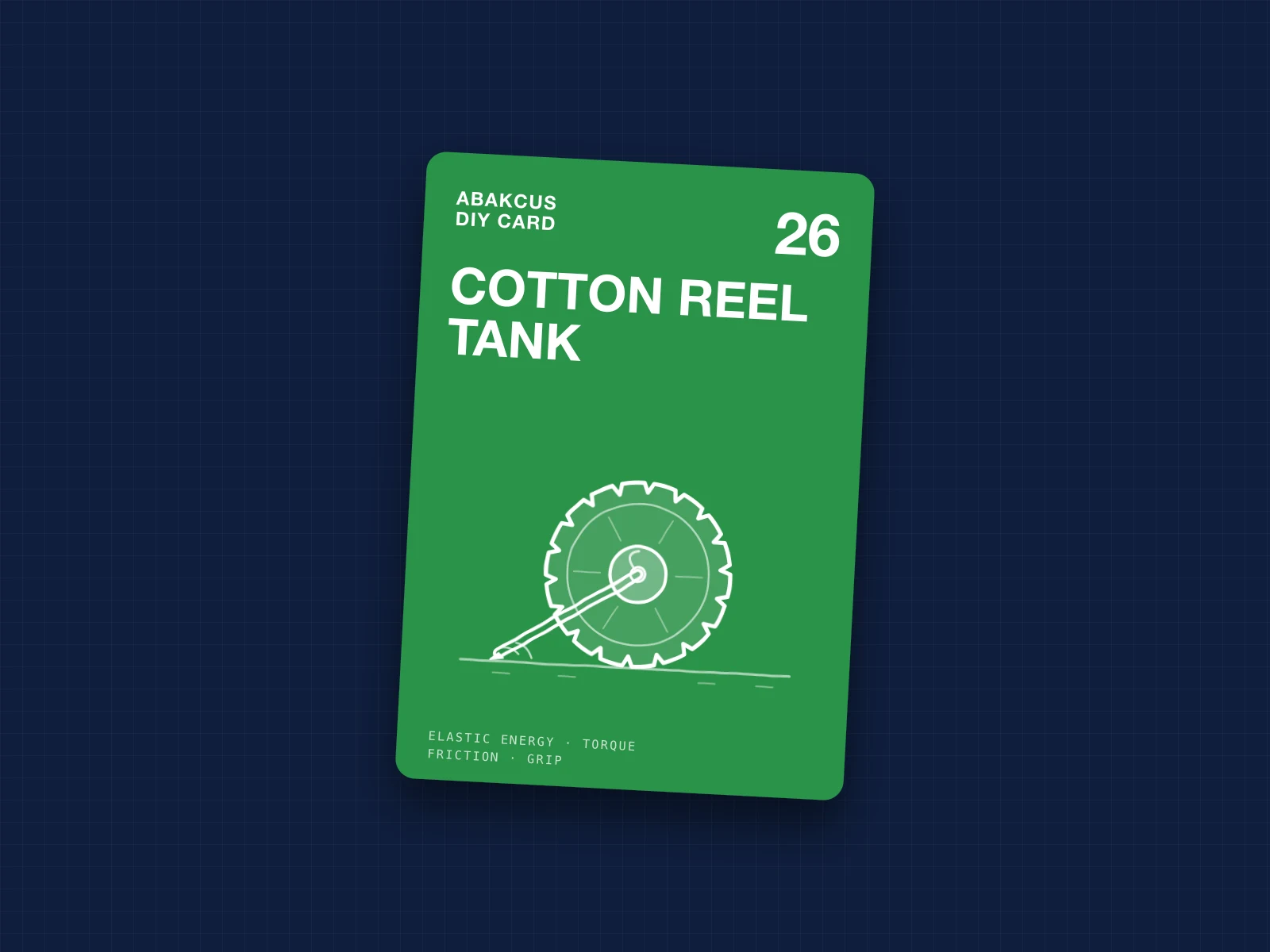
How to Build a Cotton Reel Tank (Thread Spool Tank)
An empty cotton reel, a rubber band, a pencil and a slice of candle. Wind it up and it crawls across the floor and over books, slowly giving back every turn you put in.
Open