
DIY · Card 79 · Mathematics · Geometry
Three curved triangles cut from card, and a book that glides across them as smoothly as on marbles. Not every shape that rolls is a circle.
01The brief
Roll a book on triangles, and keep it perfectly level.
π w
the perimeter of every shape of constant width w
70%
of the width squared: the Reuleaux triangle’s area
15%
how far its centre bobs as it rolls
Ask anyone why rollers are round and they will say it is the only shape that is the same width all the way round. They would be wrong. Draw three arcs on a triangle and you get a shape that fits between two parallel lines snugly at every angle.
Cut three from card, put a book on top, and it glides. It is a cousin of the square wheels that roll on curved roads, and of the area of a circle.
02Kit
Card, compasses, skewers and a book.
Tick off what you have
0 of 5 ready
03Method
Draw, round, cut, then roll a book.
Step 1 of 8 · Minute 0
You need thick card or foam board, a pair of compasses, a ruler, a pencil, scissors or a craft knife, wooden skewers, glue, and a big flat book.
The book wobbles.
Why
The two ends of a roller aren’t lined up.
Fix
Turn one end until its corners match the other exactly before the glue sets.
The arcs don’t meet at the corners.
Why
The compasses slipped or the triangle isn’t equilateral.
Fix
Check all three sides are the same length, and keep the compass setting locked for every arc.
The rollers slide instead of rolling.
Why
The table is slippery or the book too light.
Fix
Roll on a cloth or carpet, and use a heavier book so the rollers grip.
04Constant width
A roller carries a board at the height of its own width, measured from floor to top. If that width never changes as it turns, the board never moves up or down. The circle has this property; so does the Reuleaux triangle.
Roll three shapes side by side:
Circle height
100 %
Reuleaux height
100 %
Square height
125 %
Heights are shown as a percentage of the width. The square swings from 100 % to 141 % (its diagonal, √2 times its side), so the board rides up and down. The Reuleaux triangle stays at exactly 100 % at every angle, like the circle. But watch its centre dot: it rises and falls by about 15 % of the width. Rollers don’t care; a wheel on an axle would.
Triangles are only the start. Any odd number of sides works:
Number of curved sides
Width
1
Perimeter
3.1416
Area vs circle
90 %
The Reuleaux triangle: the shape of constant width with the smallest possible area. Drill bits of this shape can cut almost-square holes. Its perimeter is 3.1416…, which is π: Barbier’s theorem of 1860 says every shape of constant width w has perimeter π w, exactly like the circle. The amber lines are the jaws of a calliper: the shape fits snugly between them whichever way you turn it.
05The big idea
Round is
not the only way.
We assume the circle is unique because it is the shape we know best. Mathematics is full of moments like this: a property we thought belonged to one shape turns out to be shared by a whole family.
What the circle really has that the others don’t is a fixed centre. That is why wheels are round and rollers needn’t be: the board only feels the width, but the axle feels the centre.
06The math
1 · Barbier’s theorem
perimeter = π w
True for every shape of constant width w.
2 · Reuleaux area
A = (π − √3) ⁄ 2 · w²
The smallest area of any shape of width w.
3 · The square’s problem
√2 ≈ 1.414
Across the corners, compared with across the sides.
For 8 cm rollers, the perimeter is π × 8 ≈ 25.1 cm, exactly the same as a circle 8 cm across. The area is (3.1416 − 1.7321) ⁄ 2 × 64 ≈ 45.1 cm², against 50.3 cm² for the circle: about 90 % of it.
A square 8 cm across its sides is 8 × 1.414 ≈ 11.3 cm across its corners, so a book on square rollers lurches up and down by over 3 cm. Each arc of the Reuleaux triangle covers 60° of a circle of radius w; three of them make 3 × (π ⁄ 3) w = π w, Barbier’s theorem in miniature.
07Real life
In your pocket, in engines and in drills that cut square holes.
British coins
The 50p coin, introduced in 1969, and the 20p, from 1982, are seven-sided Reuleaux polygons. Coin machines measure their width, and it is the same whichever way they roll in.
Square-hole drills
In 1914 Harry Watts patented a drill whose bit is a Reuleaux triangle with cutting edges, held in a floating chuck. It cuts holes that are square except for slightly rounded corners.
The Wankel engine
Felix Wankel’s rotary engine, used in some Mazda cars, has a rotor close to a Reuleaux triangle. It turns inside a curved chamber, its three tips always touching the walls.
Covers that can’t fall in
A round manhole cover can’t drop through its hole however you turn it, because it is the same width everywhere. A cover shaped like a Reuleaux triangle is just as safe; a square one could slip down diagonally.
Guitar picks
Many guitar picks are rounded triangles close to the Reuleaux shape: any of the three tips can strike the strings, and the curved sides sit comfortably between finger and thumb.
Leonardo’s map
Around 1514 a world map in Leonardo da Vinci’s notebooks drew the globe as eight curved triangles, each close to a Reuleaux triangle, centuries before the shape had a name.
1875
Franz Reuleaux, a German engineer, spent his life classifying how machine parts move against each other. In his 1875 book on the theory of machines he studied the curved triangle closely, showing how it turns inside a square and how it can drive other parts.
He wasn’t the first to draw it: Leonardo da Vinci had used it, and Leonhard Euler studied curves of constant width in the 1770s. But Reuleaux showed engineers what it could do, and it has carried his name ever since.
08Is and isn’t
Only a circle has the same width everywhere.
There are infinitely many shapes of constant width. The Reuleaux triangle is the simplest, and the one with the smallest area for its width.
Rollers have to be round.
Anything of constant width carries a board perfectly level. Roundness only matters when there is an axle at the centre.
A Reuleaux wheel would work on a bike.
Not on an ordinary axle: the centre bobs up and down by about 15 % of the width as it rolls. A few inventors have built such bikes, using clever hubs.
Reuleaux drills make perfect squares.
They leave slightly rounded corners, covering about 98.8 % of the square. Close enough for many jobs, but not perfectly sharp.
09Go further
A
Measure with callipers
Hold the shape between two rulers held parallel. Turn it: does the gap ever change? Try a coin, a square and a triangle.
B
A Reuleaux pentagon
Draw a regular pentagon and an arc from each corner to the two opposite ones. Does it roll as well?
C
Measure the perimeter
Wrap a thread round your Reuleaux triangle and measure it. Is it π times the width?
D
Square-hole puzzle
Cut a square hole the size of the width in card. Can your triangle turn all the way round inside it?
E
Coin hunt
Find coins from different countries. Which have curved polygon edges, and how many sides do they have?
10Questions
A curved triangle made from an equilateral triangle by replacing each side with an arc centred on the opposite corner. Its width is the same in every direction, so it rolls between two flat surfaces as smoothly as a circle.
Draw an equilateral triangle. Set a pair of compasses to the length of a side, put the point on one corner and draw an arc between the other two corners. Repeat from the other two corners, and the three arcs make the shape.
Its edge always touches the top and bottom of a gap the same distance apart, but its centre rises and falls as it turns, by about 15 % of its width. An axle through the centre would bob up and down.
Britain’s 20p and 50p coins are seven-sided Reuleaux polygons, and Canada’s dollar coin has eleven sides. A shape of constant width always fits the same slot, so vending machines can measure it in any orientation.
Almost. A drill bit shaped like a Reuleaux triangle, guided so its centre wanders on the right path, cuts a square hole with slightly rounded corners, about 98.8 % of the square. Harry Watts patented such drills in 1914.
Safety · A grown-up should cut foam board with the craft knife, on a mat. Compass points and skewers are sharp: snip the skewer ends once the rollers are glued.
All DIY cards →Keep wandering
A few more pieces in the same spirit — math, design, and slow attention.
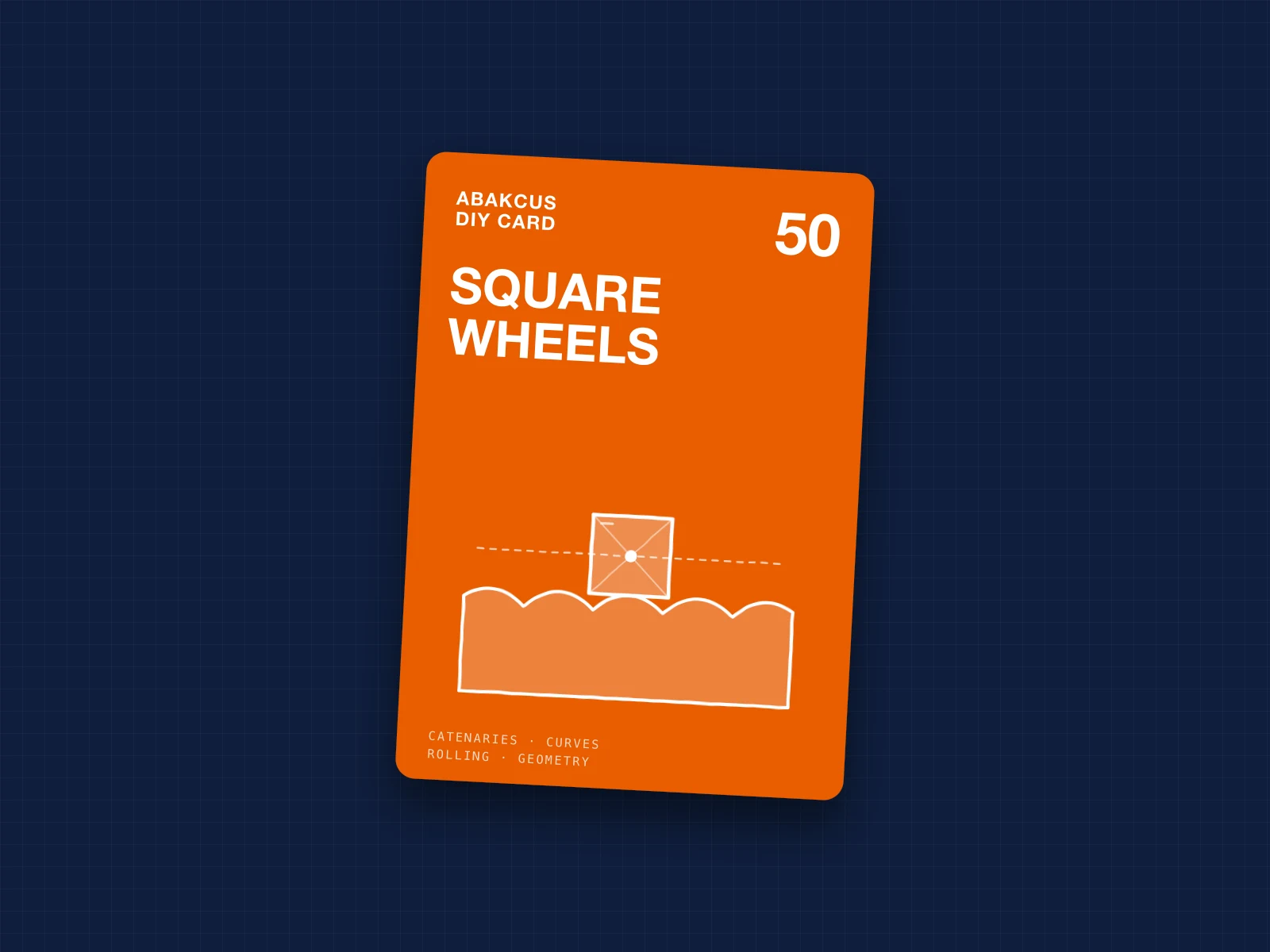
How to Make Square Wheels That Roll Smoothly on a Bumpy Road
Two cardboard squares, a skewer and a necklace. Trace a hanging chain, turn it upside down for a road, and square wheels roll as smoothly as round ones.
Open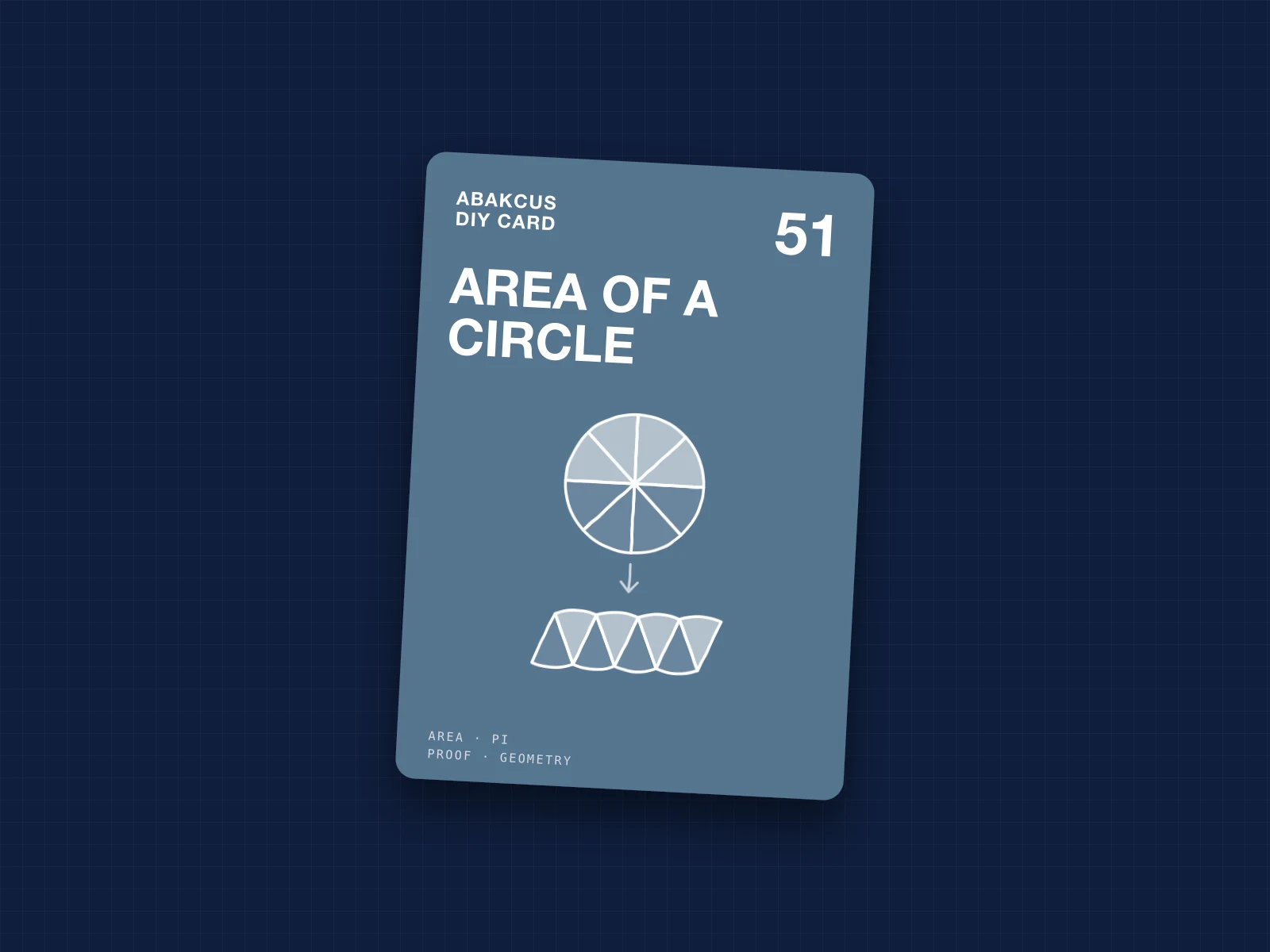
How to Show the Area of a Circle Is πr² With Paper Slices
A paper circle, three folds and a pair of scissors. Cut it into slices, lay them top to tail, and the circle becomes a rectangle that shows why its area is πr².
Open
How to Make a Hexaflexagon From a Strip of Paper
A strip of ten paper triangles folds into a hexagon with three faces instead of two. Pinch, push and open, and a face you never coloured blooms from inside.
Open
How to Make a Hyperbolic Slot: A Straight Rod Through a Curve
A pencil, a skewer and a sheet of foam board. Spin a perfectly straight stick and it glides through a perfectly curved slot, thanks to the shape of a cooling tower.
Open
How to Construct the Spiral of Theodorus With a Ruler
A ruler, a square corner and a pencil. Build one right triangle on another and draw every square root from √2 to √17, curled into a snail shell.
Open
How to Make a Galton Board That Draws a Bell Curve
A board, forty pins and a handful of beads. Every bead zigzags at random, yet together they pile into the same graceful hump every time: the bell curve.
Open