
DIY · Card 26 · Engineering · Energy
An empty cotton reel, a rubber band, a pencil and a slice of candle. Wind it up, put it down, and it crawls away across the floor, giving back every turn you put in.
01The brief
Build a tank that crawls as far as it can on a single winding.
9.4 cm
travelled for every turn of a reel 3 cm across, if nothing slips
½ kθ²
the energy stored in the twisted band: double the turns, four times the energy
1871
the year a twisted rubber band first flew a model plane
A cotton reel tank is one of the oldest home-made toys there is: a reel, a rubber band and a stick, with a slice of candle if you know the trick. Wind it up and it doesn’t race off like a car; it crawls, steadily, climbing over books and rugs like a tiny tank.
It is also a complete lesson in storing energy and letting it out well. Winding twists the band into a spring. The pencil holds one end so the reel has to turn. The candle lets the band unwind smoothly. And the notched rims decide how much of all that twist actually moves the tank. Like the marble run, the challenge is not having energy but spending it well.
02Kit
Five small things from a sewing box, a pencil pot and a candle drawer.
Tick off what you have
0 of 5 ready
03Method
Notch the rims, thread and anchor the band, add the candle and pencil, then wind it up and let it go.
Step 1 of 8 · Minute 0
You need an empty cotton reel, a rubber band a little longer than the reel, a short piece of matchstick or cocktail stick, a pencil, and a slice of candle about 1 cm thick with a hole through the middle.
The reel spins on the spot.
Why
Too much twist for the grip: smooth rims on a shiny floor.
Fix
Cut deeper notches, put a rubber band round each rim, or run it on carpet.
The pencil spins round instead of the reel.
Why
The pencil is too short to reach the floor, or it slides on the candle too easily.
Fix
Use a longer pencil so it drags on the floor, with most of it on one side.
It won’t move at all.
Why
The anchor stick is turning, or the washer friction is too high.
Fix
Tape the matchstick down firmly, and wax the candle’s faces.
04Physics
Each turn of the pencil twists the band a little further. A twisted band is a torsion spring: it pushes back with a turning force, a torque, that grows with every turn. The work you do winding it is stored as elastic energy.
On the floor, the pencil’s long end drags and can’t go round. So as the band untwists, it turns the reel. Three things then decide how far the tank gets. Friction at the washer takes a steady share of the torque all the way, and once the band is too slack to beat it, the tank stops with a few turns still wound. Grip at the rims decides whether the reel rolls or just spins on the spot. And everything else drives the tank forward. Wind it, tune it and race it:
Distance
111 cm
Running time
25 s
Turns left when it stops
8.2
Turning lost to wheelspin
0 %
Friction at the washer always keeps a few turns locked in the band: once the twist is too weak to beat it, the tank stops with energy still stored.
The track runs on a simple model with made-up but realistic constants, not on measurements of a real tank. The way each change pushes the result is real; build one and test it.
05The big idea
Store it fast,
spend it slow.
You wind the tank in a few seconds; it spends that energy over half a minute. Almost every machine that stores energy has the same problem: getting it in is easy, letting it out at the right rate is the clever part.
A watch’s escapement, a catapult’s trigger, a battery’s chemistry and your candle washer all do the same job. They stand between a store of energy and the thing it drives, and decide how fast it flows.
06The math
1 · A torsion spring
τ = k θ
The band’s torque grows in step with the angle θ it has been twisted through.
2 · Energy stored
E = ½ k θ²
The area under that straight line: a triangle. Double the turns and the energy goes up four times.
3 · Distance per turn
s = π d
One turn of a reel of diameter d rolls it one circumference, if the rims don’t slip.
For a reel 3 cm across, each turn rolls it π × 3 ≈ 9.4 cm, so 20 turns could carry it 1.9 m if nothing were lost. In practice the washer’s friction keeps the last few turns locked in the band: the tank stops when kθ falls to the friction torque, leaving θ = τ_f / k still wound.
Because energy goes as θ² but distance only as θ, winding twice as far stores four times the energy but at best doubles the distance. The extra has to go somewhere, and it goes into wheelspin, noise and a warm band. Shade the triangle and see where it all ends up:
07Real life
Springs, twisted skeins and rubber bands have powered machines for thousands of years, and still do.
Clockwork toys
Wind-up cars, walking robots and music boxes store energy in a coiled steel spring instead of a twisted band. A brake, a governor or an escapement lets it out slowly, the job your candle and pencil do.
Mechanical watches
A mainspring, wound by hand or by the swing of your wrist, stores enough energy to run a watch for a day or two. The escapement releases it in tiny, perfectly even steps.
Roman catapults
The ballista and the onager were powered by skeins of twisted sinew or hair: torsion springs, exactly like your rubber band. Twist them tighter and they stored more energy to throw a stone or a bolt.
Wind-up radios
In the 1990s, Trevor Baylis designed a radio powered by winding a spring, for places without mains electricity or a supply of batteries. A gearbox and generator turn the slowly unwinding spring into electricity.
Caterpillar tracks
Tanks, bulldozers and snow vehicles spread their weight over long tracks with ridges called grousers that bite into the ground. Your notched rims are the same idea: grip comes from teeth, not just from weight.
Rubber-powered planes
Model aircraft still fly on long loops of twisted rubber wound hundreds of turns with a hand drill. Fliers tune exactly what you tune here: how much to wind, how fast to let it out, and how to waste none of it.
1871
On 18 August 1871, in the Tuileries Gardens in Paris, the young French engineer Alphonse Pénaud launched a little model aeroplane he called the Planophore. It weighed about 15 grams and was powered by a rubber band twisted some 240 turns, turning a propeller at the back. It flew about 40 metres and stayed up for around 11 seconds.
It was the first stable powered model aircraft, and it showed that a small, light store of twisted rubber could do real work. Rubber-powered models have flown ever since, and the toy helicopters they inspired fascinated the young Wright brothers. Like the electric motor card, it is a machine you can hold in one hand that turns stored energy into motion.
08Is and isn’t
More turns always means further.
Up to a point. The energy stored grows with the square of the turns, but the distance only grows with the number of turns. Wind too far and the extra twist goes into wheelspin, or knots and snaps the band.
The candle is just there for weight.
It is a bearing. Without it the pencil grinds against the reel, the friction is high and jerky, and the tank lurches or stops early.
The pencil pushes the tank along.
The pencil doesn’t push: it holds. Resting on the floor, it stops the band’s end from turning, so the untwisting band has to turn the reel instead.
A rubber band gives back all the energy you put in.
Not quite. Twist a band fast and hold it to your lip: it warms up. Rubber turns some of the work of stretching into heat each time, so it always returns a little less than you gave it.
09Go further
A
Distance per turn
Wind 5, 10, 15 and 20 turns and measure how far it goes each time. Plot it. Does it go the same extra distance for every extra turn?
B
Hill climb
Make a ramp from a board on books. How steep a slope can your tank climb? What helps most: more turns, more bands, or more grip?
C
Washer trial
Swap the candle for a plastic bottle top, a coin or nothing at all. Which runs furthest, and which most smoothly?
D
Count the leftover turns
When the tank stops, lift it and count how many turns are still wound in the band. That is the energy friction kept.
E
Tank race
Everyone builds one, winds exactly 20 turns, and races. Then compare designs: what did the winner do differently?
10Questions
Thread a rubber band through an empty cotton reel. Anchor one end with a short piece of matchstick taped flat to the reel. Thread the other end through a slice of candle and push a pencil through the loop. Wind the pencil round 20 or 30 times, put the tank on the floor with the pencil trailing, and let go.
It is a bearing. The pencil turns against the candle’s smooth, waxy face instead of grinding against the reel, so the band unwinds steadily and the tank crawls instead of lurching or spinning the pencil round.
For grip. The twisted band can push harder than a smooth rim can grip the floor, and the reel spins on the spot. Notches bite into the floor like a tank’s tracks, so more of the twist becomes forward motion.
Each full turn of the reel moves it one circumference, about 9 to 10 cm for a standard reel. A well-made tank wound 20 to 30 times will usually crawl one to two metres, losing a few turns to friction and some to wheelspin.
Winding the pencil twists the rubber band, storing elastic energy. On the floor the pencil drags and can’t turn, so as the band untwists it turns the reel instead, and the reel rolls the tank along, slowly giving back the energy you put in.
Safety · A grown-up should cut the notches and the candle slice. Keep faces away from a tightly wound band, which can snap. Never light the candle: you only need a slice of its wax.
All DIY cards →Keep wandering
A few more pieces in the same spirit — math, design, and slow attention.
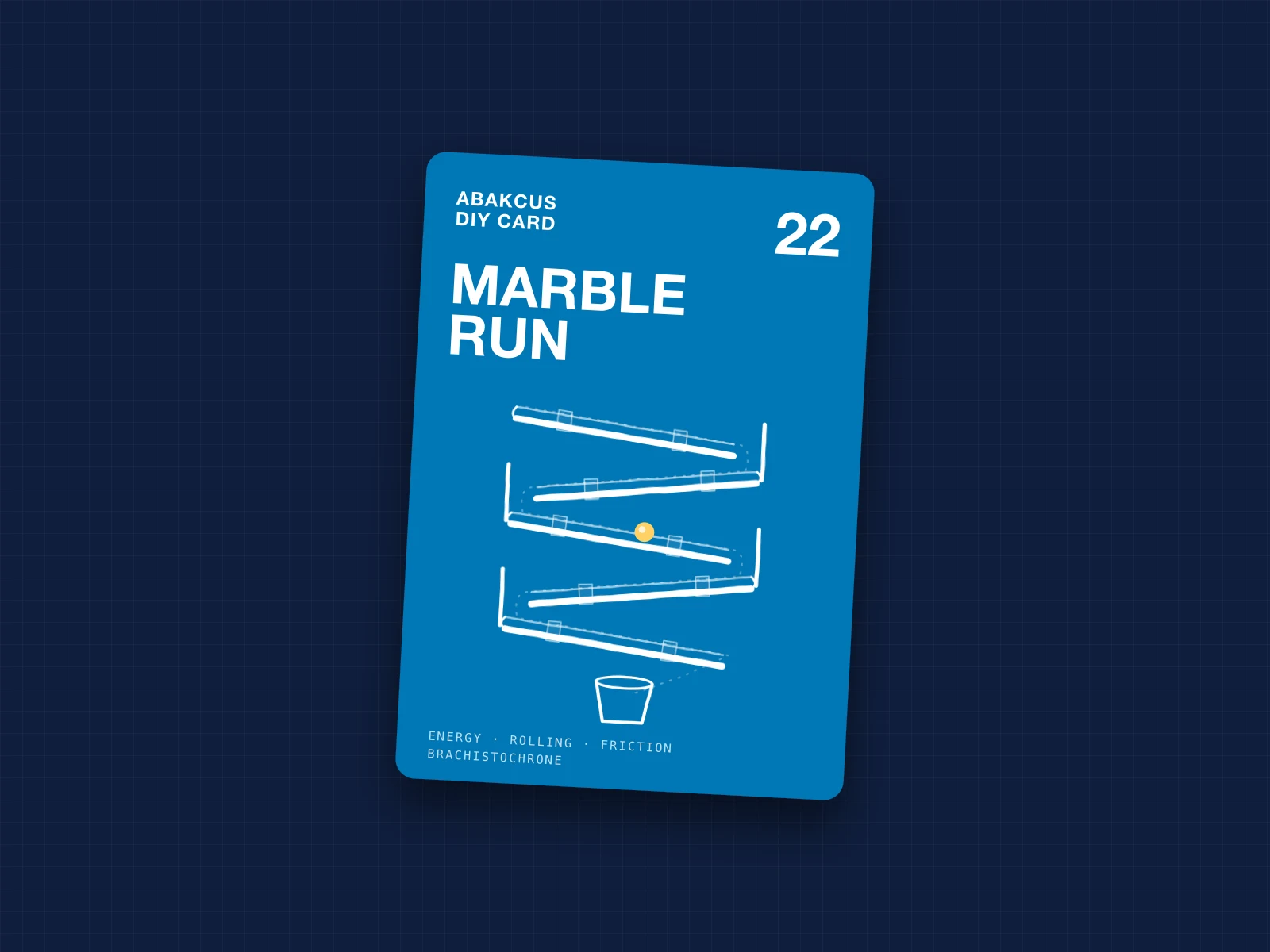
How to Build a Marble Run From Cardboard Tubes
Split tubes, a wall and some tape: a zigzag run that keeps a marble busy for half a minute on a one-metre drop it could fall in less than half a second. Height is the fuel; the trick is spending it slowly.
Open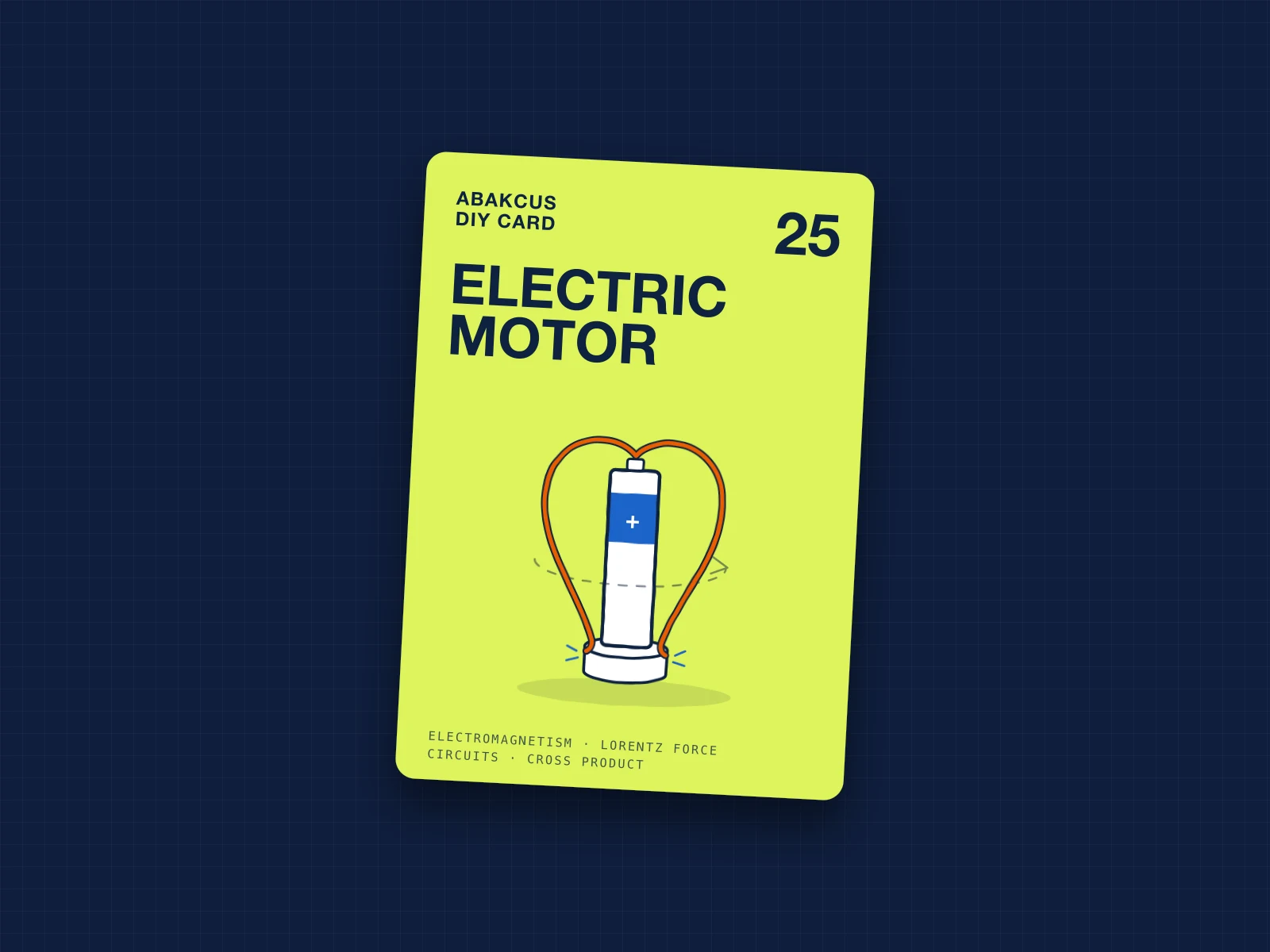
How to Make a Simple Electric Motor (Homopolar Motor)
A battery, a magnet and a bent piece of copper wire: three parts, no coils, and the wire spins on its own. It is the same push that drives every electric motor, found by Faraday in a single afternoon in 1821.
Open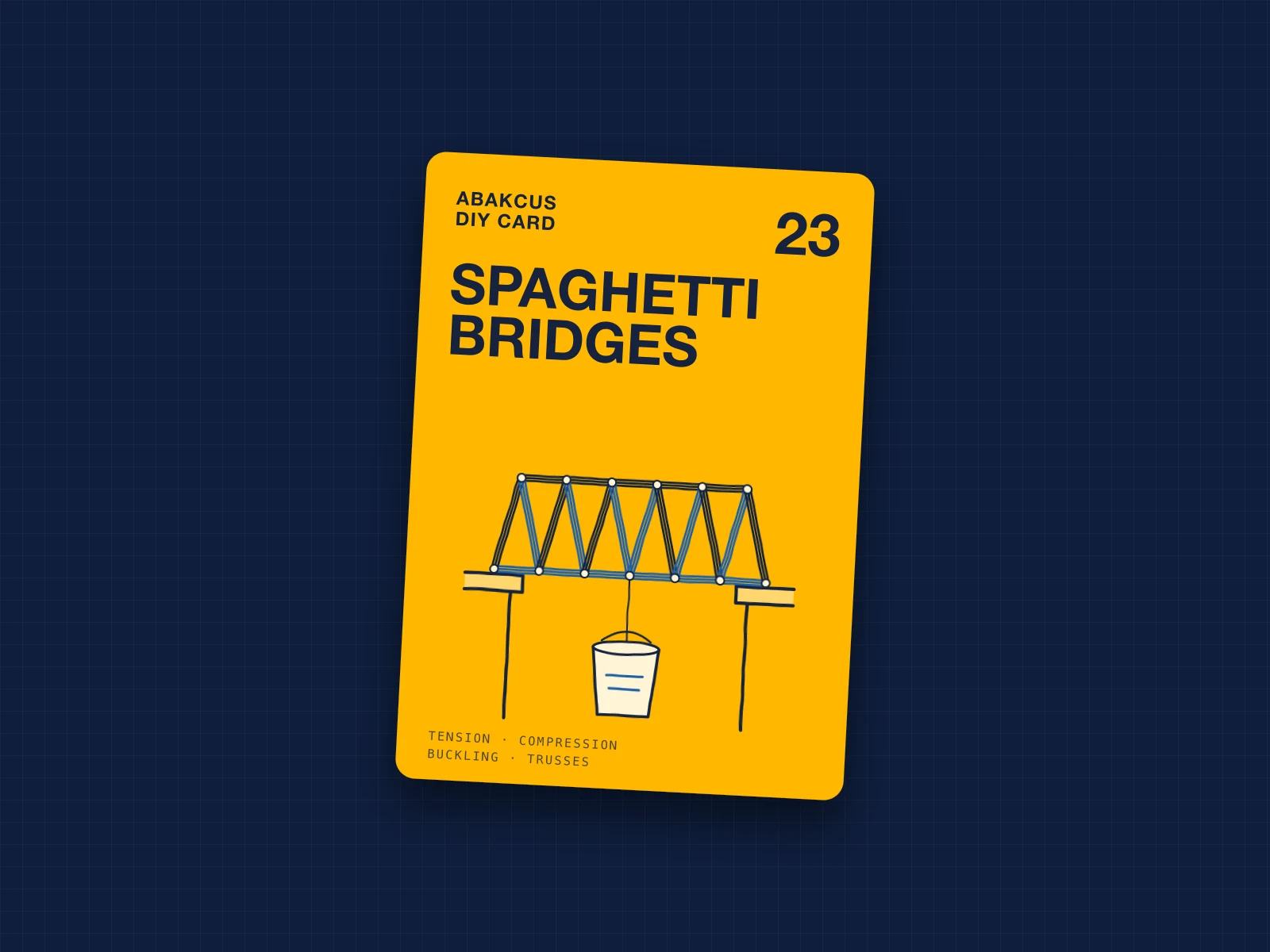
How to Build a Spaghetti Bridge (and Why Pasta Buckles)
One strand of dry spaghetti can hang five kilograms from its end, then buckles under less than two hundred grams pushed along it. A good bridge pulls where pasta is strong and keeps the pushes short.
Open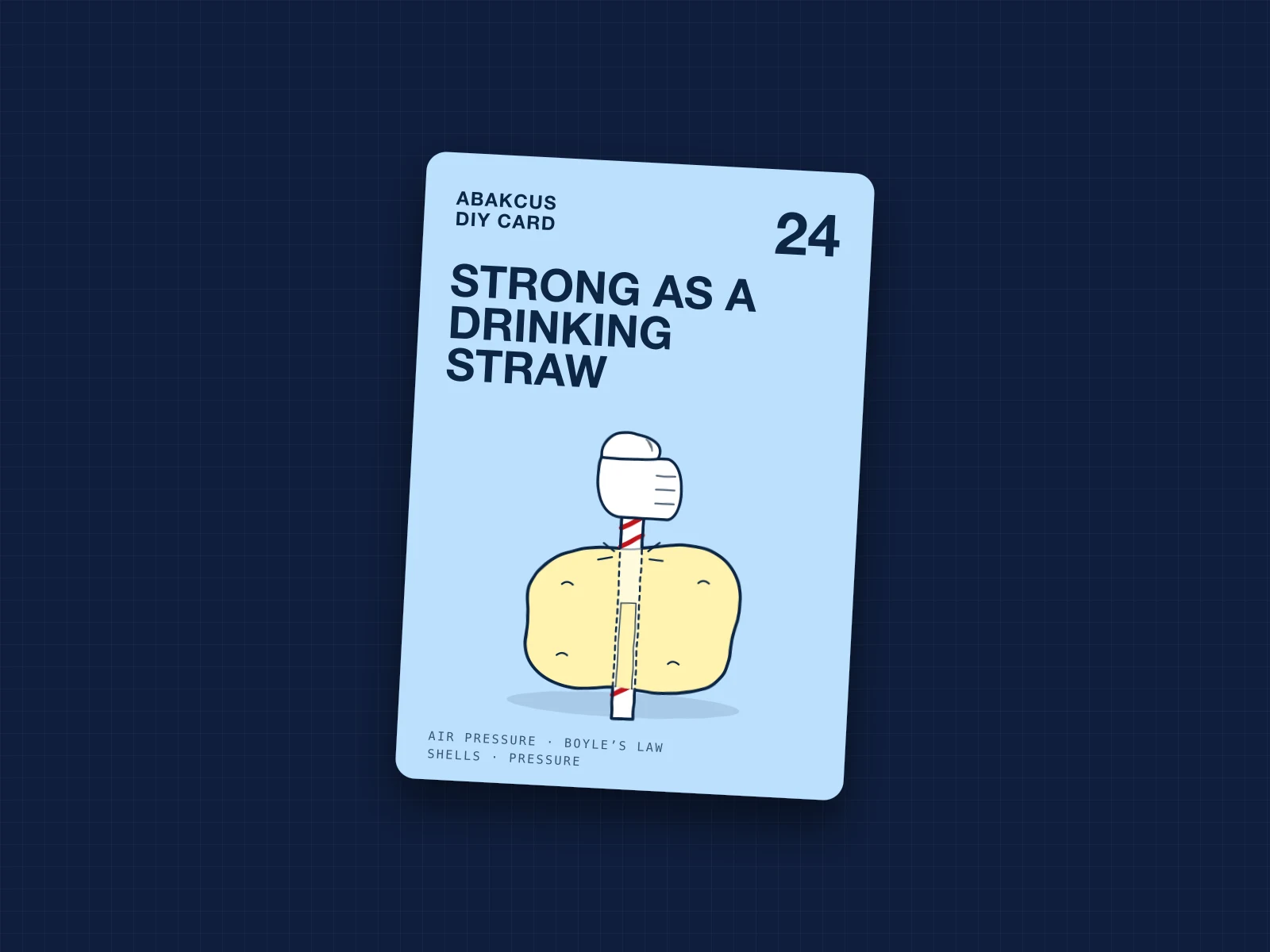
How to Push a Straw Through a Raw Potato
Stab a potato with a plastic straw and the straw crumples. Put your thumb over the top first and it goes straight through. The air trapped inside can’t get out, so the straw can’t cave in.
Open
How to Push a Skewer Through a Balloon Without Popping It
A wooden skewer goes in at the top of a balloon and out beside the knot, and the balloon just sits there. The trick is knowing where the rubber is least stretched, and why stretch decides everything.
Open
How to Do the Egg Drop Inertia Trick: Newton’s First Law
Knock a tray out from under an egg and the egg drops straight down into a glass of water. The trick is speed, not strength, and the egg’s weight turns out not to matter at all.
Open