On September 9, 1990, a reader named Craig Whitaker sent a question to Parademagazine's “Ask Marilyn” column. The question was short. It concerned a game show, three doors, a car, and two goats. Marilyn vos Savant, the column's author and the holder of the highest recorded IQ in the Guinness Book of World Records, answered in two sentences. What followed was one of the most remarkable episodes in the public history of mathematics.
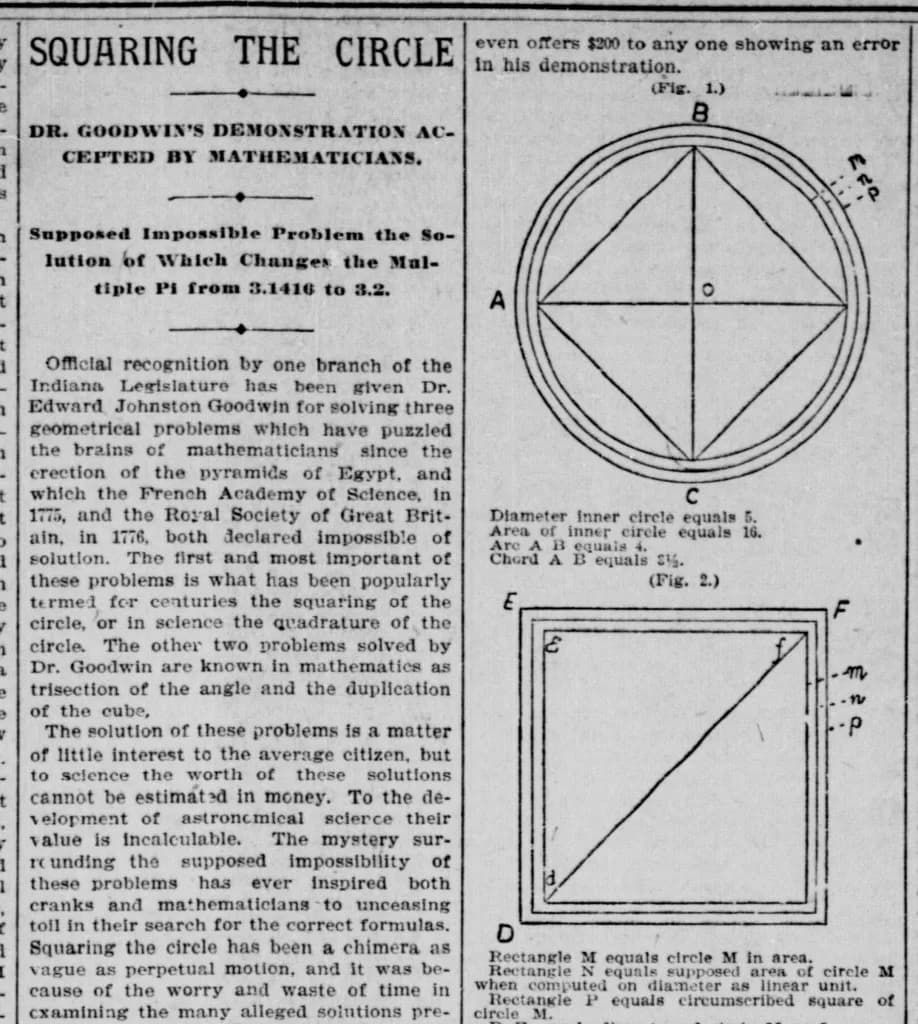
The puzzle has since become famous enough to carry its own name — the Monty Hall Problem — though the problem itself is considerably older than the controversy. What made 1990 different was not the puzzle, but the woman who answered it, and the people who disagreed. It belongs in the same company as the Indiana legislature that tried to redefine the value of π by statute — famous cases where experts and institutions were publicly, confidently, and completely wrong about mathematics.
Who Was Marilyn vos Savant?
Born Marilyn Mach on August 11, 1946, in St. Louis, Missouri, she grew up in a family of modest means — both grandfathers were coal miners, her parents ran a bar and grill. By the time she was ten, she had reportedly read through the entire Encyclopædia Britannica.
That same year, she was administered the Stanford-Binet Intelligence Scale, a test normed for children. The result came back at 228 — her measured mental age was 22 years and 10 months, her actual age just 10. This figure, submitted to the Guinness Book of World Records alongside a later Mega Test result of 186, earned her a listing as the person with the highest recorded IQ on the planet.
The Guinness category was retired in 1990 — they concluded IQ tests were too unreliable to designate a single record holder. By then, vos Savant had already established her column. “Ask Marilyn” launched in 1986; each week, readers submitted logic puzzles, mathematical problems, and philosophical dilemmas, and she answered them. The column would run until 2022, for 36 years.
A Problem with Three Doors
The puzzle Whitaker submitted had appeared before, in various forms. Joseph Bertrand's box paradox dates to 1889. Martin Gardner described a structurally identical scenario in Scientific Americanin 1959, noting presciently that “in no other branch of mathematics is it so easy for experts to blunder as in probability theory.” In 1975, UC Berkeley statistician Steve Selvin formalized the three-door version in a letter to The American Statistician and called it the Monty Hall Problem, after the host of Let's Make a Deal. Nobody argued with Selvin.
The setup: three doors. Behind one is a car. Behind the other two are goats. You choose a door — say Door 1. The host, who knows what is behind every door, opens one of the other doors to reveal a goat — say Door 3. He then asks: would you like to switch to Door 2, or keep Door 1?
The intuitive answer is that two doors remain, so the odds are 50–50. This is wrong. Vos Savant's answer was precise:
“Yes; you should switch. The first door has a 1/3 chance of winning, but the second door has a 2/3 chance.”
— Marilyn vos Savant, Parade, September 9, 1990
The key is what the host's action tells you. When you first picked Door 1, the probability that the car was behind it was 1/3. That probability does not change simply because the host opens another door. The remaining 2/3 probability — the probability that the car was behind one of the two doors you didn't pick — now collapses entirely onto Door 2, because the host has eliminated Door 3. Switching wins 2 out of every 3 games. Staying wins only 1 out of 3.
All Possible Scenarios
One clean way to see it: enumerate every possible game where you always switch. There are nine equally likely starting configurations.
| Car Behind | You Choose | Host Opens | You Switch To | Result |
|---|---|---|---|---|
| Door 1 | Door 1 | Door 2 or 3 | Door 3 or 2 | Lose |
| Door 1 | Door 2 | Door 3 | Door 1 | Win |
| Door 1 | Door 3 | Door 2 | Door 1 | Win |
| Door 2 | Door 1 | Door 3 | Door 2 | Win |
| Door 2 | Door 2 | Door 1 or 3 | Door 3 or 1 | Lose |
| Door 2 | Door 3 | Door 1 | Door 2 | Win |
| Door 3 | Door 1 | Door 2 | Door 3 | Win |
| Door 3 | Door 2 | Door 1 | Door 3 | Win |
| Door 3 | Door 3 | Door 1 or 2 | Door 2 or 1 | Lose |
Six wins. Three losses. Switching is correct two-thirds of the time. The math is not in dispute. It never was, really — the dispute was about whether vos Savant, specifically, was allowed to be right. It is a pattern familiar from science education research: the gap between knowing the name of something and actually understanding it is where most confident errors live.
The Letters
About 10,000 of them arrived. Nearly 1,000 were signed by people with PhDs. The majority — roughly 92 percent — told her she was wrong. Many did not stop at disagreement.
“You blew it, and you blew it big! Since you seem to have difficulty grasping the basic principle at work here, I'll explain. After the host reveals a goat, you now have a one-in-two chance of being correct. Whether you change your selection or not, the odds are the same. There is enough mathematical illiteracy in this country, and we don't need the world's highest IQ propagating more. Shame!”
— Scott Smith, Ph.D. — University of Florida
“May I suggest that you obtain and refer to a standard textbook on probability before you try to answer a question of this type again?”
— Charles Reid, Ph.D. — University of Florida
“You are utterly incorrect about the game show question, and I hope this controversy will call some public attention to the serious national crisis in mathematical education. How many irate mathematicians are needed to get you to change your mind?”
— E. Ray Bobo, Ph.D. — Georgetown University
“You are the goat!”
— Glenn Calkins — Western State College
“Maybe women look at math problems differently than men.”
— Don Edwards — Sunriver, Oregon
She was forced to write three follow-up columns. Even after doing so — clearly, with worked examples — some correspondents refused to update. One man wrote back nearly a year later: “I still think you're wrong. There is such a thing as female logic.”
None of the men who had written equally confident, equally wrong corrections to Steve Selvin in 1975 had received a single hostile reply. This fact was not lost on anyone paying attention.
The Experiment
Vos Savant's solution was ultimately proved the only way it could be proved to people unwilling to follow a mathematical argument: she asked them to run the experiment. She invited schoolteachers to conduct it with their classes. Students folded paper, flipped coins, simulated the game hundreds of times. The results were, as she put it, close to unanimous.
Over the following two years, acceptance shifted. The percentage of general readers agreeing with her rose from 8 to 56. Among academics, it moved from 35 to 71. Computer simulations confirmed the result. The problem was eventually renamed, informally, “Marilyn and the Goats.”
Among those who changed their minds was Robert Sachs, a math professor at George Mason University, who had written to tell her she “blew it” and offered to help her understand. He later sent a second letter. “After removing my foot from my mouth I'm now eating humble pie,” he wrote. “I vowed as penance to answer all the people who wrote to castigate me. It's been an intense professional embarrassment.”
Why Is This Problem Hard?
The standard explanation is that the host's action is not random. He always opens a losing door — he never reveals the car. This means his choice carries information. When the host opens Door 3, he is telling you, in effect, that if the car is behind Door 2, he was forced to open Door 3. The non-randomness of his action is what shifts the probability.
A useful restatement: imagine 100 doors. You pick Door 1. The host opens 98 of the other 99, revealing goats behind all of them, leaving only your door and Door 100 closed. Would you switch? The probability that the car is behind Door 100 is now 99/100. The principle is identical in the three-door case — scaled down to numbers that, unfortunately, allow the brain to tell itself a comfortable story about 50–50. This is comparable to how our visual intuition fails with Euclid's proof that prime numbers never run out — the conclusion seems impossible until you follow the logic step by step.
Stanford statistician Persi Diaconis put it plainly: “Our brains are just not wired to do probability problems very well, so I'm not surprised there were mistakes.” Vos Savant herself had anticipated this in a follow-up column — the strict answer requires knowing that the host always opens a losing door on purpose. “Anything else,” she wrote, “is a different question.”
The problem also illustrates something that recurs across mathematics education: conditional probability is genuinely unintuitive, and even puzzles that look simple on the surface conceal layers of combinatorial structure that resist casual reasoning.
Watch the Story
After the Goats
Vos Savant continued writing “Ask Marilyn” until 2022. She returned to probability and logic repeatedly over the decades, and the column generated other famous controversies — including a structurally similar problem about the sex of puppies, and a disputed 1993 book questioning Andrew Wiles's proof of Fermat's Last Theorem, for which she later issued a retraction.
The Monty Hall episode remains the one she is best known for, partly because the mathematics is genuinely counterintuitive, and partly because the response revealed something uncomfortable about how expertise and gender interacted in 1990 — and, arguably, continue to interact. The problem was not new. The answer was not new. The person who wrote it down was a woman, and that, apparently, was new enough.
The car was behind Door 2. It always was.