Few pages in history have been reproduced as often as these two, and every time I look at them I get stuck on the same thing. Albert Einstein’s signature sits at the bottom and his summer address sits at the top, but the man who thought of the letter, drafted it, decided who it should go to and chased it after it was signed was Leo Szilard. Einstein gave more than his name, of course, but to understand why the letter speaks in Einstein’s voice I have to go back six years, to a London street corner where Szilard was waiting for the lights to change.
On the morning of September 12, 1933, The Times reported a speech Ernest Rutherford had given the day before at the British Association. Anyone who talked about getting energy out of splitting atoms, Rutherford had said, was talking moonshine. Szilard, a thirty-five-year-old Hungarian physicist who had fled Berlin after Hitler came to power, was annoyed by it. By his own account he left his hotel in Bloomsbury, stopped at a red light on Southampton Row, and while he stood there an idea came to him. If a neutron hits a nucleus and splits it, and the split releases two neutrons, those two can split two more nuclei, those release four, and the process feeds itself and grows. By the time the light turned green Szilard had thought of the chain reaction, but he did not know which element would do it. He patented the idea the following year, and in 1936, to keep it out of the wrong hands, he assigned the patent to the British Admiralty.
The missing piece arrived from Berlin five years later. In December 1938 Otto Hahn and Fritz Strassmann bombarded uranium with neutrons, found barium in the result and could not explain it, because barium weighs roughly half as much as uranium. The explanation came from Lise Meitner, living in exile in Sweden, and her nephew Otto Frisch, who are said to have worked it out on a walk in the snow over Christmas. The uranium nucleus wobbles like a drop of water, stretches, pinches at the waist and comes apart in two, releasing about 200 million electron volts as it does. A chemical reaction gives a few electron volts per atom, so the difference is a factor of tens of millions. Frisch borrowed the word biologists use for cell division and called it fission. When Niels Bohr brought the news to America in January 1939, the whole question Szilard had been carrying for six years came down to one experiment. Did uranium release new neutrons when it split?
Szilard was working at Columbia University at the time as an unpaid guest, and he set up the experiment with Walter Zinn on March 3, 1939. They sent neutrons into a sample of uranium and watched an oscilloscope for the flashes that fast neutrons from fission would leave on the screen. Years later Szilard described that night. They turned the switch, saw the flashes, watched them for a while, switched everything off and went home, and that night, he said, there was very little doubt in his mind that the world was headed for grief. In the same weeks Enrico Fermi got similar results in another Columbia lab, and in Paris Frédéric Joliot, Hans von Halban and Lew Kowarski published in Nature that each fission released more than one neutron.
Szilard wanted those results kept out of print. He persuaded Fermi for a while, but the Joliot group did not wait, and within weeks the news was in every physics laboratory in the world. What frightened Szilard was Germany. The lab that discovered fission was in Berlin, Germany had occupied the rest of Czechoslovakia in March 1939, and Europe’s oldest uranium mine, Joachimsthal, was now on German soil. The tons of pitchblende residue from which Marie Curie separated polonium and radium had come from that same mine.
The richest uranium ore in the world, though, was at the Shinkolobwe mine in the Belgian Congo, and Szilard wanted a way to stop the Belgian company that ran it from selling ore to Germany. He thought of Einstein, because Einstein had known Queen Elisabeth of Belgium for years, wrote to her, and played violin with her at the palace. So Roosevelt was not in Szilard’s first plan at all. He was going to ask Einstein to write a warning to Belgium.
On July 12, 1939, Szilard, who could not drive, got into his Columbia colleague Eugene Wigner’s car and the two of them headed out to the North Fork of Long Island. Einstein was spending the summer in a house he had rented from a Dr. Moore at Nassau Point, and he passed his days sailing around the bay in a small boat he called Tinef, Yiddish for a worthless thing. Einstein could not swim. Szilard and Wigner could not find the address, and just as they were about to give up they asked a boy of about seven by the side of the road where Professor Einstein lived, and the boy took them to the door.
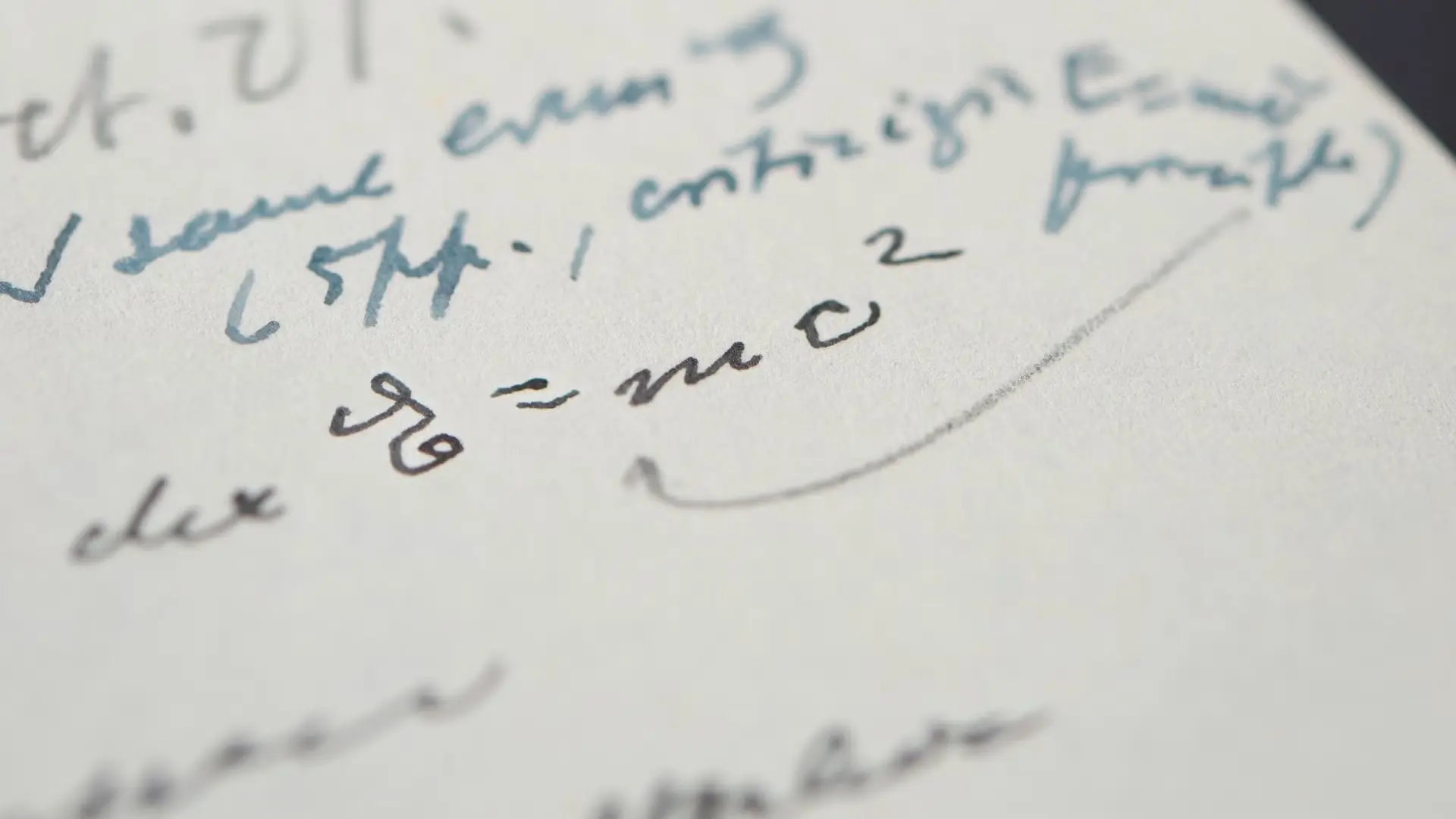
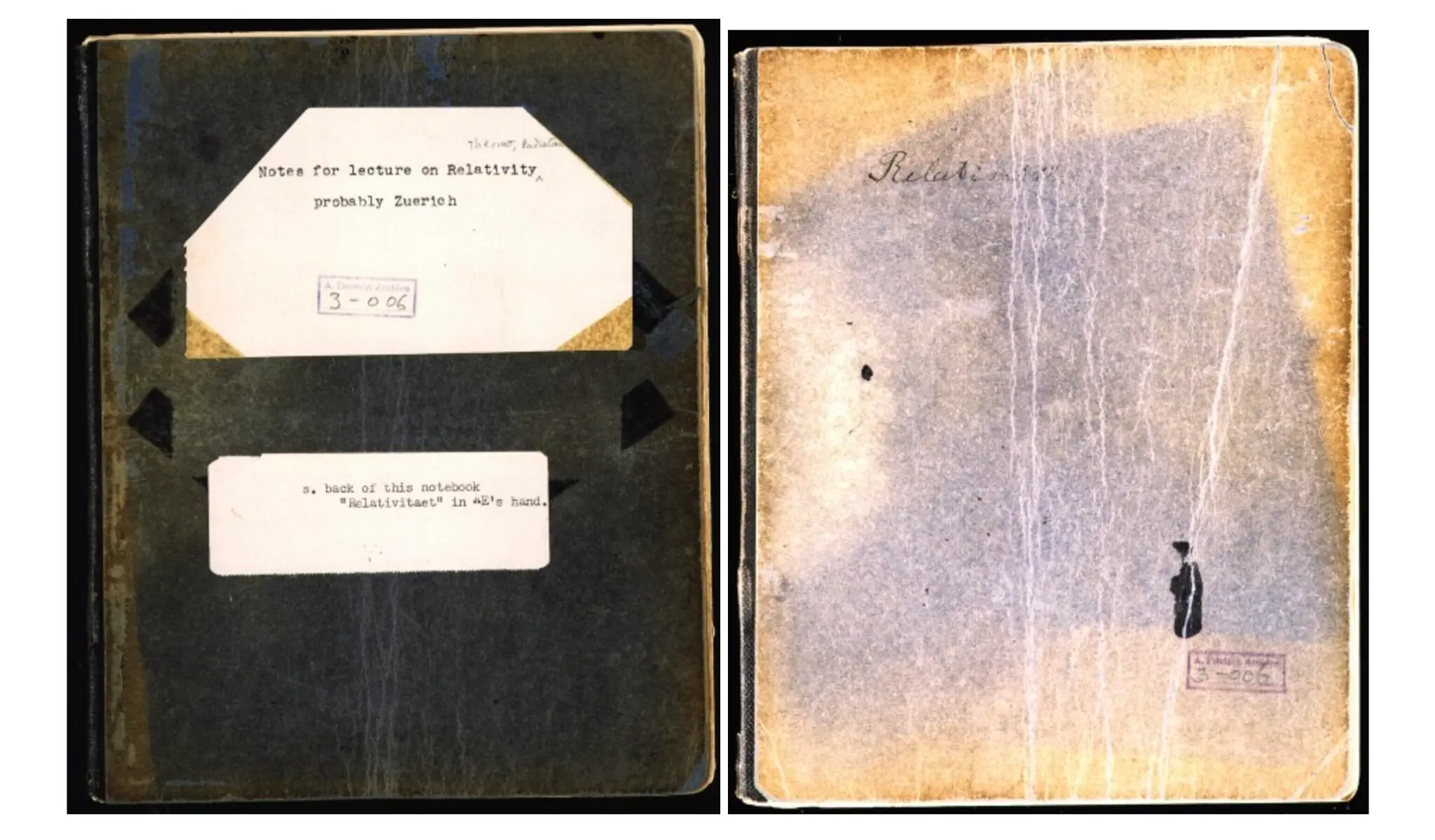
When Szilard explained the chain reaction, Einstein is reported to have said in German that he had not thought of that at all. It sounds odd, since he was the man who wrote down the relation between mass and energy in 1905, but that equation says the energy is stored in mass, not how to pull it out of one nucleus after another in a chain. Einstein grasped the logic in a few minutes and agreed to help. He dictated a letter for the Belgian ambassador in German, and Wigner wrote it down.
Back in New York, Szilard was introduced through the journalist Gustav Stolper to the economist Alexander Sachs. Sachs worked at the Lehman Corporation, had known Roosevelt since 1932, and could get an appointment at the White House. His objection was simple. This was not a matter for a queen, it was a matter for the President of the United States, and Sachs could carry the letter to him by hand. Szilard started over.
On July 30 Szilard went back to Peconic, and this time Edward Teller was driving. Teller later joked that he entered history as Szilard’s chauffeur. Einstein dictated in German again, Szilard turned it into English, and because he could not guess how much of it Roosevelt would read, he prepared two versions, one short and one long. Einstein signed both on August 2 and sent them back, and Szilard chose the long one. These are its two pages.
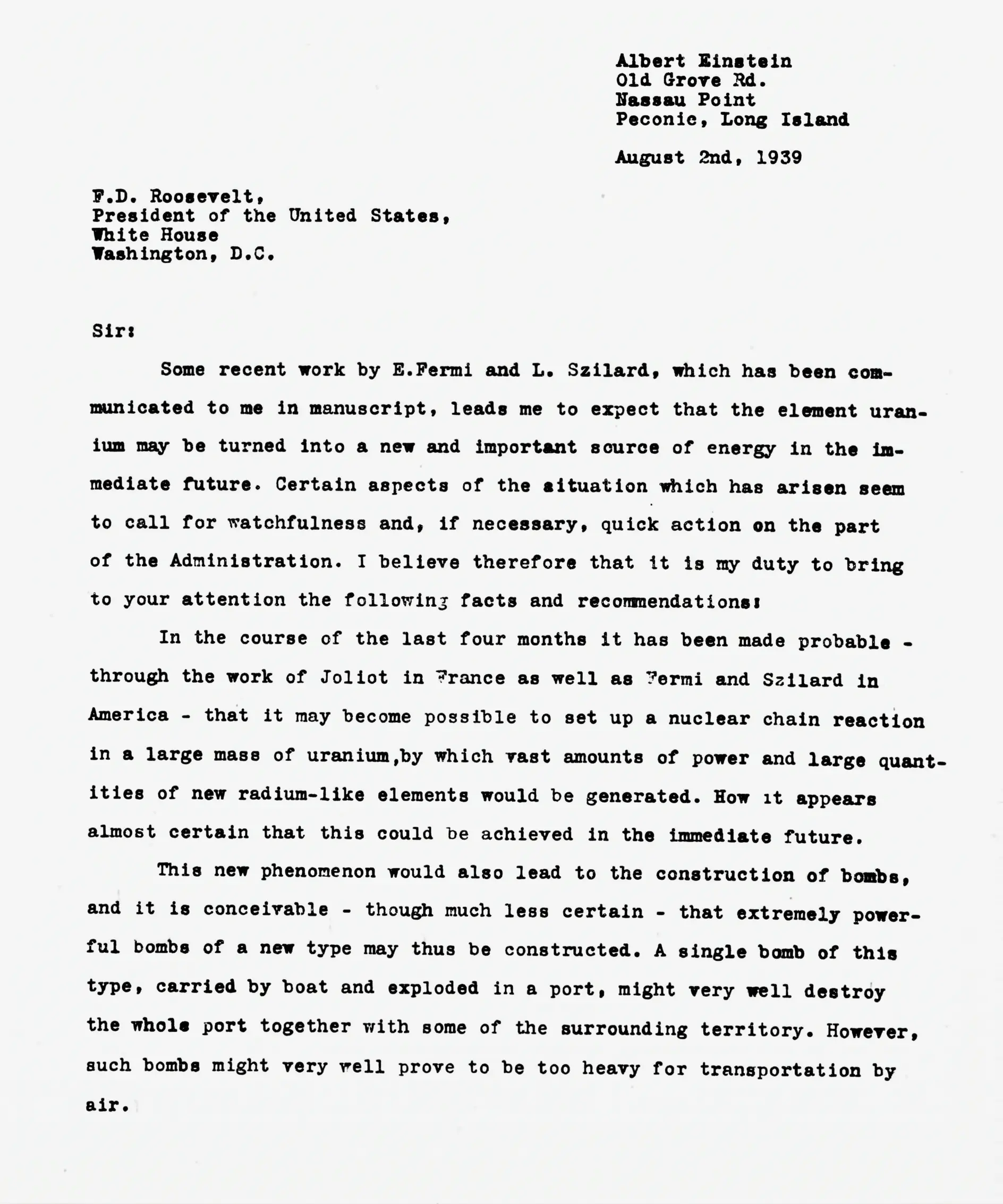
I have set the letter out paragraph by paragraph, and under each one I wrote what stands behind those sentences.
Sir:
Some recent work by E.Fermi and L. Szilard, which has been communicated to me in manuscript, leads me to expect that the element uranium may be turned into a new and important source of energy in the immediate future. Certain aspects of the situation which has arisen seem to call for watchfulness and, if necessary, quick action on the part of the Administration. I believe therefore that it is my duty to bring to your attention the following facts and recommendations:
The first sentence reads as modest, but I think it is a careful calculation. Einstein says right away that this is not his own work, and he puts Fermi’s and Szilard’s names in front of the President instead of his own. Roosevelt had very likely never heard of either of them, while everyone in America knew Einstein. Szilard’s whole plan rested on that balance, getting the warning of two immigrants who actually knew the physics heard in the voice of the most famous scientist in the world. “The immediate future” appears once in the first paragraph and again in the second, and I do not think the repetition is an accident.
In the course of the last four months it has been made probable - through the work of Joliot in France as well as Fermi and Szilard in America - that it may become possible to set up a nuclear chain reaction in a large mass of uranium, by which vast amounts of power and large quantities of new radium-like elements would be generated. Now it appears almost certain that this could be achieved in the immediate future.
“The last four months” is the stretch from the end of January, when Bohr brought the news to America, to the end of July, when the letter was written, and the real news of the letter is that in that short time an idea went from a patented daydream to “almost certain.” The “new radium-like elements” describe something nobody could yet name. When uranium-238 swallows a neutron it decays twice within a few days and becomes element 94, and when Glenn Seaborg’s group at Berkeley first isolated that element in February 1941 it was named plutonium. This side clause in the letter was describing the fuel of the bomb dropped on Nagasaki four years later.
“A large mass of uranium” is not decoration either. A neutron released by fission travels some distance before it hits the next nucleus, and some of the neutrons born near the surface leave the uranium along the way. A neutron that escapes takes no part in the chain. As a sphere grows, the volume producing neutrons grows with the cube of the radius while the surface losing them grows only with the square, so if I double the radius, production goes up eight times and the escape route only four. At some size volume beats surface and each generation is born larger than the one before. Physicists call that threshold the critical mass, and they call the average number of neutrons each neutron leaves to the next generation k. If k is below 1 the chain dies out, if it equals 1 the chain burns at a steady rate, and if it is above 1 the chain grows.
Why a bigger sphere makes the chain catch
This is not real uranium, it is a toy model. Neutrons travel an average of one unit before a collision, each collision has a 60 percent chance of causing a fission that releases 2 or 3 new neutrons, and otherwise the neutron is absorbed and lost. A neutron that leaves the sphere drops out of the chain. Change the radius and start the chain again.
- Generation
- 0
- Neutrons
- 40
- Escaped
- 0%
- Measured k
- not yet
In the model the chain catches at a radius of around 1.5 units. Below that, each generation is thinner than the last and the chain dies in a few steps, and above it the numbers run away. Counting generations is enough to see what running away means. If the number doubles every generation, after 10 generations I get 1,024, after 20 a little over a million, and after 80 about 1.2 × 10²⁴ fissions. The first reactor Fermi built in Chicago in 1942 was designed to keep k as close to 1 as possible, and the whole difference between a reactor and a bomb lies in how far above 1 k goes and how fast.
This new phenomenon would also lead to the construction of bombs, and it is conceivable - though much less certain - that extremely powerful bombs of a new type may thus be constructed. A single bomb of this type, carried by boat and exploded in a port, might very well destroy the whole port together with some of the surrounding territory. However, such bombs might very well prove to be too heavy for transportation by air.
This is the most quoted paragraph in the letter and also the one that got the most wrong. In the summer of 1939 Szilard and his colleagues imagined the bomb as something like a huge slow-neutron reactor packed with tons of moderator, which is why they thought it could only be brought into a harbor by ship. That picture changed in March 1940. Otto Frisch again, this time with Rudolf Peierls in Birmingham, wrote a short memo showing that if pure uranium-235 were separated, no moderator was needed at all, and a bomb working on fast neutrons would be far smaller than anyone had assumed. The bomb dropped on Hiroshima in 1945 weighed about 4,400 kilograms, the one dropped on Nagasaki about 4,700, and both were released from B-29 bombers.
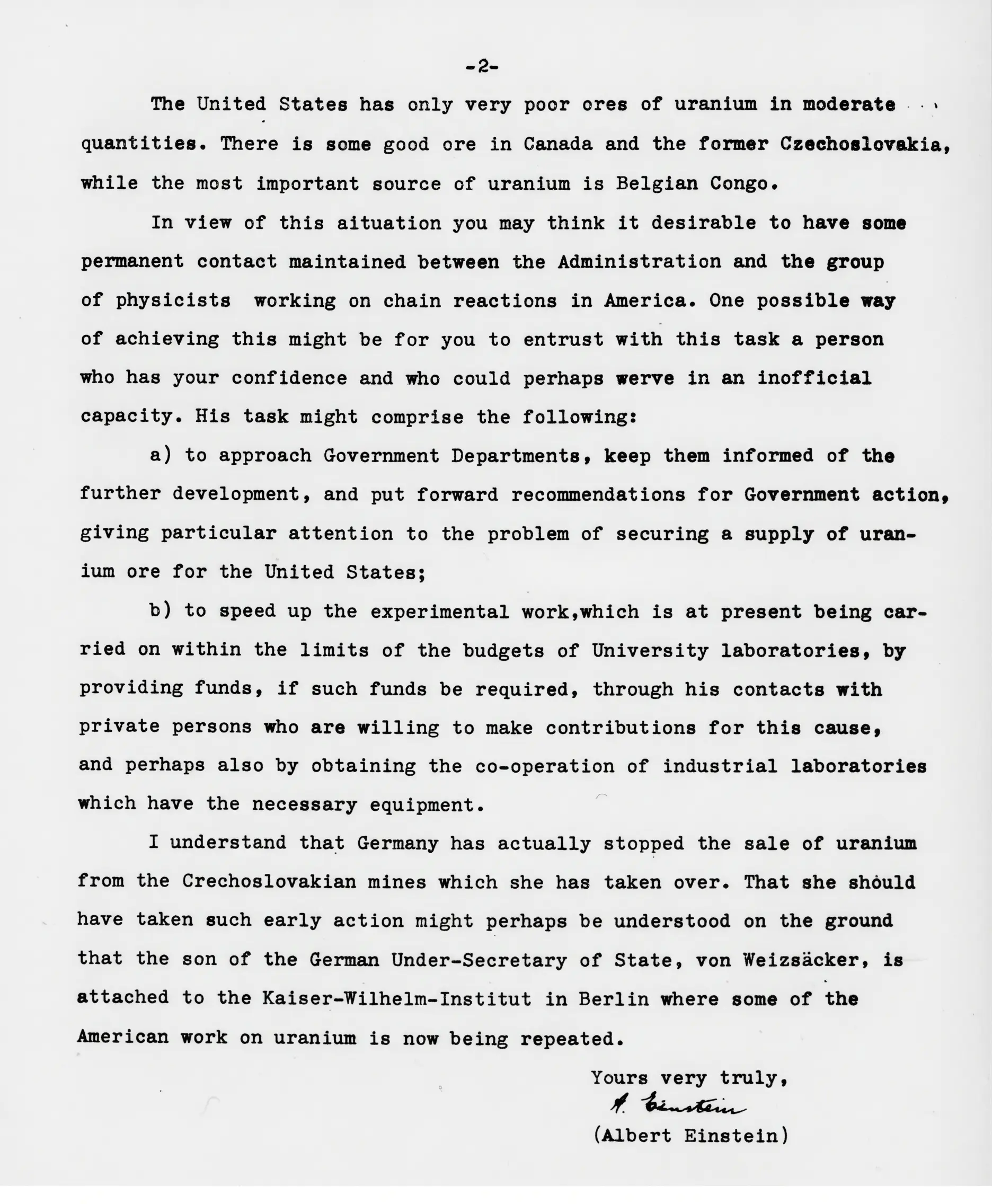
The United States has only very poor ores of uranium in moderate quantities. There is some good ore in Canada and the former Czechoslovakia, while the most important source of uranium is Belgian Congo.
Page two opens with geology, and these two sentences are what is left in the letter of Szilard’s first plan, the Belgian one. The American ore was carnotite sandstone on the Colorado Plateau, with uranium content well below one percent. The good Canadian ore came from Port Radium on the shore of Great Bear Lake. “The former Czechoslovakia” are the two coldest words in the letter, because when it was written the country had been off the map for four months. At Shinkolobwe some of the ore ran above 60 percent uranium oxide, and Edgar Sengier, who ran the mine for Union Minière, expected the Germans to invade Belgium and in 1940 shipped about 1,200 tons of it to New York, where it sat in a warehouse on Staten Island. The ore waited there in sacks for two years until it was bought for the Manhattan Project in September 1942. Most of the uranium the project used came from the Congo.
In view of this situation you may think it desirable to have some permanent contact maintained between the Administration and the group of physicists working on chain reactions in America. One possible way of achieving this might be for you to entrust with this task a person who has your confidence and who could perhaps serve in an inofficial capacity. His task might comprise the following:
a) to approach Government Departments, keep them informed of the further development, and put forward recommendations for Government action, giving particular attention to the problem of securing a supply of uranium ore for the United States;
b) to speed up the experimental work, which is at present being carried on within the limits of the budgets of University laboratories, by providing funds, if such funds be required, through his contacts with private persons who are willing to make contributions for this cause, and perhaps also by obtaining the co-operation of industrial laboratories which have the necessary equipment.
To me this section reads like a job description cut to fit the man who would carry the letter, Sachs himself. Someone trusted, unofficial, going back and forth between government and physicists, raising money from wealthy acquaintances if needed. The most surprising detail of the letter is hidden here. In the first plan for a program that would end up employing well over a hundred thousand people, the source of money named is not the government but “private persons who are willing to make contributions for this cause.” In the summer of 1939 the Columbia experiments really were running on the university’s budget and on borrowed uranium. Roosevelt did not take the suggestion as written. He set up an official committee instead of an informal go-between, and the slow pace of the next two years was the price of that choice.
I understand that Germany has actually stopped the sale of uranium from the Czechoslovakian mines which she has taken over. That she should have taken such early action might perhaps be understood on the ground that the son of the German Under-Secretary of State, von Weizsäcker, is attached to the Kaiser-Wilhelm-Institut in Berlin where some of the American work on uranium is now being repeated.
Yours very truly,
A. Einstein
(Albert Einstein)
The letter ends with a piece of intelligence, and the name in it reads heavily today. The son is the physicist Carl Friedrich von Weizsäcker, twenty-seven at the time. His father Ernst von Weizsäcker was not an under-secretary, as the letter has it, but State Secretary, the highest-ranking civil servant in the German Foreign Office. German uranium work really had started in April 1939, and when the war began it passed to the army. In 1941 Weizsäcker drafted a patent application describing how element 94 could be produced in a reactor and used as an explosive. But the German program never ran a single reactor that reached k equal to 1 before the war ended.
And then there is the signature. Einstein signed A. Einstein, and his name was typed again underneath in parentheses. Almost every sentence of the letter is Szilard’s, but those two words are what got it read at the White House.
The letter was handed to Sachs in mid-August, together with a technical memo Szilard had written. Szilard was not sure when Sachs would get to the President, and at one point he even considered sending the letter through Charles Lindbergh, until Lindbergh’s campaign to keep America out of the war made that idea impossible. On September 1 Germany invaded Poland, two days later Britain and France declared war, and Roosevelt’s calendar filled up. By the time Sachs got his appointment it was October 11, and the letter had been in his hands for two months.
According to Sachs, he did not hand the letter over that evening, because he knew Roosevelt had no patience for long technical documents. He read his own summary aloud instead. The President was interested but not convinced, and invited Sachs back for breakfast the next morning. At breakfast, Sachs said, he skipped the physics and told the story of Robert Fulton offering Napoleon the steamship and Napoleon dismissing it as nonsense. Some historians think the breakfast scene was embellished, but what happened next is on record. Roosevelt told Sachs, “Alex, what you are after is to see that the Nazis don’t blow us up,” then called in his military aide Edwin Watson and told him this required action.
Action meant the Advisory Committee on Uranium, chaired by Lyman Briggs of the National Bureau of Standards, which met for the first time on October 21, 1939. Szilard, Wigner and Teller were there, and Teller asked for 6,000 dollars to buy graphite. Two days earlier Roosevelt had written Einstein a short thank-you note saying he had convened a board to look into the matter. The money only came in February 1940, and Einstein, pushed by Szilard, wrote two more letters on March 7 and April 25, 1940, complaining about how slowly things were moving.
The real acceleration came from Britain. The MAUD Committee, which grew out of the Frisch and Peierls memo, reported in the summer of 1941 that a bomb could be made with a relatively small amount of uranium-235 and could be ready within a few years. Roosevelt approved an expanded program in October 1941, Pearl Harbor came in December, and in August 1942 the army set up the Manhattan Engineer District. At its peak the project employed some 130,000 people and cost what would be tens of billions of dollars today.
Einstein had no part in it. In the summer of 1940 army intelligence refused him a security clearance, citing his pacifism and his left-wing associations. His only military work during the war was consulting for the Navy’s Bureau of Ordnance on conventional explosives. Szilard was inside the project, and on December 2, 1942, he was there when the first reactor, built on a squash court under the stands of a Chicago football field, reached a self-sustaining chain reaction. Wigner had brought a bottle of Chianti to celebrate. Szilard shook Fermi’s hand and told him that this day would go down as a black day in the history of mankind.
When Germany surrendered in May 1945, Szilard started asking why the bomb was still being built. He asked Einstein for a second letter introducing him to Roosevelt, and Einstein wrote it on March 25, 1945. When Roosevelt died at Warm Springs on April 12, the letter was lying unopened on his desk. In July Szilard sent President Truman a petition signed by 70 scientists in Chicago, asking that the bomb not be used against Japan without warning. The petition never reached Truman’s desk.
- September 1933Szilard thinks of the chain reaction at a red light in London
- December 1938Hahn and Strassmann find uranium splitting in Berlin
- March 3, 1939Szilard and Zinn measure neutrons from fission at Columbia
- July 12, 1939Szilard and Wigner knock on Einstein’s door in Peconic
- August 2, 1939Einstein signs the letter
- October 11, 1939Sachs takes the letter to the White House
- October 21, 1939The Briggs Committee meets for the first time
- December 2, 1942The Chicago reactor reaches k equal to 1
- July 16, 1945The first test explosion in New Mexico
- August 6 and 9, 1945Hiroshima and Nagasaki
On August 6, 1945, Einstein was on vacation at Saranac Lake in upstate New York. When his secretary Helen Dukas heard the news on the radio and told him, he is said to have answered with a single German cry of woe. Estimates of the dead in Hiroshima and Nagasaki by the end of 1945 range from 110,000 to 210,000. In 1947 Einstein told Newsweek that had he known the Germans would not succeed in building a bomb, he would have done nothing. On November 16, 1954, he told Linus Pauling, who was visiting him, that he had made one great mistake in his life when he signed the letter to Roosevelt recommending that atom bombs be made, though there was some justification in the danger that the Germans would make them. Pauling wrote it in his diary that day. Einstein died five months later, in April 1955.
After the war Szilard left physics for biology. He died in La Jolla in 1964. Of the two copies Einstein signed, the one Szilard kept sold at auction in New York in 2024 for 3.9 million dollars. The copy that went to Roosevelt is at the Franklin D. Roosevelt Presidential Library in Hyde Park, together with the summary Sachs read to the President in October 1939.