
DIY · Card 17 · Physics · Chemistry
A bottle of oil, a little coloured water and a fizzy tablet. Blobs of colour climb through the oil, hang at the top and drift back down, and nothing in the bottle is hot.
01The brief
Make a lamp where blobs of colour rise and fall, using nothing hotter than tap water.
8 %
how much lighter sunflower oil is than water, the whole reason it floats
~375 ml
of carbon dioxide from a single fizzy tablet, on paper
1963
the year the first lava lamp went on sale in England
This is the experiment that ends up on the windowsill. It takes ten minutes to make and looks like a 1960s lamp, but it runs on a completely different engine. The real thing is heated from below. This one is powered by a chemical reaction, and the lift comes from bubbles.
Two rules are doing all the work. Oil and water don’t mix, and the lighter one floats, as in the density tower. And a blob of something heavy can be carried up by a bubble of gas, as the dancing raisins showed. Put the two together in a bottle and you get a lava lamp.
02Kit
A bottle, two liquids that won’t mix, some colour and something that fizzes. A torch turns it into a lamp.
Tick off what you have
0 of 5 ready
03Method
Pour, wait, colour, fizz. Then keep it going a quarter of a tablet at a time, and finish by watching it unmix itself.
Step 1 of 8 · Minute 0
Pour water into a clean, clear plastic bottle until it is about a quarter full.
The blobs won’t lift off.
Why
The piece of tablet is too small, or the water layer is too thin for big blobs to form.
Fix
Use a bigger piece, or add a little more water so the layer is a few centimetres deep.
It’s all over in a few seconds.
Why
A whole tablet at once uses up all the gas in one go.
Fix
Break each tablet into quarters and add them one at a time.
It went cloudy.
Why
The oil was poured in too fast, or the bottle was shaken, and the water broke into tiny droplets.
Fix
Leave it alone for a few minutes and let the layers settle again.
04Physics
Water molecules are lopsided: slightly negative at one end, slightly positive at the other. They cling to each other through hydrogen bonds. Oil molecules are long, even chains with nothing to grab on to. Put the two together and the water keeps hold of itself, squeezing the oil out into a separate layer. Water is denser, so it ends up at the bottom.
The tablet contains baking soda and citric acid, dry, side by side. Nothing happens in the oil, because neither can dissolve in it. Once the tablet reaches the water, they dissolve, react and give off carbon dioxide.
Each bubble on its way up carries a blob of coloured water with it. Water alone is heavier than oil, but water and gas together are lighter, so the blob floats up. At the top the gas escapes into the air, the blob is heavy again, and it sinks back into the water layer. Drop in a piece of tablet and watch, then try the lighter baby oil:
Gas to come
0 ml
Blobs moving
0
Trips to the top
0
Still. The water sits on the bottom until there is gas to carry it.
05The big idea
Change the density,
and things move.
A blob in a liquid has only one question to answer: am I heavier or lighter than the stuff I’m pushing aside? Change the answer and it moves. The homemade lamp changes it with gas. The real lamp changes it with heat, which makes wax swell.
Most of the movement in the world’s oceans, its air and the rock under our feet comes down to the same question. Warm air rises and cold air sinks; salty water sinks under fresh; hot rock creeps up through the mantle. The lava lamp lets you watch it happen on a windowsill.
06The math
1 · Floating condition
f ≥ 1 − ρoil / ρwater
A blob floats once the share f of its volume that is gas brings its average density below the oil’s.
2 · Stokes’ law
v = 2 Δρ g r² / 9μ
The steady speed of a small sphere of radius r through a liquid of viscosity μ, when the density difference is Δρ.
3 · The fizz
3 NaHCO3 + C6H8O7 → 3 CO2 + …
Baking soda and citric acid give three molecules of carbon dioxide for every molecule of acid.
Sunflower oil has a density of about 920 kg/m³, so a blob floats once 1 − 920/1000 = 8 % of it is gas. Baby oil is lighter, about 830 kg/m³, and needs 17 %, which is why some blobs that rise in sunflower oil never leave the bottom in baby oil.
Take a blob 6 mm across that is one fifth gas. Its average density is 800 kg/m³, 120 below the oil’s. With sunflower oil’s viscosity of about 0.05 Pa·s, Stokes’ law gives 2 × 120 × 9.81 × 0.003² / (9 × 0.05) ≈ 4.7 cm/s. That is a little too fast: Stokes’ law is exact only for very slow, very small spheres, and correcting for the swirl behind the blob brings it down to about 3.4 cm/s. The r² is the striking part: double the blob’s size and it goes four times as fast.
The tablet’s side is chemistry. A typical effervescent antacid tablet holds about 1.9 g of baking soda and 1 g of citric acid. The acid runs out first: 1 / 192 ≈ 0.0052 mol, giving three times as much carbon dioxide, which at room temperature fills about 375 ml. Size your own blob:
Rises at 3.4 cm/s
In sunflower oil a blob floats once about 8 % of it is bubble. At this speed it crosses a 20 cm bottle in about 5.8 seconds.
One tablet makes about 375 ml of gas: enough, on paper, for about 16,579 blobs this size.
1 g of citric acid is 0.0052 mol; with baking soda it gives three times as much carbon dioxide, 0.016 mol, and a mole of gas fills about 24 litres. Much of it escapes as free bubbles that carry no water at all, which is why a quarter of a tablet runs out in a couple of minutes.
07Real life
From the kitchen cupboard to the Earth’s mantle, things float and sink by the same rule as the blobs.
The real lava lamp
The shop-bought kind uses heat instead of gas. A bulb in the base warms a blob of wax until it expands and becomes a little less dense than the liquid around it. It rises, cools at the top, shrinks, and sinks to be warmed again, the same loop as the bottle, run by temperature.
Salad dressing
Shake oil and vinegar and they look mixed for a minute, then separate, exactly like the encore step. Cooks add mustard or egg yolk because those contain molecules with one end that likes water and one that likes oil, which hold the droplets apart.
Oil spills
Spilled crude oil floats on the sea for the same reason the oil sits on the water in the bottle. That is why clean-up crews ring it with floating barriers called booms and skim it off the top, and why it smothers seabirds and shorelines instead of sinking out of sight.
Rising magma
Deep underground, molten rock is less dense than the solid rock around it, so it rises in blobs and plumes, often over thousands of years. The real lava lamp borrowed its name from volcanoes, and the physics is not far off.
Galileo thermometers
Glass bulbs float in a tall tube of clear liquid. As the room warms, the liquid expands and gets less dense, and the bulbs sink one by one. The lowest floating bulb tells the temperature: density changing with heat, as in a real lava lamp.
Hot-air balloons
Heat the air in the envelope and it expands, so the balloon holds less mass than the cold air it pushes aside, and up it goes. Let it cool and it sinks. Every lava lamp, homemade or not, is a tiny fleet of balloons.
1963
The lava lamp started as an egg timer. Edward Craven Walker, a British inventor, spotted an odd homemade timer made of liquids in a glass, in a pub in the south of England. Its maker, Donald Dunnet, had patented the idea; Walker took it over and worked on the wax and the liquid until the blobs behaved.
In 1963 his company, Crestworth, launched the result as the Astro lamp. Later renamed Mathmos, the company still makes it by hand in Poole, Dorset. Sources disagree on some of the early details, but the physics is the same as the one that drives the hot water up in the underwater volcano: warm it, it gets lighter, up it goes.
08Is and isn’t
Oil floats because it’s thicker.
Thickness (viscosity) and heaviness (density) are different things. Golden syrup is thick and sinks; petrol is runny and floats. Oil floats only because a litre of it weighs about 920 g, against 1000 g for water.
The fizz is the oil boiling.
Nothing is hot. The bubbles are carbon dioxide made by a chemical reaction between the baking soda and the acid in the tablet, which only starts once the tablet reaches the water.
Shaking mixes oil and water.
It only breaks the water into tiny droplets spread through the oil, an emulsion. Leave it and the droplets find each other and settle back into a layer. Without a helper molecule like soap, they never truly mix.
A real lava lamp is full of lava.
It is wax in a liquid, and the whole thing never gets anywhere near as hot as molten rock. It does get hot enough to burn, though, so never touch a lamp that has been on, and never heat a homemade one.
09Go further
A
The salt version
Skip the tablet and sprinkle a teaspoon of salt on top. The grains drag blobs of oil down, then dissolve and let them float back up.
B
Race the oils
Try sunflower oil against baby oil in two identical bottles. Which one gives faster blobs? Check your guess with the calculator above.
C
Warm against cold
Make one lamp with warm water and one with cold. Chemical reactions speed up with temperature. Which lamp fizzes faster, and which lasts longer?
D
Time a blob
Mark two lines 10 cm apart on the bottle and time a blob between them with a stopwatch. Estimate its size, and compare your speed with the calculator.
E
A three-layer lamp
Pour a layer of golden syrup in first, then the water, then the oil. Where do the blobs go now, and does anything get through the syrup?
10Questions
Oil and water don’t mix, and water is denser, so it sits on the bottom. A fizzy tablet reacts in the water and makes carbon dioxide. Bubbles of gas attach to blobs of coloured water and carry them up through the oil; at the top the gas escapes and the blobs sink again.
Water molecules are polar and cling tightly to each other through hydrogen bonds. Oil molecules are non-polar and can’t join in, so mixing them would break up water’s bonds for nothing in return. The water stays together and squeezes the oil out into its own layer.
Salt works differently but nicely: sprinkle it on top and grains of salt drag blobs of oil down to the bottom, then dissolve in the water and let the oil float back up. Baking soda in the water plus a few drops of vinegar also makes gas, though it is messier to control.
Each piece of tablet keeps it going for a minute or two. Add another piece to restart it. The oil and water can be reused for days; when you’re done, put the oil in the bin rather than down the sink.
A real lava lamp has no gas. It contains a wax blend in a clear liquid, heated by a bulb in the base. Warm wax expands, becomes slightly less dense than the liquid and rises; at the cooler top it contracts, becomes denser and sinks back to be heated again.
Safety · A grown-up should handle the tablets: many contain aspirin and are medicine, not sweets. Never put the cap on while it is fizzing, never heat a homemade lamp, and don’t drink the contents. Put the used oil in the bin, not down the sink.
All DIY cards →Keep wandering
A few more pieces in the same spirit — math, design, and slow attention.
The Ivory Soap Microwave Experiment: Why the Bar Puffs Up
Put a bar of Ivory soap in the microwave and it swells into a cloud several times its size. Hot air alone can’t do that. The water hidden in the soap, turning to steam, can.
Open
The Dancing Raisins Experiment: How Bubbles Lift a Raisin
Drop raisins into fizzy water and they sink, rise, turn over at the top and sink again, for an hour. Each one is a tiny submarine that fills its own ballast tanks with bubbles and empties them at the surface.
Open
How to Make a Density Tower: Stacking Liquids in a Glass
Honey, washing-up liquid, water, oil and rubbing alcohol, poured one by one into a glass, settle into five sharp layers. Which goes where is decided by one number, and one of them only stays put thanks to the oil.
Open
How to Make an Underwater Volcano: Convection in a Jar
Hot red water in a salt shaker, lowered into a jar of cold water. It erupts, curls into a mushroom, and lies on the surface like oil, because water one and a half percent lighter has nowhere to go but up.
Open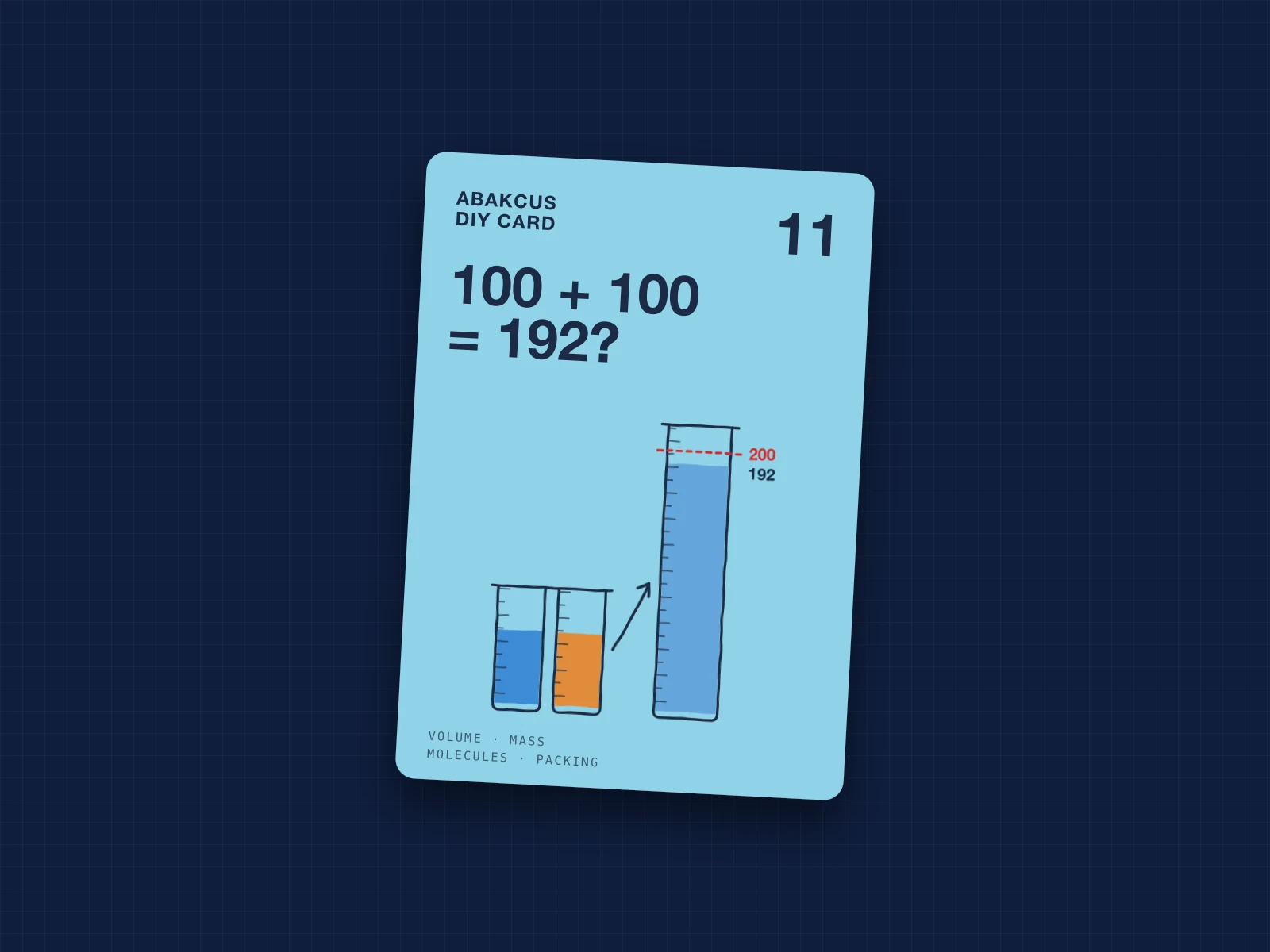
Why 100 ml + 100 ml Makes Less Than 200 ml
Pour 100 ml of alcohol into 100 ml of water and you get about 192 ml. Nothing leaks, nothing evaporates, and the scale says not a gram is missing. The molecules have simply moved in closer together.
Open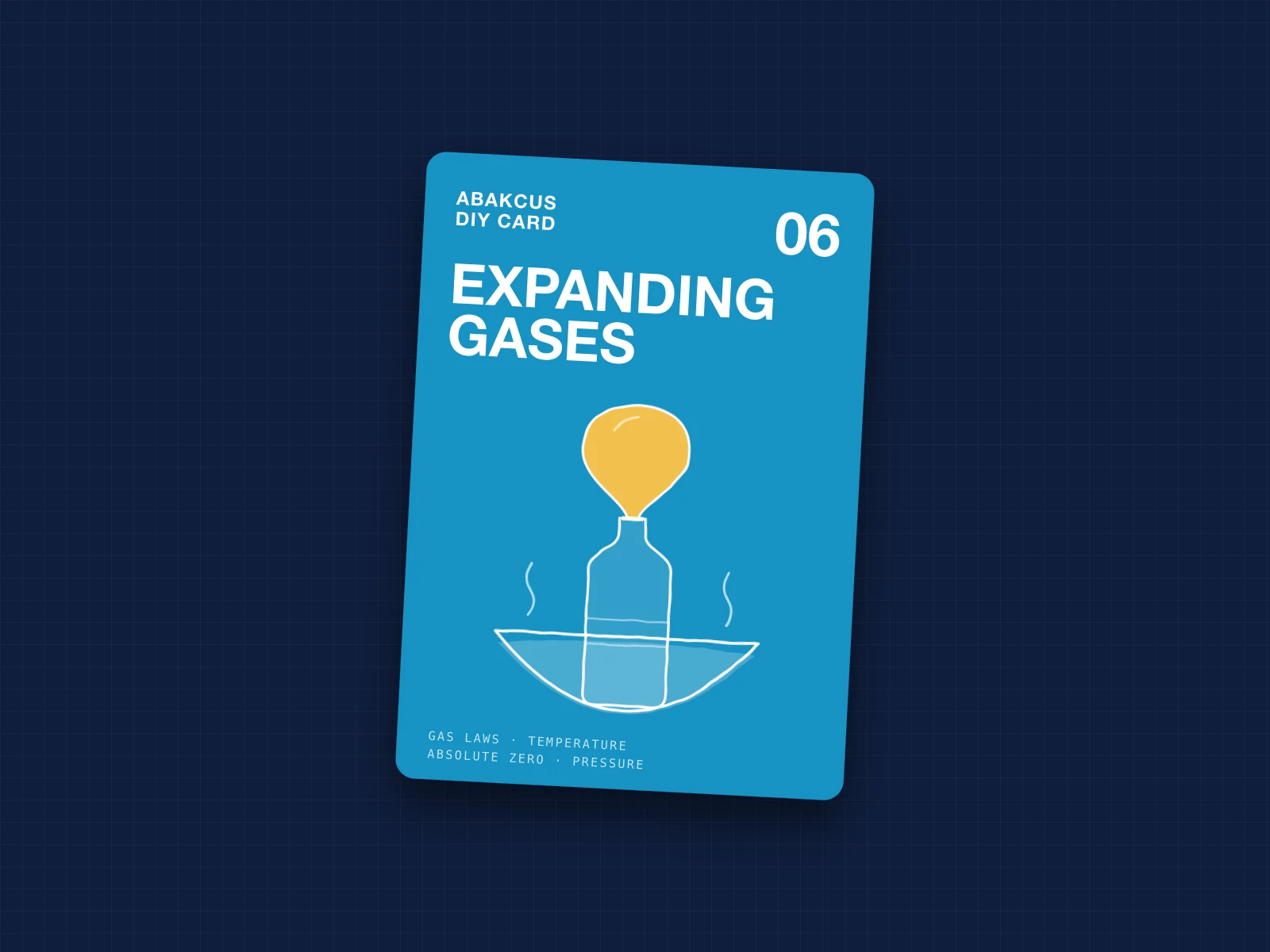
How to Blow Up a Balloon With Hot Water: Charles’s Law
Put a balloon on an empty bottle, stand the bottle in hot water, and the balloon lifts itself up. The air didn’t get any more of itself. It just needs more room, and from that one fact you can find absolute zero.
Open