
DIY · Card 16 · Physics · Chemistry
A handful of raisins in a glass of lemonade. They sink, sit still for a moment, then rise, turn over at the surface and sink again, for the best part of an hour.
01The brief
Make raisins rise and sink, over and over, in a glass of water, without touching them.
0.1 ml
of gas a raisin needs stuck to it before it can rise
~70
bubbles of a millimetre and a half, roughly, to make that much gas
4 litres
roughly how much gas hides in a litre of freshly opened fizzy drink
This is the most hypnotic experiment in the deck, and the laziest: drop the raisins in and walk away. Come back in five minutes and they are still at it, some lying on the bottom, some on the way up, some bobbing at the top before tumbling back down. Each one keeps its own rhythm, like dancers who can’t hear the same music.
There is no trick to it, only a drink that is trying to get rid of its gas, and raisins that give the gas somewhere to start. It is buoyancy, the same rule that floated the hot water in the underwater volcano, switched on and off by bubbles.
02Kit
A freshly opened fizzy drink is the engine. Raisins are the dancers. A glass of tap water is the proof.
Tick off what you have
0 of 4 ready
03Method
Thirty seconds to set up. The rest is watching closely, and then checking that plain water does nothing.
Step 1 of 8 · Second 0
Open a new bottle of clear fizzy water or lemonade and pour it into a tall, clear glass.
The raisins just lie on the bottom.
Why
The drink is too flat, or the raisins are big and heavy.
Fix
Use a freshly opened bottle and smaller, wrinklier raisins. Cut a big one in half.
They all shoot up and stay there.
Why
The bubbles aren’t popping, often because the raisins are light or the drink is very fizzy.
Fix
Wait a few minutes for the fizz to calm down, or use a slightly bigger raisin.
It stopped after ten minutes.
Why
A wide glass or a warm drink lets the gas escape quickly.
Fix
Use a tall, narrow glass and a drink straight from the fridge.
04Physics
At the factory, fizzy drinks are filled with carbon dioxide under several times normal air pressure, which forces far more gas to dissolve than water could hold at ordinary pressure. Seal the bottle and it stays there. Open it, and the drink holds much more gas than it can keep. It has to let it go.
But a bubble can’t just appear out of nowhere in the middle of the liquid; it needs something to start on, a tiny pocket of air on a rough surface. The raisins are perfect for that. Their wrinkles trap specks of air, gas pours into them from the drink, and the raisins grow a coat of bubbles.
Then buoyancy takes over. A raisin alone is denser than water. A raisin wearing enough bubbles is not. It rises, the bubbles poking out at the top pop or knock off, and it sinks to start again. Watch the cycle, and watch it slow down as the drink goes flat:
Time
0 min
Fizz left
100 %
Trips to the top
0
A toy model with real proportions: a raisin needs about a tenth of a millilitre of gas stuck to it before it can rise.
05The big idea
Bubbles need
somewhere to start.
A newly opened drink is a liquid holding more gas than it can keep, waiting for permission to let it go. A tiny bubble is hard to start from nothing: its own curved surface squeezes it so hard it dissolves again. A ready-made pocket of air on a rough surface skips that hard first step.
That is why bubbles rise in strings from fixed spots, why a sweet dropped in cola erupts, why shaken bottles explode, and why raisins dance. Change where bubbles can start, and you change everything about how a fizzy drink behaves.
06The math
1 · Floating condition
Vgas ≥ Vraisin (ρraisin − ρwater) / ρwater
The raisin rises once the water displaced by it and its bubbles weighs more than the raisin. Solve for the gas volume it needs.
2 · One bubble
V = π d³ / 6
The volume of a single round bubble of diameter d. Halve the diameter and you need eight times as many bubbles.
3 · Henry’s law
c = k · p
The gas a liquid can hold is proportional to the pressure of that gas above it. k is a constant for each gas and temperature.
Take a raisin of 0.5 g with a density of about 1.3 g/ml. It takes up 0.5 / 1.3 ≈ 0.38 ml, so it displaces 0.38 g of water but weighs 0.5 g. The bubbles must supply 0.38 × 0.3 ≈ 0.12 ml of extra volume. A bubble 1.5 mm across holds π × 1.5³ / 6 ≈ 1.8 mm³, so the raisin needs about 65 of them.
And there is plenty of gas to go round. A fizzy drink typically holds several grams of carbon dioxide per litre; at about 7 g, that is 7 / 44 ≈ 0.16 mol, which at room pressure would fill nearly 4 litres. Henry’s law explains the rest: once the cap is off, the carbon dioxide above the drink is almost nothing, so nearly all of that gas will eventually leave. Play with your own raisin:
About 66 bubbles to lift it
The raisin takes up 0.38 ml, so it pushes aside 0.38 g of water but weighs 0.50 g. The bubbles must make up the difference: 0.115 ml of gas, or 115 cubic millimetres.
A litre of this drink hides about 3.8 litres of gas.
7 g of CO₂ is 0.16 mol, and a mole of gas at room temperature fills about 24 litres. Enough to lift tens of thousands of raisins.
07Real life
From celebration drinks to deep-sea diving, the same two ideas, gas leaving a liquid and bubbles changing buoyancy, keep turning up.
Champagne’s strings of bubbles
The neat strings of bubbles in a glass of champagne rise from fixed spots. Researchers who filmed them found most start on tiny cellulose fibres stuck to the glass, from cloths or dust, each one trapping a pocket of air like a raisin’s wrinkle. Some glasses are etched at the bottom on purpose.
The cola geyser
Drop sweets with a rough, chalky coating into a bottle of diet cola and a fountain of foam shoots metres into the air. The sweets are covered in millions of nucleation sites, so the dissolved gas comes out all at once. Do it outdoors, and stand back.
The bends
Divers breathing compressed air at depth absorb extra nitrogen into their blood, exactly as a bottled drink absorbs gas under pressure. Come up too fast and it fizzes out as bubbles in the body. Slow ascents give the gas time to leave through the lungs.
Fish swim bladders
Many fish carry a gas-filled bag inside them, a swim bladder. By adding gas or letting it out, they adjust how much water they displace and hover at any depth without swimming, as a raisin would if it could control its bubbles.
Submarines
A submarine dives by flooding ballast tanks with seawater and surfaces by blowing them full of compressed air. It is the dancing raisin with a crew: the same hull, made heavier or lighter than the water it displaces by how much gas it carries.
Warm bottles that fizz over
Gas dissolves better in cold water than in warm. Open a warm bottle and much more gas comes out at once, and it foams over; a chilled one stays calmer and keeps its fizz longer. Raisins in a warm drink dance faster but stop sooner.
1772
In the late 1760s, Joseph Priestley lived next door to a brewery in Leeds. Curious about the heavy gas that hung over the fermenting vats, he held bowls of water above them and found that the water took up the gas and gained a pleasant, sharp taste. In 1772 he published how to make it at home, by dripping acid onto chalk and passing the gas into water.
The work won him the Royal Society’s Copley Medal, and Priestley called it his happiest discovery, though he never made money from it. A Geneva jeweller, Johann Jacob Schweppe, did, selling bottled soda water a few years later. The gas, carbon dioxide, is the same one the vinegar fizzed out of an eggshell in the first card of this deck.
08Is and isn’t
Raisins float because they’re light.
A raisin is denser than water: drop one in tap water and it sinks. It only rises while it is wearing enough bubbles to make up the difference.
The bubbles come out of the raisin.
The gas comes from the drink. The raisin only gives it a place to gather: its wrinkles hold tiny pockets of air where bubbles can start growing.
Bubbles form anywhere in a fizzy drink.
A brand-new bubble needs a starting point. In a perfectly smooth, clean glass, a fizzy drink can hold on to its gas surprisingly well; scratches, fibres and raisins set it free.
Shaking a bottle puts more gas into it.
Shaking adds no gas at all. It mixes in thousands of tiny bubbles that act as starting points, so when you open it the gas comes out all at once.
09Go further
A
Race the drinks
Set up three glasses: soda water, lemonade and cola. In which do the raisins make the most trips in ten minutes?
B
Cold against warm
Try a drink from the fridge and the same drink at room temperature. Count the trips, and notice which goes flat first.
C
Count the bubbles
Watch one raisin closely with a magnifying glass just before it lifts off. Roughly how many bubbles are on it? Check the calculator above.
D
Find other dancers
Try dried pasta, lentils, popcorn kernels, a sultana, a dried cranberry. Make a list of dancers, floaters and sinkers.
E
A smooth glass
Pour the same drink into a very clean, smooth glass and a scratched one. Which one gives more streams of bubbles?
10Questions
A raisin is slightly denser than water, so it sinks. Carbon dioxide coming out of the drink forms bubbles on its wrinkly surface, and once enough are stuck to it, the raisin and its bubbles together are lighter than the water they displace, so it rises. At the top the bubbles pop and it sinks again.
Bubbles need somewhere to start. The raisin’s wrinkles hold tiny pockets of trapped air, which give the dissolved gas a place to come out of the drink and grow into bubbles. Smooth objects collect far fewer.
Usually for up to an hour or so, slowing as the drink goes flat. Every bubble carries a little of the dissolved gas away, and once most of it has gone there isn’t enough to lift the raisins any more.
No. Tap water has almost no dissolved carbon dioxide, so no bubbles form and the raisins stay on the bottom. That is the best proof that the bubbles, not the raisins, do the work.
Henry’s law says that the amount of gas that dissolves in a liquid is proportional to the pressure of that gas above it. Fizzy drinks are bottled under high carbon dioxide pressure, so they hold a lot of gas; once opened, the pressure drops and the extra gas comes out as bubbles.
Safety · Raisins and small dried foods can be a choking hazard for very young children. Don’t drink the experiment afterwards, and if you try the cola geyser, do it outdoors and stand well back.
All DIY cards →Keep wandering
A few more pieces in the same spirit — math, design, and slow attention.
How to Blow Up a Balloon With Hot Water: Charles’s Law
Put a balloon on an empty bottle, stand the bottle in hot water, and the balloon lifts itself up. The air didn’t get any more of itself. It just needs more room, and from that one fact you can find absolute zero.
Open
How to Make a Density Tower: Stacking Liquids in a Glass
Honey, washing-up liquid, water, oil and rubbing alcohol, poured one by one into a glass, settle into five sharp layers. Which goes where is decided by one number, and one of them only stays put thanks to the oil.
Open
How to Get an Egg Into a Bottle Without Touching It
Two days in vinegar take the shell away, a warm bottle does the rest. The egg goes through a mouth narrower than itself, pushed by ten tonnes of air per square metre.
Open
How to Make an Underwater Volcano: Convection in a Jar
Hot red water in a salt shaker, lowered into a jar of cold water. It erupts, curls into a mushroom, and lies on the surface like oil, because water one and a half percent lighter has nowhere to go but up.
Open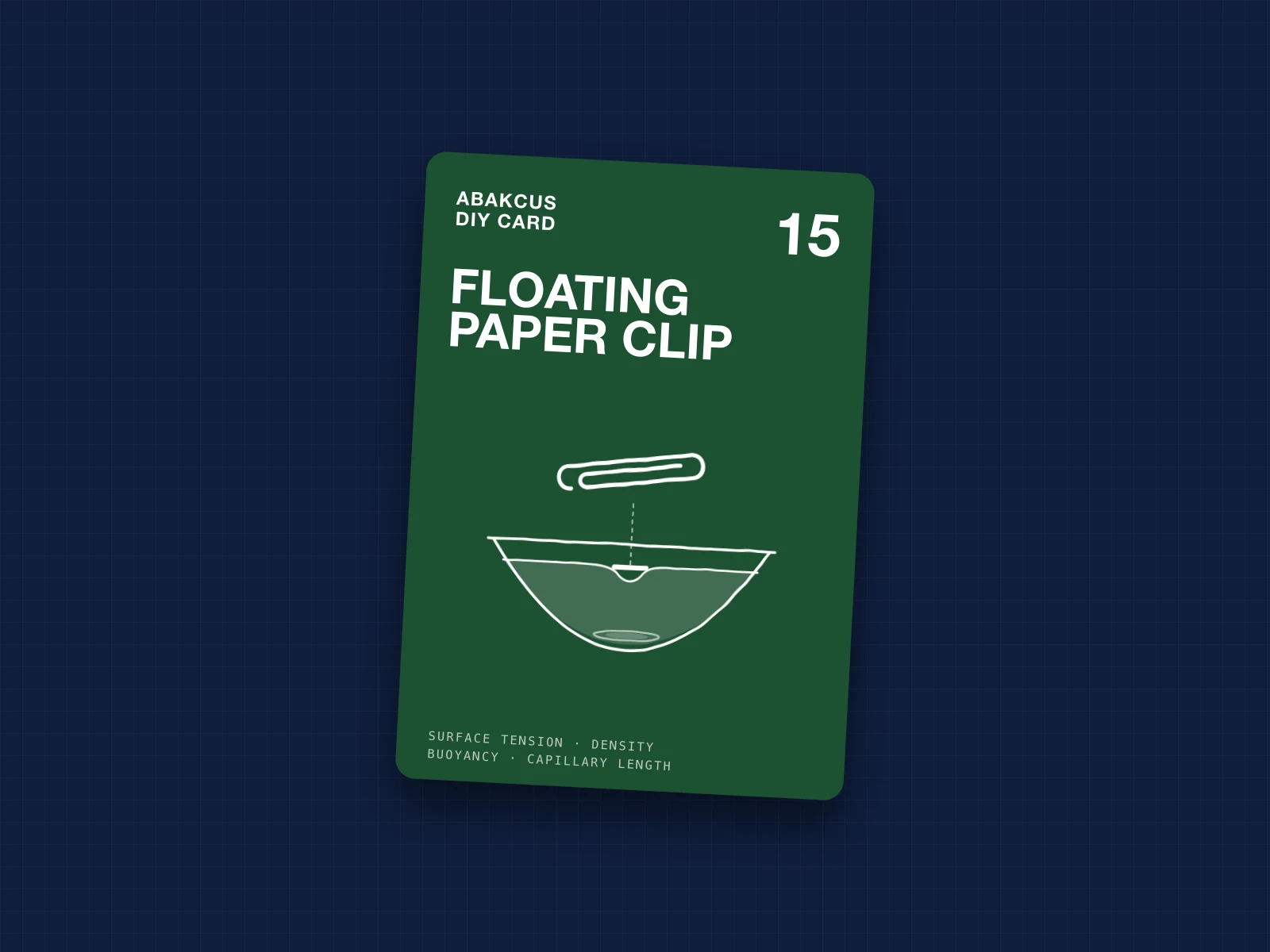
How to Float a Paper Clip on Water: Surface Tension
Steel is nearly eight times denser than water, and a paper clip still lies on top of it if you put it down gently. The surface bends into a dimple and holds it, like a trampoline, until a drop of soap breaks the spell.
Open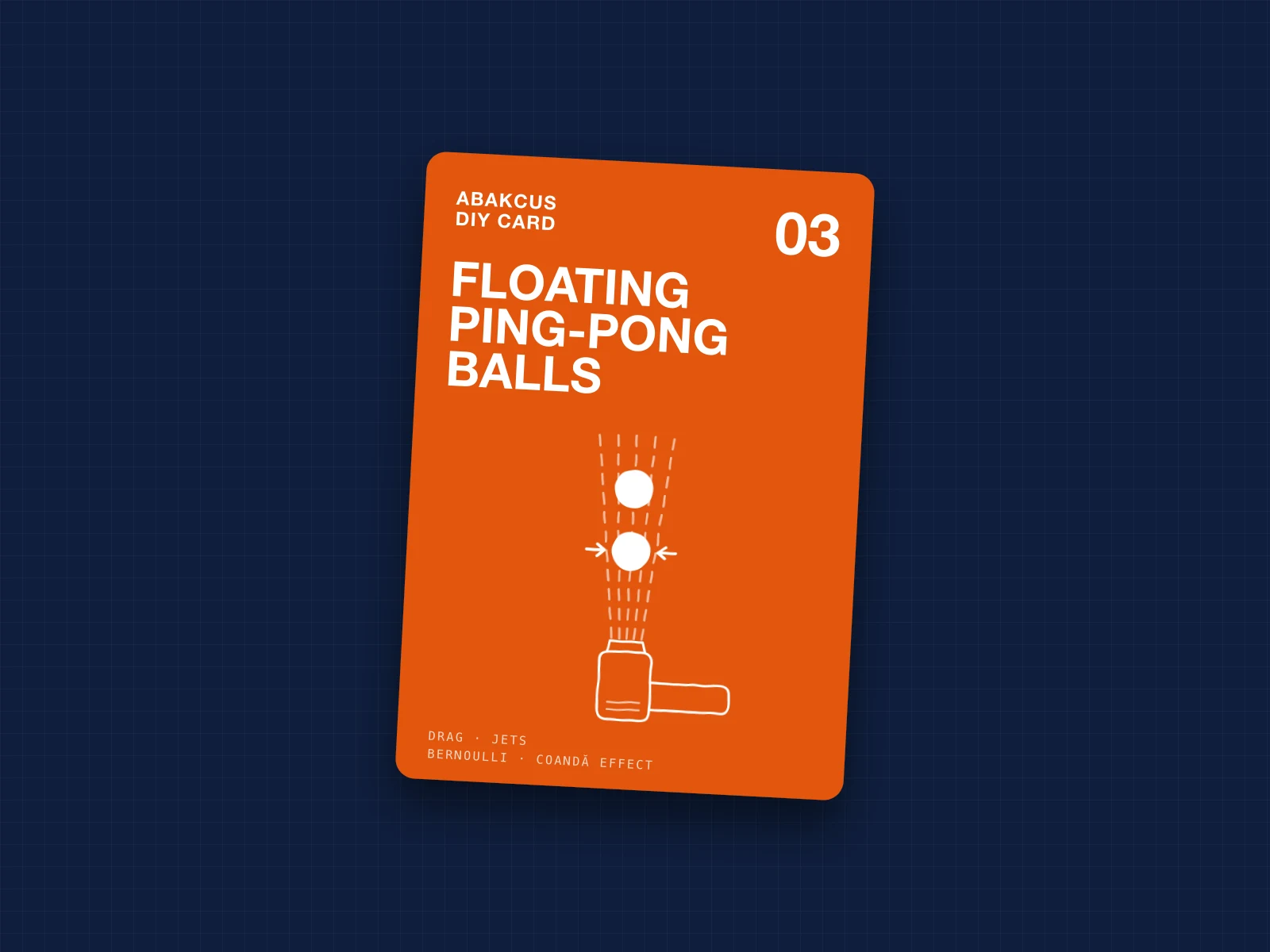
How to Make a Ping-Pong Ball Float With a Hair Dryer
Point a hair dryer at the ceiling and a ping-pong ball sits in mid-air, wobbling but never falling out. Most explanations of why are wrong, and the real one is better.
Open