
DIY · Card 10 · Physics · Motion
An egg on a cardboard tube on a tray on a glass of water. One sharp slap, and the tray flies off across the table while the egg drops neatly into the glass.
01The brief
Drop an egg into a glass of water without touching it, by knocking away everything underneath it.
20 ms
roughly how long a sharply slapped tray takes to slide out from under the egg
1 cm
about how far sideways the egg drifts on the way down, and still lands in the glass
0
how much the egg’s weight matters to whether it works
This is the party trick of physics teachers everywhere: a tower of glass, tray, tube and egg, and one confident slap. The tray shoots across the table, the tube cartwheels away, and the egg, which never moved, plops straight down into the water as if someone had lowered it on a string.
It looks like a trick of strength or nerve. It is really a trick of time. The egg is not held in place by anything; it is simply left behind, because whatever could have dragged it sideways was given only a few hundredths of a second to do it. And the egg’s weight, which you would expect to matter most, cancels out completely.
02Kit
Four things from the kitchen and the bathroom bin. Start with a hard-boiled egg; switch to a raw one when you are sure.
Tick off what you have
0 of 4 ready
03Method
A minute to stack it, a few practice swipes, and the moment itself. Then do it wrong on purpose, to see why it works.
Step 1 of 8 · Minute 0
Stand a sturdy glass on a table, near the edge but not at it, and fill it about three-quarters full of water.
The egg flies off sideways with the tray.
Why
The blow was too slow, so friction had time to drag the tube and egg along.
Fix
Use a quicker, flatter slap, and a smoother tray, such as an upside-down pie tin.
The egg hits the rim of the glass.
Why
The tube wasn’t directly above the middle, or the blow went slightly upward.
Fix
Line it up from above, and strike exactly level, straight out sideways.
The glass moved too.
Why
The tray caught on the glass rim, or your hand hit the glass.
Fix
Let the tray overhang more on the side you hit, and use a heavier glass.
04Physics
Everything has inertia: a tendency to keep doing what it is already doing. A still egg stays still unless something pushes it. When you strike the tray, you push the tray, and the tray in turn knocks the light cardboard tube flying. Nothing pushes the egg, except for one thing: friction from the tube rubbing out from underneath it.
Friction is real, but it only acts while the surfaces are sliding past each other, and how far it moves the egg depends on how long it gets. Slap the tray out in a fiftieth of a second and friction hardly gets started. The egg picks up a sideways speed of a few centimetres a second, then falls, and lands within a centimetre or so of where it started. Push slowly, and friction has all the time it needs to carry the egg off with the tray.
Here is the surprise. You would think a heavier egg, with more inertia, would be easier to leave behind. But a heavier egg also presses down harder, so friction pulls on it harder too, in exactly the same proportion. The mass cancels. Slide the egg’s weight up and down and watch nothing change:
Plop: it lands 1.6 cm off centre
The tray takes 24 ms to clear. In that time friction pushes the egg sideways at 3.9 m/s², the same for a 60 g egg as for any other, so it falls with a sideways speed of 9 cm/s.
05The big idea
Things keep
doing what they do.
For two thousand years, people believed with Aristotle that motion needs a cause: stop pushing a cart and it stops. It took Galileo and then Newton to turn that upside down. Motion doesn’t need a cause. Change in motion does. Left alone, a moving thing keeps moving and a still thing stays still.
Everyday life hides this because friction is everywhere, quietly slowing everything down. The egg trick strips friction away for a fraction of a second and lets you see the rule underneath: the egg was still, nothing pushed it, so it stayed still, right up until gravity took it straight down.
06The math
1 · Newton’s second law
a = μmg / m = μg
The sideways force from friction is μ times the egg’s weight, mg. Divide by the mass to get its acceleration: the m cancels.
2 · Time to clear
t = L / v
The tray has to slide about the width of the tube, L, before it is gone. At speed v that takes this long.
3 · Sideways drift
d = ½ a t² + a t · tf
The egg slides a little while the tray is under it, then falls for time t_f still carrying the sideways speed it picked up.
Put in numbers for cardboard, with μ ≈ 0.4. The egg’s sideways acceleration is 0.4 × 9.8 ≈ 3.9 m/s², the same for a quail’s egg or an ostrich’s. A sharp slap sends the tray off at about 3 m/s; clearing 6 cm takes t = 0.06 / 3 = 0.02 s.
In that time the egg slides ½ × 3.9 × 0.02² ≈ 0.8 mm and picks up a sideways speed of 3.9 × 0.02 ≈ 8 cm/s. It then falls about 12 cm, which takes √(2 × 0.12 / 9.8) ≈ 0.16 s, drifting another 1.2 cm. Total: a little over a centimetre, and the glass gives you nearly two. Slow the slap to 1 m/s and the drift triples to over 4 cm. Splat.
Inertia applies to spinning too. A spinning thing keeps spinning, and that is how you can tell a raw egg from a boiled one without cracking it. The liquid inside a raw egg has inertia of its own, separate from the shell:
Spin them, then tap stop while they turn. The blue dot is a mark on the shell; the yolk shows the inside.
Spinning inertia is the same idea that made the water in the tornado in a bottle keep turning after you stopped swirling.
07Real life
Inertia is behind car safety, kitchen tricks and the longest journey ever made by a human-built object.
Seatbelts
When a car stops suddenly, the people inside don’t: they keep going forward at the car’s old speed until something stops them. A seatbelt does it over a long, stretchy fraction of a second, instead of the windscreen doing it in an instant.
Tightening a hammer head
A loose hammer head is tightened by banging the end of the handle on the floor. The handle stops dead; the heavy head keeps moving down and slides further onto it.
Ketchup that won’t come out
Hold the bottle upside down and smack its base. The bottle jerks downward and stops; the ketchup inside, still moving, carries on out of the neck.
A dog shaking dry
A wet dog twists its body back and forth several times a second. At each reversal the skin changes direction, but the water drops keep going, fly off, and soak whoever is standing nearby.
Voyager 1
Launched in 1977, Voyager 1 used its last big engine burns decades ago and has been coasting ever since, at about 17 kilometres a second. In space there is almost nothing to slow it down, so it simply keeps going.
The tablecloth trick
Yank a smooth tablecloth out from under plates and glasses fast enough, and they stay where they are. It is the egg drop with a dinner service, and the same rule decides whether it works: the faster the pull, the less time friction has.
1638
In Two New Sciences, published in 1638 while he was under house arrest, Galileo described a ball rolling on a perfectly smooth, level plane. With nothing to slow it, he argued, it would roll on forever. It was a thought experiment no one could build, and it broke with two thousand years of thinking about motion.
Isaac Newton turned the idea into the first of his three laws of motion in 1687. Every slapped tray is a small test of it. The first egg in this deck was pushed by the air; this one is left alone, and that is the whole point.
08Is and isn’t
Inertia is a force that holds the egg in place.
Inertia isn’t a force at all. It is the egg’s tendency to keep doing what it was doing, staying still, until a force makes it change. The trick works because hardly any force reaches the egg.
A heavier egg would stay put better.
It has more inertia, but it presses down harder too, so friction drags on it harder. The two cancel exactly, and every egg is pushed sideways by the same μg. Only speed helps.
Moving things naturally slow down and stop.
That was Aristotle’s view, and it held for two thousand years. Things only slow down because friction or air pushes on them. Take those away, as in space, and they keep going.
You need to hit the tray hard.
You need to hit it fast. A sharp, light slap that sends the tray off quickly beats a big, slow shove every time.
09Go further
A
Coin on a card
Lay a playing card over a cup with a coin on top. Flick the card away sharply with a finger: the coin drops into the cup.
B
The egg tower
Line up three or four glasses under one long tray, a tube and egg on each. One slap, and all of them drop at once.
C
The paper-tower pull
Stack a tower of coins on a strip of paper and pull the paper out fast. The tower stays standing. Pull slowly, and it topples.
D
Spin the eggs
Mix up a raw and a boiled egg and use the spin-and-stop test to tell them apart. Try it on a friend who doesn’t know the trick.
E
Measure the speed
Film the slap in slow motion with a phone, count how many frames the tray takes to clear, and put the speed into the lab above.
10Questions
An egg sits on a cardboard tube on a tray over a glass of water. Strike the tray sharply sideways and it shoots out, taking the light tube with it. Friction has almost no time to drag the egg sideways, so with nothing beneath it, the egg falls straight down into the water.
Inertia is the tendency of an object to keep doing what it is already doing: to stay still if it is still, or to keep moving at the same speed in the same direction. It isn’t a force. The more mass something has, the more inertia it has, and the harder it is to speed up, slow down or turn.
No. A heavier egg has more inertia, but it also presses down harder, so friction drags on it harder. The two effects cancel exactly: friction accelerates any egg sideways by the same amount, about μ times g. What matters is how fast the tray leaves.
Spin it on a plate, touch it briefly to stop it and let go. A boiled egg stays stopped. A raw egg starts turning again, because the liquid inside kept spinning when the shell stopped, and it drags the shell back into motion.
An object stays at rest, or keeps moving in a straight line at a steady speed, unless a force acts on it. Isaac Newton set it out in 1687, building on Galileo’s work. The egg drop is the first law in action: the egg stays where it was because almost no sideways force reaches it.
Safety · Use a sturdy, heavy glass and practise over a towel or the sink. Strike the tray, never the glass, and wash your hands after handling raw egg.
All DIY cards →Keep wandering
A few more pieces in the same spirit — math, design, and slow attention.
How to Get an Egg Into a Bottle Without Touching It
Two days in vinegar take the shell away, a warm bottle does the rest. The egg goes through a mouth narrower than itself, pushed by ten tonnes of air per square metre.
Open
How to Make a Tornado in a Bottle: Vortex Science
Swirl an upside-down bottle of water and a funnel of air drills down through the middle. It spins fastest at the centre for the same reason a skater spins faster with arms pulled in, and it has nothing to do with which hemisphere you live in.
Open
How to Make a Ping-Pong Ball Float With a Hair Dryer
Point a hair dryer at the ceiling and a ping-pong ball sits in mid-air, wobbling but never falling out. Most explanations of why are wrong, and the real one is better.
Open
How to Make Oobleck: The Liquid That Turns Solid
Cornflour and water, stirred together in a bowl. Stir slowly and it pours like cream; punch it and it cracks like a brick. The grains inside are doing something physicists only pinned down in the last fifteen years.
Open
How to Push a Skewer Through a Balloon Without Popping It
A wooden skewer goes in at the top of a balloon and out beside the knot, and the balloon just sits there. The trick is knowing where the rubber is least stretched, and why stretch decides everything.
Open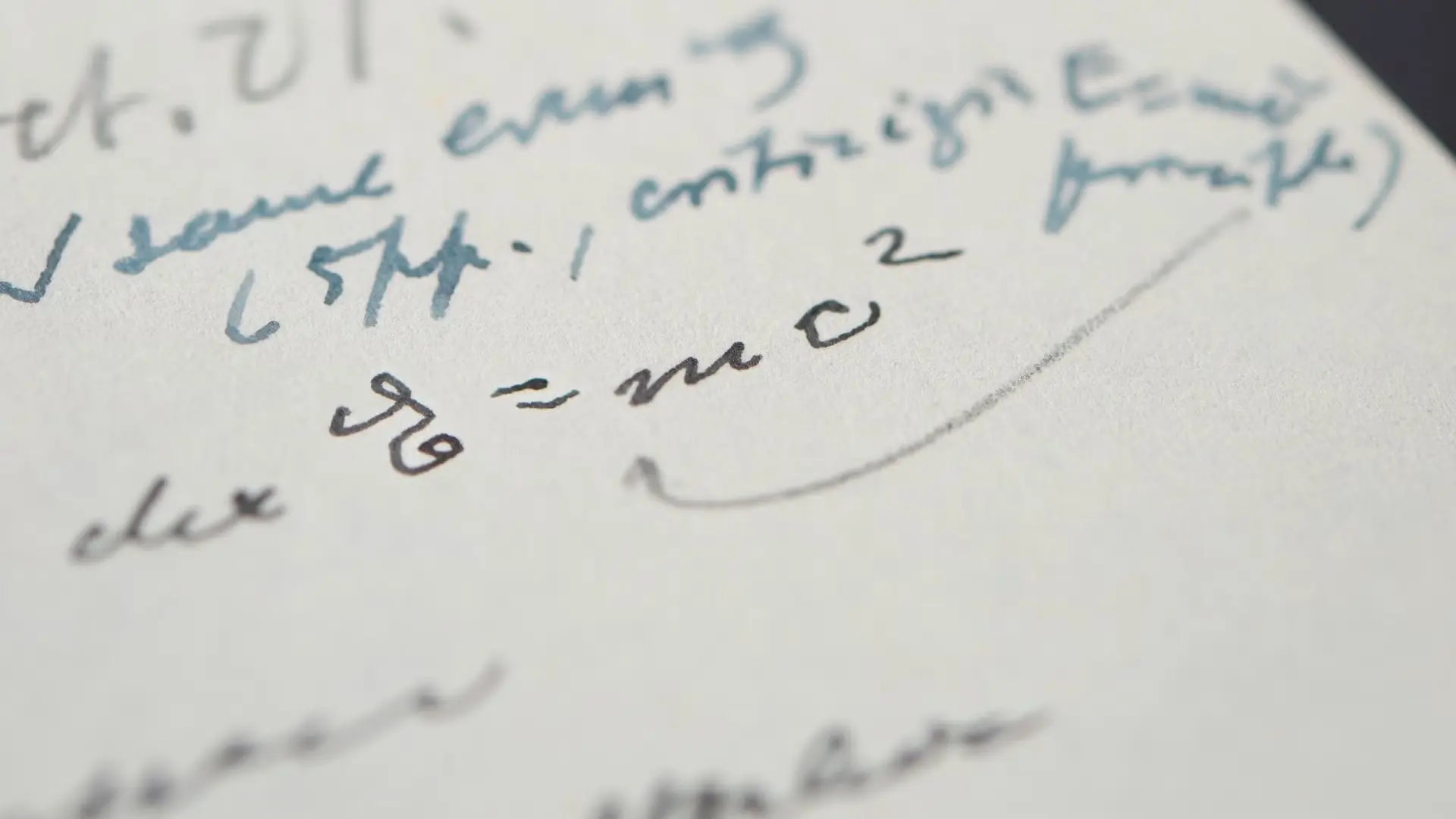
When Did Einstein First Write E = mc²?
The world's most recognized equation did not appear in its familiar form in 1905. The paper trail from Einstein's journal paper to the 1912 manuscript to the 1946 letter.
Open