
DIY · Card 03 · Physics · Air
Point a hair dryer at the ceiling, drop a ping-pong ball into the air, and it stays there, wobbling but never falling out. Then try two.
01The brief
Make two ping-pong balls float in one stream of air at the same time, without them knocking each other out.
8.6 m/s
the air speed at which the drag on a ping-pong ball equals its 2.7 g weight
44 Pa
the push that air carries: four hundredths of one percent of the atmosphere
~35°
how far you can often tilt the stream before the ball gives up and falls out
This is the quickest experiment in the deck and the most argued about. It takes ten seconds to set up and works first time: point a hair dryer straight up, drop a ping-pong ball into the air above it, and the ball hangs there, shivering, as if it were on an invisible stand. Push it sideways and it swings back. Tilt the dryer and it follows.
Almost every explanation you will find says the same thing: fast air has low pressure, so the still air round the jet squeezes the ball back in. That is wrong, and the real answer is more interesting. It also explains wings, spoons under taps and why racing cars stick to the road.
02Kit
Two things, both probably in the house already. The ping-pong ball matters: it is light for its size, which is exactly what the air needs.
Tick off what you have
0 of 2 ready
03Method
The first ball floats in seconds. The rest of the steps are about poking it, tilting it and finally getting a second one to share the air.
Step 1 of 8 · Second 0
Plug in the hair dryer, take off any nozzle or diffuser, and set it to the cool setting. Start on the lower fan speed.
The ball shoots off to the side.
Why
The jet is lumpy, or so fast that the ball overshoots the narrow part of the stream.
Fix
Take off any attachment, use the low speed, and drop the ball right in the middle.
The ball won’t lift at all.
Why
The air is too slow for this ball, or the ball is heavier than a ping-pong ball.
Fix
Use the high speed, hold the ball closer to the nozzle, and stick to light, smooth balls.
The second ball knocks the first one out.
Why
It was dropped from too high, or off-centre, and hit the lower ball hard.
Fix
Turn the speed down and lower the second ball by hand until the air takes it.
04Physics
Why it stays up is the easy half. Air rushing past the ball drags it along, the way wind drags a leaf. The drag grows with the square of the air’s speed. The ball’s weight does not change. So somewhere in the jet there is a speed at which the two are equal, and for a ping-pong ball that speed is about 8.6 metres per second.
The jet leaving the dryer is faster than that, but it does not stay fast. As it rises it drags still room air along with it, spreads out and slows down. So the ball climbs to the height where the jet has slowed to exactly 8.6 m/s. Lower down, the air pushes it up harder than gravity pulls; higher up, gravity wins. The ball is caught between the two, and it bobs around that height. Unlike the hot water in the underwater volcano, which floats because it is lighter than what surrounds it, the ball is far heavier than air. It is held up by moving air, not by buoyancy.
The ball floats 42 cm above the nozzle
A ping-pong ball weighs 2.7 g, so it needs air moving at 8.6 m/s (with a drag coefficient of 0.47). That air carries a dynamic pressure of only 45 Pa, about 0.044 % of the atmosphere, and that is enough to carry the ball’s 26.5 mN of weight.
Why it stays in is the hard half, and the one most explanations get wrong. Push the ball towards the edge of the jet and watch the air. More of the fast stream now flows past the ball’s inner side, and that air does not just carry on upward. It follows the curve of the ball and bends round it.
Air can only be made to travel in a curve if something pushes it toward the centre of the curve, and in a fluid that push is a pressure difference: the pressure is lower on the inside of the bend, right against the ball’s surface. So the ball’s inner side ends up at lower pressure than its outer side, and it is pulled back toward the middle of the jet. The air, bent outward, is pushed the other way. It is the same pairing of forces that lets a jet of water drag a spoon into it, and that lets a fluid follow a curved surface at all. Engineers call that clinging the Coandă effect.
05The big idea
Bend the air,
and it bends you back.
The ball does not stay in the jet because fast air is somehow “low pressure” in general. It stays because it forces the air to change direction, and changing the direction of moving air takes a push. Whatever pushes the air one way is pushed back the other way. That is Newton’s third law, written in wind.
Bernoulli’s principle is still in there, as one way of doing the accounting: along the curved path round the ball, the air speeds up and its pressure drops. But the cause is the curve. Strip away the slogans, and lift, suction and the floating ball all come down to the same sentence: to make air turn, you have to push on it, and it pushes on you.
06The math
1 · Drag
F = ½ ρ v² Cd A
The push of moving air on the ball. ρ is the density of air, C_d about 0.47 for a sphere, A the ball’s cross-section.
2 · Balance
v* = √(2mg / ρCdA)
Set drag equal to weight and solve for the speed of air the ball needs. Light and wide means slow air will do.
3 · The jet slows
u(x) ≈ 6 U₀ D / x
Past about six nozzle widths, a round jet’s centre speed falls in proportion to distance. D is the nozzle width, U₀ the speed leaving it.
A ping-pong ball is 40 mm across and weighs 2.7 g, so its weight is 0.0265 N and its cross-section 12.6 cm². Put those into the second formula with air at 1.2 kg/m³ and you get v* ≈ 8.6 m/s, about 31 km/h, a brisk breeze. The push carried by air at that speed, ½ρv², is about 44 Pa. The egg in the bottle was pushed by twelve thousand pascals; this ball is held up by forty-four.
Now put the third formula to work. A dryer blowing 15 m/s out of a 4 cm nozzle slows to 8.6 m/s at x = 6 × 15 × 0.04 / 8.6 ≈ 42 cm. That is where the ball floats. Double the air speed and the height doubles too. A golf ball needs about 33 m/s, which no hair dryer reaches at any height, so it never lifts.
One more number explains the shiver. The Reynolds number, which compares the air’s momentum with its stickiness, is about 23,000 here. At that value the air leaves the back of the ball in a churning, unsteady wake that throws off eddies unevenly, so the ball never sits perfectly still. That same wake is what makes the two-ball challenge hard. Try it yourself:
Floating
Tilt the stream until the ball gives up, flick it sideways and watch it swing back, then try to keep 3 up at once.
07Real life
Some of these are the curve at work, some are Bernoulli in a pipe. Both are everywhere once you look.
A spoon under the tap
Hold the back of a spoon loosely in a stream of tap water. Instead of being pushed away, it is pulled into the stream. The water curves round the spoon’s bulge, and the curve lowers the pressure on it, the same pull that keeps the ball in the jet.
Aircraft wings
A wing lifts because it turns a huge amount of air downward, and the air bending round its curved top leaves lower pressure there. The popular story, that air over the top must race to meet the air underneath, is false: it actually arrives first.
Perfume atomisers
Squeeze the bulb and air rushes through a narrow tube across the top of a thin straw dipped in perfume. In the fast air the pressure really does drop, as Bernoulli said, and the liquid is lifted up the straw and torn into mist.
The pitot tube
Aeroplanes measure their speed with a small forward-facing tube that feels the full push of the oncoming air, and compare it with the still air pressure to the side. The difference is the dynamic pressure, ½ρv², and from it the airspeed.
The line on a railway platform
A fast train drags a thick layer of air along with it and leaves a turbulent slipstream behind. The gusts can tug at people and pushchairs near the edge, which is why stations paint a line to stand behind.
Racing car floors
The floor of a modern racing car is shaped into tunnels that narrow and widen again. Air speeding through the narrow part drops in pressure, and the air above presses the car onto the track, harder the faster it goes.
1738
Daniel Bernoulli published Hydrodynamica in 1738, with the idea that where a flowing fluid speeds up, its pressure falls. He was thinking of water in pipes, and in a pipe the rule works beautifully: squeeze the flow through a narrow section and the pressure there drops. It is the principle behind atomisers, carburettors and the airspeed indicators on every aeroplane.
The trouble starts when the rule is stretched to compare a jet with the still air beside it, which is the move most explanations of the floating ball make. A spinning ball adds yet another twist, the Magnus effect, which is how Roberto Carlos bent a free kick round a wall in 1997.
08Is and isn’t
The jet is fast, so it is at low pressure, and the still air around it squeezes the ball in.
A jet blowing into open air is at very nearly room pressure; if it were not, it would swell or shrink as it left the nozzle. The low pressure is on the ball itself, where the air has to curve round it.
Bernoulli says faster air always has lower pressure.
Bernoulli’s rule compares pressure and speed along one stream of air as it speeds up or slows down. It says nothing about moving air in one place compared with still air somewhere else.
Air over a wing goes faster because it has to meet the air underneath at the back.
Nothing makes the two meet. Wind-tunnel smoke shows the air over the top arriving well before the air underneath.
It floats because a ping-pong ball is so light.
Lightness only sets how fast the air must blow. A golf ball would float too, in air moving at about 33 m/s; a hair dryer just can’t manage that.
09Go further
A
The funnel trick
Blow hard down an upside-down funnel with a ping-pong ball under it. The ball stays up inside the funnel, and the harder you blow, the more it sticks.
B
Find the tilt limit
Tip the dryer a few degrees at a time and note the angle at which the ball drops out. Then try on the low and high fan speeds.
C
Measure your dryer
Read the ball’s height with a tape measure on each setting and type it into the lab above. Work backwards to your dryer’s air speed.
D
A ball under the tap
Hold a ping-pong ball by a thread so it just touches a running tap. The stream pulls it in and holds it at an angle, the jet trick done with water.
E
Two balls on strings
Hang two ping-pong balls on threads a few centimetres apart and blow between them. Most people expect them to fly apart. They swing together.
10Questions
The air rushing past the ball drags it upward. The jet slows down as it rises, so the ball climbs until it reaches the height where the drag exactly matches its weight, and it hovers there.
When the ball drifts off-centre, the fast air flows round its inner side and is forced to curve. Air bending round a surface leaves lower pressure on that surface, so the ball is pulled back toward the middle of the jet.
Partly. Bernoulli’s principle describes how pressure falls where air speeds up along its path, and that happens where the air curves round the ball. The common explanation, that the jet itself is at low pressure and the still room air squeezes the ball in, is wrong: a free jet is at room pressure.
About 8.6 metres per second. A ping-pong ball weighs 2.7 g and is 40 mm across, and at that speed the drag on it equals its weight. Most hair dryers blow faster than that at the nozzle, so the ball floats where the jet has slowed to this speed.
Yes, but it takes practice. The upper ball sits in the slow, turbulent wake of the lower one, so the two jostle and swap places. A lower fan speed and a gentle drop straight down the middle make it easier.
Safety · Keep the dryer away from water and use the cool setting. Don’t point it at anyone’s face, and switch it off between tries so it doesn’t overheat.
All DIY cards →Keep wandering
A few more pieces in the same spirit — math, design, and slow attention.

How to Make a Tornado in a Bottle: Vortex Science
Swirl an upside-down bottle of water and a funnel of air drills down through the middle. It spins fastest at the centre for the same reason a skater spins faster with arms pulled in, and it has nothing to do with which hemisphere you live in.
Open
How to Make a Density Tower: Stacking Liquids in a Glass
Honey, washing-up liquid, water, oil and rubbing alcohol, poured one by one into a glass, settle into five sharp layers. Which goes where is decided by one number, and one of them only stays put thanks to the oil.
Open
How to Push a Skewer Through a Balloon Without Popping It
A wooden skewer goes in at the top of a balloon and out beside the knot, and the balloon just sits there. The trick is knowing where the rubber is least stretched, and why stretch decides everything.
Open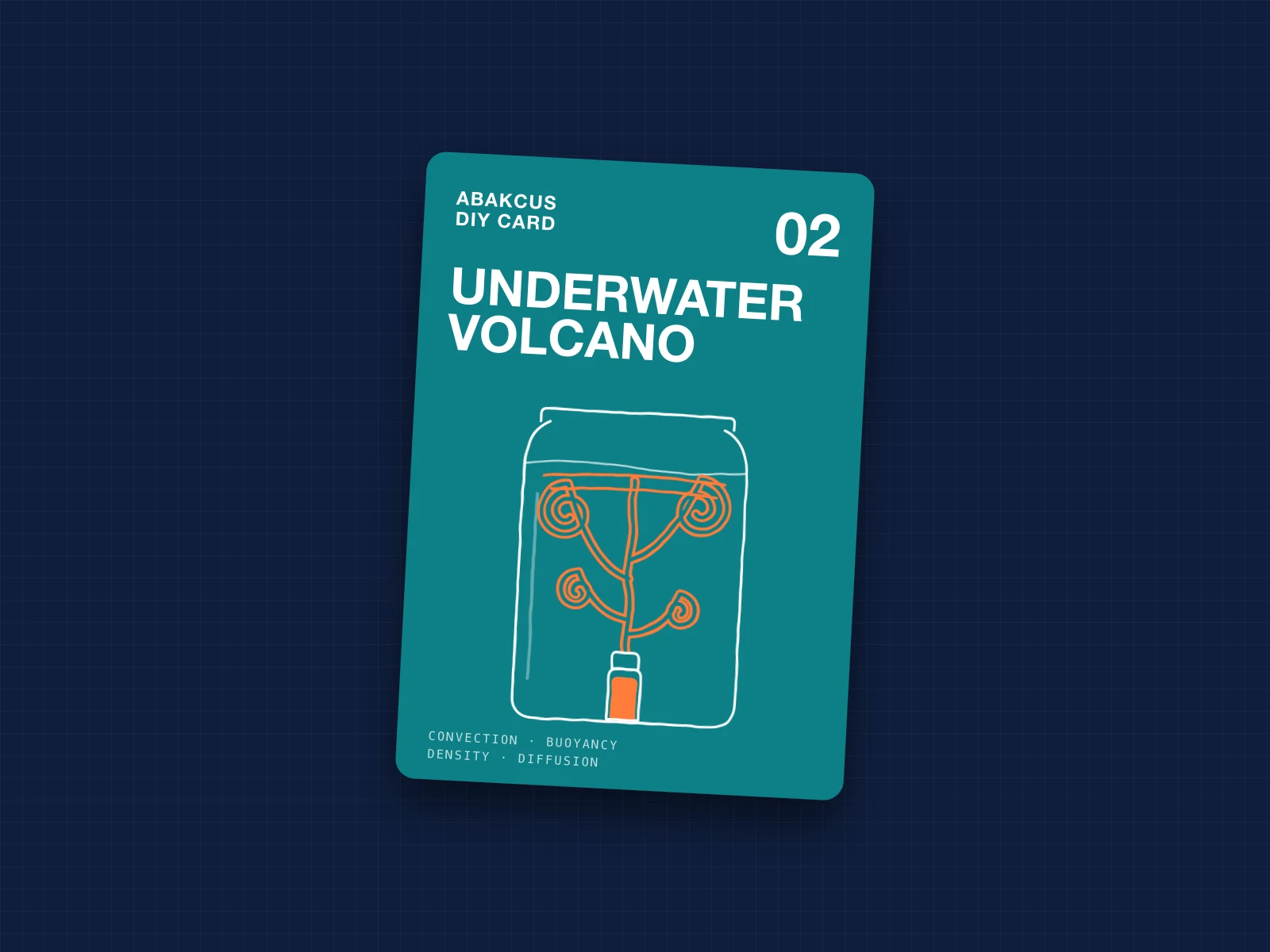
How to Make an Underwater Volcano: Convection in a Jar
Hot red water in a salt shaker, lowered into a jar of cold water. It erupts, curls into a mushroom, and lies on the surface like oil, because water one and a half percent lighter has nowhere to go but up.
Open
How to Get an Egg Into a Bottle Without Touching It
Two days in vinegar take the shell away, a warm bottle does the rest. The egg goes through a mouth narrower than itself, pushed by ten tonnes of air per square metre.
Open
The Feynman Technique: A Complete Guide
The four-step learning method developed by Nobel Prize-winning physicist Richard Feynman. How it works, why it works, and how to apply it to anything.
Open