
DIY · Card 96 · Math · Logarithms
Two strips of card, marked the right way, multiply any two numbers when you slide one along the other. It is the calculator that built the modern world, and you can make one in half an hour.
01The brief
Add two lengths. Multiply two numbers.
25 log n
centimetres from the start line: where each number goes
3
significant figures from a 25 cm rule
350 years
that engineers did their sums on slide rules, until pocket calculators arrived
Put a ruler next to a ruler and you can add: slide one along by 2, look at its 3, and the other ruler says 5. A slide rule does the same thing, but its marks are spaced by logarithms. Slide it along by 2, look at its 3, and the other scale says 6.
Making one is the best way to understand what a logarithm is for. If you have already built the abacus, this is the next calculator in line; the tangram is another piece of maths you can cut from card.
02Kit
Card, a ruler and a steady hand.
Tick off what you have
0 of 5 ready
03Method
Measure, mark, copy, then slide.
Step 1 of 8 · Minute 0
You need two strips of stiff card about 30 cm × 4 cm, a 30 cm ruler, a sharp pencil, a fine pen and a calculator to check your answers.
2 × 3 reads 6.3, not 6.
Why
The marks on the two strips don’t match exactly.
Fix
Re-copy the marks from one strip to the other, edge to edge, with a sharp pencil.
The strips slip apart.
Why
There is nothing holding them in line.
Fix
Tape a card sleeve round the fixed strip so the slide runs inside it, or slide them along a ruler’s edge.
The answer runs off the end.
Why
The product is bigger than 10.
Fix
Use the slide’s right-hand 1 instead of its left one, and multiply the reading by 10.
04How it multiplies
On your scales, the distance from 1 to any number is its logarithm. Slide the C scale so its 1 sits over the first number, then look along to the second: the two distances add up, and the scale underneath shows the product. Try it:
The rule reads
6
So the answer is
6
Exact
6.0000
Slide C’s 1 over the first number on D. Under the second number on C, D shows the answer: the two lengths add, so the numbers multiply.
How good is it? That depends on how long the rule is and how carefully you line it up:
Error
± 0.46 %
2 × 3 reads
5.97 – 6.03
Gap 1.0 → 1.1
10.3 mm
Gap 9.9 → 10
1.09 mm
Good for about 3 significant figures. On a log scale, an error of a fixed distance is an error of a fixed percentage, wherever it happens. So the marks can be far apart near 1, where 0.1 is a big step (10 %), and squeezed together near 10, where 0.1 is only 1 %. Twice the length, half the error: that is why engineers kept long rules on their desks.
05The big idea
Turn times
into plus.
Multiplying big numbers by hand is slow and easy to get wrong. Adding is quick. Logarithms swap one for the other: the log of a product is the sum of the logs. That trick saved astronomers and navigators years of work after Napier published it in 1614.
A slide rule builds the trick into a piece of wood. You never see a logarithm on it. You just slide, and the adding is done by the lengths themselves.
06The math
1 · The key rule
log (a × b) = log a + log b
Logarithms turn multiplying into adding.
2 · The scale
x = L × log₁₀ n
Distance from the start line on a rule of length L.
3 · The error
error ≈ ln 10 × δ ⁄ L
δ is how finely you can line up a mark.
On a 25 cm rule, 2 sits at 25 × log 2 = 25 × 0.301 = 7.5 cm and 3 at 25 × 0.477 = 11.9 cm. Put them end to end and you reach 19.4 cm, and 25 × log 6 = 19.5 cm. Laying lengths end to end has found 2 × 3 = 6.
If you can line up marks to within half a millimetre, the error is about 2.30 × 0.05 ⁄ 25 ≈ 0.5 %, so 2 × 3 reads somewhere between 5.97 and 6.03. That is three good figures, and enough to design a bridge, as long as you keep a safety margin.
07Real life
From the Moon landings to the frets on a guitar.
Apollo
Apollo crews carried small Pickett slide rules as a backup in case the computers failed. One that belonged to Buzz Aldrin was sold at auction in 2007.
Bridges and jets
For more than three centuries engineers did their sums on slide rules. The bridges, skyscrapers and jet aircraft of the 1950s and 60s were designed with them.
Guitar frets
Each fret shortens the string by the same fraction, so the frets get closer together as you go up the neck, just like the crowded right-hand end of a slide rule’s scale.
Loudness and earthquakes
Decibels, the Richter scale and pH are all logarithmic scales. Each step up means multiplying, not adding, just as each centimetre on your rule does.
Star brightness
Astronomers rank stars by magnitude, another log scale: five magnitudes is exactly 100 times dimmer.
Log graph paper
Scientists plot growth on paper with log scales, so that anything that keeps doubling turns into a straight line.
1620
In 1614 the Scottish laird John Napier published his tables of logarithms. Six years later the London astronomer Edmund Gunter drew a logarithmic scale on a two-foot ruler; to multiply, you measured off lengths with a pair of dividers and added them.
Around 1622 the clergyman and mathematician William Oughtred threw away the dividers. He put two Gunter scales side by side and slid one along the other. That was the slide rule, and in one form or another it stayed on engineers’ desks until the pocket calculators of the 1970s.
08Is and isn’t
A slide rule gives exact answers.
It gives about three significant figures. Engineers knew this and added safety margins to everything they designed.
Napier invented the slide rule.
Napier invented logarithms, published in 1614. Gunter put them on a ruler in 1620, and Oughtred made two scales slide around 1622.
It adds numbers.
It adds lengths. Because the lengths are logarithms, adding them multiplies the numbers. To add 2 + 3 you would need an ordinary ruler.
Slide rules only multiply and divide.
Real rules carry extra scales for squares, cubes, square roots, logarithms and trigonometry.
09Go further
A
Times tables
Set C’s 1 over 7 on D. Every number on C now sits over 7 times itself on D: the whole seven-times table at once.
B
Double the length
Make a 50 cm rule with the same method. Is it more accurate? By how much?
C
Squares
Draw a third scale at half size (12.5 × log n), repeated twice. Read it against D to find squares and square roots.
D
Circular rule
Draw the scale round the edge of two paper plates, one smaller than the other, and pin them at the centre. It never runs off the end!
E
Race a calculator
Time yourself on ten multiplications. The rule gets faster with practice, and you always know roughly what the answer should be.
10Questions
Mark two strips of card with the same logarithmic scale: put each number n at 25 × log₁₀ n centimetres from a start line, so 2 is at 7.5 cm, 3 at 11.9 cm and 10 at 25 cm. Slide one strip along the other to multiply and divide.
Its scales are logarithmic, so the distance to each number is proportional to its logarithm. Laying one distance after another adds the logarithms, and since log a + log b = log (a × b), the end point lands on the product.
A standard 25 cm rule gives about three significant figures, an error of roughly half a percent. Longer rules are more accurate; the error halves each time the length doubles.
Edmund Gunter drew a logarithmic scale on a ruler in 1620, a few years after John Napier published logarithms. Around 1622, William Oughtred put two such scales side by side and slid them, making the first slide rule.
Yes. Apollo crews carried small Pickett slide rules as backup calculators, and one belonging to Buzz Aldrin was later sold at auction.
Safety · Completely safe. The only sharp thing is the scissors.
All DIY cards →Keep wandering
A few more pieces in the same spirit — math, design, and slow attention.
How to Make an Abacus: A Soroban From a Shoebox Lid
A shoebox lid, five skewers and 25 beads become a Japanese soroban that counts to 99,999 and makes place value and carrying visible.
Open
How to Make a Tangram From a Square of Card
One square of card, five straight lines, seven pieces. Rearrange them into cats, boats and swans, and every picture has exactly the area of the square.
Open
How to Make a Galton Board That Draws a Bell Curve
A board, forty pins and a handful of beads. Every bead zigzags at random, yet together they pile into the same graceful hump every time: the bell curve.
Open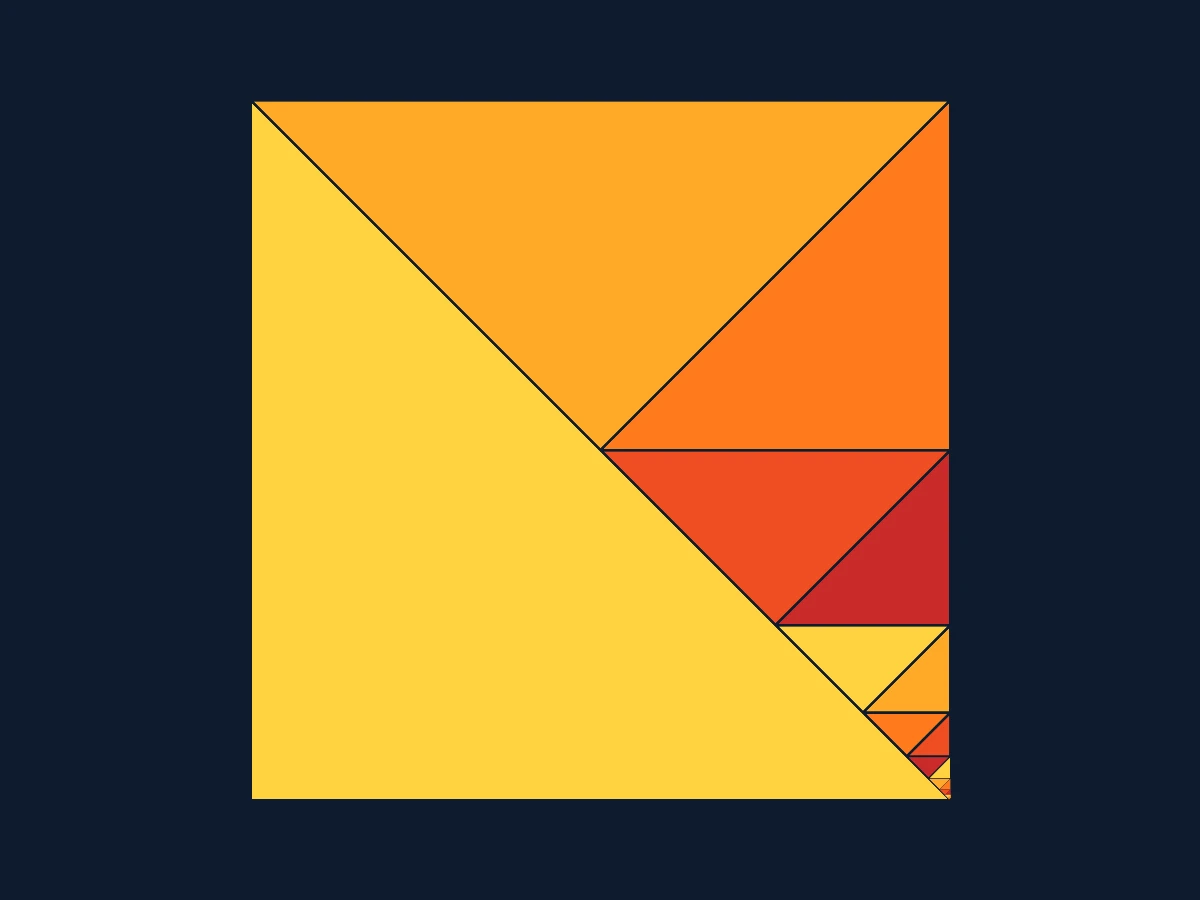
1/2 + 1/4 + 1/8 + … = 1: A Proof Without Words
Cut a square in half, then cut what is left in half, and keep going. The pieces never run out, yet together they make exactly one square.
Open
How to Make a Clinometer and Measure a Tree’s Height
A protractor, a straw and a weighted thread. Sight the top of a tree, read one angle, pace one distance, and trigonometry gives you its height.
Open
How to Make a Hexaflexagon From a Strip of Paper
A strip of ten paper triangles folds into a hexagon with three faces instead of two. Pinch, push and open, and a face you never coloured blooms from inside.
Open