∞
pieces in the square
1
total area, exactly
0
area left uncovered
Add up infinitely many numbers and common sense says the total should be infinite. It does not have to be. A half plus a quarter plus an eighth plus a sixteenth, continued without end, comes to exactly 1. Not roughly 1, and not 1 “in the limit” as a polite way of saying almost.
The square at the top of this page is the whole argument. It is one of the best-loved proofs without words in mathematics, and once you have read it you will not need to be told the answer again.
Reading the picture
Always half of what is left
Start with a square of area 1. There is one rule and it never changes: cut the white part into two equal pieces, color one, and leave the other for next time.
Cut 1 · colored so far
1/2
Cut the square along its diagonal and color one half.
Cut 2 · colored so far
3/4
Cut the other half in two. Color one piece: a quarter.
Cut 3 · colored so far
7/8
Cut what is left in two again. Color one piece: an eighth.
Cut 4 · colored so far
15/16
Same rule, once more. A sixteenth is all that stays white.
Why it is a proof
Two facts, both visible
≤ 1
The pieces never spill over
Every cut is a halving, so the colored pieces have areas 1/2, 1/4, 1/8, 1/16 and so on. They never overlap and they never leave the square. However many you add, the total cannot be more than 1.
≥ 1
Nothing is left out
After one piece, half the square is white. After two, a quarter. After ten, 1/1024. Pick any point other than the bottom-right corner itself and the cuts eventually pass it. No patch with any area stays white.
Not more than the square, and not less. The pieces add up to exactly 1.
Try it
Build the square yourself
Covered after 3 pieces
0.875
7/8
Newest piece
1/8
Still uncovered
1/8
The gap is always exactly as big as the piece you just placed, so it halves every time.
The fine print
What an infinite sum means
Nobody can perform infinitely many additions, so “the sum of infinitely many numbers” needs a definition before it can be true or false. The one mathematicians settled on is this: add the terms one at a time and watch the running totals. If they close in on a single number, coming within any distance of it you care to name and staying there, that number is the sum.
The square shows exactly that. After n pieces the running total is 1 − 1/2n: the square minus its white corner. Choose how close you want to get.
Name a tolerance
20
pieces put the total within a millionth of 1, and it never drifts back out.
gap after 20 pieces = 1/1,048,576
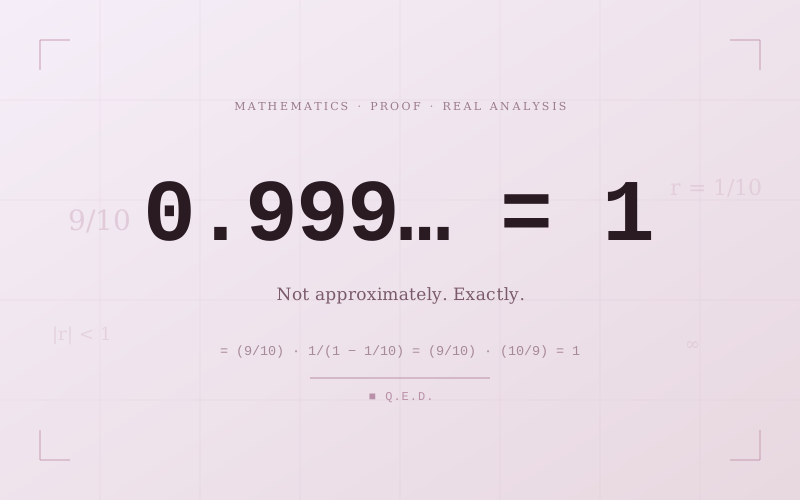
No number other than 1 passes that test, so the sum is 1. It is the same idea that makes 0.999… exactly equal to 1. In fact it is the same statement written in base two, where 1/2 + 1/4 + 1/8 + … is the number 0.111…
About 450 BC
Zeno’s runner
The sum is older than the notation for it. Zeno of Elea argued that motion is impossible: a runner heading for a wall must first cover half the distance, then half of what remains, then half of that. There are infinitely many stages, he said, and nobody can finish infinitely many tasks.
Start the run and watch the stage counter. The stages pile up without limit, and the runner arrives anyway, on time.
Stage
1
Time
0.0 s
Distance
0.000
The track is the square unfolded into a line. Infinitely many stages do not need infinite distance, and at a steady pace they do not need infinite time, because the stages shrink as fast as they multiply.
Same trick, different fraction
A third, by quarters
1/4 + 1/16 + 1/64 + … = 1/3
Split a square into four equal squares. Give three of them three different colors, then split the fourth the same way, and repeat forever.
Each color gets a quarter of the square, then a sixteenth, then a sixty-fourth. The three colors are treated identically at every step and between them they fill the whole square, so each must cover exactly a third of it. Archimedes used this very sum in the third century BC to find the area under a parabola.
The general rule
One formula for all of them
r + r2 + r3 + … = r / (1 − r)
If each term is a fixed fraction r of the one before it, with r between −1 and 1, the sum is r / (1 − r). Put in r = 1/2 and you get 1. Put in r = 1/4 and you get 1/3. The algebra is quick, but the squares are what make it believable, in the same way that a cube cut into eight blocks makes sense of (a + b)3.
Ratio r
0.50
Sum
1.000
0.5 + 0.25 + 0.125 + 0.0625 + … = 1
Each block is the fraction r of the one before it. Whatever r you pick, the blocks fill the bar and stop.
Sources
- Roger B. Nelsen, Proofs Without Words: Exercises in Visual Thinking, Mathematical Association of America, 1993.
- Aristotle, Physics, Book VI, on Zeno’s arguments against motion.
- Archimedes, Quadrature of the Parabola, Propositions 23–24.