
DIY · Card 70 · Space · Physics
A big packing box, a few yogurt pots and a handful of cotton reels become a rocket a child can climb inside. And while the astronaut counts down, you can find out why real rockets are almost all fuel.
01The brief
Build a rocket from a box, then find out what a real one is made of.
9.4
km/s of speed change to reach orbit, losses included
~90%
of the Saturn V’s lift-off weight was propellant
1903
the year Tsiolkovsky published the rocket equation
Every child who has sat in a cardboard box knows it can be anything: a car, a boat, a castle. With a pointed nose, a round window and a door that really opens, it becomes a rocket, and its pilot can count down for as many launches as they like.
Real rockets have a secret that this one doesn’t: they are almost entirely fuel. One equation, written down over a century ago by a deaf schoolteacher in Russia, explains why, and why they are built in stages. Try the recycled rocket for one that actually flies, or hang a paper rocket garland above the launch pad.
02Kit
A big box and a raid on the recycling bin.
Tick off what you have
0 of 6 ready
03Method
Nose cone first, then the window, the hatch and all the gadgets.
Step 1 of 8 · Minute 0
Find a big cardboard packing box a child can sit in, extra card for the nose, a few yogurt pots, cotton reels, a polystyrene wreath ring, plastic lids, letter stickers, coloured paper, silver paint, glue and tape, and a craft knife for a grown-up.
The cone keeps sagging.
Why
The card is too thin or the base is too wide.
Fix
Use corrugated card, or make the cone taller by removing a bigger slice so its sides are steeper.
The door tears at the hinge.
Why
The fold runs across the corrugations.
Fix
Reinforce the hinge with a long strip of strong tape on both sides.
The box squashes when climbed on.
Why
An empty box has no internal bracing.
Fix
Tape a folded cardboard strip across each inside corner, and keep it a sitting rocket, not a climbing one.
04Rocket science
A rocket moves by throwing its propellant backwards as fast as it can. But it has to carry that propellant with it, and speeding up the fuel it hasn’t burnt yet costs fuel too. Tsiolkovsky’s equation captures this: the speed gained depends on the exhaust speed and on the ratio of full to empty mass.
Choose an engine, fill the tank, and launch:
Exhaust speed
3 km/s
Mass ratio
6.7 : 1
Final speed
5.7 km/s
Not enough for orbit. With kerosene + oxygen engines, a single rocket would need to be 95.6 % propellant to reach orbit. Watch the curve: the speed climbs fastest at the very end, when the rocket is nearly empty and light.
One rocket can’t carry enough. The answer is to throw parts of it away on the way up:
┃ orbit needs 9.4 km/s
With kerosene engines (3 km/s exhaust), one stage give 6.6 km/s: not enough for orbit. Each time an empty stage falls away, the engines above no longer have to push its dead weight. Going from one stage to two makes a huge difference; after three, extra stages add little, which is why most rockets that reach orbit have two or three.
05The big idea
A rocket is
a fuel tank.
Because speed grows with the logarithm of the mass ratio, each extra km/s needs the rocket to be heavier by the same factor again. Doubling the speed means squaring the mass ratio.
That is the “tyranny of the rocket equation”. It is why the crew capsule on top of a giant rocket is so small, why every gram on board is counted, and why rockets shed their empty stages as they climb.
06The math
1 · Rocket equation
Δv = vₑ · ln(m₀ ⁄ m₁)
m₀ full mass, m₁ empty mass, vₑ exhaust speed.
2 · Fuel needed
f = 1 − e^(−Δv ⁄ vₑ)
The fraction of take-off mass that must be propellant.
3 · Cone from a circle
sector = 360° × r ⁄ s
r the cone’s base radius, s its sloping side.
With kerosene engines, vₑ ≈ 3 km/s. A rocket that is 90 % propellant has a mass ratio of 10 and gains 3 × ln 10 ≈ 6.9 km/s: not enough. To reach 9.4 km/s in one piece it would need 1 − e^(−3.13) ≈ 95.6 % propellant, leaving just over 4 % for tanks, engines and crew.
For the nose cone of a box 50 cm wide, the circle must reach the corners, a base radius of about 35 cm. With a slope of 60 cm the sector is 360° × 35 ⁄ 60 = 210°, so you cut away 150°, and the cone stands √(60² − 35²) ≈ 49 cm tall.
07Real life
From a cabbage patch in Massachusetts to boosters that land themselves.
The Saturn V
The rocket that took astronauts to the Moon weighed nearly 3,000 tonnes at lift-off, and almost 90 per cent of that was propellant. It had three stages, each thrown away once its tanks ran dry.
Goddard’s first flight
On 16 March 1926, in a snowy field in Auburn, Massachusetts, Robert Goddard launched the first liquid-fuelled rocket. It flew for about two and a half seconds and landed in a cabbage patch.
Squid jets
A squid fills its body with water and squirts it out backwards through a funnel to shoot forwards. It is the rocket principle under the sea: throw mass one way and you move the other.
Landing boosters
Since 2015, SpaceX has landed the first stages of its Falcon 9 rockets back on Earth so they can fly again. Staging still applies; the stage just isn’t thrown away any more.
Orbital speed
To stay up, a spacecraft 400 km above the Earth must travel sideways at about 7.7 km/s, fast enough to go round the planet in about 90 minutes. Getting high is easy; getting fast is the hard part.
The balloon rocket
Blow up a balloon, tape it to a straw on a string, and let go. The air rushes out one way and the balloon zips the other: Newton’s third law, the same law that lifts every real rocket.
1903
Konstantin Tsiolkovsky lost most of his hearing to scarlet fever as a boy, was largely self-taught, and spent his life as a schoolteacher in the provincial Russian town of Kaluga. In his spare time he worked out how to travel into space.
In 1903 he published the rocket equation and proposed liquid hydrogen and oxygen as fuel; later he sketched multi-stage “rocket trains”, decades before anyone could build them. He called the Earth the cradle of humanity, and said that no one can live in the cradle for ever.
08Is and isn’t
Rockets push against the air.
They push against their own exhaust. That is why they work even better in the vacuum of space, where there is no air to get in the way.
Space is a long way up.
The edge of space is usually put at 100 km, about an hour’s drive straight up. The real challenge is speed: orbit needs about 7.8 km/s sideways.
A bigger rocket goes faster.
Size alone doesn’t help. Only the exhaust speed and the ratio of full to empty mass decide how much speed a rocket can gain.
Astronauts float because there is no gravity in orbit.
At the height of the space station, gravity is still about 90 per cent as strong as on the ground. Astronauts float because they are falling round the Earth together with their spacecraft.
09Go further
A
A balloon rocket race
Thread straws on two strings across a room and race balloons along them. Does a bigger balloon always win?
B
Mission control
Write a launch checklist with the astronaut: fuel, hatch, seat belt, countdown. Real flights run on checklists.
C
A cone challenge
Make cones from circles with 90°, 180° and 270° removed. Which is tallest? Which holds the most rice?
D
Paper stages
Build a three-stage rocket of stacked cardboard tubes that pull apart. How many stages does the Saturn V have?
E
Spot the station
Look up when the International Space Station passes over your home and go outside to watch it cross the sky in a few minutes.
10Questions
Stand a big packing box on end, tape a card cone on top, and cut a round porthole and a hinged door. Decorate it with yogurt-pot domes, cotton-reel dials, plastic-lid fuel caps and letter stickers, then hang paper stars around it.
Cut a circle, remove a slice, and roll the rest so the cut edges meet. A cone with a base radius r and a sloping side s needs a sector of 360° × r ⁄ s. For a 35 cm base and a 60 cm slope that is 210°, so you cut away 150°.
Konstantin Tsiolkovsky’s equation, published in 1903: Δv = vₑ · ln(m₀ ⁄ m₁). The speed a rocket can gain depends only on how fast its exhaust leaves and on the ratio of its full mass to its empty mass, not on its size.
Reaching orbit takes about 9.4 km/s of speed change, including losses to gravity and air, while good engines push their exhaust out at only 3 to 4.5 km/s. The rocket equation then demands a full rocket many times heavier than the empty one: the Saturn V was nearly 90 per cent propellant at lift-off.
Once the bottom stage’s tanks are empty, they are dead weight. Dropping them means the next engines only have to speed up what is left. Two or three stages let a rocket reach orbit with tanks and engines that can actually be built.
Safety · A grown-up should do all the cutting with the craft knife and any spray painting, outdoors. Keep small parts such as lids and stickers away from children under three, and make sure the hatch opens easily from the inside.
All DIY cards →Keep wandering
A few more pieces in the same spirit — math, design, and slow attention.
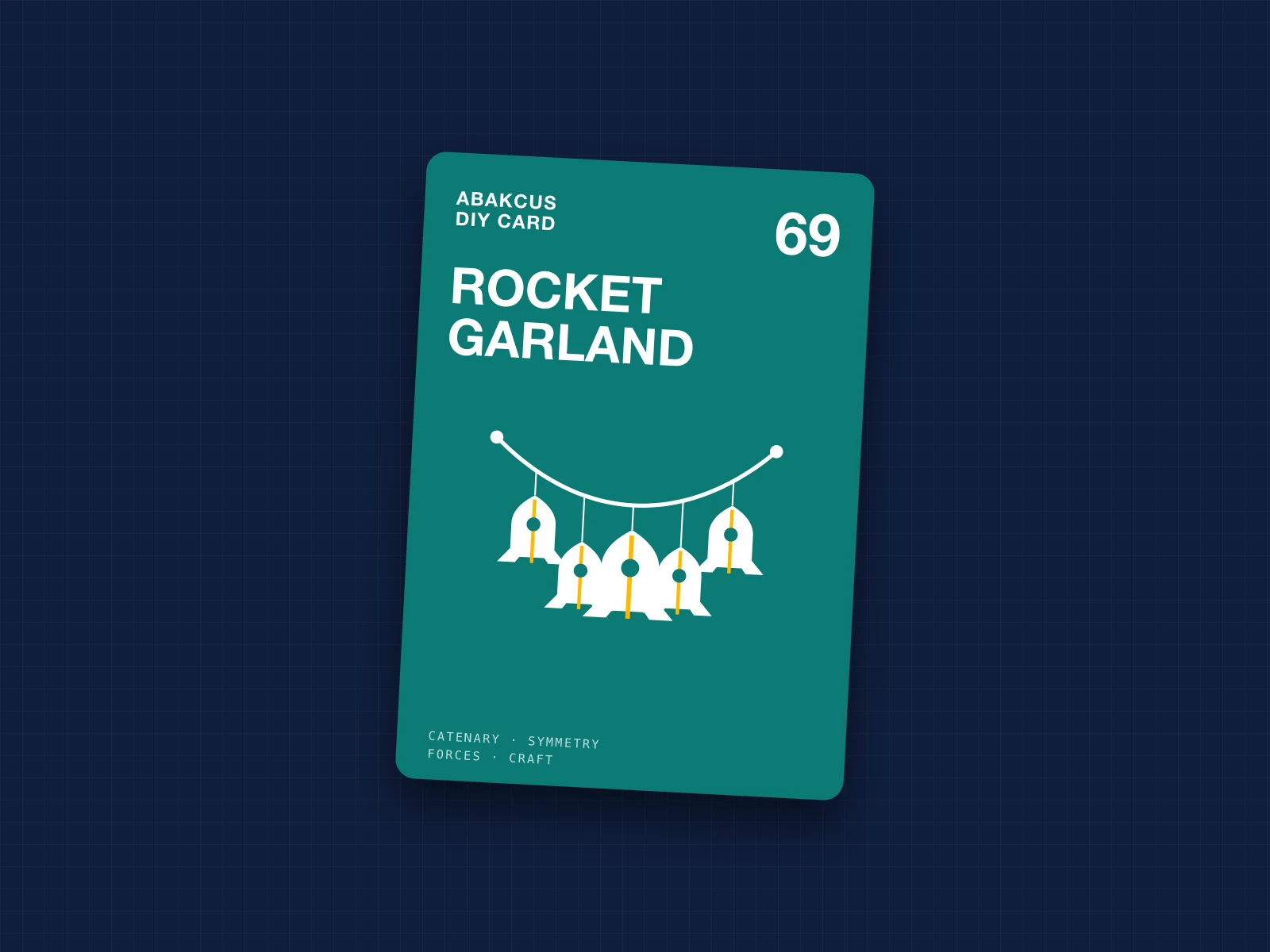
How to Make a Paper Rocket Garland With Slotted 3D Rockets
Two flat paper rockets and one slit each. Slot them together, string a fleet along a cord, and the cord draws a curve that took mathematicians fifty years to solve.
Open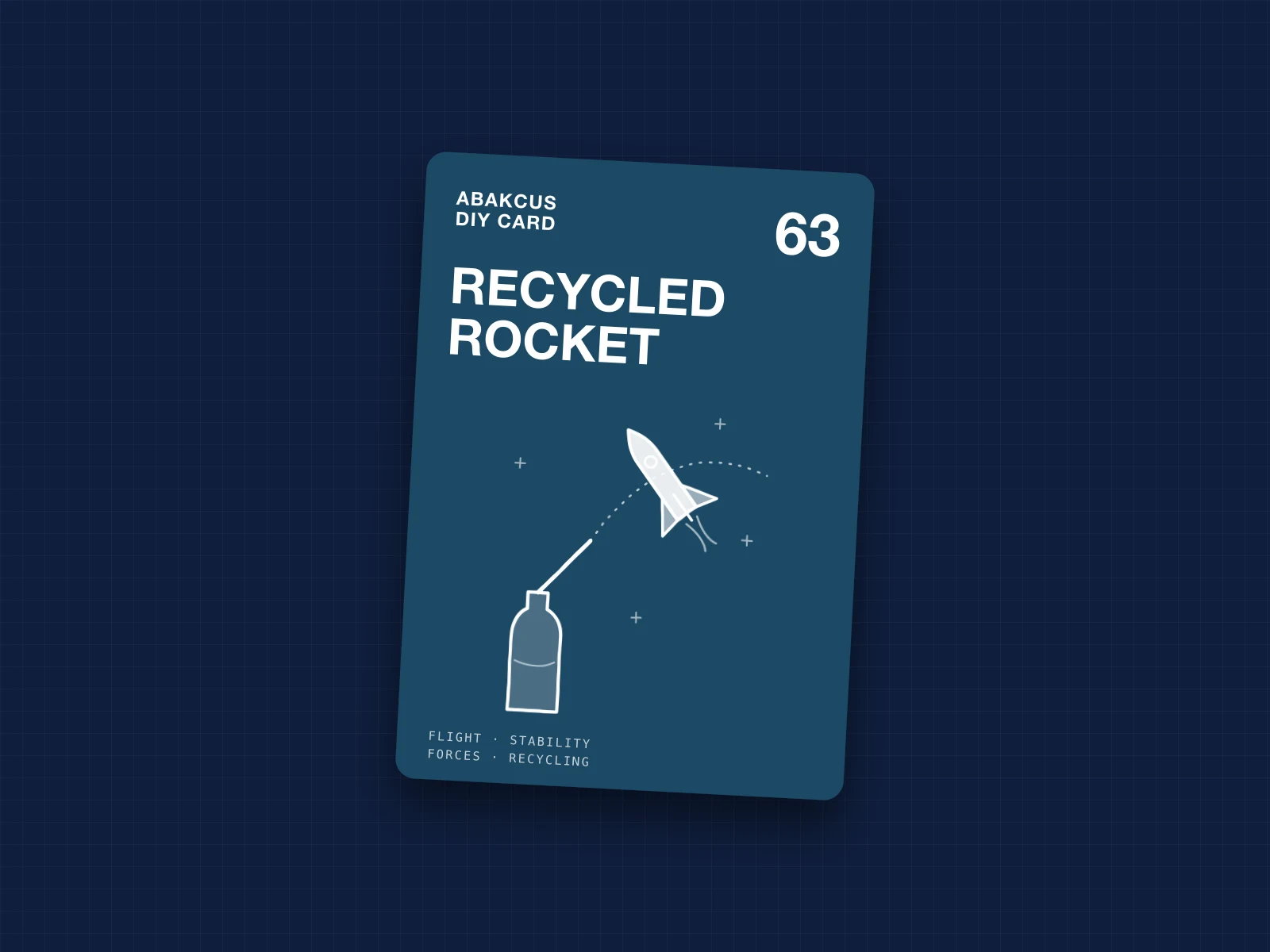
How to Make a Rocket Toy From the Recycling Bin That Flies
A plastic bottle, a scrap of paper and a corner of a cereal box. Roll a rocket, give it fins and a clay nose, then squeeze and watch it streak across the garden.
Open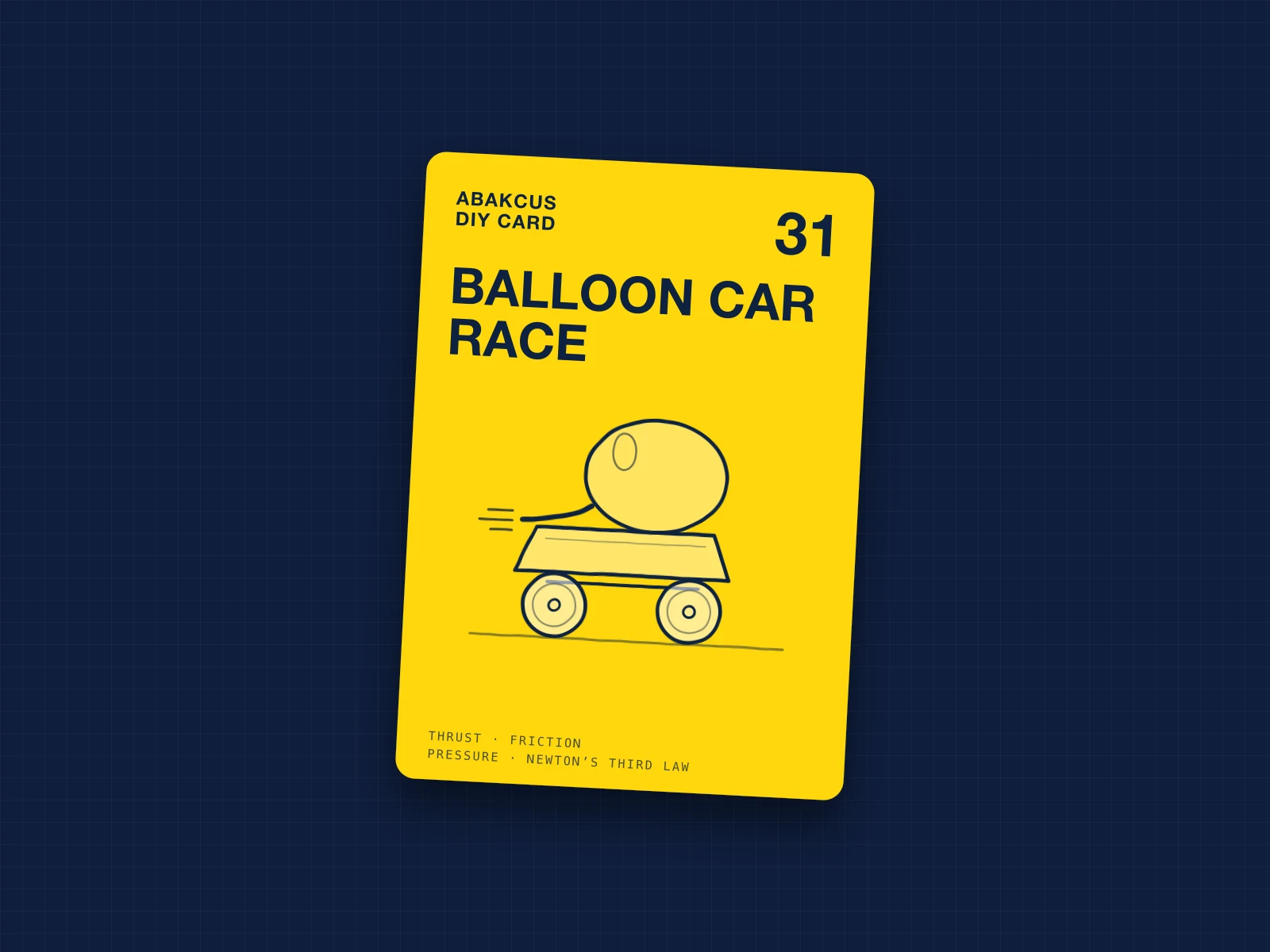
Balloon Car Race: How to Make a Balloon-Powered Car
Half a cup, four bottle tops, two skewers and one balloon. Blow it up, let it go, and a jet of your own breath sends the car racing across the floor.
Open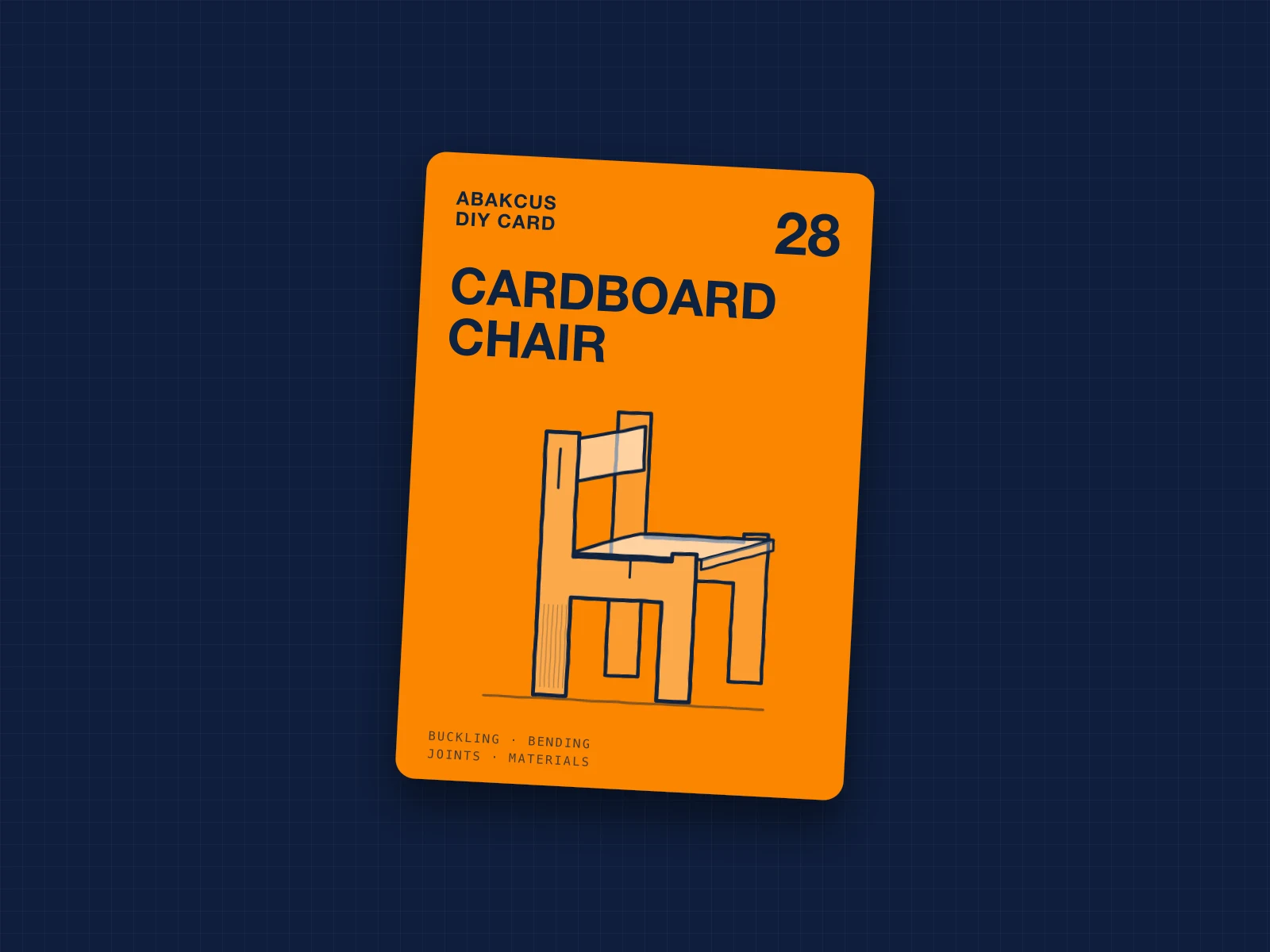
How to Make a Cardboard Chair That Holds Your Weight
Nothing but cardboard: no glue, no tape, no screws. Just slots, folds and the flutes the right way up, and a chair that holds a grown-up.
Open
How to Make a Moon-Themed Clock With a Moon Phase Window
A full moon for a clock face, a battery movement and a hand-turned phase window. It keeps the time to the second and, with a nudge every few days, keeps pace with the Moon.
Open
How to Make a Cardboard Boat That Floats (and Carries Coins)
One sheet from an old box, folded into a tray and sealed with tape and wax. Then the test: how many coins can it carry before the water comes over the side?
Open