The Stockholm studio Humans since 1982 is two people, Per Emanuelsson and Bastian Bischoff. Both were born in 1982, which is where the studio's name comes from, and since 2008 they have really been doing one thing. They line up analog clocks side by side, run their hands with software, and make the clocks write the time together. Spending eighteen years on a single idea is not easy, but this idea is so solid that with every new work it gets a little bigger, a little more expensive, and it still does not get old.
At the very bottom of their website a counter runs, counting the time since the studio was founded, and while I was preparing this piece it showed 18 years, 6672 days and 576,508,334 seconds. The seconds starting with 576 million is a coincidence, but a nice one, because one of the walls I describe a little further down has exactly 576 motors.
The studio's signature work is ClockClock 24. The first version of the work is The Clock Clock from 2008, and the year it was shown at the Saatchi Gallery in London is 2010. Today it is in the permanent collections of the Vitra Design Museum in Germany, the Musée international d'horlogerie in Switzerland and the Nationalmuseum in Sweden.
The 24 in the name is the number of clocks in the body. The clocks sit in 8 columns and 3 rows and the math is very simple. Each digit is written with a block 2 clocks wide and 3 clocks tall, and when four blocks of 6 clocks sit side by side, the four digits for the hour and the minute need exactly 24 clocks. For most of the minute the clocks spin on their own, sometimes unaware of each other and out of order, sometimes in perfect sync, and once a minute all the hands line up and show the time like a digital clock.
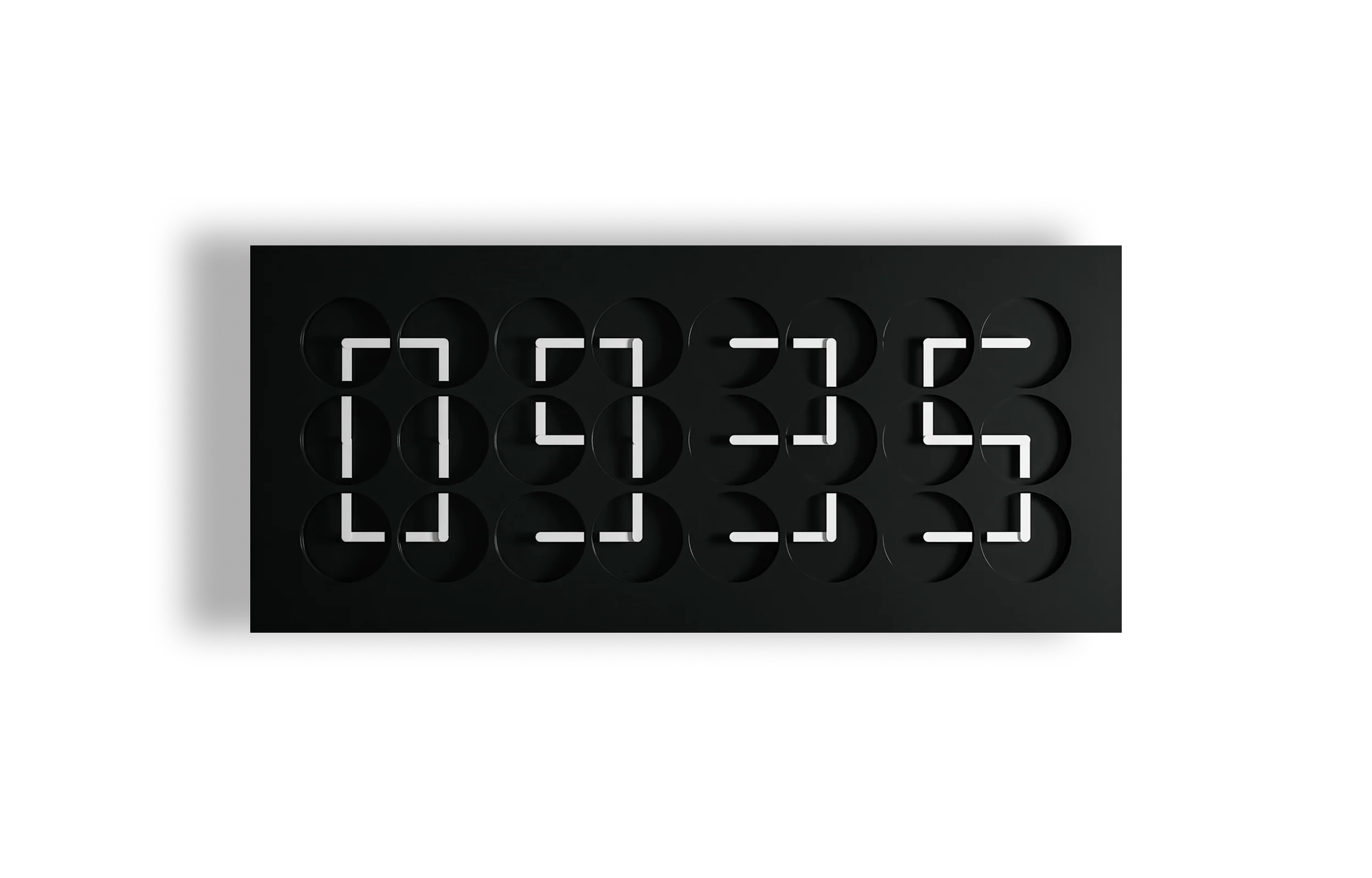
The body is made from a handcrafted mineral composite and the white model is 90 × 40 centimeters. Both the software and the hardware are developed by the studio's own designers, engineers and programmers, and every piece is made at the headquarters in Stockholm. Each clock comes numbered, and out of the box come a certificate of authenticity signed by the studio, an operator's manual, a hanging bracket and a pair of gloves. The gloves are for handling art, so you are expected to hang a wall clock wearing gloves.
When it comes to prices, things take off a bit. The two plainest models, the white CC24 White and the black CC24 Black, are sold in editions of 950 each and cost $7,900 and $8,500. The editions of 250 with silver and gold hands sit between $11,300 and $12,700, and the blue Dada Blue, an edition of 100, is $10,100. The version made with the Danish architect Bjarke Ingels, of which only 10 were made, is $23,100, and CCL (Tidal) at the very top of the list is again limited to 10 and costs $70,000. The Pinakin versions, five of each, and the small nine-clock CC9 White are already sold out.
Even on the cheapest model that comes to $329 per clock, and for that you get 24 clocks that cannot tell the time on their own. On the Bjarke Ingels version the figure passes $962. How an edition of 950 counts as limited is, if you ask me, a separate argument.
The studio's big wall works carry the name A Million Times, and here too the number in the model name gives the number of clocks. In the vertical AMT72 the clocks sit in 6 columns and 12 rows, so exactly 72 of them. In the round model on their site the rows have 3, 7, 7, 9, 9, 9, 7, 7 and 3 clocks, which adds up to 61, and AMT61C also appears in the name of the Moncler work, which has a round section. The C at the end comes from the round body, if you ask me. The work made in 2021 for the Moncler store in Milan is an AMT200V combined with an AMT61C. Made from black mineral composite, this wall measures 160 × 700 centimeters and at 7 meters tall it can be seen from both floors of the two-story store.
The family also has a member with 24 columns and 12 rows, 288 clocks, and the rest of this piece runs through that one. The faces are pure white, with no numbers and no tick marks, and in the middle of each there are only two black hands. The hands turn slowly for a while, then a moment comes and all 576 hands fall into the same order and turn into a wave that crosses the wall from end to end, then the wave breaks up and the same hands this time write letters, numbers, and finally the time of that moment in big digital digits. All 576 motors are run from a program written specially for this work, running on an iPad. Getting a digital clock out of analog clocks is, if you ask me, one of the most elegant reversals I have seen in years, and it is probably the work I would sit in front of longest in a museum.
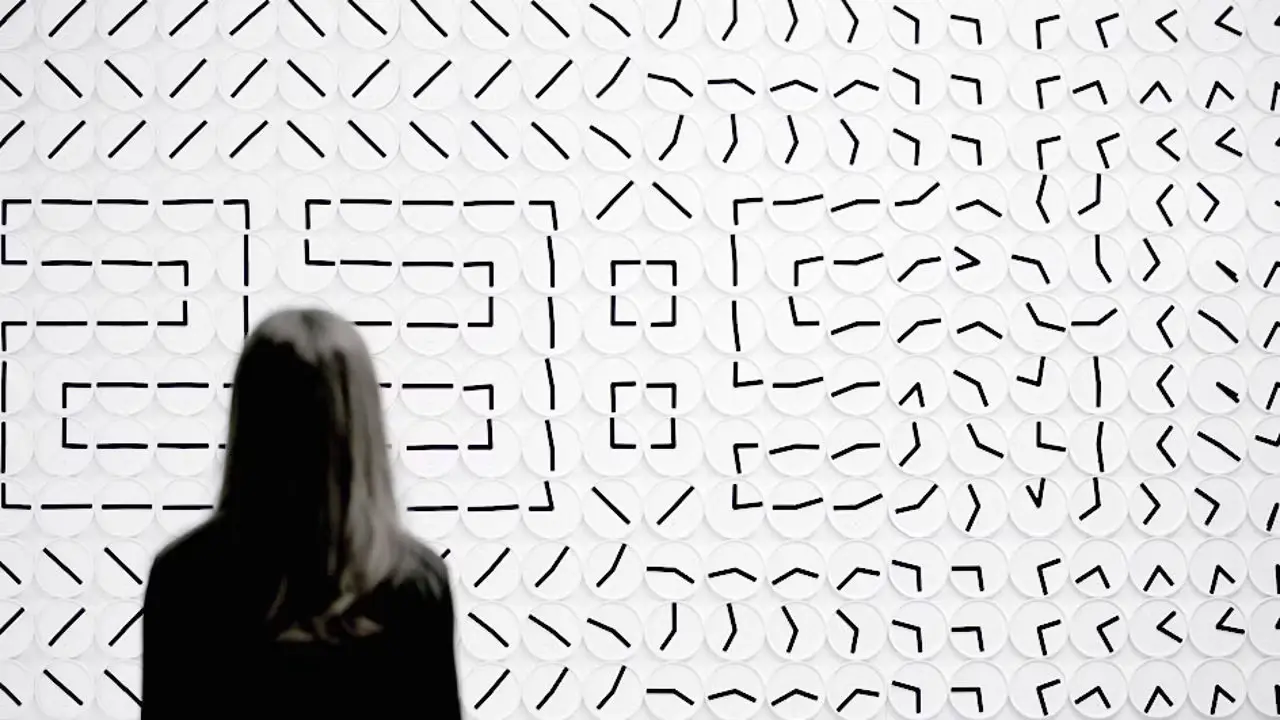
A pixel on a screen knows one thing, how bright to be. Each clock on this wall works like a pixel too, but instead of brightness it carries two angles. The difference between hour hand and minute hand disappears here, both hands are the same length and reach the edge of the face. Depending on the angle between the two hands, a clock can really draw three things. When the hands point exactly opposite each other you get a straight line cutting across the whole face, when there are 90 degrees between them you get a corner, and when both point the same way you get a half line that looks like a one-handed clock, that is, the end of a line. When the hands of two neighboring clocks meet where the faces touch, the lines join up and unbroken paths can be drawn across the wall.
Because a clock has two hands, at most two lines can leave a single point, and a junction where three paths meet, like in the letter T, cannot be drawn with any clock. That the letters in the photos look hollow, like outlines drawn with a double line, comes from this constraint, if you ask me.
At first glance the clocks on the wall look like ordinary clocks, yet with an ordinary clock it is not possible to draw even half of these letters. In an ordinary clock both hands are tied to the same gear train, and when the minute hand makes twelve turns the hour hand only completes one. If I call the angle of the hour hand α, the angle of the minute hand is always twelve times that.
The mod 360 here means full turns are not counted. This small link narrows down the shapes a clock can draw a great deal. For the two hands to point in exactly opposite directions and make a straight line, the difference between them, that is 11α, has to land on one of the odd multiples of 180 degrees, and that happens only 11 times in twelve hours.
That is why an ordinary clock can draw a straight line in only 11 different directions. One of them is the vertical line at 6:00, but none of the 11 directions is horizontal. With corners it is even tighter. When the hour hand points exactly at 3, 6, 9 or 12, the minute hand is on 12 every time, so the only right-angle corners a geared clock can draw are the └ at 3:00 and the ┘ at 9:00. The ┌ and ┐ corners needed to close a square with horizontal and vertical sides, and a straight horizontal line, never appear on such a clock.
This is why every hand on the wall has its own motor, why 288 clocks need 576 motors. If the hands were not freed from each other, this wall could not draw a single square.
In one of the photos the wall writes no letters at all, only the slope of the lines on the faces changes column by column from left to right. In the leftmost clocks the line is horizontal, a few columns later it stands up, then it leans the other way and comes back to horizontal, and all the rows are identical. Since this 180-degree turn from horizontal to horizontal is spread over about 16 columns, the line turns roughly 11 degrees in each column. So the angle of a hand depends only on which column the clock sits in, and follows a simple rule like θ = x · Δ.
When I add time to this rule, that is when I spin all the clocks at the same speed while keeping the angle difference between columns, a wave appears flowing along the wall. In fact nothing goes anywhere, each clock turns in its own place. In a stadium wave nobody walks out of their seat either, everyone stands up for a moment when their turn comes and sits back down, and the wave runs from one end of the stand to the other, much like the flashes that sweep through a tree full of synchronized fireflies.
The wall below has the same 288 clocks in the same 24 × 12 layout. In wave mode the slider changes the angle difference between columns. When the difference is zero the whole wall turns at once like one big clock, and as it grows the wave gets tighter. Time mode writes the current time, and you can type four digits in the box to have the wall write any number you like.
On the switch to digits I turned every hand one extra turn before it reached its target, and turned the two hands of the same clock in opposite directions. The left columns also set off a little before the right ones, so the digits do not land on the wall all at once, they arrive spreading from left to right.
The state of a single hand can be described by a point on a circle. The state of a clock whose two hands turn independently is the product of two circles, that is a single point on the surface of a torus. An ordinary geared clock cannot use the whole of this torus, it lives on a single string wound around it, and that string goes around the torus once in one direction and twelve times in the other. A clock with freed hands can reach every point of the torus. By the same logic the whole 288-clock wall is a single point on a 576-dimensional torus. Every pattern the wall shows is a position of this point, and every animation is a path this point follows.
Even if the hands could only point in eight directions, that is in 45-degree steps, each clock would have 8 × 8 = 64 different states and the wall could show 64²⁸⁸ different patterns. This number is equal to 2¹⁷²⁸ and has exactly 521 digits. The name of the work says a million, and a million is a number with seven digits.
Sources
- Humans since 1982, studio website and shop (humanssince1982.com).
- Humans since 1982 on Vimeo: A Million Times 96, 120 (Tidal) and 288 (Ten).