
By Ali Kaya
A scanner the size of a highlighter
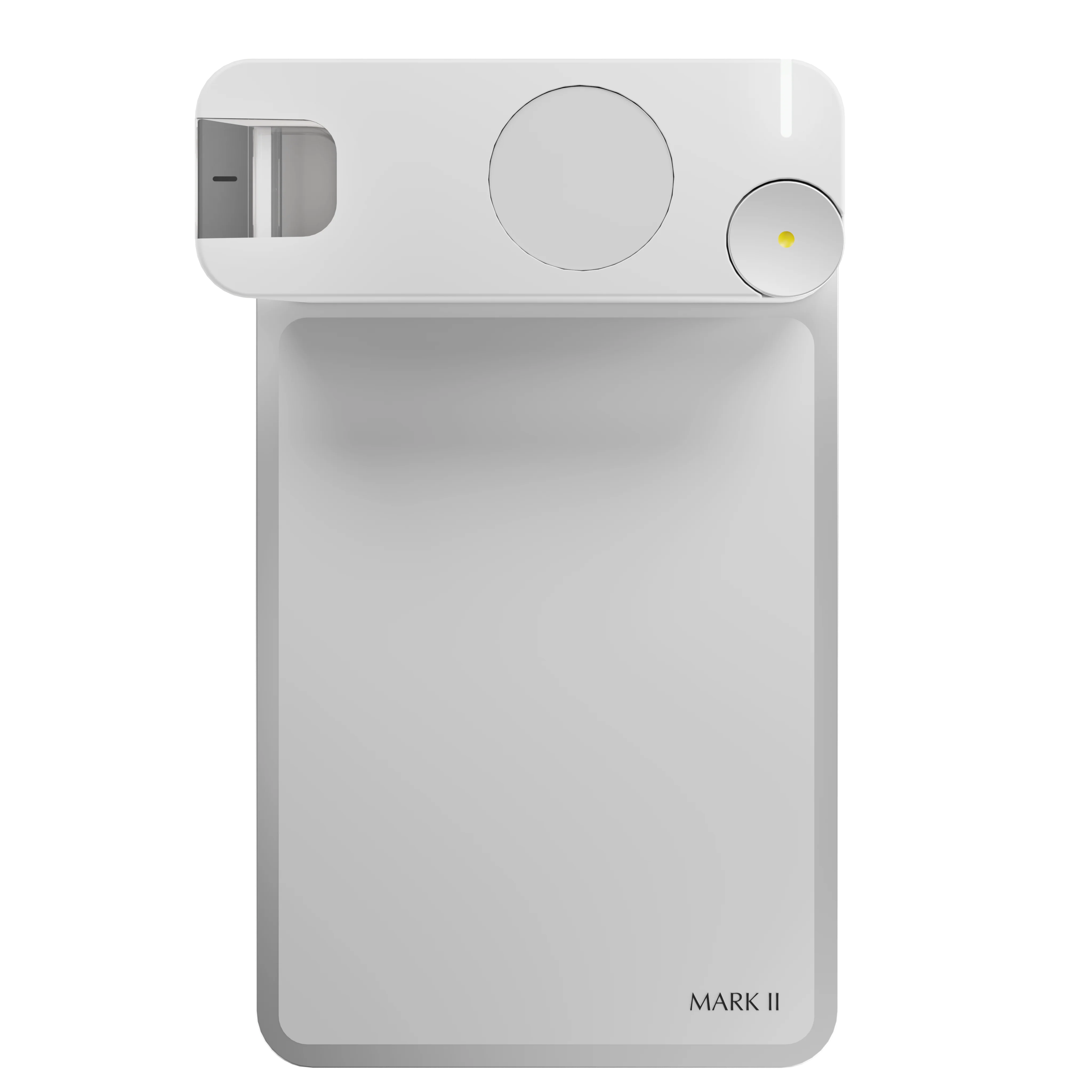
he sentence you underline in a paper book disappears along with the book once it goes back on the shelf, and when you look for it months later — which book, which page — remembering is most of the time just not possible. Mark II is a small device that catches what you read in a paper book and carries it to your phone, and it sits right in that gap.
It is shaped like a highlighter, the body is aluminum and ABS, and the maker compares its weight to a pair of AirPods. Using it comes down to two moves. Hold the button and brush the tip across the line and it scans the sentence and tells you it got it with a small light; hold the button and talk and it records whatever that sentence made you think as a voice note and sends it the moment you let go. It reads the handwriting you scribble in the margin too, in more than a hundred languages, on screen as well as on paper. Everything piles up in an iOS app where you can organize, search and even chat with your notes; it syncs with Notion, Readwise, Obsidian and Evernote, charges over USB-C and lasts a week. What this $159 device does is really a very old job, sped up.
Watch
Brush the tip along a line, and the sentence lands on the phone.
Locke's two pages
John Locke starts keeping notebooks of what he reads in 1652, his first year at Oxford. These commonplace books work as a personal encyclopedia of quotations, collecting sentences from books under subject heads; in 1721 Jonathan Swift, telling a young poet he cannot do without one, fits the reason into a single line — “great wits have short memories.” It is the same instinct that fills a scientist's working notebook, like the one in Roger Penrose's journal.
These notebooks have an old problem: when you start a blank one you have no idea how many pages to give each subject, and the pages you set aside either stay empty or fill up in the first month. The method Locke draws out of twenty-five years of note-taking is published in French in 1685, and the English translation comes after his death, in 1706 — the whole 1706 edition can be read online today.
You rule the first two pages into a table: each row goes to a letter of the alphabet, and each letter is split into five vowels, a, e, i, o, u. To file a note you first give it a head, then look at the first letter of that head and the first vowel that follows it. In Locke's own example the head Epistola falls into the i cell of row E. If the cell is empty you turn to the first blank page, write the note there and put the page number in the cell; if the cell is already filled you go to the page written there.
The hash table you meet almost everywhere in computers today is exactly this: a rule that squeezes a long key — here a word — into one of a small, fixed number of cells, and Locke's rule looks at only two letters. With a rule this crude, different heads landing in the same cell is unavoidable, and Locke doesn't hide it — he lists Ebionitae, Episcopus, Echinus and Efficacia as heads you might find in the same part of the book. Heads that share a cell live side by side on the same pages.
File your head in Locke's index
Type a head and add it, and whichever cell the rule puts it in turns yellow. The table opens with the five heads from Locke's own example. Click a cell to see the heads inside it.
All five of Locke's heads sit in cell E i.
Locke's table is built on the Latin alphabet. Here I use today's 26 letters, and fold accented letters into their plain forms. Heads with no vowel after the first letter can't be placed by the rule.
The table has 26 letters and 5 vowels, so 130 cells. By the pigeonhole principle, once you write the 131st head at least two heads have to share a cell — but real words never wait for that limit, and in Locke's example five heads pile into the same cell on the first try. Computer scientists call this fix chaining. The first known written version of the idea turns up at IBM, in an internal memo by Hans Peter Luhn dated January 1953, 268 years after Locke's method. One rule Luhn suggests adds the adjacent digits of a number in pairs and keeps the units digit; when Knuth shows it he picks the first eight digits of π, so 31415926 comes down to 4548.
Who picks the head
In Locke's method the whole load is in picking the head. For every quotation you decide which subject it belongs to, and Locke wants the head to be an important and essential word for the matter at hand. Mark takes that decision away from you: you brush the sentence and the app takes over the organizing, the searching, the finding again. It is a different bargain from a deliberate method like the Feynman technique, where the effort of sorting is the point.
On the about page the founder writes that capital is taking thinking away from us through frictionless shortcuts, and presents Mark as a way back to analog. Hearing this from a device that pairs with your phone over Bluetooth strikes me as a little funny, but he isn't wrong either: you can take a note without putting the book down, without unlocking the phone and photographing the page, without taking your eyes off the line. Leaving the choice of head to software still feels strange to me, but better that the sentence sits somewhere searchable than gets lost on the shelf. Locke's method caught on so well that almost a century later John Bell was printing blank notebooks with the index already laid out, advertised as formed on the principles recommended and practised by Mr Locke.
Specifications
- Maker
- Mark (thinkwithmark)
- Form
- Highlighter-shaped, aluminum & ABS
- Weight
- About a pair of AirPods
- Scan
- Brush the tip to capture a line
- Voice
- Hold and talk to record a note
- Handwriting
- Reads margins in 100+ languages
- App
- iOS — organize, search, chat with notes
- Sync
- Notion, Readwise, Obsidian, Evernote
- Battery
- USB-C, about a week
- Price
- $159
Also on Abakcus
For a working notebook where the thinking happens on the page, see Roger Penrose's journal. And for an older information tool that folded a hard task into a hand-held object, there is Napier's Bones.
Mark II is made by Mark, the highlighter-shaped scanner that carries a sentence from a paper book to your phone — a very old job, sped up.