
By Ali Kaya
unter Craighill says he measures small things every single day — his office is full of tape measures, cutting mats, T-squares, calipers and, yes, other rulers — but none of them was his ruler. He wanted a tool he liked reaching for, and no such ruler existed. In the Brooklyn studio the work started as an ordinary fixed-body ruler, and after a few weeks design manager Kevin Chee proposed adding a caliper function to the body, which took the project somewhere else entirely. Tuning the friction of the sliding part turned out to be harder than they expected, so they took apart the calipers already sitting around the office and hunted for the balance between hardware tightness and lubrication. The result is a small engineering marvel disguised as a desk object.
Lines cut, not printed
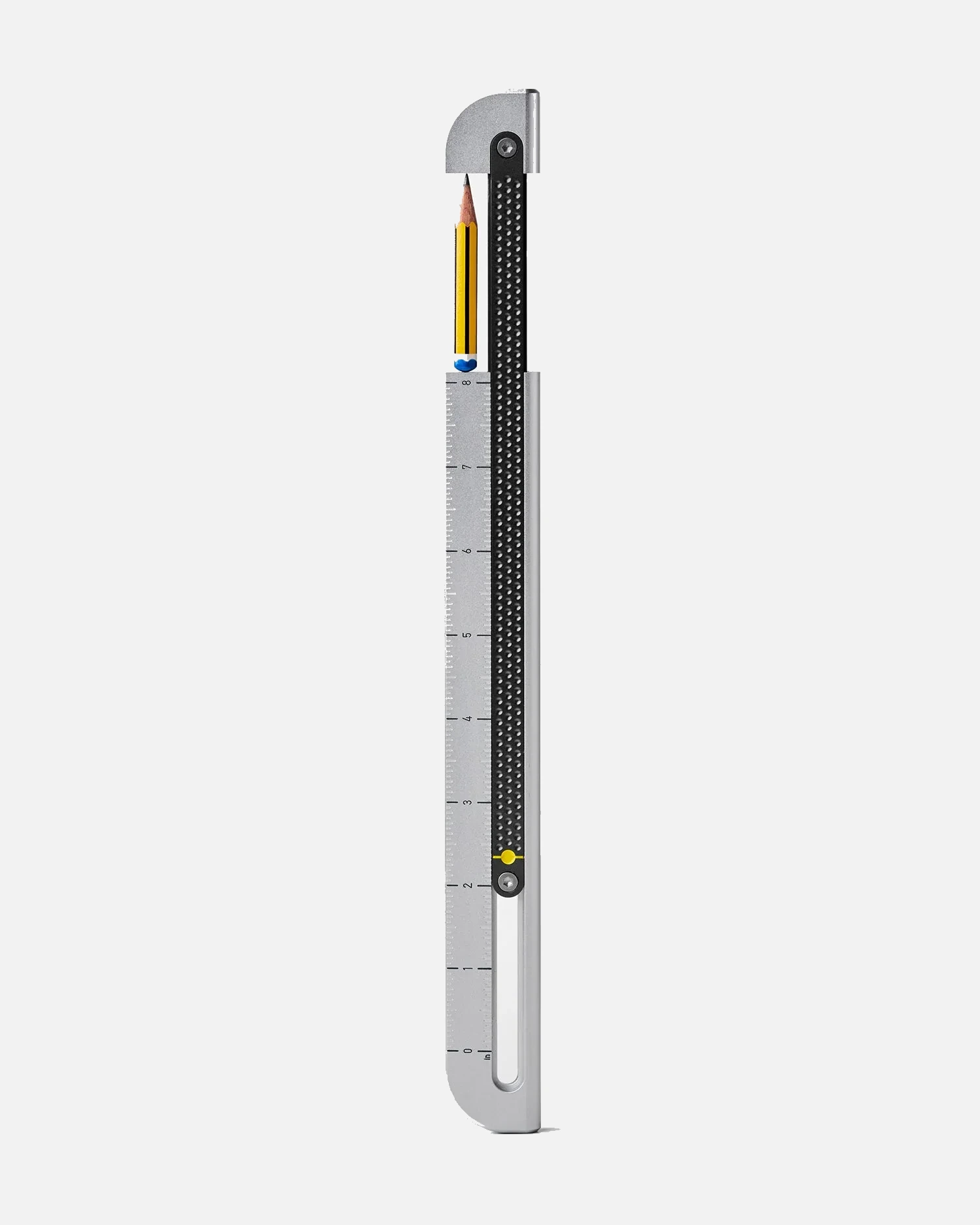
Pick the Metrolog up and it reads as a tool rather than a ruler. The body is milled from aluminium, the surface is silver and grey anodised, a thin bevel runs the edges, and small circles along the slider rail give the fingers something to hold. Hunter calls those circles the machinist's version of polka dots — a fair description, since they are the only ornament here that also does a job.
The real difference is that the graduations are not printed. On most rulers the lines are ink: the body outlives them, the lines fade first and then vanish, and you are left holding a bar with no scale on it. On the Metrolog every line is cut into the metal on a CNC machine, so the scale is as durable as the body carrying it. The 279-millimetre body weighs 104 grams — just enough to keep it from sliding around the desk. The same obsession with machined precision animates the ornamental lathes of fancy turning, where the tool marks are the whole point.
The inch side stops at a sixteenth, the metric side at a millimetre. Both stop where the naked eye can actually read.
The caliper idea came from a fortifications engineer in 1631
A ruler and a caliper do not answer the same question. A ruler measures an edge; a caliper catches the distance between two surfaces, and that second job needed a clever way of subdividing the scale. Pierre Vernier got interested in measuring instruments while working on city fortifications and maps, and in a book printed in Brussels in 1631 he proposed setting a second scale beside the main one. A movable sector thirty-one half-degrees long but divided into thirty equal parts, fixed onto the quadrant's half-degree scale, lets each part come to half a degree plus one minute — so by reading which line coincides with the main scale you can resolve the minute. He said himself he took the idea from Clavius and Pedro Nunes, and that his instrument resolved angles smaller than a third of a minute.
The scale did not catch on right away. It came into common use only in the middle of the eighteenth century, and took its present name at the end of that century when Lalande used it; until then it was called a nonius, after the Latin name of Pedro Nunes. Every caliper we hold today is a grandchild of that second scale. The Metrolog, tellingly, has no vernier scale at all — Craighill chose to stop at a sixteenth on the inch side and a millimetre on the metric side, which is where the eye reads without help. That is not a shortcoming; it is the limit the tool was given.
What it cannot do
The Metrolog does not replace a real caliper. There are no inside jaws, no depth rod, and the jaw opening will not take the diameter of a thick rod. In exchange you are not keeping a sharp-tailed instrument on your desk, and most of what you measure during a day is a thickness, a gap or an edge anyway. Expecting workshop tolerances from a ninety-eight-dollar ruler would be a mistake — the job this one does is answering the questions that land on a desk.
One meeting in eight inches
Here is where the engineering turns into arithmetic. For a long time the relation between the inch and the millimetre was not a clean number. When the agreement six countries signed on 1 July 1959 defined the yard as exactly 0.9144 metres, an inch became exactly 25.4 millimetres. Before that the American inch was about 25.4000508 millimetres, and that difference of roughly three parts per million was a genuine headache in international manufacturing.
Now look at the Metrolog's two scales. The inch side advances in sixteenths, and a sixteenth of an inch is 1.5875 millimetres — as a fraction, 127/80. For an inch line to sit exactly on top of a millimetre line, the number k × 127/80 has to be a whole number, and since 127 and 80 are coprime, k has to be a multiple of 80. The eight-inch scale is made of 128 steps, so after zero the only step that satisfies this is step 80 — five inches. Its equivalent is exactly 127 millimetres. That number is also prime, and being 2⁷ − 1 it is a Mersenne prime, though that part is pure coincidence. This is the kind of quiet numerical elegance that How Round Is Your Circle spends a whole book chasing — the place where mathematics and the machine shop turn out to be the same subject.
Two scales, one body
Drag the amber indicator. It snaps to the sixteenth-inch lines, and the magnified view below shows where that line falls against the millimetre graduations.
On the ruler the only place the two systems land on the same line is the five-inch mark, and there the metric side reads 127. The widest miss is at 2 1/2 inches, because that is exactly 63.5 millimetres — the midpoint between two millimetre lines. The narrowest miss is at the 3 15/16 inch line: it comes to 100.0125 millimetres, missing the 10-centimetre mark by twelve and a half microns, which is below what the eye — and the cutter that milled the line — can tell apart.
Specifications
- Material
- Aluminium, silver & grey anodised
- Dimensions
- 279 × 32 × 10 mm
- Weight
- 104 g
- Imperial scale
- Up to 8 in, in 1/16 in steps
- Metric scale
- Up to 20 cm, in 1 mm steps
- Jaw opening
- 157 mm
- Graduations
- CNC milled into the metal
- Designers
- Hunter Craighill & Kevin Chee
- Made in
- Brooklyn
- Price
- $98
Watch
The Metrolog in the hand — the telescoping jaw and the milled scales.
Also on Abakcus
For another instrument that folds arithmetic into a hand-held object, see Napier's Bones. And for the mathematics hiding inside everyday manufacturing — how you actually cut a straight edge or a true circle — there is How Round Is Your Circle.
The Craighill Metrolog is available on Amazon, and Craighill tells the story of how it was made and lists the finished ruler on its own site.
The Amazon link is an affiliate link; if you buy through it, Abakcus earns a small commission at no extra cost to you.