
By Ali Kaya
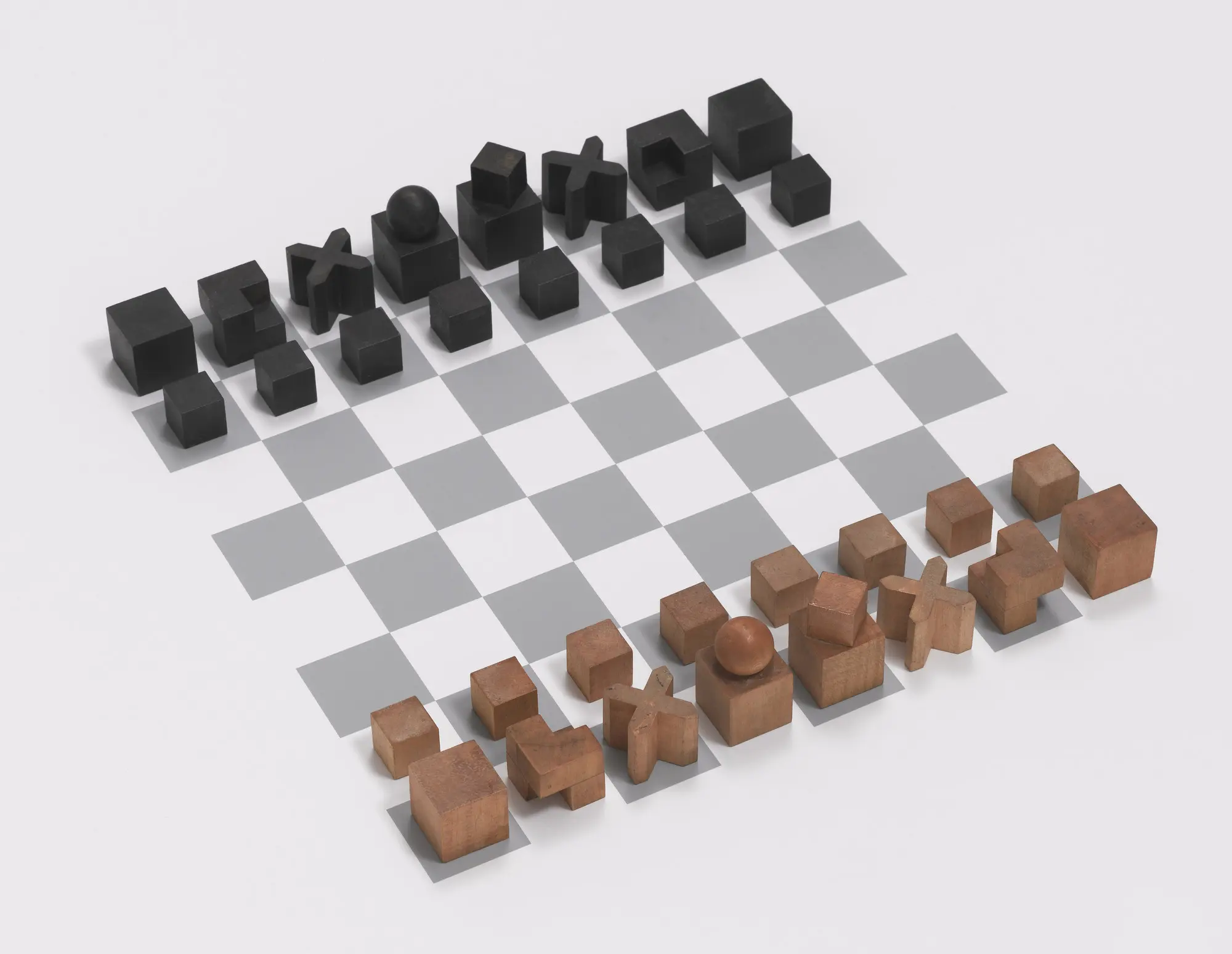
or centuries chess pieces have stood on the board like little statues: the knight an actual horse's head, the rook a tower with battlements, the pawn a soldier with a knob on his head. Not one of them tells you how it moves — memorising that is left to the player. Josef Hartwig, who worked as a master craftsman in the wood and sculpture workshop of the Bauhaus in Weimar from 1921 to 1925, starts thinking about this from the other end in 1922, and decides that instead of making players memorise the moves he will write them into the shapes of the pieces.
Hartwig does not come to the school as a painter or an architect. He is a sculptor who started as an apprentice to a stonemason in Munich at the age of thirteen, his hands used to stone and chisel, so when he looks at a chess piece he is less interested in what can be added to it than in what can be taken away. In the end he is left with nothing but the cube, the sphere and a few combinations of the two — and for me the lovely part is that with so little material he manages to describe six different moves without mixing any of them up. It is the same reductive instinct that animates the Bauhaus workshops elsewhere, from Erich Dieckmann's tubular chairs to the way Oliver Byrne redrew Euclid in pure colour and shape.
The shape tells you the move
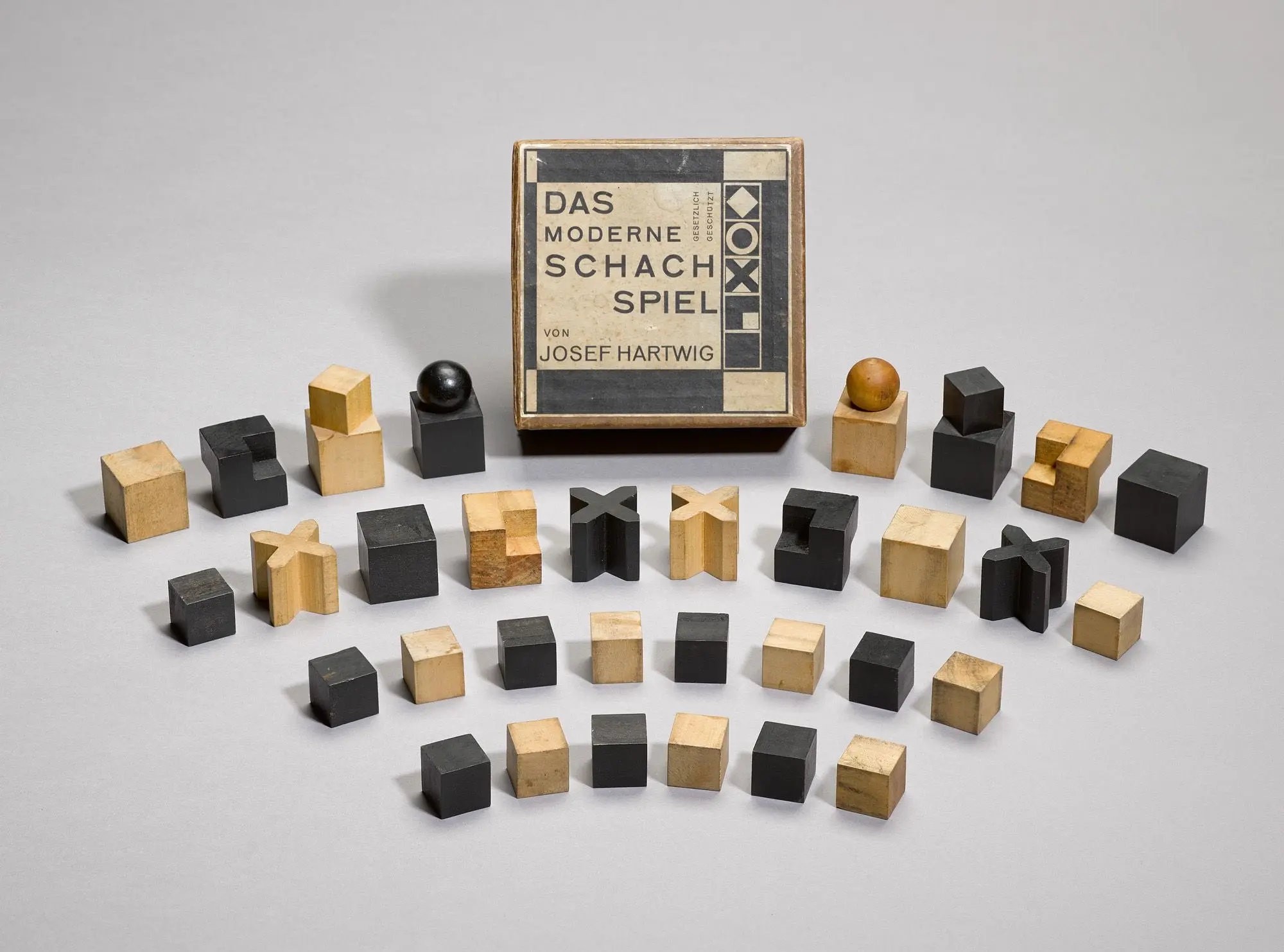
Hartwig's own explanation is short and reads almost like a rulebook. In 1924 he writes that the pawn and the rook move at right angles to the edge of the board and are therefore cubes; that the knight turns in a hook over four squares, so four cubes are joined at right angles; that the bishop moves diagonally and so becomes a cross cut out of a cube; and that the king moves both straight and diagonally and is a small cube set corner-wise on a larger one. The queen, the most mobile piece, he leaves to a cylinder and a sphere.
What I like most shows up not from the side but from above. Seen from above the bishop is the diagonal paths of the board themselves; the edges of the king's lower cube point in the four straight directions while the corners of the small cube on top point in the four diagonal ones; and because the queen's sphere reads as a circle from above, it favours no direction at all. Pick a piece below and tap a square — the drawing on the right shows the piece seen from above, and the red lines show where it can go.
Look at the piece from above
Choose a piece, then tap a square on the board. The board is empty, so the long-range pieces run all the way to the edge.
view from above and directions of movement
The knight draws a hook over four squares, and the four cubes joined at right angles show the same hook from above.
d4: 8 moves
The knight hides something subtler. Count its move square by square from where it starts to where it lands — two straight and one to the side — and you get four squares in total, which laid side by side make the shape of the letter L. Shapes made by joining four equal squares edge to edge are called tetrominoes, and the L is one of them. Hartwig's knight, made of four cubes, is the path the knight travels on the board, cast in cubes.
The volume tells you the value
The pawn and the rook go in the same directions and both are cubes, so when you ask how he tells them apart, Hartwig's answer is volume. On a sample sheet prepared for the Bauhaus in 1926 he writes that the pieces are formed from the cube and the sphere, and that these shapes, alone or combined, show the way a piece moves through their form and its value through their volume.
That sentence pushes a maths teacher straight into a calculation. The smallest piece is a cube 2.2 centimetres on a side; the largest is 4.8 centimetres tall on a 2.9-centimetre base. In chess a pawn is usually counted as 1 point and a rook as 5, and if volume followed those points exactly the rook's edge would be 2.2 × ∛5 ≈ 3.76 centimetres — a cube almost a centimetre wider than the base of the largest piece in the set. So Hartwig uses volume not as a ruler but as a ranking: bigger is worth more, but twice as big is not worth twice as much, and on a game board that is the right call.
The shape shows the way a piece moves; the volume shows what it is worth. Geometry doing the work a legend usually does.
Watch
The pieces in the round — cube, cylinder and sphere on the board.
A cube and a sphere in Weimar
The queen's shape is no stranger to Weimar. The Stein des guten Glücks — the “stone of good fortune” that Goethe had set up in 1777 beside his garden house on the banks of the Ilm, nothing more than a sphere resting on a cube — is counted among the first non-figurative monuments in Germany, and there the cube stands for steadiness and the sphere for fortune that never stays put. Hartwig never mentions this stone, so calling it his inspiration is too easy; but I like that the freest piece on the board meets a form carved in stone in the same town a hundred and forty-seven years earlier.
The box and the workshop
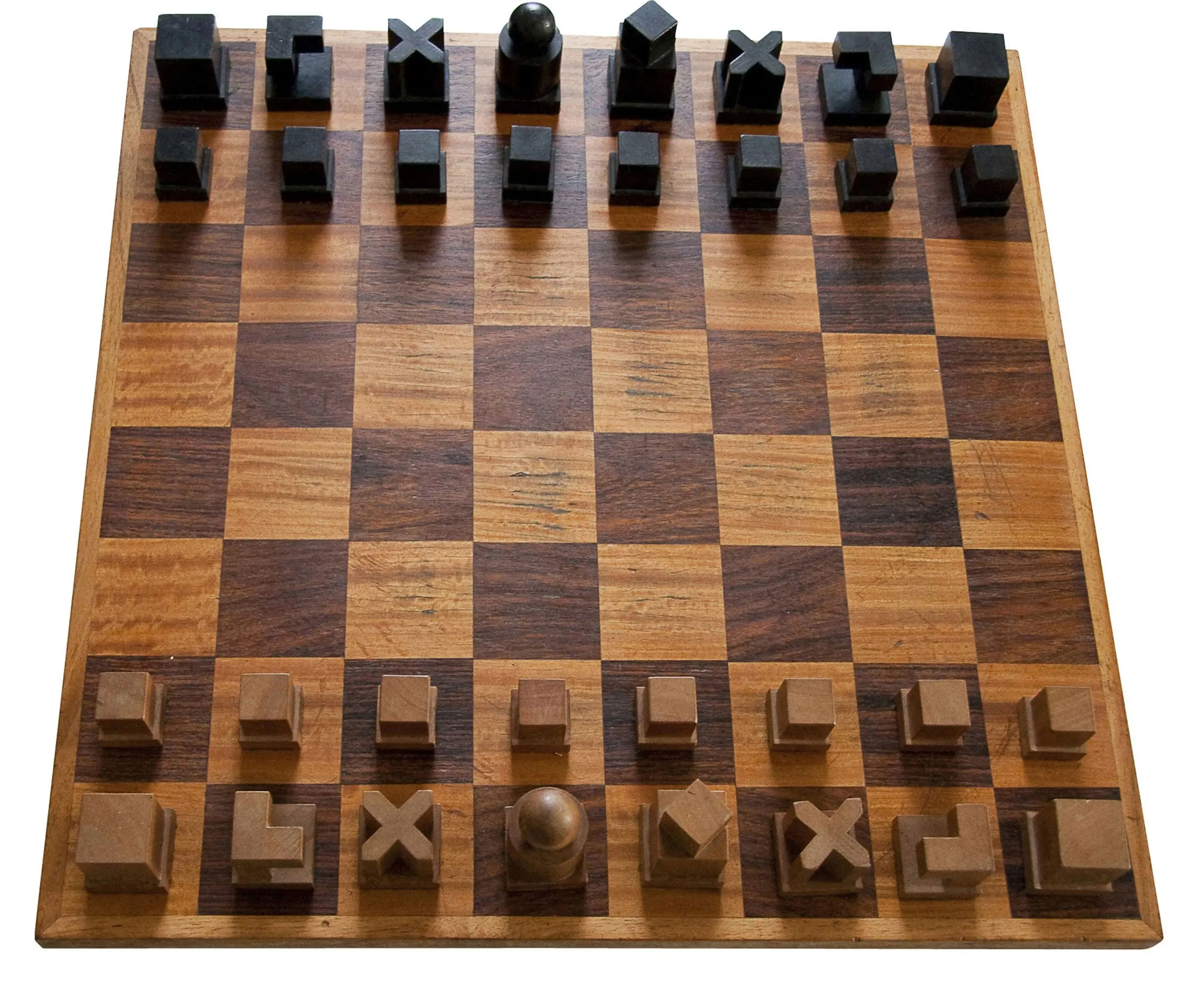
Between 1922 and 1924 Hartwig tries several models that differ in their details, and settles on Model XVI, in which the pawns are plain cubes. The first pieces are carved from pear wood, and the design of the box is left to his colleague Joost Schmidt — who also designed the best-known poster of the 1923 Bauhaus exhibition. Schmidt adds a column of square, circle and cross to the box label, so the box shows you the alphabet of what is inside before you even open it.
All thirty-two pieces fit into a cardboard box 12.4 centimetres on a side, and in some sets the queens carry a stamp on their underside marking the design as legally protected. The Bauhaus wanted to design objects for industrial mass production, yet very few of the school's objects actually reached it — and Hartwig's chess set, which started out handmade and went on being produced in maple in Dessau, became one of the most successful products of the Weimar Bauhaus.
The 1924 set in the collection of the Museum of Modern Art in New York is a gift of Alfred H. Barr, the museum's first director. Today the set is produced again by the Swiss maker Naef in maple, thirty-two pieces and a board.
Specifications
- Designer
- Josef Hartwig, Weimar Bauhaus
- Year
- 1924 (Model XVI)
- Box design
- Joost Schmidt
- Vocabulary
- Cube, cylinder, sphere
- Smallest piece
- 2.2 cm cube (pawn)
- Tallest piece
- 4.8 cm, 2.9 cm base (king)
- Pieces
- 32, plus a board
- Original material
- Pear wood, then maple
- Made today by
- Naef, in maple, under Bauhaus licence
- Price
- ~$490
The top views in the widget are drawn from Hartwig's 1924 description and are not to scale. The queen is drawn as a sphere on a cube, as she appears in today's production.
Also on Abakcus
For more of the Bauhaus turning function into pure form, see Erich Dieckmann's metal tube chair. And for geometry made legible as colour and shape — the same idea a century earlier — there is The Geometry of Type.
The Bauhaus chess set is made today by Naef and sold through design shops — you can see it at Art of Play and from Naef's own distributor. Thirty-two pieces, one board, and a whole grammar of moves you can read at a glance.