
DIY · Card 89 · Weather · Physics
Hot water, an icy lid and one puff of hairspray. Within seconds a little white cloud churns inside the jar, made exactly the way clouds are made in the sky.
01The brief
Damp air, cooling, specks: the recipe for every cloud.
3
ingredients every cloud needs: water vapour, cooling, particles
~20 s
for the air under the icy lid to cool enough
1911
when C. T. R. Wilson’s cloud chamber first showed particle tracks
Clouds look like the most distant, untouchable things there are. Yet the recipe for one is simple enough for a kitchen: damp air, some cooling and a few specks of dust. Put them in a jar and a cloud appears.
This is weather in miniature, and the same physics once led to a Nobel prize. It is a natural partner for the jar barometer and the tornado in a bottle.
02Kit
A jar, hot water, ice and hairspray.
Tick off what you have
0 of 5 ready
03Method
Warm the air, cool it from above, then give it something to condense on.
Step 1 of 8 · Minute 0
You need a clean glass jar with a metal lid, hot tap water (not boiling), a handful of ice cubes, a can of hairspray, a sheet of dark paper and a torch.
No cloud appears.
Why
The water isn’t warm enough, or the lid isn’t cold enough.
Fix
Use hotter tap water, add more ice, and wait a little longer before adding the spray.
The cloud is hard to see.
Why
The room is bright or the background is pale.
Fix
Dim the lights, hold dark paper behind the jar and shine a torch from the side.
The glass fogs up instead.
Why
The jar’s sides were cold.
Fix
Swirl the hot water round first to warm the glass all over.
04Making clouds
Warm air can hold much more water vapour than cold air. Cool it below its dew point and the extra vapour must go somewhere: it condenses into droplets, if it can find specks to condense on.
Change the water, the ice and the spray:
Dew point
48 °C
Lid
2 °C
Water squeezed out
69 g/m³
Air cooled below its dew point can’t hold all its water vapour. About 69 g of water per cubic metre turns into tiny droplets around the hairspray specks: a cloud.
In the sky, air is cooled a different way: by expanding as it rises. You can do that in a squeezed bottle:
Air before
22 °C
Just after letting go
15.6 °C
Dew point
21.2 °C
Letting go drops the temperature, in theory, to about 15.6 °C, below the dew point of this damp air (21.2 °C), so a cloud appears. Squeeze again and it warms and vanishes. Expanding air does work pushing outwards and pays for it with its own heat. Real bottles warm the air back a little, so the true drop is smaller, but the cloud still flickers into view.
05The big idea
Cold air
holds less water.
At 30 °C a cubic metre of air can hold about 30 grams of invisible water vapour; at 0 °C, only about 5. Cool damp air and the difference has to come out as liquid.
That one fact makes clouds, fog, dew, frost on windows and the mist on a cold can of drink. All weather that is wet begins with air being cooled.
06The math
1 · Saturation pressure
e = 6.11 · e^(17.6 T ⁄ (243 + T))
The Magnus formula, T in °C, result in hPa.
2 · Vapour in the air
ρ = RH · e ⁄ (R_v · T)
RH the relative humidity; ρ in g per m³.
3 · Expansion cooling
T₂ = T₁ · (1 ⁄ p)^0.286
T in kelvin; the air expands from pressure p to 1.
Air at 50 °C just above hot water can hold about 83 g of vapour per cubic metre. Cooled to 2 °C under the icy lid it can hold only about 6 g. At 90 % humidity, roughly 69 g per cubic metre must condense: plenty for a thick little cloud.
In a bottle squeezed to 8 % above normal pressure and released, the air cools in theory from 22 °C to about 295 × (1 ⁄ 1.08)^0.286 − 273 ≈ 15.6 °C, well below the 21 °C dew point of very damp air. In the sky, rising air cools about 10 °C for every kilometre it climbs, until clouds form.
07Real life
From jet contrails and your own breath to particles from space.
Contrails
The white lines behind high aircraft are clouds. Hot, damp engine exhaust full of tiny particles meets air far below freezing, and its water instantly condenses and freezes.
Your breath
On a cold day you can see your breath. The warm, damp air from your lungs cools below its dew point the moment it meets the cold air, making a tiny cloud.
Fog
Fog is a cloud at ground level. On clear, still nights the ground cools quickly, chilling the air above it below its dew point.
Cloud seeding
In 1946 Vincent Schaefer dropped dry ice into a cloud from an aeroplane and set off snow. Today some countries spray tiny particles such as silver iodide into clouds to encourage rain or snow.
Dew on the grass
On cool mornings, blades of grass are colder than the air around them. Water vapour condenses directly onto them as dew, without making a cloud first.
Particle tracks
In a cloud chamber, fast particles from space leave thin trails of droplets, like tiny contrails. In 1932 Carl Anderson discovered the positron, the first antimatter particle, from such a trail.
1894
In September 1894 the young Scottish physicist Charles Thomson Rees Wilson spent a few weeks at the weather observatory on top of Ben Nevis. The glories and coronas he saw around the Sun in the mountain mists so fascinated him that he set out to make clouds in the laboratory.
Expanding damp air in a glass chamber, he found that droplets formed on electrically charged particles. By 1911 his cloud chamber showed the tracks of individual particles as thin trails of mist, and in 1927 it earned him a Nobel prize. A curiosity about clouds became one of the great tools of 20th-century physics.
08Is and isn’t
Clouds are made of water vapour.
Vapour is invisible. Clouds are tiny droplets of liquid water or crystals of ice.
Clouds weigh nothing.
A fluffy cumulus cloud can contain hundreds of tonnes of water. It floats because its droplets are so tiny they fall extremely slowly, and rising air holds them up.
The steam from a kettle is steam.
Real steam, hot water vapour, is invisible. The white plume a little way from the spout is droplets: a cloud.
The hairspray makes the cloud.
It only provides specks. The water in the cloud comes from the hot water at the bottom of the jar.
09Go further
A
Squeeze-bottle clouds
Put a little warm water and a whiff of smoke (with a grown-up) in a plastic bottle, cap it, squeeze hard and let go. Watch the cloud flicker.
B
Temperature test
Try water at different temperatures. What is the coolest water that still makes a cloud?
C
Rain in a jar
Fill a jar with water, top it with shaving foam as a ‘cloud’, and drip coloured water on until it ‘rains’ through.
D
Cloud spotting
Learn the ten main cloud types and keep a week’s diary of which ones you see.
E
Dew point check
Put ice and water in a shiny tin and stir with a thermometer. Note the temperature when the outside first fogs: that is the room’s dew point.
10Questions
Pour a few centimetres of hot water into a glass jar, rest the lid upside down on top and pile ice on it. After about 20 seconds, lift the lid, add a quick puff of hairspray, and put the icy lid back. A cloud forms under the lid; shine a torch through it against a dark background to see it clearly.
Water vapour finds it hard to turn into droplets in perfectly clean air. The hairspray adds microscopic specks for droplets to grow on, just as dust, sea salt and smoke do in the real sky. Matches or a little smoke work too, with a grown-up.
Warm, damp air rises and expands as the pressure drops. Expanding air cools, and when it cools below its dew point the water vapour condenses onto tiny particles, forming billions of droplets that we see as a cloud.
The temperature to which air must be cooled for its water vapour to start condensing. The damper the air, the higher its dew point. Air at 22 °C and 95 % humidity reaches its dew point at about 21 °C.
No: water vapour is an invisible gas. Clouds are made of tiny liquid droplets or ice crystals, which scatter light and look white. The visible ‘steam’ from a kettle is droplets too.
Safety · A grown-up should pour the hot water: use hot tap water, never boiling water, which can crack glass. Spray hairspray only in a ventilated room, away from faces and flames, and never use matches without a grown-up.
All DIY cards →Keep wandering
A few more pieces in the same spirit — math, design, and slow attention.
How to Make a Barometer With a Jar and a Balloon
Stretch a balloon over a jar, glue on a straw, and the straw tips up and down as the air presses harder or softer. It is a real barometer, with one catch every homemade one shares: it is also a surprisingly good thermometer.
Open
How to Make a Tornado in a Bottle: Vortex Science
Swirl an upside-down bottle of water and a funnel of air drills down through the middle. It spins fastest at the centre for the same reason a skater spins faster with arms pulled in, and it has nothing to do with which hemisphere you live in.
Open
How to Make Ice Cream in a Bag With Ice and Salt
Milk, sugar and vanilla in one bag; ice and salt in another. Ten minutes of shaking makes real ice cream, colder than a freezer can get.
Open
How to Blow Up a Balloon With Hot Water: Charles’s Law
Put a balloon on an empty bottle, stand the bottle in hot water, and the balloon lifts itself up. The air didn’t get any more of itself. It just needs more room, and from that one fact you can find absolute zero.
Open
How to Get an Egg Into a Bottle Without Touching It
Two days in vinegar take the shell away, a warm bottle does the rest. The egg goes through a mouth narrower than itself, pushed by ten tonnes of air per square metre.
Open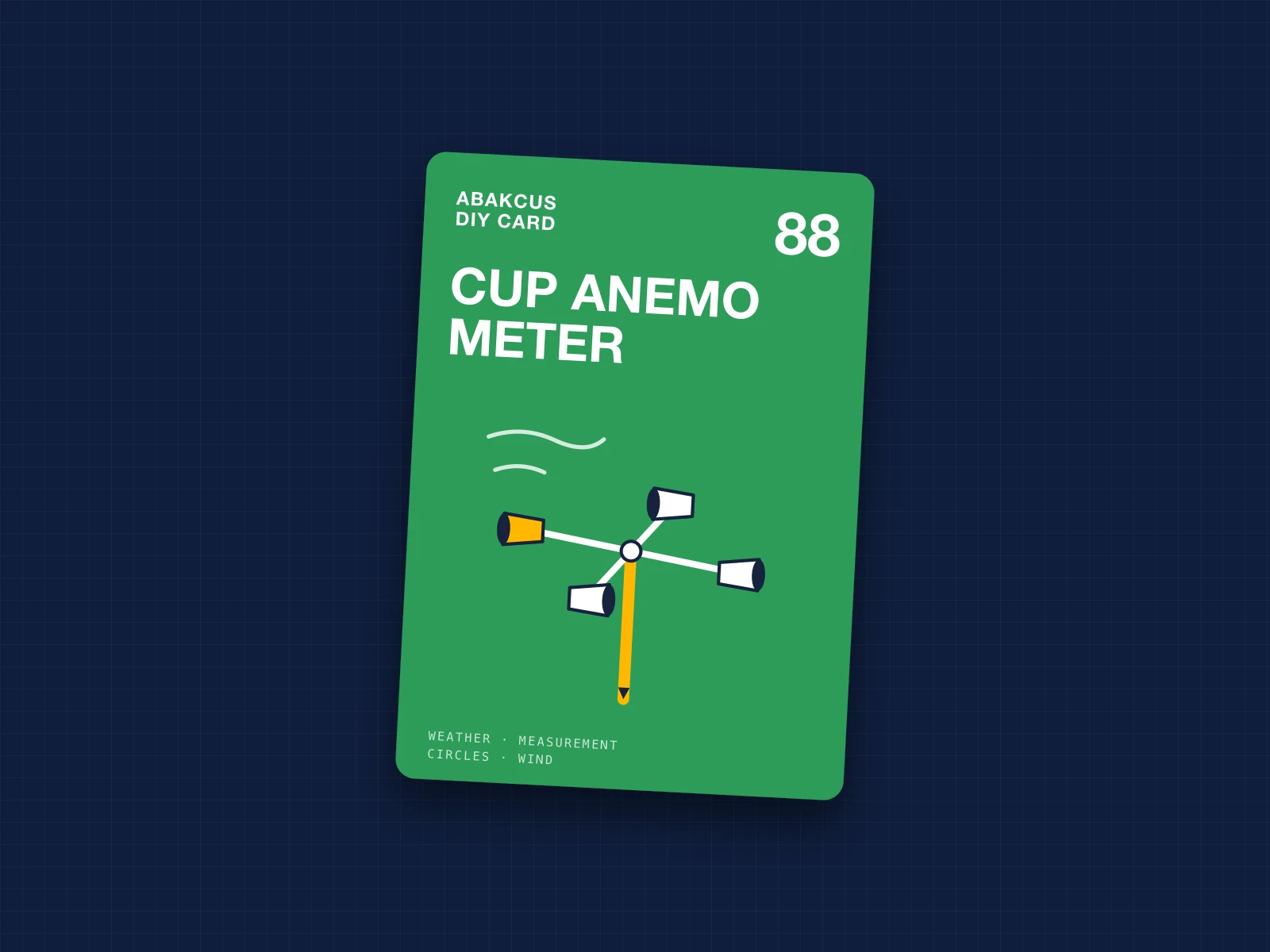
How to Make a Cup Anemometer to Measure Wind Speed
Five paper cups, two straws and a pencil. Set it spinning in the breeze, count the turns for thirty seconds and work out how fast the wind is blowing.
Open