
DIY · Card 13 · Physics · Weather
A balloon stretched over a jar, a straw for a pointer, and a scale on the wall. Over a week, the straw rises and falls with the weather, if you can stop it from reading the temperature instead.
01The brief
Build an instrument that shows the air pressure changing, and use it to guess tomorrow’s weather.
1013 hPa
the average push of the air at sea level, about 10 tonnes on every square metre
±30 hPa
roughly how far ordinary weather pushes it up and down
3.5 hPa
what a single degree of warming does to the air sealed in your jar
Before weather apps, people watched a dial on the hallway wall. When its needle swung towards “Change” and then “Rain”, they took an umbrella. That dial was a barometer, and it was reading the weight of the air overhead, which shifts by a few percent as weather systems pass.
You can build one from a jar, a balloon and a straw. It really works. But every homemade barometer has a hidden flaw, and it is the most interesting part of the experiment: the sealed air in the jar is also measuring the temperature of the room, and it is very good at it.
02Kit
Six things from a drawer, and then a week of patience. The most important ingredient is a spot in the house whose temperature never changes.
Tick off what you have
0 of 6 ready
03Method
Ten minutes to build, a careful choice of where to put it, then a reading every morning and evening.
Step 1 of 8 · Minute 0
Snip the narrow neck off a balloon with scissors, leaving the round part as a flat sheet of rubber.
The pointer never moves.
Why
The rubber is leaking, so the pressures inside and outside even out.
Fix
Reseal it with a fresh balloon, stretched tight, and tape the edge all the way round.
It swings every afternoon.
Why
The sun or a radiator is warming the jar, and warm air inside pushes the lid up.
Fix
Move it to an inside wall, out of sunlight and away from heaters.
The swings are too small to read.
Why
The straw is short, or glued too far from the middle of the rubber.
Fix
Use a longer straw with its end glued right at the centre, and a finer scale.
04Physics
The moment you seal the jar, you trap a sample of the day’s air. It presses up on the rubber lid with exactly the same force as the room presses down, which is why the lid starts flat.
Then the weather moves on. When a high-pressure system arrives, the air outside presses harder; the lid is pushed into the jar, and the straw, pivoting on the rim, tips its far end up. When pressure falls, the air inside wins, the lid bulges, and the tip sinks. The egg in the bottle was pushed by the same difference between two sides of a seal.
The catch is that the trapped air presses harder when it warms. Its molecules move faster and hit the rubber harder, just as the air in the balloon on a bottle did. The jar cannot tell the difference between the weather changing and the room warming up. Play with both:
Sealed at 1013 hPa, 20 °C
The pointer hasn’t moved
The weather has changed the outside pressure by +0 hPa. The room’s warmth acts like +0.0 hPa more.
05The big idea
You live at the bottom
of an ocean of air.
Above you is a hundred kilometres of air, thinning as it goes up, and all of it is pulled down by gravity. Its weight presses on everything at the bottom, which is us. Air pressure is simply the weight of the air above, spread over every square metre.
Weather is that ocean sloshing. Warm, rising air leaves less weight overhead; cool, sinking air piles more on. The changes are small, a few percent, but they decide whether the sky clears or clouds over, and a balloon on a jar is sensitive enough to feel them.
06The math
1 · Sealed gas
p₂ = p₁ · T₂ / T₁
Air in a sealed jar that can’t expand: its pressure is proportional to its absolute temperature, in kelvin.
2 · The weight of air
Δp = ρ g h
Climbing a height h through air of density ρ removes this much pressure. Near the ground, about 1 hPa for every 8 metres.
3 · Up through the sky
p = p₀ · e−h/H
Higher up, the air thins and pressure falls ever more gently. H, about 8 km, is the height over which it drops by a factor of e.
Seal the jar at 1013 hPa and 20 °C, which is 293 K. If the room warms by one degree, to 294 K, the trapped air pushes with 1013 × 294 / 293 ≈ 1016.5 hPa. That is 3.5 hPa more, for a change in temperature you would barely notice. Ordinary weather moves the outside pressure by maybe 5 to 10 hPa in a day. So a two-degree swing between morning and afternoon is as big as the weather itself.
The second formula turns the barometer into an altimeter. Air near the ground has a density of about 1.2 kg/m³, so each metre of height takes away 1.2 × 9.8 ≈ 12 Pa. One hectopascal is about 8.5 metres of climbing, three floors of a building, and your jar will notice.
Go higher and the third formula takes over, with the air thinning faster than you climb. Where it thins, water boils cooler too, because there is less air pressing on its surface to hold the molecules in:
Air pressure
1013 hPa
Air above you
100 % of sea level
Water boils at
100 °C
Near the ground, every 8 metres or so of height costs about 1 hPa, as much as a jar barometer notices. Carry yours up three flights of stairs and watch it.
07Real life
From the phone in your pocket to the cockpit of a plane, barometers are everywhere, mostly hidden.
The barometer in your phone
Most smartphones carry a tiny pressure sensor. It helps GPS work out your height, and it is sensitive enough to tell which floor of a building you are on, roughly a hectopascal every few floors.
Aircraft altimeters
A plane’s altimeter is a barometer with its scale marked in feet instead of pressure. Before landing, pilots dial in the local sea-level pressure from air traffic control, so the needle reads true height above the runway.
Popping ears
Your middle ear is a sealed pocket of air behind the eardrum, a jar with a rubber lid. When the pressure outside changes in a lift, plane or tunnel, the drum bulges until a swallow opens the tube to your throat and lets the pressures even out.
Weather maps
The curving lines on a weather map are isobars, joining places with the same pressure. Wind blows around the highs and lows, and where the lines crowd together the pressure changes quickly over a short distance and the wind is strong.
Cooking up a mountain
Less air pressing on a pan of water lets it boil at a lower temperature. In a mountain town, pasta cooks more slowly and cake recipes need adjusting; on top of Everest, water boils at around 70 °C, not hot enough for a good cup of tea.
Storms that lift the sea
Under a deep low, the air presses less hard on the ocean and the sea surface rises, about a centimetre for every hectopascal of drop. Together with the wind, it adds to the storm surge that floods coasts during hurricanes.
1648
In 1643 Evangelista Torricelli filled a glass tube with mercury, upended it in a dish, and found the column always settled about 76 centimetres high. He argued that the weight of the air outside, pressing on the dish, was holding it up. Many doubted it.
Blaise Pascal saw how to prove it: if air has weight, there should be less of it on a mountain. On 19 September 1648 his brother-in-law Florin Périer carried a mercury tube up the Puy de Dôme in central France while a second one stayed at the bottom. At the summit, the mercury stood several centimetres lower. Two centuries later, in 1844, Lucien Vidie built the first aneroid barometer, a sealed metal box with a flexing lid, which is exactly what your jar is.
08Is and isn’t
A jar barometer measures only air pressure.
It measures pressure and temperature tangled together. One degree of warming moves the pointer about as far as a day’s change in the weather.
Low pressure always means rain.
It makes rain likely, not certain. What matters most is the trend: a pressure that keeps falling for a day or two is a much better warning than any single reading.
High pressure means hot weather.
High pressure means clear skies. In summer that brings heat; in winter it brings frost and fog, because clear nights let the ground lose its warmth.
Air doesn’t weigh anything.
The air above every square metre of the ground weighs about ten tonnes. We don’t notice because it pushes from every direction at once, inside us as well as outside.
09Go further
A
Climb with it
Carry the jar up three or four flights of stairs, or up a hill, and watch the pointer sink as the air thins. About 8 metres of height is one hectopascal.
B
Keep a weather diary
Read the pointer at the same time every day for a month, next to a note of the sky. See how often a falling pointer comes before rain.
C
Make it a thermometer
Put the jar in the fridge for ten minutes, then on a sunny windowsill. Mark where the pointer goes and you have calibrated a thermometer.
D
Calibrate it
For a week, write each pointer reading next to the pressure from a weather app. Plot one against the other and mark real hectopascals on your scale.
E
Read a real barometer
Find an old dial barometer and compare it with your jar. Inside it is a sealed metal box doing exactly what your balloon does.
10Questions
Cut the neck off a balloon, stretch it tightly over a clean, dry jar and seal it with a rubber band. Tape one end of a straw to the middle of the rubber so it lies across the rim and sticks out, then mark a scale behind the tip. When outside air pressure rises, the rubber dips and the straw’s tip rises.
The jar traps a fixed amount of air. When the air pressure outside goes up, it pushes the rubber lid down into the jar; when it falls, the air inside pushes the lid up. The straw is a lever that turns that tiny movement into a visible swing.
The sealed air inside expands its push when it warms, by about 3.5 hPa for every degree Celsius. That is as much as the weather often changes the pressure in a whole day, so temperature changes can swamp the reading. Keep the jar somewhere the temperature stays steady.
High pressure usually comes with sinking air, clear skies and settled weather. Low pressure comes with rising air, clouds and often wind and rain. A falling barometer over a day or two is a classic sign that unsettled weather is on its way.
At sea level it averages about 1013 hectopascals. Weather pushes it up and down by a few tens of hectopascals. The lowest ever measured at sea level was 870 hPa, in the eye of Typhoon Tip in 1979.
Safety · Use a sturdy jar and handle the scissors with care. Skip latex balloons if anyone has a latex allergy, and keep scraps of balloon away from small children.
All DIY cards →Keep wandering
A few more pieces in the same spirit — math, design, and slow attention.
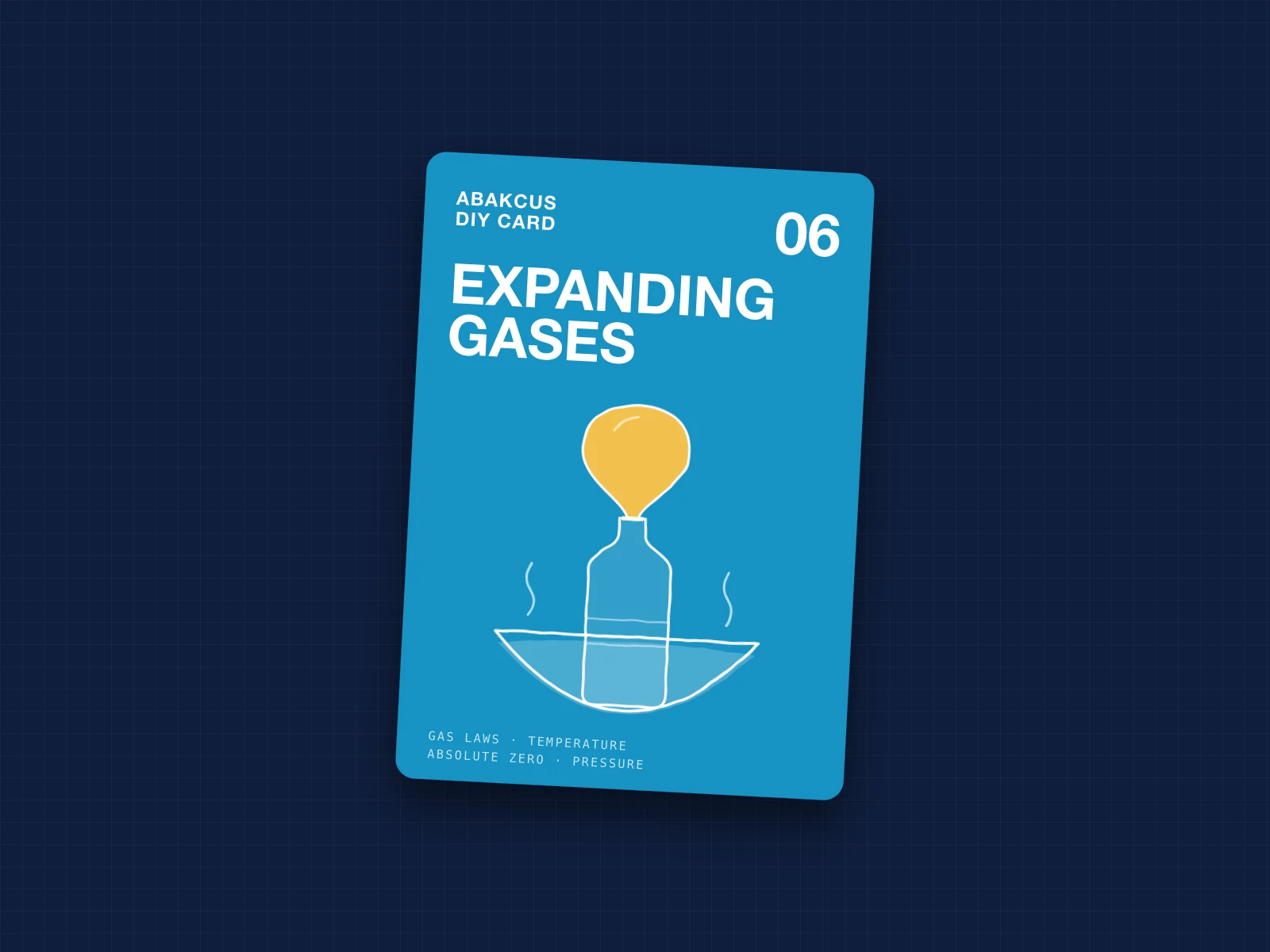
How to Blow Up a Balloon With Hot Water: Charles’s Law
Put a balloon on an empty bottle, stand the bottle in hot water, and the balloon lifts itself up. The air didn’t get any more of itself. It just needs more room, and from that one fact you can find absolute zero.
Open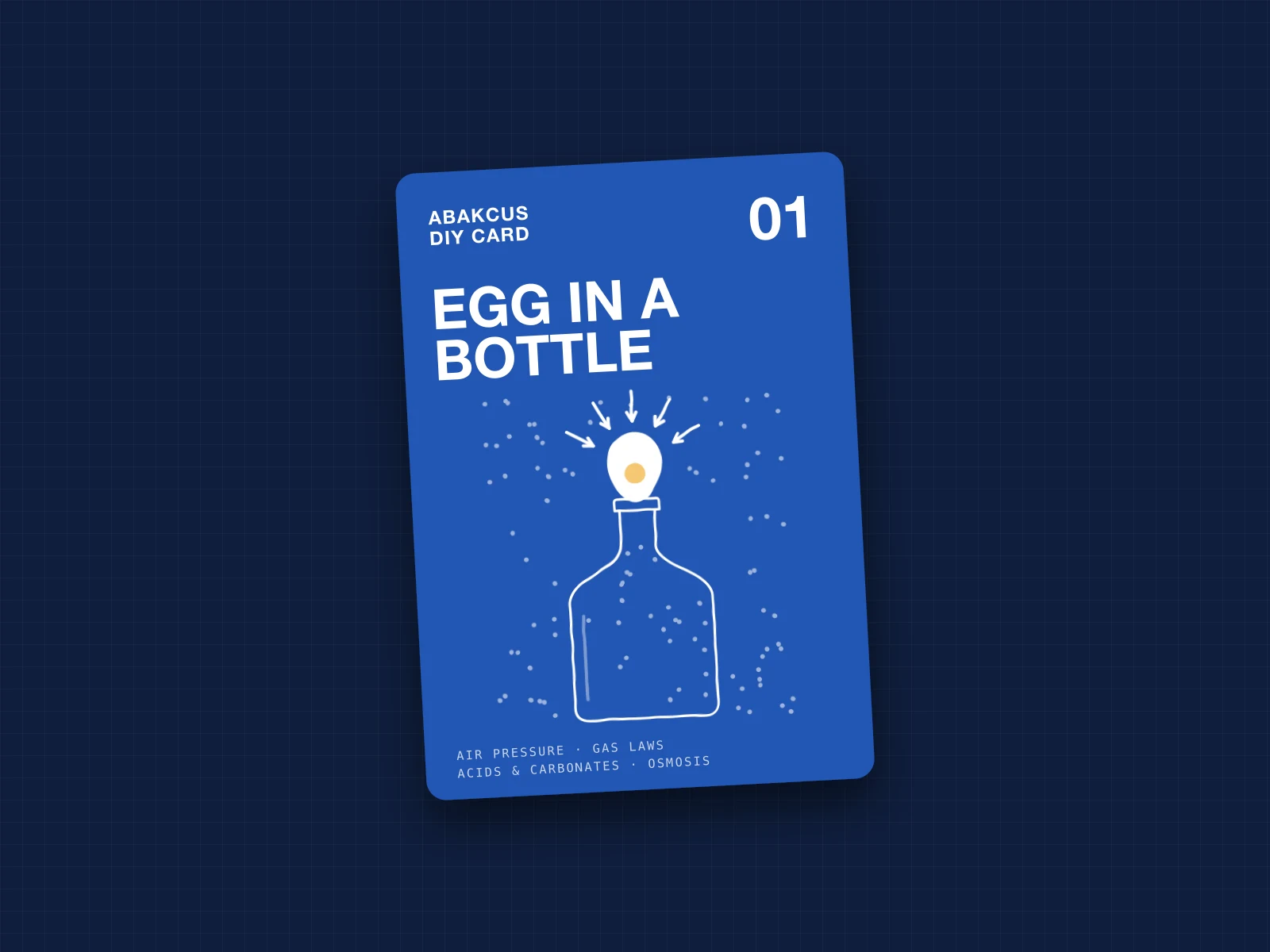
How to Get an Egg Into a Bottle Without Touching It
Two days in vinegar take the shell away, a warm bottle does the rest. The egg goes through a mouth narrower than itself, pushed by ten tonnes of air per square metre.
Open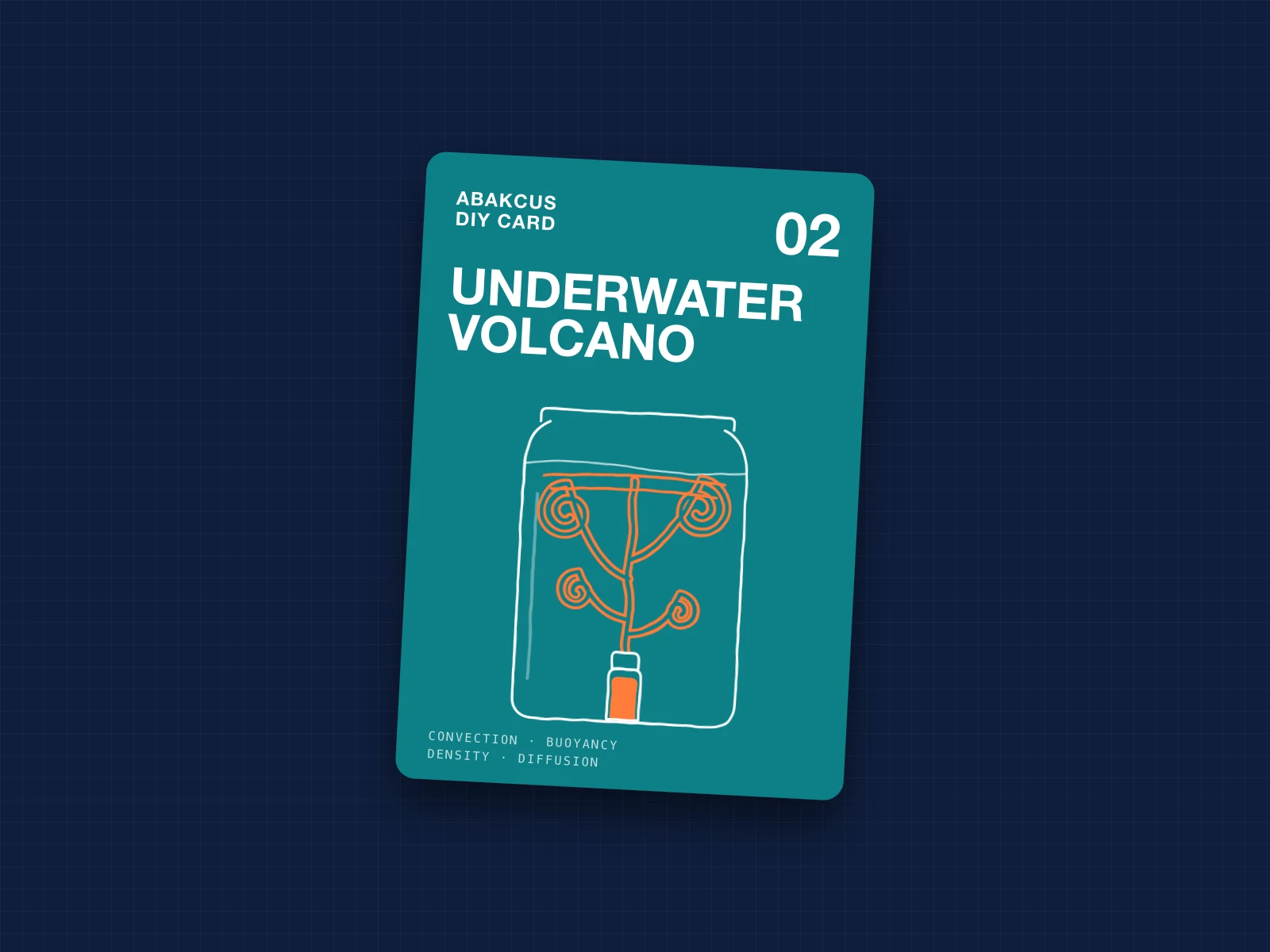
How to Make an Underwater Volcano: Convection in a Jar
Hot red water in a salt shaker, lowered into a jar of cold water. It erupts, curls into a mushroom, and lies on the surface like oil, because water one and a half percent lighter has nowhere to go but up.
Open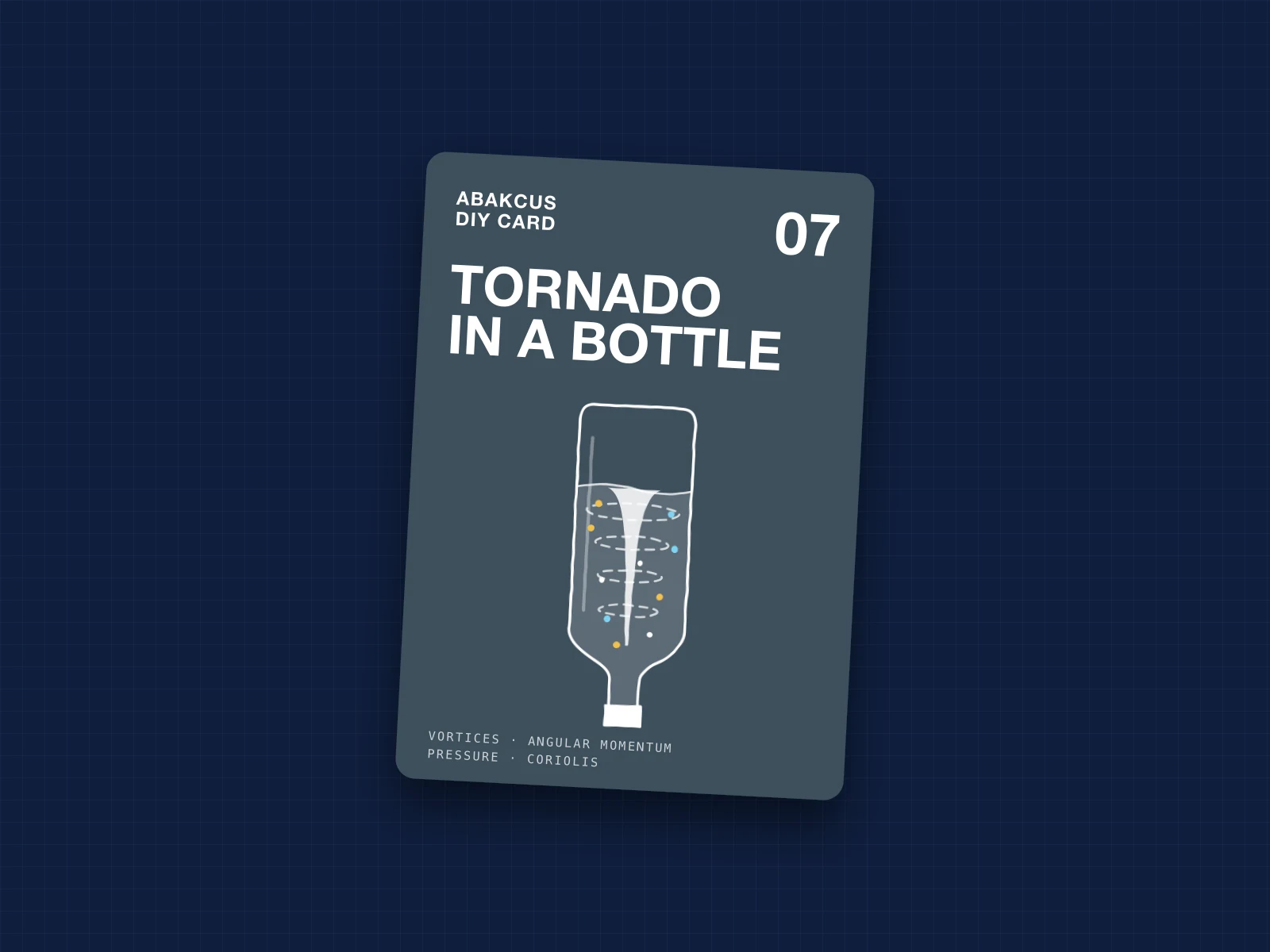
How to Make a Tornado in a Bottle: Vortex Science
Swirl an upside-down bottle of water and a funnel of air drills down through the middle. It spins fastest at the centre for the same reason a skater spins faster with arms pulled in, and it has nothing to do with which hemisphere you live in.
Open
How to Measure the Speed of Light With Chocolate
Take the turntable out of a microwave, heat a bar of chocolate for twenty seconds, and measure the gap between the melted spots. Multiply by the number on the back of the oven and you get the speed of light, give or take a few percent.
Open
How to Push a Skewer Through a Balloon Without Popping It
A wooden skewer goes in at the top of a balloon and out beside the knot, and the balloon just sits there. The trick is knowing where the rubber is least stretched, and why stretch decides everything.
Open