
By Ali Kaya
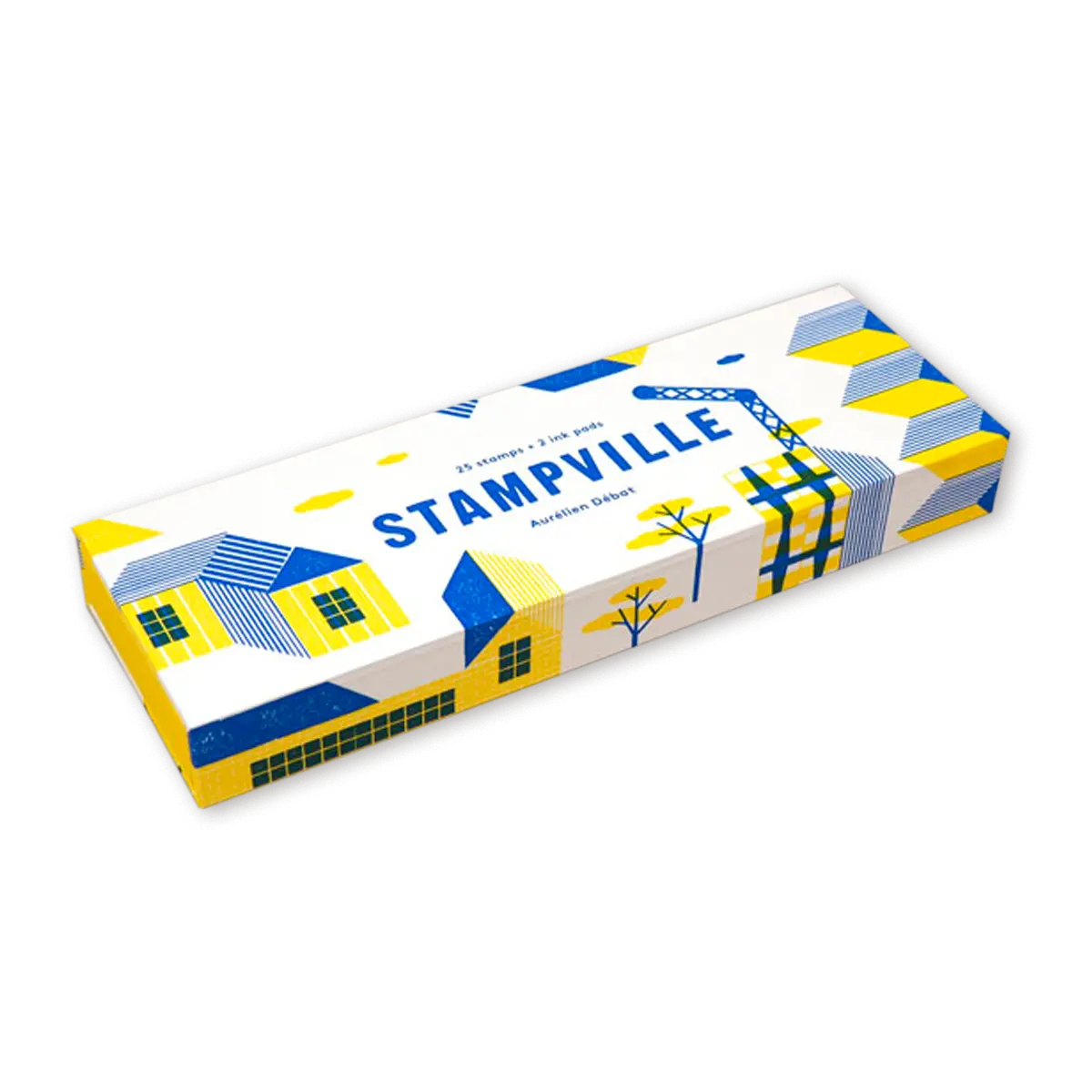
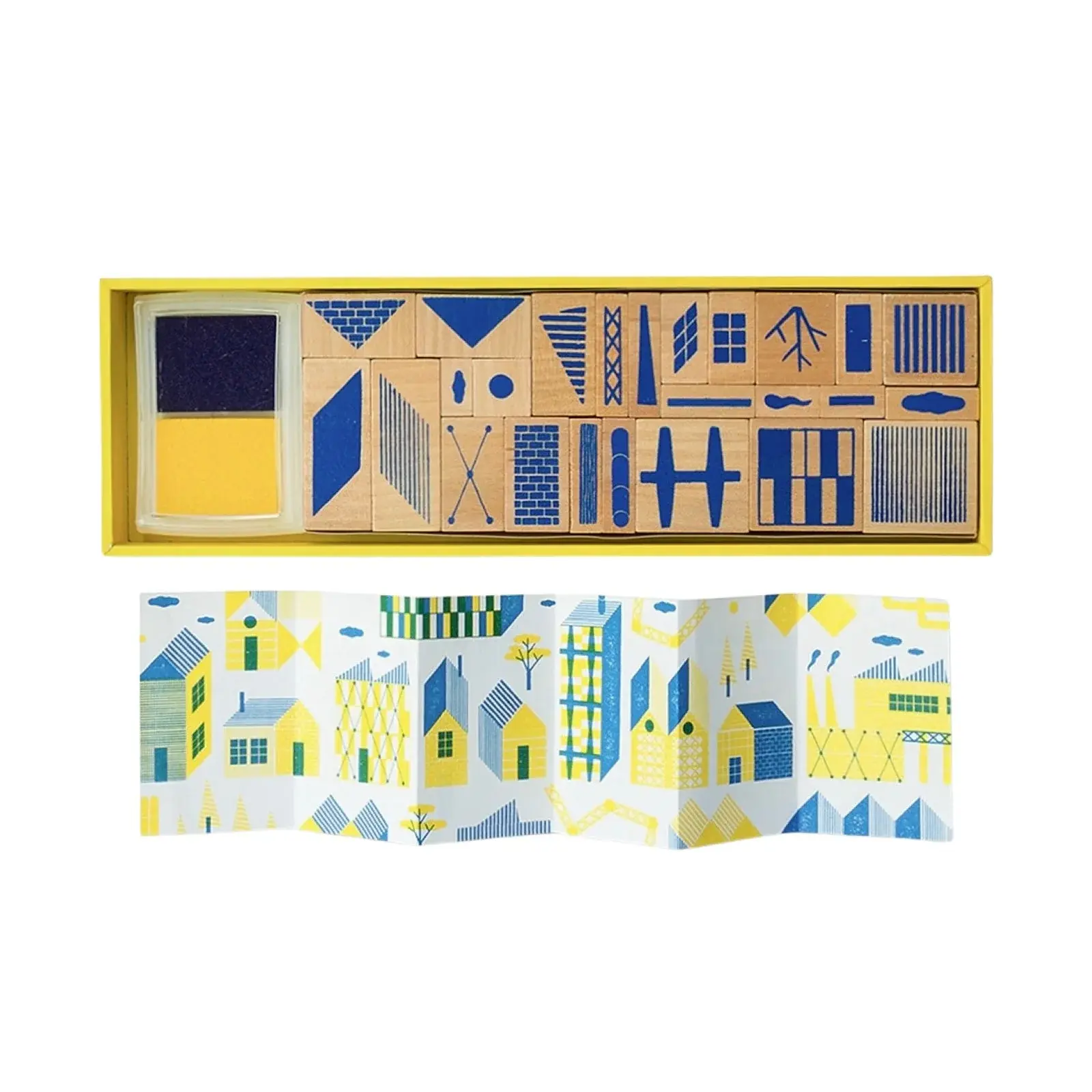
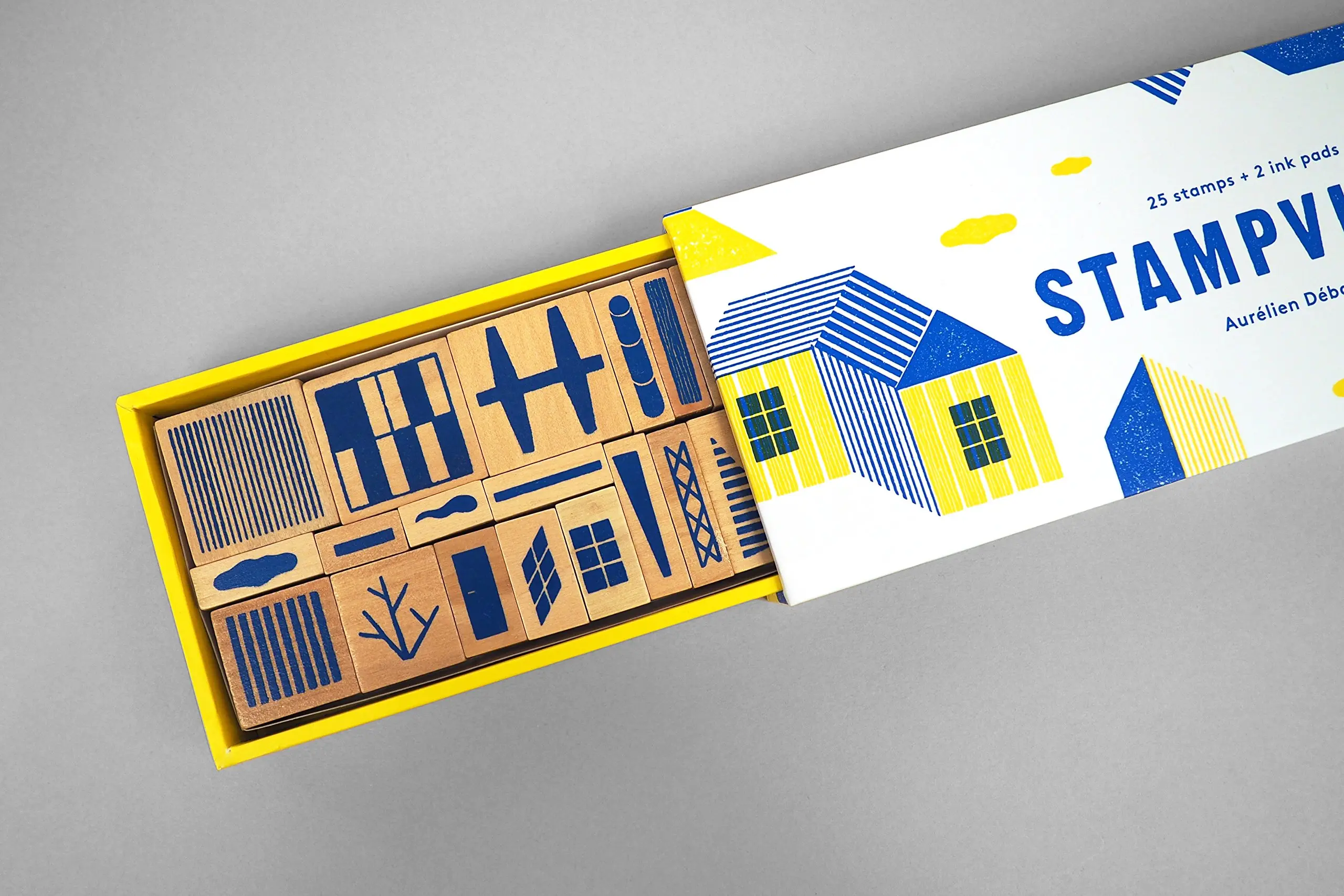
tampville is a matchbox-style box with twenty-five wood-backed rubber stamps in different shapes and textures and a double ink pad, one side yellow and one side blue — and that is the whole kit. Nothing to plug in, nothing to charge. The reason it works so well, I think, is that it gives you parts of buildings rather than buildings, so the house is something you have to put together yourself.
Aurélien Débat was born in France in 1979, studied illustration at Les Arts Décoratifs in Strasbourg and now lives and works in Marseille; before the stamps he wrote and illustrated children's books. His architectural drawings are built from simple hatching and flat fills that leave the white of the paper alone, and he had already drawn La Grande-Motte, building sites and transport before he cut that same vocabulary into rubber. Each stamp is one architectural element — a piece of wall, a roof, a patch of ground, a texture — and lined up in the box they read less like a toy and more like a type case, an alphabet you set a city with.
The bench below is not a copy of Débat's stamps — the shapes are mine — but it works the way the box does. Pick a stamp, pick an ink, press it onto the sheet, and stamp over what is already there.
Stamp a street
Choose a stamp and an ink, then tap the sheet. Stamp yellow over blue, or blue over yellow, and watch the third colour appear.
Empty sheet
Two inks, three colours
Where the yellow and the blue land on top of each other the paper turns a dark green, and nobody put green in the box. Ink does not add light, it takes light away — each layer absorbing part of the spectrum and letting the rest bounce back from the paper. Yellow ink swallows the blue end of white light, blue ink swallows most of the red end, and what survives both layers is the narrow band in the middle our eyes call green. That is why the overlaps come out darker than either ink on its own, and why Débat can print what looks like a three-colour town with two pads. If you like colour pinned down and named, there is a whole pre-photographic system of it in Werner's Nomenclature of Colours.
Two stripes, a third pattern
The stamps that interest me most are the hatched ones, because hatching printed over hatching does something plain shapes never do. When two sets of fine parallel lines overlap at a slight angle, a much larger set of broad bands appears across them — a moiré — and those bands are in neither stamp. For two identical line sets with spacing p crossed at an angle θ, the bands repeat every D = p / (2 sin(θ/2)), so the smaller the angle the wider the bands: at a few degrees, a roof hatched in 1-millimetre lines can carry stripes more than a centimetre apart. Turn the second stamp with the slider and watch a tiny change in angle move something far bigger. The same trick, animated, drives Takahiro Kurashima's Poemotion.
Stamp one roof over another
Both stamps have the same line spacing. Only the angle between them changes.
line spacing p = 1
band spacing D = 11.5 p
How infinite is infinite
The box promises that the combinations are infinite, and as a maths teacher I cannot leave a sentence like that alone. Twenty-five stamps, two inks and four ways to turn each stamp give 25 × 2 × 4 = 200 different impressions, and because ink stacks the order matters: a blue wall over a yellow roof is not the same picture as a yellow roof over a blue wall. A modest street of ten impressions then has 200¹⁰ ≈ 1.02 × 10²³ possible sequences — about a sixth of Avogadro's number, the count of particles in one mole of a substance — and that is before you decide where on the page any of it goes. The positions are what really make it infinite, since a stamp can land anywhere, so the box is right, only for a better reason than the one it gives.
Inside, along with the stamps and the pads, there is a fold-out sheet of ideas, and the whole thing is 27.9 centimetres long and 9.5 wide, published by Princeton Architectural Press — small enough to slide into a drawer, and long enough that a street fits across the lid.
Specifications
- Designer
- Aurélien Débat
- Publisher
- Princeton Architectural Press
- Contents
- 25 wood-backed rubber stamps + double ink pad
- Inks
- Yellow and blue (green where they overlap)
- Extras
- Fold-out sheet of ideas
- Box
- 27.9 × 9.5 cm, matchbox style
- Ages
- 4 and up
- Price
- ~$26.95
Also on Abakcus
For colour pinned down and named the pre-photographic way, see Werner's Nomenclature of Colours. And for the same overlapping-line trick set in motion, watch Poemotion.
Stampville is published by Princeton Architectural Press and available on Amazon. Twenty-five stamps, two inks, and a third colour you never have to buy.
The Amazon link is an affiliate link; if you buy through it, Abakcus earns a small commission at no extra cost to you.