
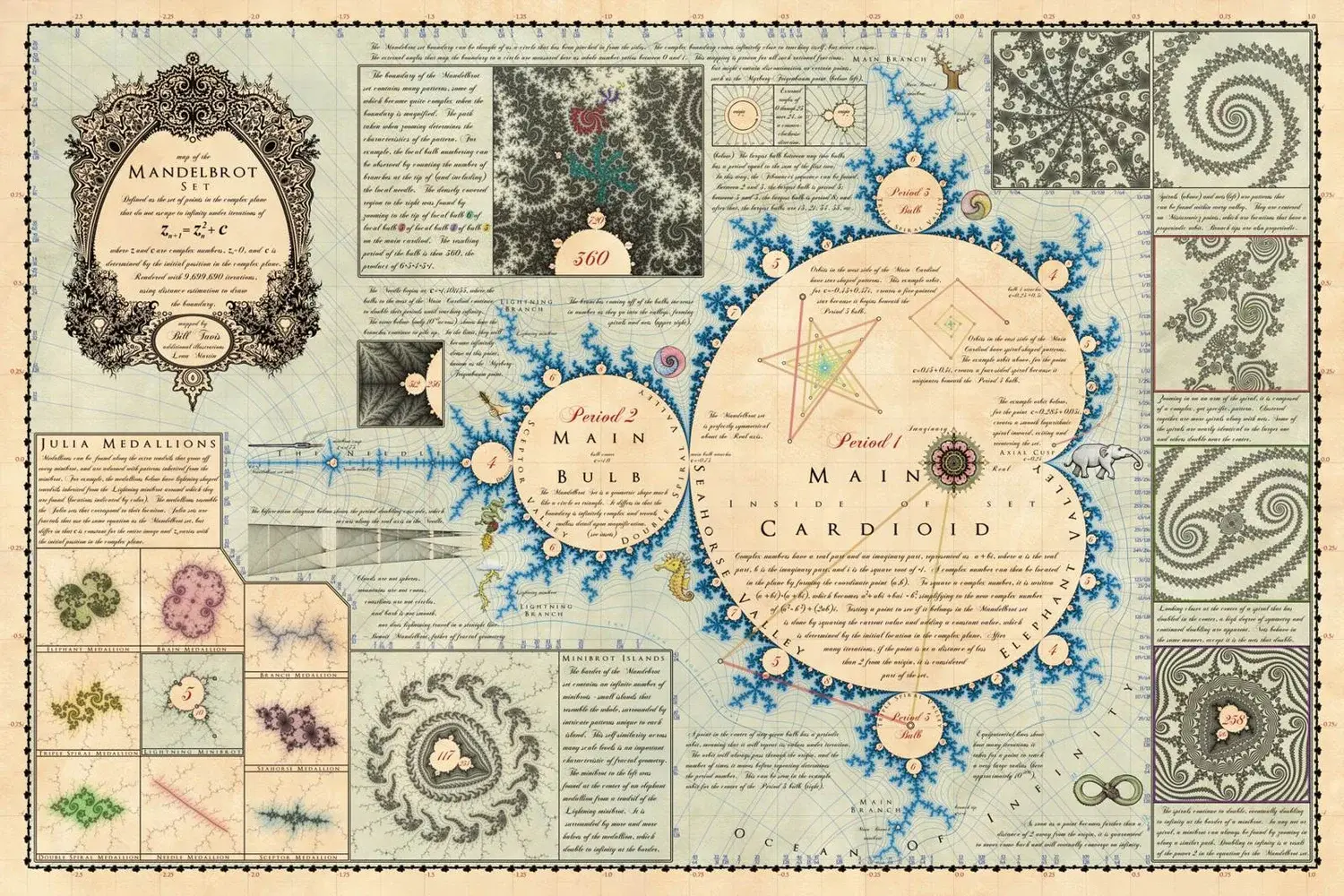
ld navigation charts were honest about their limits. Where the cartographer's knowledge ran out, the parchment filled with sea serpents and the warning that here be dragons. The Mandelmap poster takes that gesture and aims it at a stranger ocean — one whose coastline is not merely unmapped but, in a precise mathematical sense, endless. You can sail toward its shore forever and never reach a final, smooth edge. Every magnification reveals a new bay, a new spiral, a new flotilla of miniature copies of the whole.
What the artist Bill Tavis built is a map of the Mandelbrot set drawn in the full visual grammar of seventeenth-century cartography: a hand-lettered cartouche, an ornate compass rose, equipotential lines curving like ocean currents, and pen-and-ink creatures lurking in the margins. The joke and the genius are the same. A fractal really does behave like a coastline, and it deserves a coastline's map.
01 / The TerritoryInfinite complexity from a single line of algebra
The Mandelbrot set is named for Benoît Mandelbrot, the mathematician who gave fractal geometry its name and its manifesto in The Fractal Geometry of Nature. The astonishing thing about the set is the gap between its cause and its effect. The cause is almost embarrassingly small:
That is the entire engine. You pick a point c on the complex plane, start with z at zero, and feed the result of each step back into the formula. If the numbers stay bounded no matter how long you iterate, the point belongs to the set. If they fly off toward infinity, it does not. The black interior is the company of the bounded; everything outside has escaped. And the border between them — neither cleanly inside nor out — is where every ornate, chaotic, beautiful detail lives.
“Arising from a very simple and compact formula, the set is stunning seen as a whole, but its true wonders appear when you look closer at the border.”
Bill Tavis, on the Mandelmap
02 / The MapSeahorse Valley, Elephant Valley, and a coastline mapped to a circle
A region this intricate cries out for place names, and over decades of exploration the community that zooms into the set has given them. Tavis catalogued these and rendered them as a proper gazetteer. Wander the chart and you find familiar harbors, each labeled and, where helpful, illustrated by hand.
A partial gazetteer of the set
- Seahorse ValleyThe pinched channel between the main cardioid and the large bulb, where spiral tails coil exactly like seahorses.
- Elephant ValleyThe bay to the right of the cardioid, lined with a rounded, trunk-like procession of forms.
- The Main CardioidThe heart-shaped body of the set — its mainland, home of the period-1 region.
- Julia MedallionsInset portraits of Julia sets, the close mathematical cousins generated at chosen points.
Beyond the names, the map encodes the real mathematics. Hundreds of bulbs are labeled by hand with their period numbers — and if you read them around the boundary you can count to infinity by even numbers, by odd numbers, or trace the Fibonacci sequence hiding in the order. External angles mark how far around the set you have travelled counter-clockwise, mapping the wild border onto a clean circle. Equipotential lines, drawn like depth contours, show how quickly an escaping point races off to infinity. It is a chart you can navigate by, not merely admire — the same impulse behind the Map of Mathematics, which turns an abstract field into territory you can travel.
03 / The MakerCoffee-stained paper and software written from scratch
Bill Tavis is an artist and researcher who was a strong math student in his youth and then took the long way back to the subject through art. The Mandelmap is where the two paths meet. He spent more than a year on it, insisting it be both mathematically accurate and genuinely beautiful — two demands that usually pull against each other, in the same way Rafael Araujo's hand-drawn geometry reconciles ruler-exact structure with the patience of a draftsman.
The craft runs deep. Every element was built from scratch; even the antique patina comes from real coffee-stained paper that Tavis scanned in. The fractal views were rendered at high resolution with software he coded himself, some of it written specifically for this single poster so he could control exactly what each region showed. He used shapes lifted directly from the Mandelbrot set to fashion the compass rose and the cartouche, so the ornament is not decoration borrowed from old maps but structure grown from the territory itself. The marginal sea monsters and animals — the inspiration for names like Elephant Valley — were drawn in pen and ink by illustrator Helena Martin.
The project began, as the best ones do, selfishly: Tavis wanted a printed map of the set for his own explorations, and none existed. A 2016 Kickstarter funded the first run many times over, and the poster has since reached fractal enthusiasts in dozens of countries.
04 / Why It MattersA pattern to the chaos
There is a quiet thesis under all the ornament. We tend to file “chaos” and “order” as opposites, but the Mandelbrot set refuses the distinction. Its border is the most complex object most of us will ever look at, and yet it is utterly lawful — generated, reproduced, and navigable by a rule a child could memorize. The Mandelmap makes that paradox sit still long enough to study. It says, in the calm voice of an old sea chart: there is a pattern to the chaos, and here is how to find your way around it.
Hung on a wall, it works on two levels at once. From across the room it is a handsome antique map. Up close, it rewards exactly the kind of slow looking that mathematics asks for — the longer you stare, the more there is to see, which is, after all, the whole point of the territory it charts.
Watch
Mandelmap poster — A detailed map of the Mandelbrot set fractal.
In short
A poster that is half antique sea chart, half working mathematical diagram — and entirely an argument that the most chaotic-looking object in mathematics is, in the end, perfectly lawful.
Also on Abakcus
The territory the Mandelmap charts gets its founding manifesto in Mandelbrot's The Fractal Geometry of Nature. For another field rendered as a map you can travel, see the Map of Mathematics. And if it is the marriage of exact geometry and patient hand-work that draws you in, Rafael Araujo's geometrical masterpieces belong on the same wall.
Bill Tavis — The Mandelmap Poster: A vintage-style map of the Mandelbrot set
Offset lithography, 36×24" & 54×36" · abakcus.com