
DIY · Card 53 · Physics · Waves
Twelve nuts on twelve strings, each a little shorter than the last. Let them go together and they weave waves, snakes and seeming chaos, then swing back into a perfect line, exactly on time.
01The brief
Twelve separate pendulums, one dance.
12
pendulums, from 44.2 cm down to 14.7 cm
15–26
swings each makes in 20 seconds, one more than its neighbour
20 s
until every pendulum is back in line
A single pendulum is the most regular thing you can make: it swings back and forth at its own steady rhythm, set by its length and nothing else. Line up twelve of them, each tuned a fraction faster than the one before, and something spectacular happens.
Released together, they slide out of step. A wave runs along the row, then a snake, then two rows weaving through each other, then apparent chaos, and then, as if rehearsed, they all swing back into line. Nothing connects them: the whole show comes from timing. It is a cousin of the balance bird, another toy built on where weight hangs, and of the water clock, another way to keep time.
02Kit
A stick, string, a dozen nuts and some patience with a stopwatch.
Tick off what you have
0 of 6 ready
03Method
Getting the lengths right is everything. Measure, then tune by counting.
Step 1 of 8 · Minute 0
You need a straight stick about 60 cm long, such as a dowel or broom handle, 12 identical nuts or washers, a ball of thin string or fishing line, sticky tape, a ruler, scissors, two chairs and a phone to use as a stopwatch.
The pendulums swing in circles or twist.
Why
The V is too narrow, or the release was crooked.
Fix
Tie the two strings further apart along the stick, and pull the bobs straight back before letting go.
The line doesn’t come back together.
Why
Some pendulums are slightly the wrong length.
Fix
Count each one’s swings in 20 seconds again and adjust by a few millimetres until every count is exact.
The pattern fades quickly.
Why
The bobs are too light, or the stick is moving.
Fix
Use heavier nuts, swing them only 10 cm or so, and tape the stick firmly to the chairs.
04Physics
In 20 seconds the longest pendulum swings 15 times and its neighbour 16. After 10 seconds, the first has made 7½ swings and the second 8: they are exactly opposite. After 20 seconds both have made whole numbers of swings and are back together. Every pair of neighbours does the same, and together they make the patterns.
Watch it from above, and design your own, with string lengths to match:
All in line: every pendulum has made a whole number of swings, so they are back together.
String lengths, pivot to centre of bob
It all works because a pendulum’s timing depends on its length alone. Try changing the weight, the length and the size of the swing:
One full swing
1.27 s
Swings per 20 s
15.7
Swap the bob: the timing doesn’t change, because a heavier bob is pulled harder but is also harder to get moving. Four times the length gives twice the time. Pulling it back further barely matters up to about 15°; at 15° the swing is 0.4 % slower than a tiny one, which is why the toy works best with small swings.
05The big idea
Simple rhythms,
complex patterns.
Each pendulum on its own is utterly predictable. The waves and snakes are not in any one of them: they appear only when you look at all twelve at once, each slightly out of step with the next.
The same thing happens with sound, when two notes a little apart make a throbbing beat, and with light, in the shimmering stripes of a moiré pattern. Small differences in rhythm, added up, make big patterns.
06The math
1 · Period
T = 2π√(L ⁄ g)
Time of one full swing, for small swings. g = 9.81 m/s².
2 · The design
Tₖ = Γ ⁄ (N + k)
Pendulum k makes N + k swings in a cycle of Γ seconds.
3 · Its length
Lₖ = g (Γ ⁄ 2π(N + k))²
Put the two together and solve for L.
For the longest pendulum, Γ = 20 s and N = 15: each swing takes 20 ⁄ 15 ≈ 1.33 s, so L = 9.81 × (1.33 ⁄ 2π)² ≈ 0.442 m. The shortest makes 26 swings, each 0.77 s, and needs 0.147 m. Because length goes with the square of the period, a pendulum four times as long swings only half as fast.
Halfway through, at 10 s, neighbours are exactly half a swing apart, so the odd and even pendulums form two separate rows. At a third of the way, 6.7 s, they fall into three rows; at a quarter, four. In between, the bobs trace waves along the line.
07Real life
From cathedral lamps to skyscrapers, the steady swing keeps time and calms sway.
Pendulum clocks
Because a pendulum’s swing takes the same time whatever its size, it makes a superb timekeeper. Christiaan Huygens built the first pendulum clock in 1656, and for nearly three centuries pendulums were the world’s most accurate clocks.
A chandelier in Pisa
The story goes that the young Galileo, sitting in Pisa Cathedral, timed a swinging lamp against his own pulse and noticed that big swings and small ones took the same time. He went on to show that only the length matters.
Foucault’s pendulum
In 1851 Léon Foucault hung a heavy ball from the dome of the Panthéon in Paris. As the hours passed, its swing slowly turned, showing that the Earth was rotating underneath it.
Big Ben
The pendulum of the Great Clock at Westminster is about 3.9 metres long and beats once every 2 seconds. Its timing is fine-tuned by adding or removing old pennies stacked on top of it.
Taipei 101
Near the top of the Taipei 101 skyscraper hangs a 660-tonne steel ball. When typhoon winds rock the building, the giant pendulum swings against the sway and calms it.
Swings and metronomes
A playground swing is a pendulum: pumping at its natural rhythm sends you higher. A musician’s metronome is one too, turned upside down, with a sliding weight to change its beat.
1991
In February 1991 the physicist Richard Berg published a one-page note in the American Journal of Physics: fifteen uncoupled pendulums of increasing length, tuned so the longest swings 51 times a minute and the shortest 65. Harvard built one for its lecture demonstrations, and videos of it have since been watched millions of times.
The idea may be much older. A similar apparatus is said to have been built by Ernst Mach, the physicist after whom the Mach number is named, in Prague around 1867. Your stick-and-string version works on exactly the same principle.
08Is and isn’t
Heavier pendulums swing more slowly.
Weight makes no difference to the timing. Gravity pulls a heavy bob harder, but it is harder to move by the same factor, and the two cancel.
The pendulums are linked somehow, passing the wave along.
Each pendulum swings completely on its own. The waves you see are only the pattern made by their slightly different rhythms; no energy travels between them.
Bigger swings take longer.
Only slightly, and only for big swings. Up to about 15° the difference is a fraction of a percent: that near-constant timing is what Galileo spotted.
The pattern is chaotic, so it never repeats.
It looks chaotic in the middle, but it is perfectly regular. Every 20 seconds, all the pendulums come back into line together.
09Go further
A
Watch from above
Stand on a chair and look down on the row. The bobs trace snakes and spirals that are hard to see from the front.
B
A longer cycle
Use the designer to plan a 60-second cycle, like the famous Harvard version. The lengths change only a little, but the patterns slow right down.
C
The seconds pendulum
Find the length that makes one swing, there and back, every 2 seconds. Check it against the formula: about 99 cm.
D
Weight test
Hang one nut and three nuts on strings of the same length. Release them together. Do they stay in step?
E
Film it
Film the wave in slow motion from the end of the row. Pause at 5, 10 and 15 seconds and sketch the patterns.
10Questions
It is a row of pendulums of slightly different lengths. Each is tuned to make exactly one more swing than its neighbour in a set time, say 20 seconds. Released together, they drift out of step into waves and patterns, then all come back into line at the end of the cycle.
Hang 12 identical nuts in V-shaped strings from a stick, at lengths from 44.2 cm down to 14.7 cm. Tune each so that in 20 seconds the longest swings 15 times and each shorter one swings once more. Pull them all back with a ruler, release them together and watch.
For a pendulum to make n swings in a time Γ, its length must be L = g(Γ ⁄ 2πn)², with g = 9.81 m/s². For a 20-second cycle starting at 15 swings, that gives 44.2, 38.8, 34.4, 30.7, 27.5, 24.8, 22.5, 20.5, 18.8, 17.3, 15.9 and 14.7 cm, measured to the centre of each bob.
No. A heavier bob is pulled down harder by gravity, but it is also harder to get moving, by exactly the same amount. The time of a swing depends only on the length, and slightly on how far you pull it back.
The physicist Richard Berg described a 15-pendulum version in the American Journal of Physics in 1991, and it became a famous demonstration at Harvard. A similar apparatus is said to have been built by the physicist Ernst Mach in Prague around 1867.
Safety · Make sure the stick is taped firmly so it can’t roll off the chairs, and keep the swinging nuts away from faces. Small nuts are a choking hazard for toddlers.
All DIY cards →Keep wandering
A few more pieces in the same spirit — math, design, and slow attention.
How to Make a Wave Machine From Skewers, Tape and Sweets
Two stools, a strip of duct tape, fifty skewers and a bag of jelly sweets. Tap one end and a wave you can watch ripples down the line and bounces back.
Open
How to Make a Harmonograph That Draws With a Pendulum
A broom handle, a board on a Y of string and a felt-tip pen. Set it swinging and the pen draws figures of eight and woven shells, the shapes of musical harmony.
Open
How to Make Moiré Patterns With Two Grids and a Turntable
Two squares of black mesh and a turntable. Spin one grid under the other and giant shimmering squares bloom and swirl, a pattern that exists in neither grid.
Open
How to Make a Balance Bird That Perches on Its Beak
A bird cut from card, two coins and a fingertip. It balances on the very tip of its beak, rocks when you nudge it, and settles back, as if it had decided to stay.
Open
How to Make a Water Clock That Times Exactly One Minute
Two plastic cups, a pinhole and three-quarters of a cup of water. Tune the hole until it runs dry in exactly sixty seconds, and you have built the oldest kind of clock there is.
Open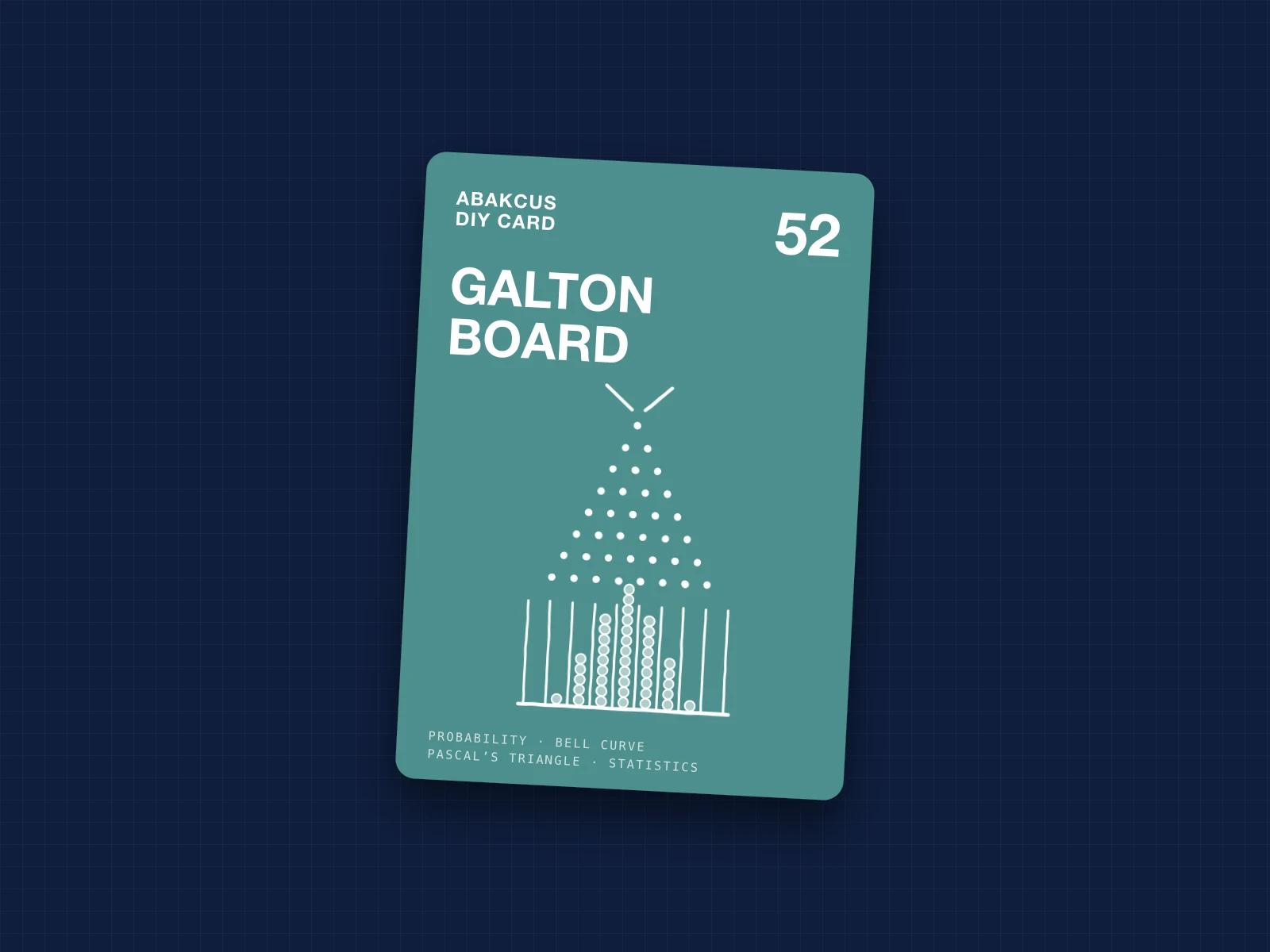
How to Make a Galton Board That Draws a Bell Curve
A board, forty pins and a handful of beads. Every bead zigzags at random, yet together they pile into the same graceful hump every time: the bell curve.
Open