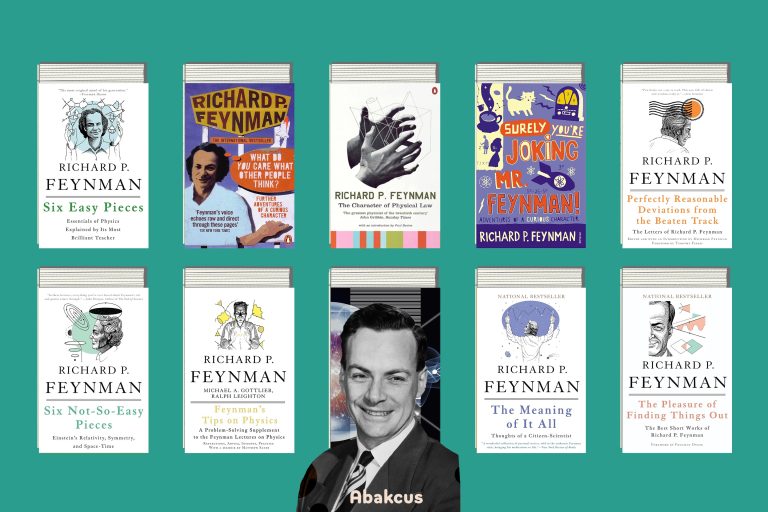
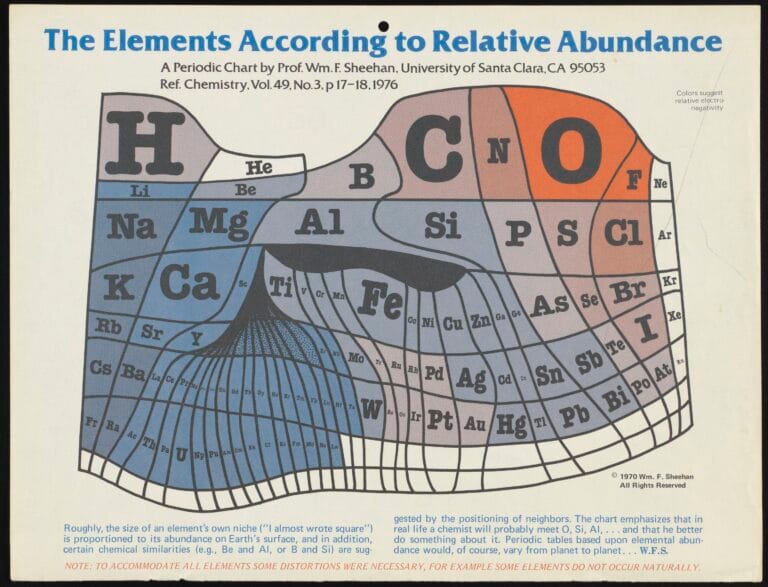
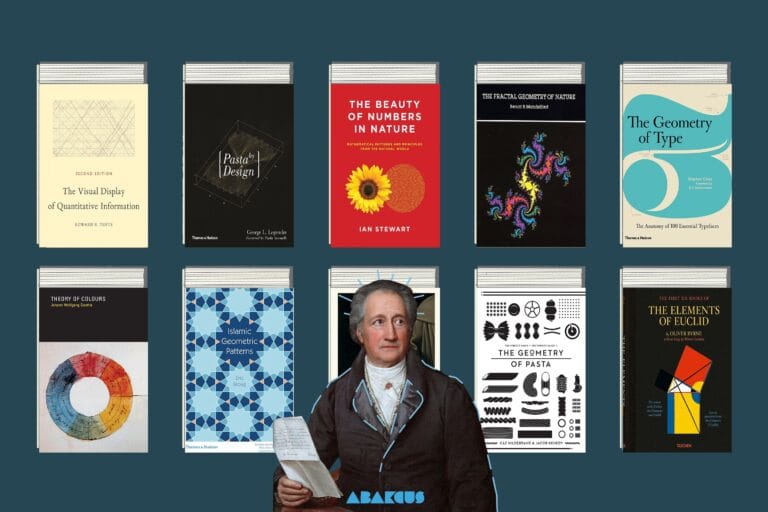
Have you ever considered learning how to think mathematically? Using math proofs requires logical reasoning, problem-solving skills, and the ability to make connections between concepts. By reading math books to learn mathematical proofs, you can unlock the power of this type of thinking and gain valuable insight into a variety of topics. Below, you will find 70 best math books to learn mathematical proofs.
The Benefits of Learning Math Proofs
Math proofs are used in various fields, such as engineering, economics, computer science, physics, and mathematics. Learning to think mathematically will benefit your studies in these fields and give you an edge in other aspects of life, such as problem-solving, decision-making, and critical thinking. Mathematical proofs provide a systematic way to analyze problems so that you can come up with solutions quickly and accurately.
Math Books to Learn Mathematical Proofs
Math books are essential if you want to learn mathematical proof. These books provide an easy-to-understand approach to understanding the fundamentals behind math proofs. They often include step-by-step instructions on how to solve problems as well as visual demonstrations of how these concepts work together. Reading these books is key to developing your skills in mathematical proof because they provide an accessible entry point into more advanced topics like abstract algebra or number theory.
While math books are great for getting started with learning mathematical proof, they have their limitations when it comes to tackling more complex problems. As you progress further down the road with studying math proofs, you must supplement your knowledge with online resources such as YouTube tutorials or online courses that give you a more comprehensive overview of various areas within mathematics.
Additionally, engaging in practice questions can help solidify your understanding and hone your skills when it comes to using logic and reasoning for problem-solving.
Mathematical proof is an invaluable skill that can be applied across multiple fields. It provides a framework for analyzing problems while helping develop your problem-solving abilities and critical thinking skills, which are transferable across many different domains in life. To get started with learning math proof, reading math books is essential as they provide an easy-to-understand introduction to this field while giving step-by-step instructions on how to solve various types of problems. However, as one progresses further into this area, more advanced resources should be utilized, such as online tutorials or courses along with practice questions which will help hone one’s understanding and application within this area even further!
Below, you can find 70 best math books to learn mathematical proofs. If you enjoy this book list, you should also check 30 Best Math Books to Learn Advanced Mathematics for Self-Learners.
Before I get started, I would like to suggest Audible for those of us who are not the best at reading. Whether you are commuting to work, driving, or simply doing dishes at home, you can listen to these books at any time through Audible.
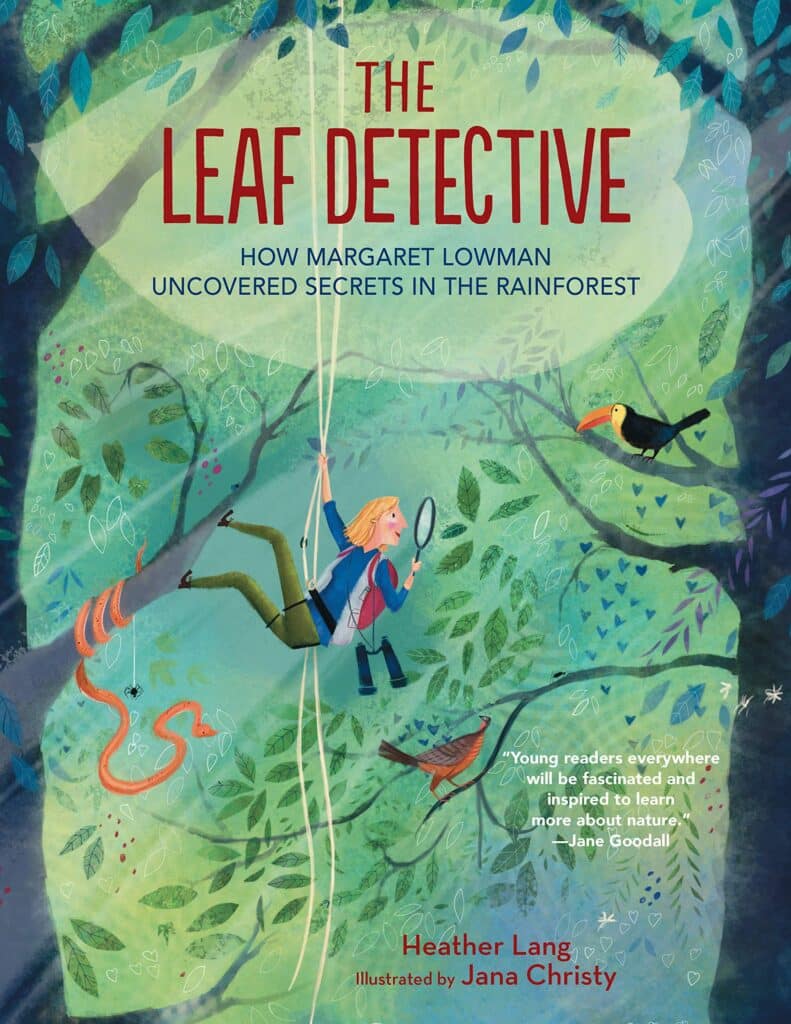
As a fervent advocate for literacy and exploration in children, I am delighted to share my thoughts on a truly captivating book that has, quite fittingly, climbed to the top of my list of exemplary STEM books for kids. “The Leaf Detective: How Margaret Lowman Uncovered Secrets in the Rainforest” by Heather Lang is not just another children’s book—it’s a vessel carrying young minds into the dense canopies of the rainforest and through the life of an extraordinarily determined scientist.
The narrative traces the steps of Meg Lowman, affectionately known as ‘Canopy Meg,’ in her unwavering quest to explore the forests’ highest leaves and branches—a world that many had ignored before her. It’s a factual adventure that begins with a curious young girl with a love for the natural world and follows her growth into a pioneering scientist who would go on to change the way we look at and understand the complex ecosystems above us.
This beautifully illustrated book accomplishes something that, in my opinion, is essential for STEM-related children’s literature: it makes science intimate and emotionally compelling. Children are invited along on Meg’s adventures as she faces dismissive teachers, daunting treetops, and loggers threatening the delicate balance of her beloved rainforest. These challenges are met with Meg’s admirable resilience—a lesson in tenacity and passion that every child can take to heart.
The illustrations do more than merely depict the story—they transport readers into the lush, verdant world of the rainforest. Each page is a celebration of color and detail, complementing Lang’s storytelling with vivid imagery that brings the richness of the forest—and Lowman’s discoveries—to life. The art engages a child’s wonder not just for what is seen on the ground, but for the often-overlooked majesty that exists above.
One doesn’t need to be a budding botanist or ecologist to appreciate “The Leaf Detective.” This book champions the universal virtues of persistence and curiosity. It also serves as an impactful introduction to environmental stewardship, subtly educating its audience about the importance of conservation and the fragility of our ecosystems—a timely message given the current climate crisis.
In conclusion, “The Leaf Detective: How Margaret Lowman Uncovered Secrets in the Rainforest” is more than deserving of its place among the best STEM books for children. It is an inspirational narrative that transcends age, instilling a sense of wonder and responsibility towards our natural world. It underscores that adversity and challenges—whether in the form of prejudice, physical danger, or environmental threats—can be confronted with perseverance and bravery.
Prepare to watch your children be enamored with the story of Meg Lowman. Not only will they turn each page with eager anticipation, but they might just close the book with dreams a little bigger, a touch of wanderlust, and a newfound appreciation for the enigmatic world of tree tops. “The Leaf Detective” is a story not to be missed, planting seeds of inspiration that are sure to grow into a legacy of learning and love for the environment.

“What is a River?” isn’t just a question asked by a curious child – it’s the title of an enriching exploration penned and illustrated by Monika Vaicenavičienė. This book stands out as a remarkable contribution to children’s literature, particularly within the STEM (Science, Technology, Engineering, and Mathematics) category. It is not only enlightening through its vivid storytelling but also successfully entices young readers into a world of profound natural wonders.
At its heart, “What is a River?” is an ode to the ebb and flow of one of nature’s most vital resource—rivers. Its pages take young readers on a journey across the globe, delving into the geographical veins that sustain both the Earth and its varied cultures. Packed with relevant information about rivers’ scientific aspects, the book does not shy away from the historical and industrial influence these water bodies have had over the years. Moreover, it ignites a sense of environmental stewardship, underlining the indispensable bond between human beings and the natural world.
The underlying message of connectivity remains a fundamental theme throughout the book. By showing how rivers are a lifeline for ecosystems, communities, and civilizations, Vaicenavičienė creates a tapestry interweaving humanity with the environment. It prompts readers – both young and old – to consider our impact and responsibility towards these flowing arteries of the planet.
In addition to the rich content, “What is a River?” shines through its artistic value. Vaicenavičienė’s illustrations are not merely add-ons; they are integral to the storytelling process, enabling a vivid understanding and capturing the imagination in a way that words alone may not. Each drawing acts as a window into various aspects of a river’s existence, aiding children’s comprehension of complex concepts while ensuring the journey through the book’s pages remains magical.
From a didactic perspective, this book is a goldmine. It serves as a crucial resource for educators and parents looking to instill a love for STEM subjects in children. The way “What is a River?” presents its themes allows children to see these topics as exciting mysteries to unravel, rather than dry, scholarly content. It proves that education can be adventurously experiential and interactive, thereby strengthening a child’s cognitive connection to learning.
It’s rare to come across a book like “What is a River?” that so effortlessly merges education with engaging storytelling. As a STEM book for kids, it surpasses expectations by challenging young minds to think beyond the superficial and dive deeper into understanding the fundamental elements of our world.
For any child with a hint of curiosity, this book is more than just a good read—it’s an adventure that can spark a lifelong passion for learning and exploration. “What is a River?” is highly recommended for its ability to teach, inspire, and connect.

The Rock from the Sky is one of the best kid’s books on the market, as it serves a perfect blend of comedy and suspense. The story follows two unlikely friends who embark on an out-of-this-world journey to uncover a mysterious object that has been found in their town.
The wry wit and broad visual suspense put The Rock from the Sky in a league all its own, making it an absolutely unique and thoroughly enjoyable read for the whole family. Your child will love this funny, informative tale from celebrated picture book creator Jon Klassen!
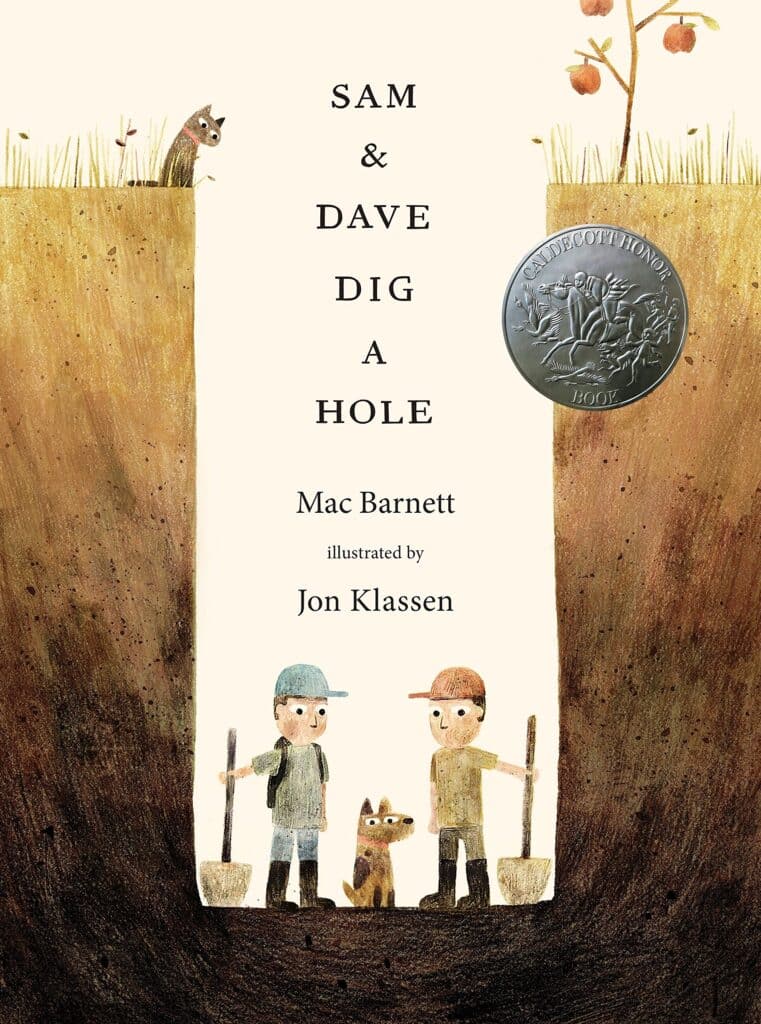
Sam and Dave Dig a Hole should be top on the list of must-reads for its young audience. Featuring an intrepid duo’s quest, this witty book offers a gentle reminder that oftentimes remarkable outcomes can come from ordinary experiences.
Sam and Dave set out to dig a hole in pursuit of something special, yet nothing is found- at first. Through whimsical characters, captivating illustrations, and a majestic plotline, Sam and Dave magically uncover something extraordinary in the most unexpected place! Be sure to get your hands on Sam and Dave’s Dig a Hole – it will prove to be an unforgettable read for you and your child.
The Book with No Pictures is one of the best kid’s books out there for a good reason! With no pictures, your child has to rely entirely on their own imagination as they read along. The hilarious situations that unfold from the nonsensical words jump off the page, allowing them to find humor in learning new vocab words and building their reading skills.
The power of The Book with No Pictures lies in your child’s understanding that they can be entertained by the written word rather than just pictures or videos – making it a great addition to their library!

The Economist’s “Numbers Guide” is a comprehensive handbook for anyone who interacts with numbers professionally. This guide serves as a trusty companion for managers and professionals across various sectors, confronting the often intimidating world of figures with straightforward and practical advice.
At its core, the “Numbers Guide” is centered on basic numeracy. Yet, it transcends mere arithmetic to present a wide-ranging toolkit for solving financial problems, analyzing data, and enhancing decision-making processes. It is a manifesto for clarity in an age where data can be as misleading as it is enlightening.
The guide meticulously unravels the complexities of financial analysis, walking the reader through the recognized techniques for dissecting financial statements and performance metrics. It is a valuable resource for those seeking to refine their decision-making skills, ensuring decisions are informed by solid and well-interpreted data.
Perhaps one of the book’s most crucial contributions is its focus on presenting and communicating numerical information. In an era of information overload, the ability to present data effectively and, more importantly, ethically, cannot be overstated. The guide offers over 100 charts, graphs, and tables, coupled with feature boxes that underscore the critical points to remember when handling numbers.
This guide stresses the importance of honesty in numerical communication. It champions clear, transparent reporting that can withstand scrutiny and invites trust—traits increasingly demanded by stakeholders in today’s businesses.
The book concludes with a comprehensive A-Z dictionary of terms, spanning from amortization to zero-sum game. This glossary is more than a quick reference—it is the backbone of the guide, ensuring readers can bridge the gap between jargon and application, and fostering a deeper understanding of numeric concepts.
“The Economist: Numbers Guide” is an indispensable asset for individuals looking to bolster their numeric literacy and confidence. It breaks down barriers to understanding, making number-crunching not just accessible, but manageable for anyone. For aspiring managers or seasoned executives, this guide promises to sharpen your numerical acumen, providing you with the foundations necessary for success in the data-driven business landscape of today and tomorrow.
With its lucid explanations, practical tools, and commitment to integrity in data presentation, “Numbers Guide” stands out as more than just a manual—it’s a navigator through the numeric demands of modern management.

“The Signal and the Noise” by Nate Silver is nothing short of a deep-dive analysis into the world of predictions and forecasting. Renowned statistician and writer Nate Silver brings to light the intricacies of differentiating the meaningful ‘signal’ from the confusing cacophony of ‘noise’ that clouds our judgment and predictions. Through this exploration, Silver doesn’t just bring statistical analysis to the average reader, he brings insight into the enlightenment and pitfalls of prediction itself.
Within the pages of “The Signal and the Noise,” Silver tallies the successes and failures of prediction across a broad spectrum of fields. The text thrives on themes of uncertainty, probability, and the complex balance between knowing what can be forecasted and what lies just beyond the reach of current predictive methods. The overarching message is that humility, paired with statistical awareness, leads to better understanding of the future.
Silver’s own experiences in the realms of baseball and politics are woven through chapters that consider forecasting in various domains, including meteorology, and finance. His examinations are meticulous, unearthing layers of thought processes and strategies of seasoned forecasters who have edged closer to precision.
Nate Silver’s methodology in “The Signal and the Noise” is both empirical and accessible. The book serves as a treatise advocating for the relevance and necessity of statistical literacy in a world inundated with data. Silver’s writing style is engaging, often leaning on narratives to break down complex concepts into relatable vignettes that captivate and educate.
Particularly gripping is Silver’s examination of prediction as a ‘paradox,’ where confidence, often misconstrued as competence, can be the very hurdle that prevents accuracy in forecasts. He deftly outlines how an incorporation of probability serves to not just enhance predictions but refocuses the lens through which we view potential outcomes.
One of the book’s greatest contributions is its success in debunking the myth that data alone can solve problems or predict futures precisely. By tying together various tales of forecasting—from the impactful tales of hurricane predictions to the seemingly trivial realm of sports betting—Silver underscores the import of perspective and the diligent scrutiny of data to find patterns.
The book’s exploration of different predictions is not only informative but a subtle call-to-arms, suggesting that amid the increasing complexities of our world, a more probabilistic mode of thinking is required. This serves to not necessarily generate exact predictions but rather cultivate a more nuanced understanding of what the future holds.
In conclusion, “The Signal and the Noise” is a paramount read for anyone living in the data-driven 21st century. Nate Silver has expertly cemented his position as a purveyor of predictions, and his book is an insightful, paradigm-shifting work that calls for a blend of humility and statistical savvy in all forecasts we dare to make.

In “The Order of Time,” Carlo Rovelli challenges us to venture beyond our everyday understanding of time—a concept so familiar yet so profoundly mystifying. Through the lens of physics and philosophy, Rovelli untangles the complex fabric of time, posing questions that shake the very foundation of our perceptions: Why is our memory locked in the past? What truly allows us to perceive time as moving from yesterday into tomorrow?
Rovelli approaches these enigmas with a narrative that is both poetic and accessible, turning what could easily be an esoteric discussion into a captivating exploration of time’s true nature. His skill in simplifying the complexity of quantum gravity and its implications on how we understand time ensures that readers are not just spectators but active participants in this thrilling inquiry.
What sets “The Order of Time” apart is not merely its scientific rigor, married seamlessly with the broader implications of time on our philosophical and cultural understanding; it is also Rovelli’s gift for storytelling. With the finesse of a poet, he dismantles age-old assumptions about time being a uniform, linear progression that dominates our existence. Instead, he introduces us to a universe that is not just strange but also liberating—an existence where, at the most fundamental level, time ceases to be. This idea is revolutionary and deeply unsettling, as it strips away the comforting structure of temporal progression we are so accustomed to.
Rovelli further enriches his narrative by interweaving insights from literature and personal reflection, allowing readers to see time through the diverse lenses of scientific discovery, cultural tradition, and individual experience. This interdisciplinary approach not only broadens the appeal of “The Order of Time” but also deepens its impact, making the abstract tangible and the intangible relatable.
Perhaps most striking is Rovelli’s proposition that our experience of time’s flow—so central to our existence—is less a feature of the external universe and more a product of our own minds. Drawing from the latest in science as well as the structure of human cognition and emotion, he suggests that time is a construct of the observer’s perspective. This idea, while philosophically rich, also offers a novel appreciation of time, encouraging readers to reconsider their relationship with this omnipresent yet elusive dimension.
“The Order of Time” is not just a book about physics; it’s an invitation to look at the world and our place within it through a new lens. Rovelli, already celebrated for his work on “Seven Brief Lessons on Physics,” proves once again that he is not just a scientist but a philosopher and a poet, capable of bridging the gap between the mysteries of the universe and the inner workings of our minds.
In essence, The Order of Time is a vivid, intellectually engaging, and deeply human exploration of what might be the last true mystery of the universe—time itself. Whether you’re a seasoned physicist, a curious philosopher, or simply someone who has pondered the ticking of the clock, “The Order of Time” offers a rare and beautifully crafted insight into one of humanity’s oldest questions.

Imagine you have a map with a collection of cities and a table showing the distances between each city. Now, picture trying to find the shortest path that passes through every city once and then returns to the starting point. That’s the traveling salesman problem (TSP) in a nutshell.
While it may not seem like something you’d encounter in everyday life, the TSP actually has many important applications. For example, imagine you’re manufacturing printed circuit boards and need to drill holes at specific points. You want to find the most efficient plan to move the drilling tool around the board, visiting each hole in the least amount of time. The TSP also holds theoretical interest in computer science as one of the most important NP-Hard optimization problems.
However, solving the TSP efficiently is a challenge. It’s an NP-Hard problem, which means finding a polynomial time algorithm for its solution is highly unlikely. Instead, researchers and practitioners have focused on developing efficient heuristics and approximation algorithms to tackle the TSP. But that doesn’t mean there haven’t been advancements in exact methods for solving the TSP.
Back in 1954, a major breakthrough was achieved in solving a TSP with 49 cities, spanning all 48 states and the District of Columbia. Dantzig, Fulkerson, and Johnson formulated the problem as an integer linear programming problem and solved it by adding constraints called “cuts” to strengthen the linear programming relaxation. Fast forward to the 1980s, cutting-edge methods like cutting plane methods, which combine problem-specific cutting planes with branch and bound techniques for integer linear programming, started gaining attention for solving TSP and other combinatorial optimization problems.
In 1988, the authors of The Traveling Salesman Problem: A Computational Study formed a team and embarked on their own TSP journey, using the branch and cut approach along with heuristic methods. Their hard work paid off, as they made significant progress in solving large-scale TSP instances, leading to the development of their branch and cut solver, Concorde. Concorde has successfully tackled TSP instances with over 85,000 cities. The Traveling Salesman Problem: A Computational Study serves as a research monograph, summarizing their extensive work on the TSP.
The Traveling Salesman Problem: A Computational Study starts off by diving into the history of the TSP and its real-world applications. Next, the authors delve into various cutting planes for the TSP, including their latest contributions to the Concorde solver. They also tackle important computational issues, such as managing LP relaxations and cuts, the LP solution process, branching strategies, and heuristic methods for finding optimal tours. Finally, the book concludes by exploring future approaches to solving even larger TSP instances.
The authors do an outstanding job of explaining how they developed new techniques to overcome the challenges posed by increasingly larger TSP instances. This book serves as a brilliant example of how theoretical research can be translated into practical software that tackles complex optimization problems once thought to be unsolvable.
Graduate students and researchers working on the TSP will find this book incredibly valuable. It’s also of interest to researchers using branch and cut methods to solve other combinatorial optimization problems. However, while the book is well-written, it’s not ideal for use as a textbook. Those seeking an introduction to the techniques used in The Traveling Salesman Problem: A Computational Study would be better served by the textbook “Combinatorial Optimization” by Cook, Cunningham, Pulleyblank, and Schrijver.
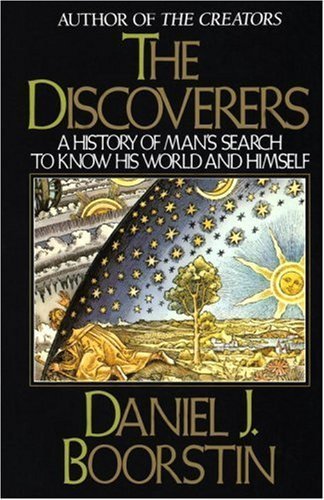
In “The Discoverers,” Daniel J. Boorstin invites readers on an expedition that traverses the breadth of human curiosity and perseverance. It’s a sprawling canvas of history that highlights ingenuity, chance, and the relentless pursuit to understand the world—a world that was once uncharted and filled with enigma.
Boorstin’s work is more than a mere historical account; it is a tapestry of stories about visionaries who have expanded the horizons of human knowledge. From the creators of calendars to the pioneers of space, each discoverer, driven by their curiosity, contributes a thread to the growing narrative of human achievement.
One central theme is how societal and cultural perceptions often hindered progress. For many of the discoverers, prevailing beliefs posed significant barriers to the acceptance of new ideas. Boorstin showcases not only their discoveries but also the courage it took to challenge and overcome the status quo.
Another recurring notion is the concept of serendipity in discovery. Many groundbreaking revelations in history have been a product of fortunate accidents or secondary findings from a search intended for something else entirely. Boorstin captures the unpredictability of the discovery process, reminding us that there is no straightforward path to enlightenment, only the winding road our curiosity paves.
Boorstin’s storytelling prowess brings to life the figures and times of the past. With prose that’s as rich as the subjects he discusses, the narrative flows effortlessly across disciplines and epochs, making complex concepts accessible and engaging. He divides the book into four main parts—Time, The Earth and the Seas, Nature, and Society—and breaks these further into book-length sections that detail specific domains of discovery.
While “The Discoverers” is comprehensive, the sheer scope of content covered can be both its greatest strength and most notable weakness. The vast array of subjects might seem overwhelming or loosely connected to readers looking for an in-depth analysis of certain historical figures or events. Those familiar with Boorstin’s style will appreciate his broad approach, but others may crave a deeper focus on fewer topics.
Additionally, the Western-centric perspective, a common critique in historical analysis, is recognizable throughout the book. Readers hoping for a more globally inclusive history of discovery may find areas lacking in diversity concerning the populations and cultures represented.
Nevertheless, “The Discoverers” stands as an enduring testament to human tenacity and intellect. Boorstin’s homage to the seekers of truth invites us to look at history through the lens of its movers—the people who have persistently asked, “What if?” and “Why not?” It’s a reminder that our current understanding of the world is built upon layers upon layers of discovery, and each layer is rich with stories of ambition, struggle, and triumph.
In our contemporary digital age, where information is at our fingertips, Boorstin’s book serves as an homage to the intellectual bravery that has driven the human race forward. It’s an inspiring read for anyone curious about the past and eager to understand the continuum of exploration that shapes our present and molds our future.