
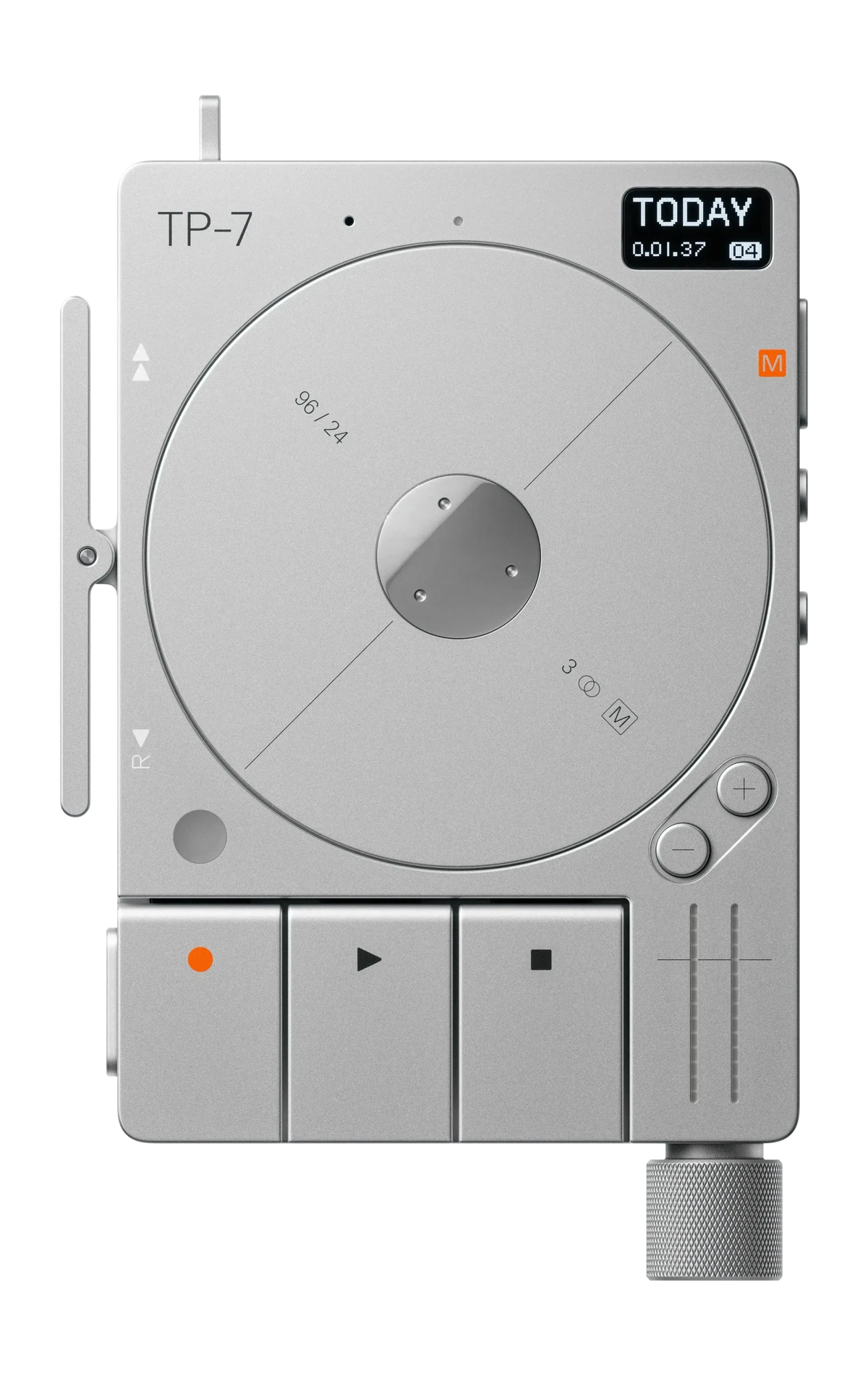
’m watching the same video for the third time this week. Nothing remarkable happens in it. A man sets a small grey slab of aluminum, no bigger than his palm, on a table. He presses a button, and the disc in the middle of it begins to turn. That’s the whole video. The disc turns, I watch. I watch the way a cat watches a laser dot. Some corner of my mind is aware of the situation and asks the obvious question. You are a man past forty, you speak two languages, you have solved integrals. Why are you watching a piece of metal spin?
Because that piece of metal is the Teenage Engineering TP-7, and I am in love with it.
Identifying the suspect
Let’s establish the scene first. Teenage Engineering is a Swedish company out of Stockholm. For twenty years their line of work has been, roughly, this: to make electronic objects that haunt engineers’ dreams, that designers frame and hang on the wall, that make wallets tremble on sight. They have a synthesizer called the OP-1 that has achieved something close to religious status among musicians. Then they started a series called “field.” The same grey aluminum vocabulary, the same merciless simplicity, the same merciless prices. They made a mixer the size of a credit card, the TX-6. And in the spring of 2023, at the Superbooth fair in Berlin, they announced the subject of this essay: the TP-7.
The TP-7 is a sound recorder. Nothing else. It doesn’t play games, doesn’t take photos, doesn’t push notifications. It records sound and plays it back. Teenage Engineering says as much, proudly, in their own copy: a machine engineered in every detail to do only one thing and to do it well. When I read that sentence, something clicked into place inside me. Because I am precisely the man who pays money for that sentence. I bought my reMarkable tablet on the strength of the same one. A tablet that only writes. Now here is a device that only records, and I am walking into the same trap, eyes open, whistling.
The sensuality of detail
Now to the device itself. Because this essay is about details, and the TP-7 is nothing but detail.
That disc in the center — the thing I’ve spent three days watching — is not decoration. It’s a motorized reel. Inside it are ball bearings and a precisely tuned brushless motor. During recording it turns slowly, exactly like the reels on old tape machines, telling you: something is happening right now, sound is flowing, time is being written down. But the real trick is this: you can grab the disc with your finger and turn it. Fast forward, rewind, move through the recording. You navigate the menus with this reel too. So you’re not tapping a screen, not scrolling a list. You’re turning a disc. It’s a gesture wired straight into the spinal cord of anyone raised on turntables.
Then there’s the matter of ergonomics, where Teenage Engineering’s engineers are frankly showing off. The device is designed to be used one-handed, and each finger is given a job. Your index finger fast-forwards, your middle finger rewinds, your thumb drops a voice memo, your pinky changes the mode. They wrote finger choreography for a sound recorder. I have never been this organized in a single meeting in my life.
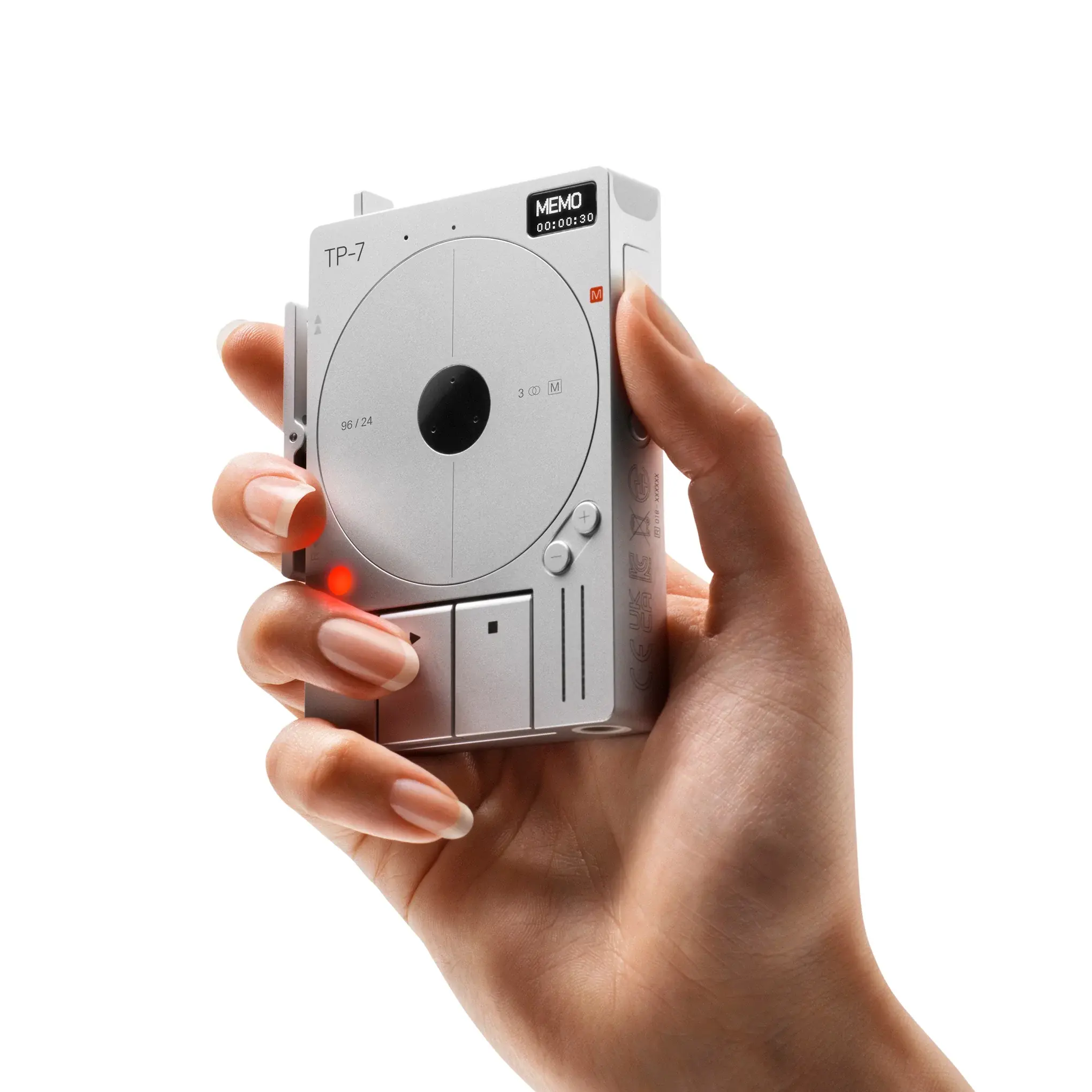
On the left side there’s a rocker, a little lever that works like a seesaw. Press the top edge and the audio runs forward, press the bottom and it runs back. When recording starts, a red lamp lights up on the device. Not a faint icon on a touchscreen — a real, physical, red lamp. The grandchild of the “ON AIR” light on the door of a radio studio.
They wrote finger choreography for a sound recorder. I have never been this organized in a single meeting in my life.
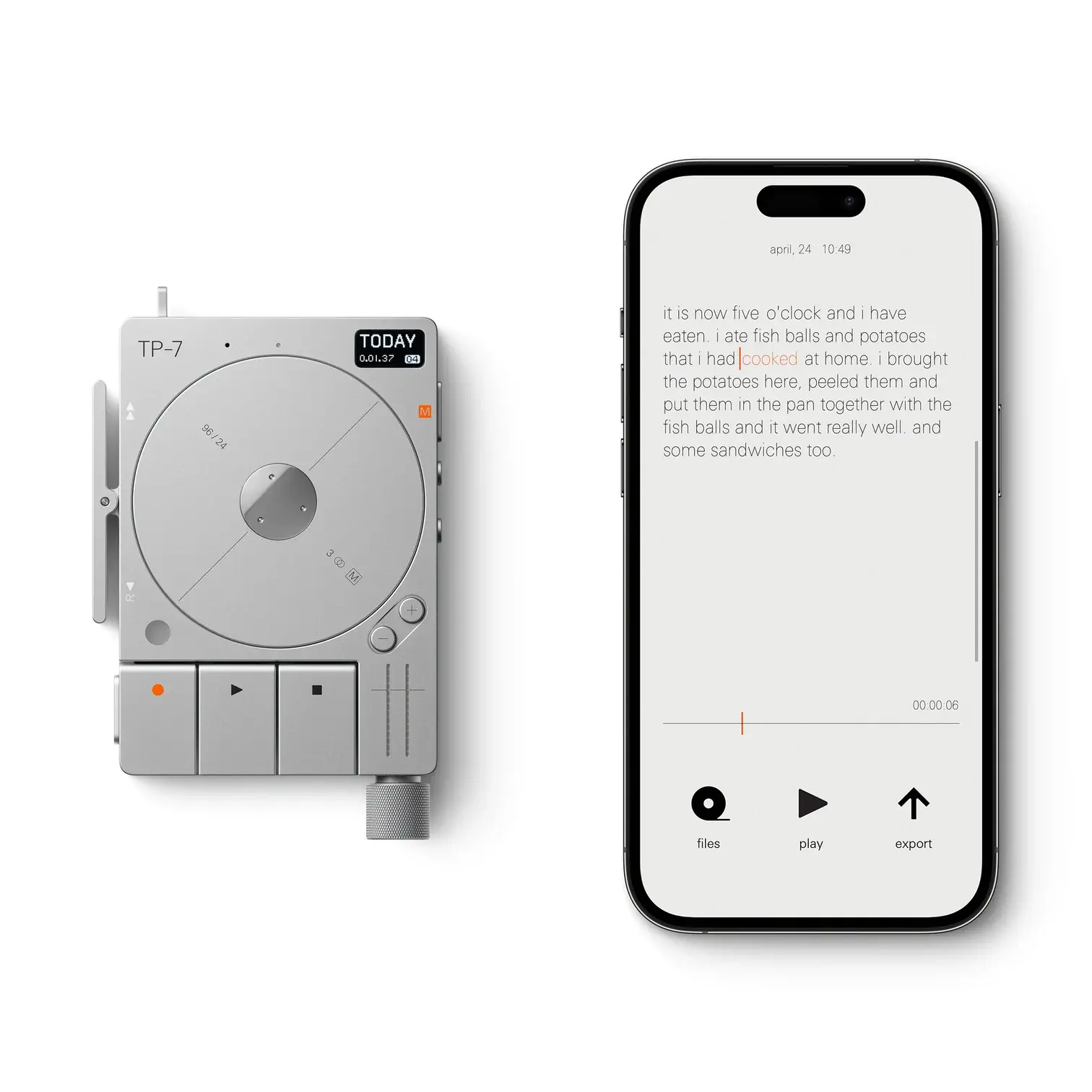
The technical side isn’t there for show either. There are three two-way stereo jacks, each of which can be an input or an output. So plug in an external mic, plug in headphones, plug in studio monitors, or plug all three into other field devices at once and record six stereo channels simultaneously. The USB-C port, besides charging, connects the device to a computer as a multi-channel audio interface, and it even passes MIDI. Recording quality is 24-bit, 96 kilohertz. It has Bluetooth and MFi, so you can connect it to a phone and transcribe conversations to text almost instantly through the app. That feature was thought up for journalists doing interviews and lawyers recording statements. I am neither a journalist nor a lawyer. I know this. Knowing it doesn’t help.
Specifications
- Recording
- 24-bit / 96 kHz, internal mic and speaker
- I/O
- 3 × two-way stereo jacks, main output, USB-C, BLE, MFi
- Storage
- 128 GB internal, non-expandable
- Battery
- 7 hours, rechargeable
- Body
- Aluminum, palm-sized, motorized reel
- Price
- $1,499. Yes.
The question in the mirror
Now let’s put the elephant on the table. There is a phone in my pocket. Inside that phone is a free voice recording app. The same phone does the transcription too. So everything the TP-7 does is already done by a device I own and carry every day. In that light, wanting a $1,499 recorder is like wanting a $1,499 hand pump when you already have running water at home.
I say this to myself. I’m not convinced. Because the point was never function; it was never function at all. When I record with my phone, I open an app, I see a notification while it opens, I glance at the notification and the recording falls out of my head, and ten minutes later I find myself checking real estate prices. The phone never lets a single task be a single task; it staples ten more to the side of every one. The TP-7’s promise is the opposite. When I pick it up, the only thing I can do is record. A small aluminum island where my attention isn’t being sold, where there are no notifications, where a task is only that task.
And there’s a layer of nostalgia, which I won’t deny. I’m from the cassette generation. I belong to the tribe that waited with a finger hovering over play and rec to tape a song off the radio, that held a grudge against the world when the DJ talked over the ending, that wound the tangled tape back with a pencil. That spinning disc in the middle of the TP-7 speaks directly to that memory. Teenage Engineering is selling me my childhood back. Clad in aluminum, fitted with bearings, marked $1,499. And I, even as I rail against the price, am thinking about paying it.
The envy chapter
I watch TP-7 owners on YouTube. What really drives me mad about these people isn’t that they own the thing — it’s the way they carry the owning. A man pulls the device out of his jacket pocket and drops it on the table like a set of keys. Fifteen hundred dollars just sits there and the man’s pulse doesn’t change. If it were me, I’d buy a case for it, then a case for the case, then tell any guest who came over to wash their hands before touching the thing. It’s that ease I envy. More than I envy the device, I envy the offhand, everyday relationship a person gets to have with it.
There’s a phrase on the internet, you know the one: shut up and take my money. For years I used it as a joke. The night I first watched the TP-7 promo video, I understood the joke wasn’t a joke. That sentence is the clinical description of a state of mind. The name of the hour when reason clocks out and goes home and desire is left working overtime. That night I added it to the cart. Then I took it out of the cart. Then I didn’t close the tab. The tab is still open. It’s been open for three weeks. My browser now thinks that tab is a member of the family.
The faint voice of the defense
Of course the accountant in me isn’t idle either; he’s built his own case file. He says: this thing doesn’t get along with wind, it struggles recording outdoors. He says: the 128-gigabyte memory can’t be expanded, and once you’re full, you’re full. He says: there’s no XLR input for professional mics, you’ll make do with those three cute little jacks. He says: for half this money, a third even, there are devices that do the same job on paper, and from reputable brands too.
All true. True one by one. And none of it works, because the real name of these objections is something else. They’re sour grapes. I’m consoling myself by counting the flaws of the thing I can’t reach. The only difference between me and the fox in the fable is that the fox didn’t keep the grapes waiting in a cart.
Here’s the real thing, and I want to confess it at the end. I don’t want this device for the sounds I’d record. I have no extraordinary sounds to record. My son’s post-match commentary, the crickets in the yard, ideas that come to me and are half bad to begin with. A phone records all of that too. I want this device for the feeling of holding something well-made in my hand. The feeling of knowing that even a single screw is exactly where it should be, of watching a motor turn for the sole purpose of telling me the recording is running. In a world full of badly made things, one well-made thing. Whether $1,499 is the right price for that, I don’t know. But I now know it has a price, and that the price means something to me.
The tab is still open. If anyone closes it, let me know.
Also on Abakcus
For another object whose owners never needed convincing, see Hagoromo Fulltouch Chalk, the piece of chalk that cleared out Amazon overnight. For another meticulously made single-purpose object that ended up in a museum gift shop, see the Author Clock, also sold at MoMA.
1 No TP-7 was purchased in the writing of this essay. Yet.
2 If my wife reads this: darling, it’s a purely theoretical piece, a literary exercise. There’s no tab, either.
3 For the technical details: the official product page, Engadget’s announcement, and the MoMA Design Store. Yes, this thing is sold at MoMA. I’m not the one calling it museum-worthy, is all I’m saying.
Abakcus · Ali Kaya
Images: Teenage Engineering
Teenage Engineering TP-7
Price $1,499 USD · teenage.engineering
abakcus.com