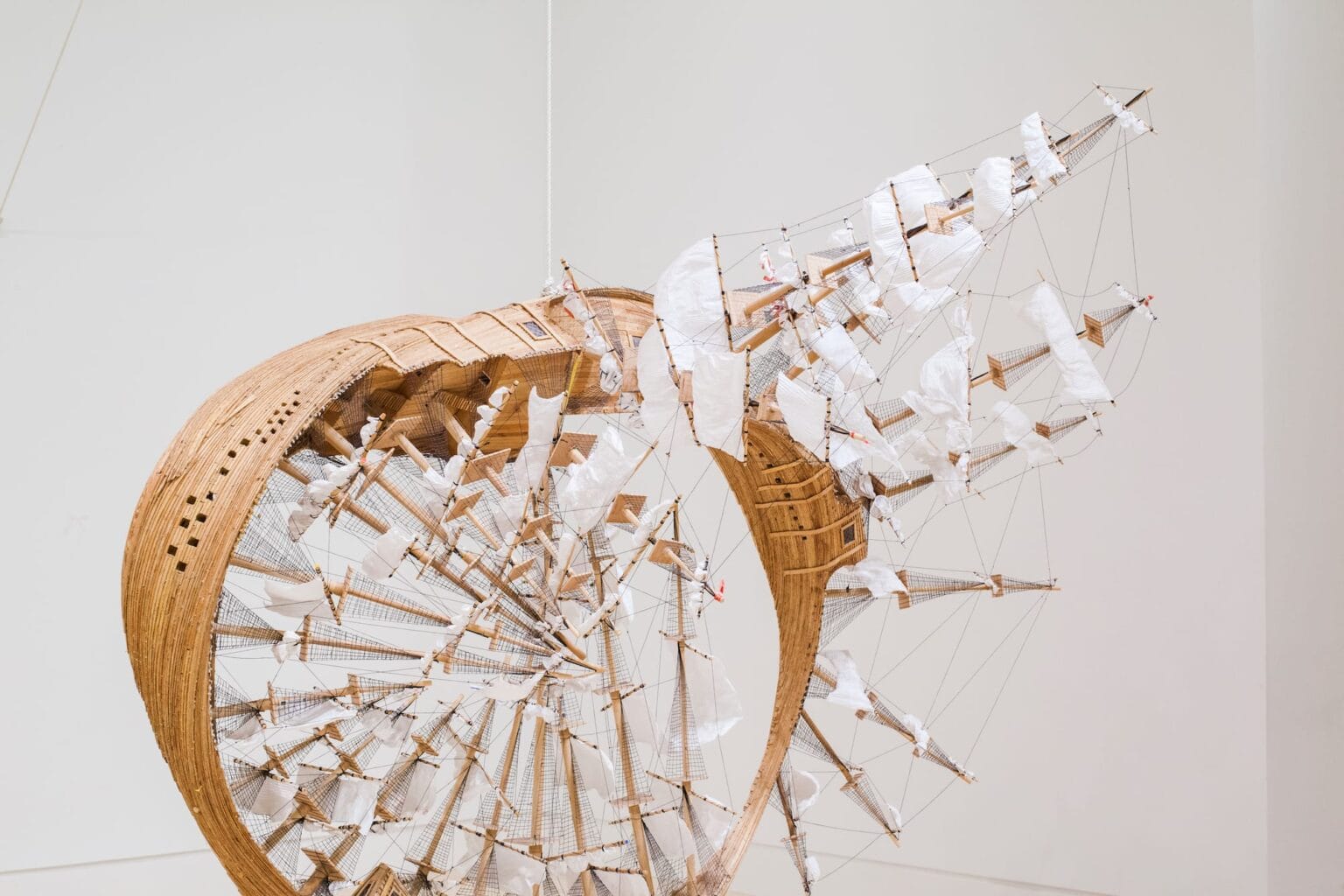
Some works of art exist simply to be looked at. Others pull you in, force you to think, and even create a slight sense of unease. Tim Hawkinson’s Möbius Ship belongs to the second group. From a distance, you see something familiar: a ship. But as you get closer, your brain starts to say, “Wait a second.” Because this ship, in the conventional sense, does not go anywhere. In fact, technically, it cannot go anywhere at all. It has no beginning and no end; its bow meets its stern, its deck folds back onto itself.
What Hawkinson does is not a simple wordplay. Möbius Ship takes the Möbius strip from mathematics and turns it into a three-dimensional, tangible, and intensely laborious sculpture. If you know the Möbius strip, you know the idea: a surface with one side and one edge, a structure with no beginning or end. You place a pencil on it, draw a line, make one full loop, and you return to where you started—but from “the other side.” Hawkinson takes this abstract idea and dresses it in the form of a ship. The result is neither exactly a toy, nor an engineering model, nor a classical sculpture.
One of the most striking aspects of the work is the materials used. Wood, plastic, string, zip ties, staples, glue… The kind of stuff you walk into a workshop, glance around, and think, “Nothing serious is going to come out of this.” Hawkinson does the opposite. With the most ordinary, even slightly makeshift materials, he constructs an extremely sophisticated idea. This is a conscious choice. Because Möbius Ship does not look like a flawless industrial object; on the contrary, it feels handmade, labored over, reconsidered again and again.
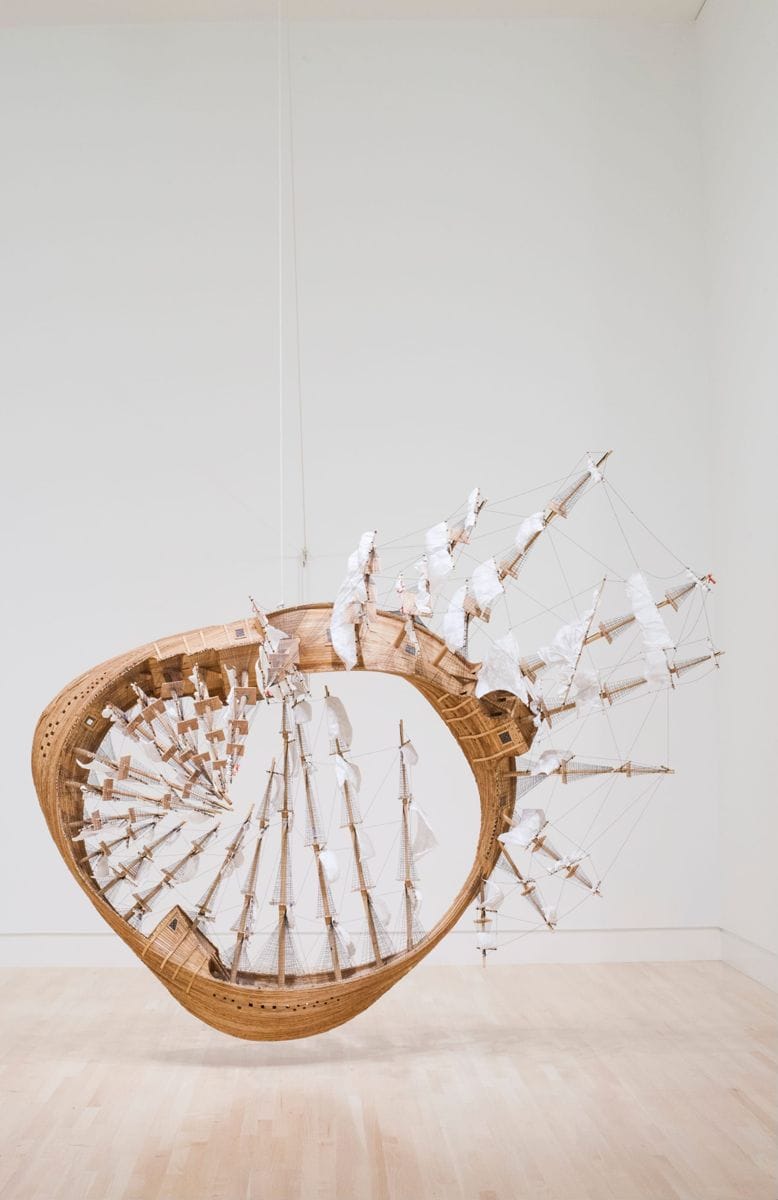
There is also a cultural layer to the piece. You probably know the tradition of “ships in bottles.” A craft that demands time, patience, and precision. Hawkinson takes this tradition and flips it inside out. His ship neither fits into a bottle nor wants to fit anywhere. It folds back into itself. And that inevitably raises a question: Do we still have to go somewhere, or are we simply circling back to the same questions over and over again?
The title itself is another playground. Möbius Ship immediately evokes Moby-Dick. A massive, obsessive story of a journey without end. In Melville’s novel, the ocean is what traps and challenges the human will; in Hawkinson’s sculpture, that role is played by form itself. Infinite, inescapable, and constantly confronting us with our own limits. There is a ship, but no route. There is a journey, but no clearly defined destination.
At this point, reading Möbius Ship merely as a “clever” work with a mathematical reference would be incomplete. The real issue is the cyclical nature of the modern world. We are constantly moving, constantly producing, but are we truly progressing? Or are we just building more elaborate Möbius strips? Hawkinson does not shout this at you. He simply places the ship in front of you and steps aside.
A Journey Folded Into Itself: Möbius Ship
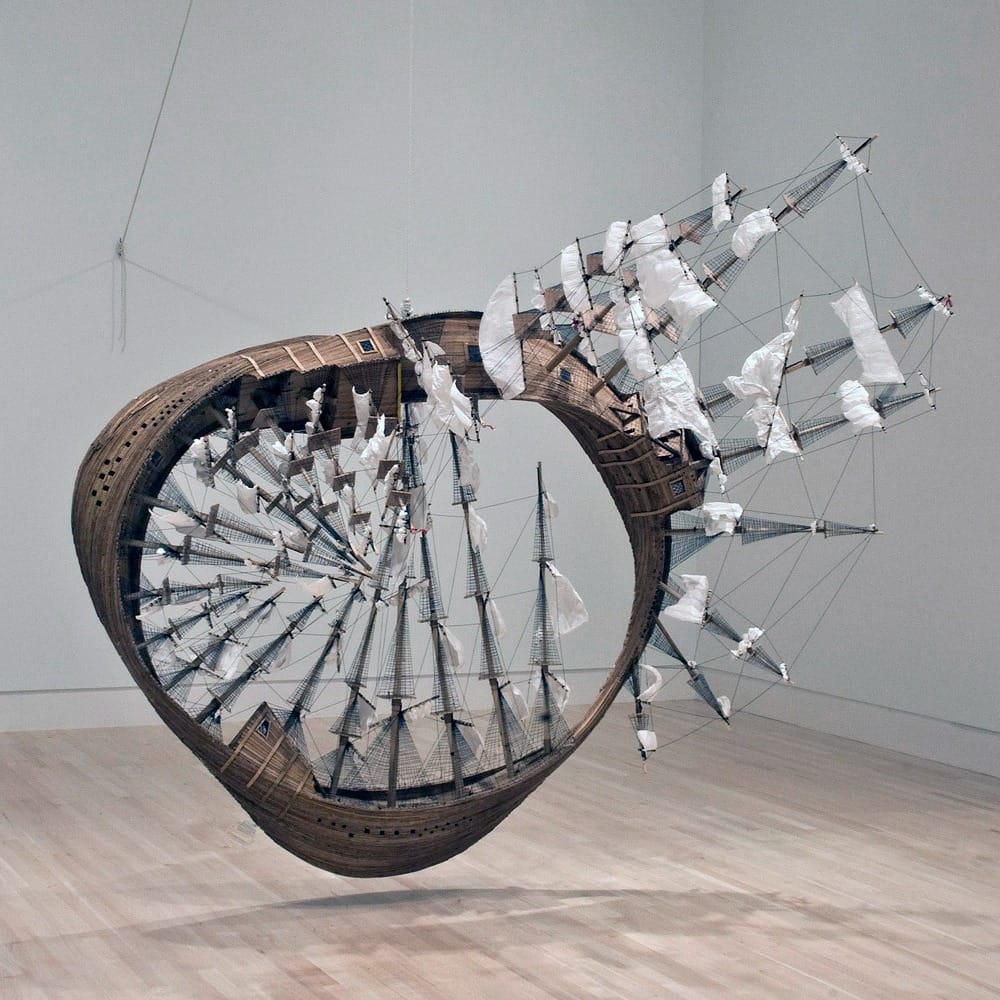
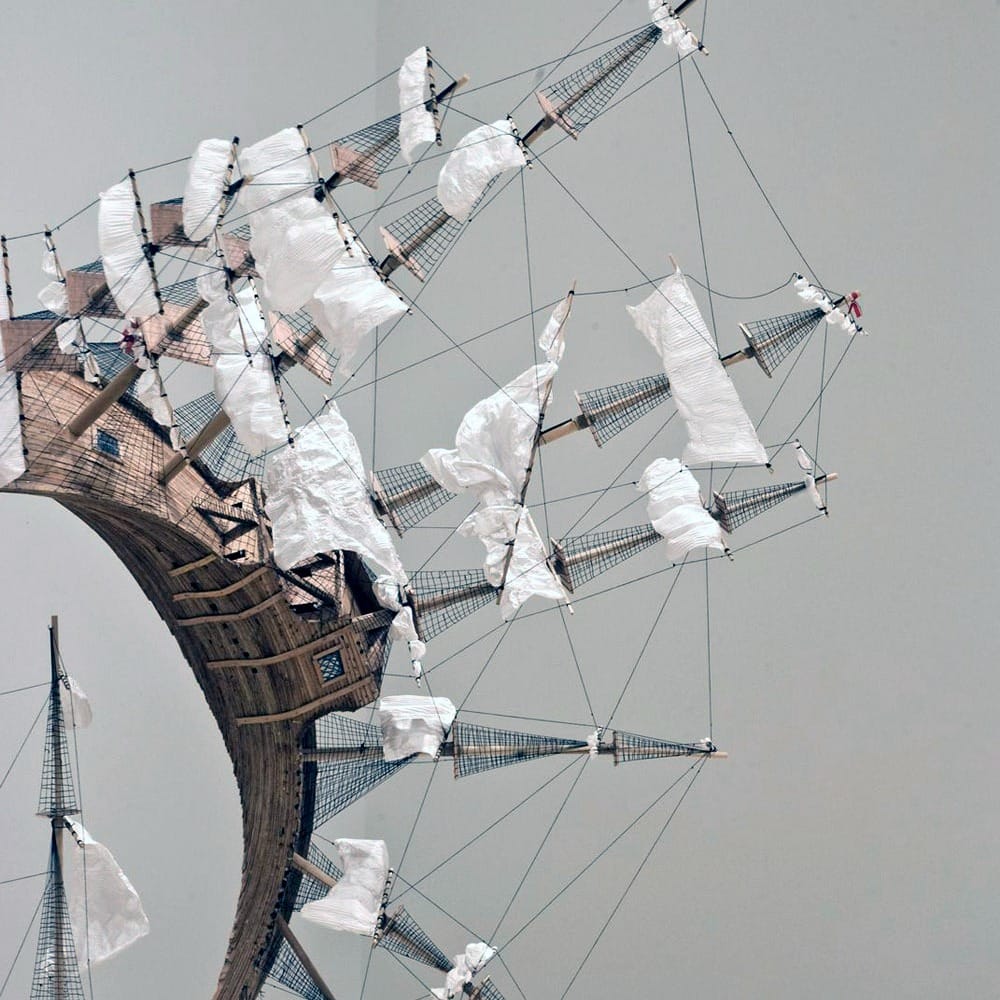
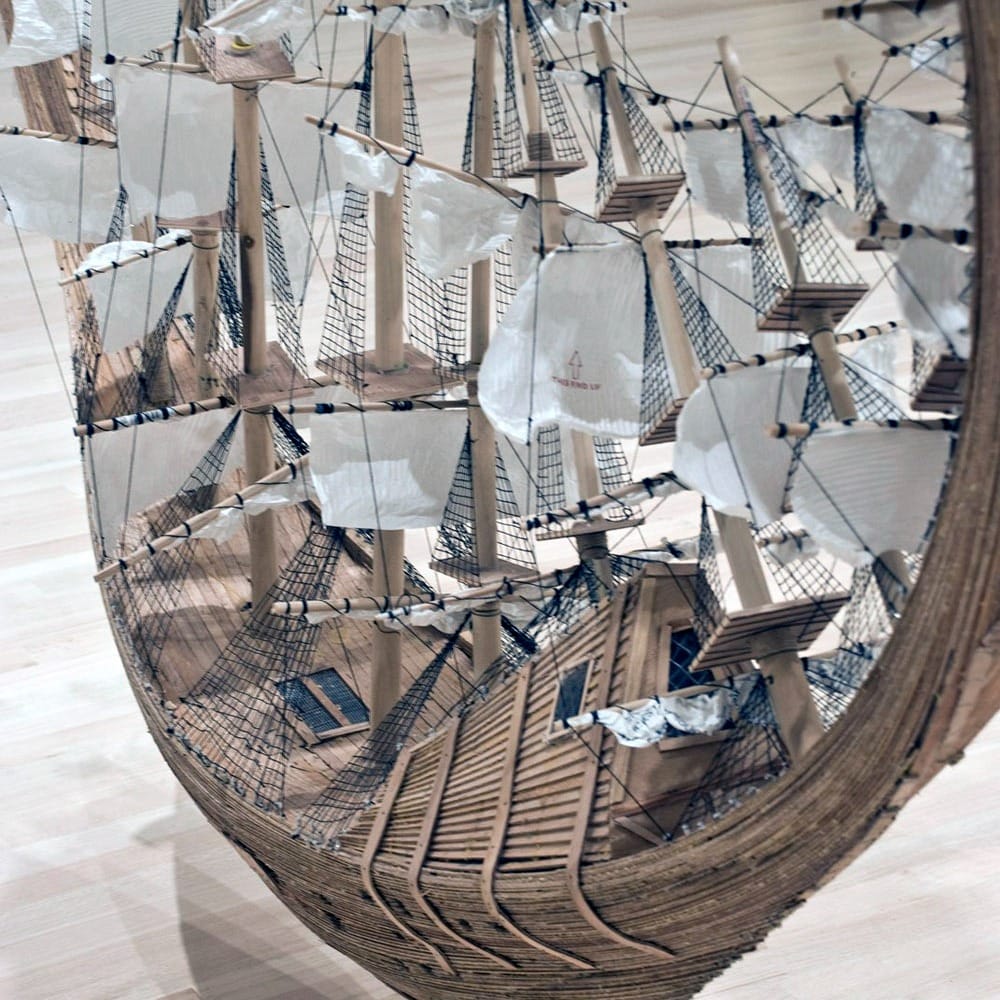
The scale of the sculpture matters as well. In photographs, it can sometimes look like a tabletop model, but in reality it approaches human scale and establishes a physical relationship with the space. As you walk around it, a question emerges: “Where am I supposed to start looking?” Because there is no correct starting point. Your gaze keeps circulating, but it never truly comes to rest.
A good idea makes you think about it again and again. Möbius Ship does exactly that. At first glance, you say, “Oh, that’s nice.” At the second glance, you ask, “How does this even stand?” By the third, the work drifts toward philosophy, time, and the idea of repetition. And even after you walk away, the piece keeps looping quietly in a corner of your mind.
Perhaps that is its strongest quality. Möbius Ship is not a finished sentence. It has no period. Just like its form. It does not take the viewer anywhere, but it sets the mind in motion. And sometimes, that is the best thing art can do: leave you not with answers, but with better questions.